
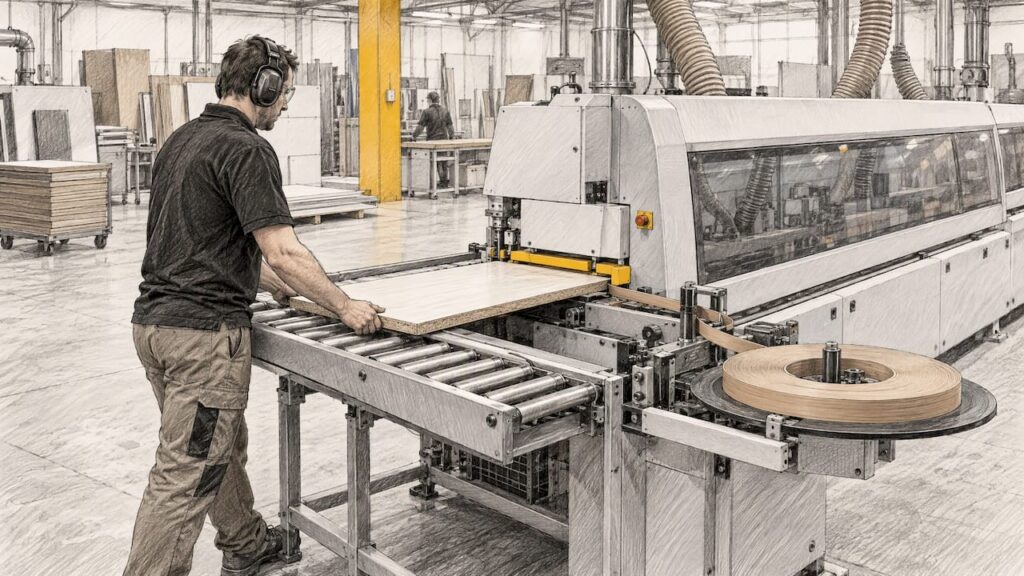
Edge banding automation means taking the manual handling out of the edgebanding process: panel loading, glue application, trimming, finishing and, on larger lines, returning the panel to the operator for the next edge. For an Australian cabinet shop, the practical answer is to automate in this order: first the settings and set-up changes (PLC control), then the panel flow (a panel return system), then the line around the machine (nesting upstream, handling downstream). Match each step to your daily panel count, not to the largest machine you can buy.
This guide is for kitchen manufacturers, cabinet makers, joinery shops and furniture makers who run an edge bander and want to know which parts of the job to automate, what a return conveyor does and what to check before you buy. Anderson Group Australia supplies edgebanders in the AFS range, and the Wood Machinery range is the place to discuss your application.
TL;DR
- Automation on an edge bander mostly means PLC-controlled settings, faster changeovers and, on some setups, automatic loading or a panel return conveyor.
- A return conveyor brings a panel back to the operator so one person can band several edges without walking the panel around the machine.
- Elite Publishing reports that automated edge banders add roughly ten to thirty percent to the cost of the machine, so size the automation to your volume.
- Guarding, interlocks and operator PPE belong in the buying decision from the start, not after installation.
- Edgebanding, nesting and drilling are separate machine jobs. Automate the one that is limiting your output first.
Table of Contents
- What “automation” actually covers on an edge bander
- The edge bander return conveyor explained
- How to decide what to automate
- Match the automation level to the machine
- Edge banding automation in the wider production line
- Safety: build it into the selection
- Keep it running: maintenance
- What to prepare before you enquire
- Talk to us about your edgebanding line
- FAQ
- Sources
What “automation” actually covers on an edge bander
An edge bander applies a thin strip of PVC, ABS, melamine or timber veneer to the exposed edges of a panel. Material Intelligence’s guide describes the sequence: the machine glues, presses, trims, scrapes and buffs the edge. Woodworking Network lists the same stages for throughfeed machines: edgebanding feed, adhesive control, clamping while the glue cures, leading and trailing edge trimming, top and bottom trimming, chamfering or softening, and sanding, polishing or scraping.

A basic machine performs these stages, but the operator still sets and adjusts them. Automation takes over different parts of that work, and they are worth separating, because each solves a different production problem.
Control and set-up
Programmable logic control (PLC) runs the functions of the machine. According to Elite Publishing’s 2022 feature on edge banding, machines now run at higher speeds, but the biggest advantage is shorter set-up times. That matters most for shops that run many different panel sizes, edge materials and thicknesses in one shift, which describes most kitchen and joinery work.
Panel loading and panel return
The second layer is moving the panel. Material Intelligence notes that edgebanding is most often applied to the four straight edges by stand-alone machines, and that some setups offer automatic panel loading or a return conveyor for banding all four sides. This is where an edge bander return conveyor comes in, covered below.
Edge and adhesive technology
The third layer is how the edge is bonded. Woodworking Network’s guide separates glue pot machines, hot-air machines and laser or infrared systems. Glue pot machines apply EVA or PUR hot melt. Hot-air machines melt a pre-applied functional layer for a zero glue line. Laser or infrared systems are mostly in high-end industrial settings. Elite Publishing adds that plasma is rarely used in Australia, laser suits large high-volume manufacturers, and that near-infrared was first shown at AWISA in Brisbane. If glue line is your main concern, read our guide on preventing visible glue lines on cabinet edges. If you are weighing adhesive types, see PUR vs EVA edgebanders.
The edge bander return conveyor explained
A return conveyor is a belt or roller section that carries a panel from the exit of the edge bander back to the operator at the feed end. A panel that needs two, three or four edges banded would otherwise be carried back by hand after each pass. With a return conveyor, one operator can feed, receive and re-feed without leaving the station.
The benefits follow from that layout:
- Fewer people per machine. The second operator who would normally catch and carry panels is no longer needed for the return trip.
- Less manual handling of large panels. Tall kitchen end panels and pantry sides are awkward to carry back alone. Our guide to panel handling automation with WHS first covers the handling risks in more detail.
- A consistent loading rhythm. Panels return in the order they were banded, which helps when you are running a batch from a nesting cell.
Anderson’s ARS is a panel-return system, distinct from the AFS edgebanders, which are the machines that apply the edge. When you talk to us about a return conveyor or ARS, the useful questions are the panel sizes, the thickness range and the floor space you have available. We confirm the exact model and configuration for your application rather than assuming it from a family name, so ask for the documented specification before you plan the layout.
Where the return conveyor fits and where it does not
A return conveyor only pays off when a single panel passes through the machine more than once. If most of your output is a single-pass job, such as one long edge on shelves, the return system adds floor space and cost without saving steps. If you run full carcase production with visible edges on several sides, it removes one of the most repetitive tasks in the shop.
The floor plan matters as much as the specification. A return conveyor extends the machine’s footprint alongside the line, so measure the run, the walkway and the forklift or trolley path before you decide.
How to decide what to automate
Start from the bottleneck, not from the catalogue. Elite Publishing describes the edge bander as the non-negotiable machine in Australian kitchen and cabinet manufacturing, alongside a CNC nesting machine, because every visible carcase edge must be edged and a poor finish is what a business can be judged on. The edges are the last thing the customer sees up close, so the edgebanding station is not the place to compromise.
Work through these questions with your own numbers:
- How many panels do you band per shift, and how many edges per panel? Many panels with multiple edges point to a return conveyor and automatic loading. Fewer panels with frequent changeovers point to PLC set-up memory first.
- How often do you change edge material or thickness? Frequent changes are where shorter set-up times save the most.
- Do you band curved or shaped parts? Straight-edge machines cover the four straight edges. Material Intelligence notes that CNC machines can band around curved panels, which is a different machine and a different decision.
- How many operators can you free up? The aim is to move people to other stations, not to reduce quality control at the edge.
- What feeds the edge bander, and what takes the panels away? An edge bander cannot outrun the nesting machine feeding it or the assembly area behind it.
Weigh the cost honestly
Elite Publishing states that automated edge banders are more cost effective than in the past but still add ten to thirty percent to the cost of the machine. That is a 2022 figure from an Australian trade feature, so treat it as a guide to the order of magnitude. For a quote, we do not publish prices for our machines, so ask us for a quotation against your specification.
Match the automation level to the machine
Anderson’s edgebanders carry the AFS prefix. Keep these distinct from the other model families in the wood range: ATS is the nesting, routing and drilling machine, ADM is six-sided drilling and routing, and ARS is the panel-return system. Each does a different job, so an edge banding decision should not be mixed with a nesting or drilling decision.
Two AFS models have their own pages:
- The AFS 243 compact edgebander suits a shop where floor space is the main constraint.
- The AFS 559-40 narrow panel edgebander is documented for narrow panel work.
Check the model page for the specification of each machine, and confirm with us which options, including any automatic loading or return arrangement, belong to the exact configuration you want. We do not assume that a feature fitted to one model is available on another. If you are still working out which type of machine suits your shop, our guide on choosing an edgebander: five types for Australian cabinet shops sets out the options.
Edge banding automation in the wider production line
The edge bander does not set the pace of your shop alone. Panels arrive from a CNC nesting machine and leave toward drilling and assembly, so the best result comes from treating the line as a whole.
Our guide on fully automated CNC nesting production lines shows how nesting, labelling and handling fit together, and the piece on a nesting-first CNC workflow for small cabinet shops covers how smaller shops can start in the right order. If your nesting output is higher than your edgebanding capacity, the edge bander becomes the queue. If the edge bander is idle waiting for panels, upgrading it will not help.
Feedback and measurement
Automated lines depend on knowing where each panel is. Encoders and linear measurement tools are the kind of components that report position and travel to a controller. Whether a given Anderson machine uses a particular feedback device is a question for the model specification, not something to assume.
Safety: build it into the selection
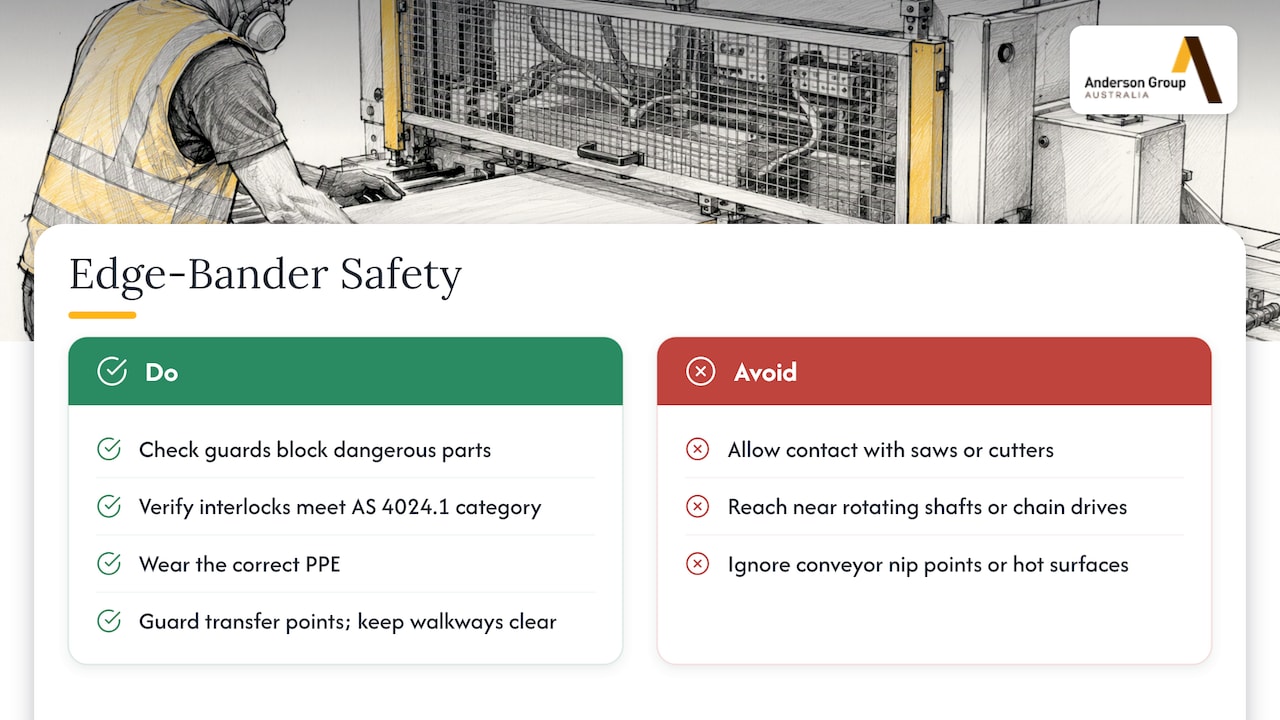
An automated line moves more panels with fewer people, and that changes where the hazards are. SafeWork NSW defines an edge bander as a machine used to permanently fix prepared moulding to board, and its edge bander checklist asks whether guards prevent access to dangerous parts, whether interlocked guards meet the correct category under AS 4024.1, and whether workers wear the correct PPE.
The UK Health and Safety Executive’s guidance on board-edge processing machinery lists accident causes that remain relevant to any edge bander, including contact with saws and cutters, entanglement at rotating shafts, trapping at chain drives and conveyor nip points, and contact with hot surfaces. That is a UK document, and Australian obligations come from your state or territory WHS regulator, so use it as a technical reference and use SafeWork or your own regulator’s guidance as the standard you work to.
A return conveyor adds conveyor nip points and moving panels at the operator’s station. When you plan the layout, check guarding at the conveyor transfer points and keep walkways clear. For a broader view of reliability and selection, see edgebander safety and selection for Australian makers.
Keep it running: maintenance
Automation raises the cost of a stoppage, because more of the line depends on one machine. Glue pots, trimming cutters, scraping units and pressure rolls are the usual wear points, and a regular routine keeps the finish consistent. Our edgebander maintenance checklist runs from shift checks to quarterly care. Service scope, response times and parts availability are agreed with us for your machine, so confirm what is included before you order.
What to prepare before you enquire
A short brief saves time and gets a quote that fits:
- Typical and largest panel sizes and thicknesses
- Panels and edges per shift
- Edge materials (PVC, ABS, melamine, timber veneer) and how often they change
- Whether panels need banding on one, two or four edges
- Floor space and the position of the nesting machine and the assembly area
- Your current bottleneck
With that list, we can discuss which AFS model suits your work and whether a return system such as the ARS belongs in the plan.
Talk to us about your edgebanding line
Anderson Group Australia supplies CNC machinery, servicing and parts to Australian manufacturers, with kitchen, cabinet, joinery and furniture makers as our main customers. We help you choose machinery for your own production. We do not offer subcontract cutting, machining or finished-part manufacturing.
To discuss your application or request a quote, start with our Wood Machinery range or the Anderson Group Australia homepage and tell us your panel volumes and the edge you need to achieve.
FAQ
What is an edge bander return conveyor?
It is a conveyor that carries a panel from the exit of the edge bander back to the operator at the feed end. It lets one person band several edges of a panel without carrying it back by hand. Anderson’s ARS is a panel-return system, so ask us which configuration suits your panel sizes.
What does edge banding automation include?
It can include PLC control of machine functions, shorter set-up changes, automatic panel loading and a panel return conveyor. Elite Publishing says the biggest advantage of modern controls is reduced set-up time. The right mix depends on your volume and how often you change materials.
What are the main types of edge banding machine?
Woodworking Network describes glue pot, hot-air and laser or infrared edgebanders. Most Australian cabinet shops choose between glue pot machines using EVA or PUR. Our guide to PUR vs EVA helps with that choice.
How much does automation add to the cost?
Elite Publishing reported in 2022 that automated edge banders add ten to thirty percent to the cost of the machine. We do not publish machine prices, so request a quote for the model and configuration you want.
Sources
- Feature: Edge Banding, Elite Publishing (2022)
- Edgebanding, Material Intelligence
- Choosing an edgebander, Woodworking Network
- Choosing the right edgebander, Woodworking Network (2009)
- Edge Bander: Checklist, SafeWork NSW
- Board-edge processing machinery: Safe working practices, HSE WIS27