
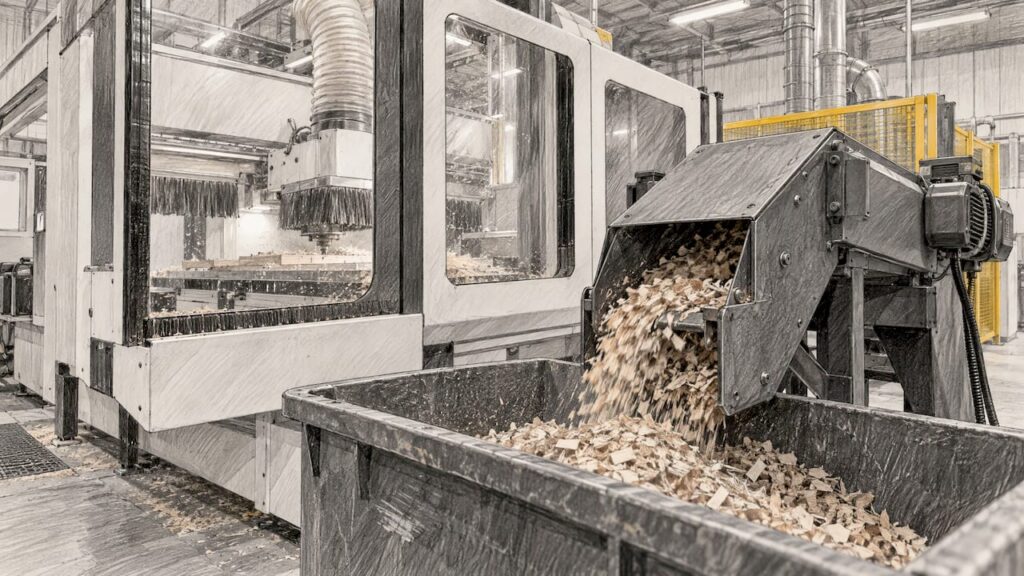
The four chip conveyor types you will meet on CNC machining centres are hinge belt, scraper, magnetic and screw (auger). The right one is set by your chip shape, your coolant and the space beside the machine, not by the machine’s brand. Long, curled chips suit a hinge belt. Short chips, fines and sludge suit a scraper. Small ferrous chips suit a magnetic conveyor. Fine chips in tight spaces suit a screw conveyor.
One point first, because it decides which half of this guide you need. A chip conveyor is a metal-cutting accessory. If you run wood panels on a nesting machine, you are managing dust and offcuts, not chips in coolant, and that is covered separately below. If you machine aluminium, steel or cast iron, read on.
TL;DR
- Hinge belt: the general-purpose choice for long, curled and snarled chips, mixed chips and high volumes.
- Scraper: compact and suited to short chips, fines and sludge, including aluminium, brass and cast iron swarf.
- Magnetic: for small ferrous chips and fines only. It does nothing for aluminium, and long stringy scrap can bridge the magnets.
- Screw (auger): useful where space is limited and for small chips, wet or dry, or as an intermediate transfer stage.
- Wood panel nesting: the issue is dust extraction and clearing finished parts, not liquid-coolant chip handling. Confirm fitment on the exact model with us.
Table of Contents
- What a chip conveyor does and why the type matters
- The four main chip conveyor types
- Which conveyor suits which chip
- Selection criteria that matter beyond chip type
- Metal machining: matching the conveyor to the machine
- Wood panel nesting: dust and offcuts, not chips in coolant
- A step-by-step way to choose
- How we can help
- FAQ
- Sources
What a chip conveyor does and why the type matters
A chip conveyor carries swarf out of the machine enclosure and into a bin or cart, so the operator is not stopping to rake chips from the bed. On wet machining it also has to return coolant to the machine. Transcon notes that designs must remove chips while returning coolant, and that the perforation has to hold back the target chip size without letting fine swarf through or clogging.
The type matters because chips are not all alike. Hennig’s chip-form guide separates ribbon, tubular, spiral, helical, arc, elemental, needle, fines and sludge forms, with long, short and snarled variants. A conveyor that handles needle chips well can jam on ribbons. Your cutting strategy, tool geometry and material all change the chip, so the conveyor should be chosen against the work you actually run.
The four main chip conveyor types
Hinge belt conveyors
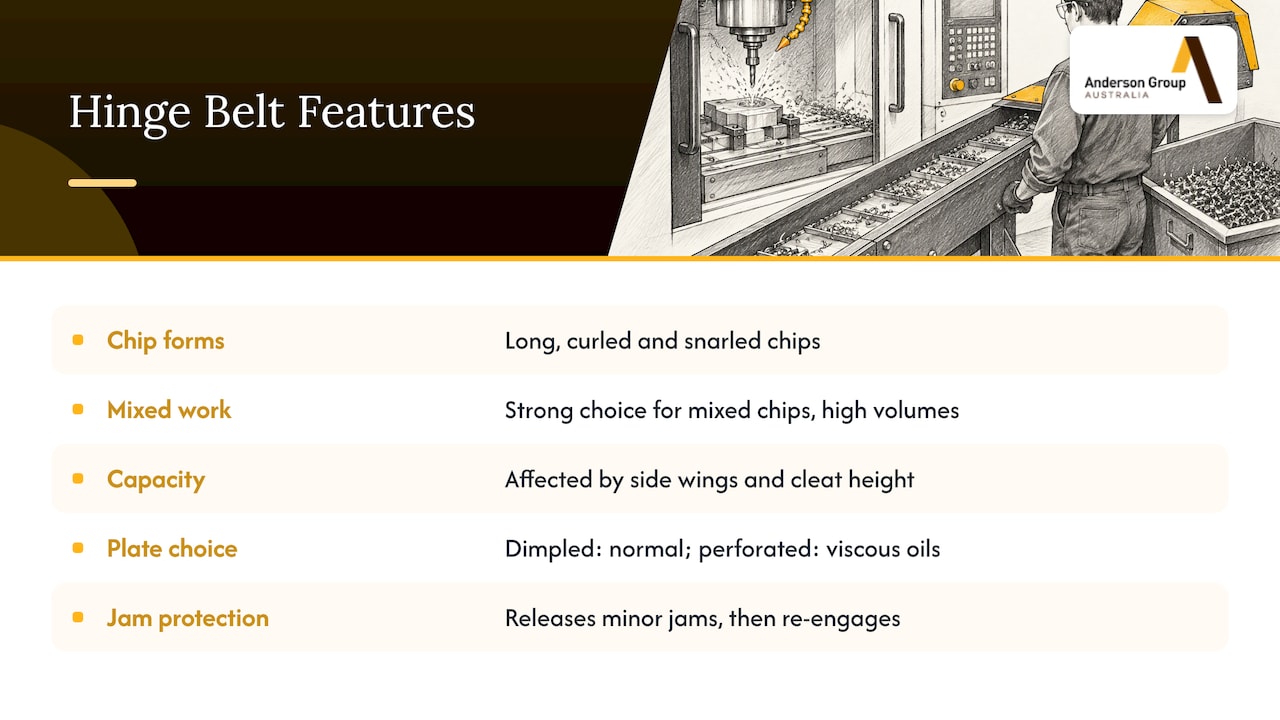
A hinge belt is a continuous belt of interlocking steel plates that runs along the machine bed, up an incline and over a discharge point. It is the most forgiving type for mixed work. Hennig rates hinge belts as suitable for most long, curled and snarled chip forms. KÖBO describes them as collecting long and twisted chips and as a strong choice for mixed chips and high chip volumes.
Two details change how a hinge belt performs. LNS documentation says side wings and cleat height affect carrying capacity. It says dimpled plates suit normal applications, while perforated plates are recommended for high-viscosity cutting oils. It also describes overload protection that releases minor jams on heavy chip loads and then re-engages.
Best for: steel and stainless turnings and milling chips, mixed jobbing work, shops that cannot predict the chip shape from one job to the next.
Scraper conveyors
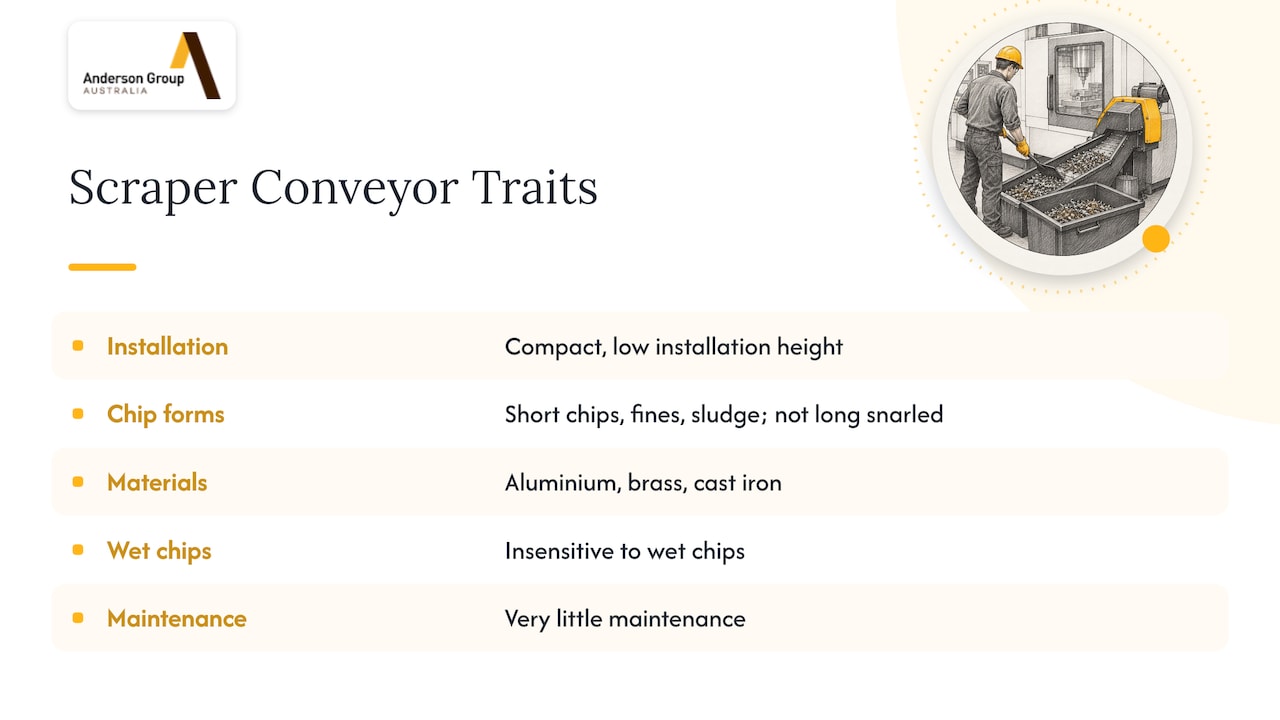
A scraper conveyor drags chips along a trough with a chain or belt carrying cross-bars. KÖBO describes scraper conveyors as compact, low in installation height, insensitive to wet chips and needing very little maintenance. They convey short chips and sludge. Hennig lists them as suited to fine chips and swarf, including aluminium, brass and cast iron.
The low height is the practical advantage. Where a machine sits on a floor with limited clearance, or the conveyor must discharge under a low point, a scraper often fits where a tall hinge belt will not. The trade is chip shape: Hennig’s guide places scrapers with elemental chips, loose arc chips, needle chips, fines and sludge, not long snarled forms.
Best for: short-chipping materials, fines and sludge, installations where height is tight.
Magnetic conveyors
A magnetic conveyor uses magnets under a belt or plate to pull ferrous chips along. Hennig UK explains that they evacuate small ferrous chips and fines. That is the limit of the design. Aluminium, brass and other non-ferrous chips are not attracted to a magnet, so this type is a steel and cast iron option only. MC3 also warns that long, string-like scrap can bridge the magnet spacing and impede performance.
Best for: shops cutting ferrous material that breaks into small chips, often as a secondary stage behind another conveyor.
Screw (auger) conveyors
A screw conveyor moves chips with a rotating helix inside a tube or trough. Hennig describes them as useful where space is limited and for small chips in wet or dry applications. KÖBO positions them for fine chips and for intermediate transfer, for example lifting chips from a primary conveyor into a bin.
Best for: compact installations, fine chips, and transfer stages between a machine and a collection point.
Which conveyor suits which chip
Use this as a starting point. It summarises the manufacturer guidance cited above and is general guidance, not a specification for any machine.
| Chip or condition | Usually suited | Watch for |
|---|---|---|
| Long, curled, snarled chips (steel, stainless) | Hinge belt | Perforation and cleat choice for your coolant |
| Mixed chips, high volume | Hinge belt | Frame size against the machine layout |
| Short chips, fines, sludge | Scraper | Poor fit for long snarled forms |
| Aluminium, brass, cast iron swarf | Scraper | Confirm chip length on your tooling |
| Small ferrous chips and fines | Magnetic | Useless for non-ferrous; string scrap can bridge magnets |
| Small chips, tight space | Screw | Capacity on bulky chips |
Chip length is the first filter. Mayfran’s 2023 selection chart assumes water-soluble coolant and defines short chips as under 2 inches (about 50 mm) that do not ball up. If your chips ball up or bird-nest, treat them as long chips whatever their length.
Selection criteria that matter beyond chip type
Coolant and filtration
Wet machining asks more of the conveyor. The coolant has to drain back to the tank, and the conveyor design decides how much sludge goes with it. LNS says belt design should match chip geometry and coolant requirements, and that its basic belt conveyors suit coarse and stringy chips when filtration is not required. If you run through-spindle coolant or high-pressure delivery, the chip load and flow rate rise together, so check the conveyor and tank as a pair. Our guide to through-spindle coolant and pump pressure in Australia covers the questions to settle with the machine supplier.
If you run minimum quantity lubrication instead of flood coolant, chips arrive nearly dry and the conveyor decision shifts. Our MQL machining buyer’s guide for metal shops explains that setup. For aluminium in particular, our guide on chip evacuation with 15 bar pumps shows how the coolant system and chip removal work together.
Machine layout and floor space
MC3’s 2023 guide lists loading direction and available floor space alongside chip type, size, shape, material and coolant flow. In practice, check three dimensions before you commit: where the discharge point lands, whether a bin or cart fits beneath it, and whether you can still open the doors and reach the machine for maintenance. LNS also says the belt frame type should match the machine’s size constraints and drive power.
Production volume
A machine that cuts steel roughing passes all shift produces a heavy chip stream that will test a conveyor. A machine used for short runs of aluminium parts produces less volume, and a compact scraper may be more than enough. Estimate your heaviest realistic shift, not your average, and ask whether the conveyor has overload protection for jams.
Maintenance and disposal
Compare how each type clears jams, how easy the belt or chain is to access, and how chips leave the machine. Many shops add a bin, a cart or a chip crusher at the discharge, so confirm the height of the discharge point against whatever sits under it. Ask for maintenance intervals in writing for the exact conveyor you are buying.
Metal machining: matching the conveyor to the machine
Chip conveyors belong to the metal and advanced-material side of what we supply. Our metal range is the Focaseiki line of machining centres, which includes vertical machining centres, production machining centres, double column machines, 5-axis machines and automatic pallet changing options. You can see them on our metal machinery page and across the full machine range.
Whether a chip conveyor is fitted as standard, offered as an option, or not available is a configuration question that depends on the exact model. A family name or axis count does not tell you. For example, the Vertical Machining Centre VMC-600/860/1160 and the VMC-1100/1250/1400 are separate pages with their own specifications. Check the product page for the model you are considering, then confirm the conveyor type, discharge height and coolant arrangement with us before you order.
If you are cutting difficult materials, the chip stream changes sharply. Titanium and nickel alloys produce tough, continuous chips and a lot of heat. Our guides to starting titanium machining and machining Inconel 718 cover the machine requirements, and both raise the importance of chip control. Tool strategy also shapes the chip: the way you cut affects how chips form and where they land, as in our guide to climb versus conventional cutting.
Mixed-metal shops have an extra problem. Aluminium swarf in a coolant system that also takes steel can stain parts and clog filtration. Our guide to CNC coolant choices for mixed metal shops is a good companion read before you settle a conveyor and tank layout.
Wood panel nesting: dust and offcuts, not chips in coolant
If you make kitchens, cabinets, joinery or furniture, a metal chip conveyor is not what your machine needs. A nesting router cuts sheet material such as melamine board and plywood, and it makes fine dust and routed waste rather than coolant-laden swarf. The questions you need answered are different:
- Dust extraction: is the machine designed for a connection to your extraction system, and what airflow does the exact model call for? Confirm this on the model’s page and with us, rather than assuming it from the machine type.
- Finished-part handling: how do cut nests leave the table and how are they sorted? Offloading and unloading options vary by configuration.
- Table cleanliness: how is the bed kept clear of dust and small offcuts between sheets?
We keep nesting, edgebanding, drilling and panel-return machines distinct, because each has its own handling needs. For woodworking, start at our wood machinery page, which links through to our nesting and panel-processing range, and tell us how you load, cut and unload so we can match the right configuration. We do not infer extraction capacity or conveyor options from a model name, and neither should you when you compare quotes.
If your shop also machines plastics, note that the material changes the chip again. Our UHMW machining guide covers setup and machine choice for that case.
A step-by-step way to choose
- Name your materials. List every material you will cut in the next three years. Ferrous only opens the magnetic option. Aluminium or mixed work removes it.
- Describe your chips. Look at what the current process produces: long ribbons, short commas, needles, fines. If chips ball up, plan for a long-chip conveyor.
- State your coolant. Flood, high-pressure, through-spindle, MQL or dry. Each shifts filtration and perforation needs.
- Measure the space. Record the discharge height you need, the bin or cart size and the clearance for maintenance access.
- Estimate peak volume. Use your heaviest shift and ask about jam protection.
- Confirm on the exact model. Check what the machine’s product page documents for conveyors and coolant, then ask us to confirm in writing what is included and what is optional.
How we can help
We supply CNC machinery, servicing and parts to Australian manufacturers. We help you choose machinery for your own production, and we do not offer subcontract cutting or machining. If you are specifying a metal machining centre, tell us your materials, chip type, coolant and floor layout, and we will match you to the right Focaseiki model and confirm the configuration. Start with the Anderson machine range or the metal machinery page, and ask for a quote based on your application.
If your work is wood panels, the wood machinery page is the place to begin, and we can discuss your production the same way.
FAQ
What is the most common type of chip conveyor?
The hinge belt is the general-purpose choice. Hennig rates it as suitable for most long, curled and snarled chip forms, and KÖBO recommends it for mixed chips and high volumes. Shops with unpredictable chip shapes usually start here.
Can a magnetic conveyor handle aluminium chips?
No. Magnetic conveyors work on ferrous material such as steel and cast iron, as MC3 describes. Aluminium is not magnetic, so a scraper or hinge belt is the usual route for non-ferrous swarf.
Which conveyor is best when floor space is tight?
Scraper and screw conveyors are the compact options. KÖBO notes that scrapers have a low installation height, and Hennig says augers suit limited space. Both depend on short or small chips, so check your chip shape first.
Does a CNC nesting router need a chip conveyor?
Not in the way a metal machining centre does. Wood panel nesting produces dust and offcuts, so extraction and finished-part handling are the key questions. Contact us with your application and the model you are considering, and we will confirm what is documented for that configuration.
Sources
- Cnc chip conveyors, Hennig UK
- Choosing the Right Chip Conveyor, Hennig
- Chip conveyor, KÖBO ECO>PROCESS
- Conveyor Selection Guide, Mayfran (2023)
- TURBO HB, LNS (2016)
- Using Chip Conveyors in CNC Machining, MC3 Manufacturing (2023)
- CNC Chip Conveyors, Transcon