
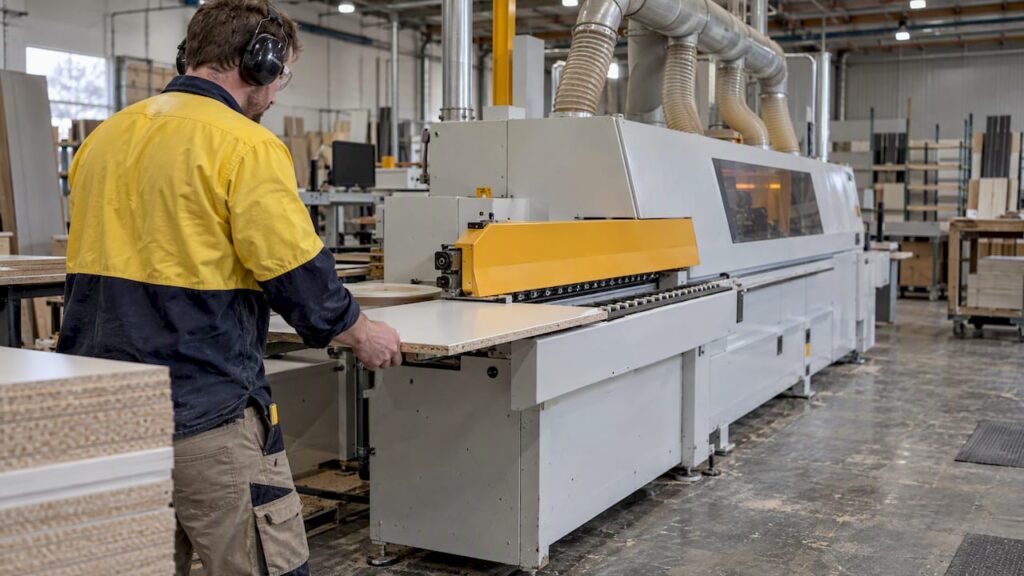
For a small shop running mixed jobs, a compact or entry-level automatic edgebander with basic trimming covers most needs. A medium-volume bespoke shop does better with a mid-range automatic that adds pre-milling and corner rounding. High-volume or commercial operations need a heavy-duty automatic with zero-joint options and automated return systems to keep pace with throughput.
TL;DR:
- EVA suits thin veneers and tape under 1mm, while tape over 2mm or solid timber edges often need PUR for stronger moisture and heat resistance.
- Hot air and near infrared systems can approach a laser finish at lower capital cost, while laser lines run faster for higher volume.
- Commercial dust extraction must use the correct L, M, or H class; domestic HEPA vacuums are unsuitable, and airflow needs routine checks.
- PUR improves moisture and heat resistance for kitchen and bathroom cabinetry, but uncured residue can set in the system, so schedule regular purging and cleaning.
- Buyers should test their own panels and edge tape during demonstrations, time a full changeover, and confirm floor space, power, and extraction requirements before purchase.
Table of Contents
- Edgebander types and zero-joint vs glue-pot approaches
- Key machine features that control finish and productivity
- Shop requirements and installation checklist
- Maintenance and operating costs: glue handling, purging and service planning
- How production volume and product mix determine the right machine and automation level
- Practical buying checklist and questions to ask at RFQ or demo
- How Anderson can help: start a quote, arrange a demo or get a machine application review
- FAQ
- Sources
Edgebander types and zero-joint vs glue-pot approaches
Edgebanders fall into five broad classes, and the right one depends on what you cut and how often. Portable units are handheld or bench-mounted tools for one-off repairs or site work. Manual machines need an operator to feed and guide every panel. Semi-automatic machines handle the banding and trimming once a panel is loaded, but still need manual positioning. Automatic machines feed, band, trim and finish panels with minimal operator input, and multifunctional machines add quick-change tooling so one line handles several adhesive systems or edge profiles.
The adhesive or activation method matters as much as the machine class. Traditional glue-pot systems melt EVA or PUR adhesive and apply it between the edge tape and the panel. Zero-joint systems use pre-applied functional layers on the tape itself, activated by hot air, near-infrared (NIR) light or laser, to create a joint line that is close to invisible. Hot-air and NIR units can achieve a similar look to laser systems at a lower capital cost, while laser lines run faster and suit higher-volume production.
Matching the method to your panel mix avoids paying for capability you will not use:
- Thin veneers and PVC/ABS tape under 1mm generally run well on glue-pot EVA systems without extra investment.
- Thick solid-timber edges or tape over 2mm often need stronger PUR adhesion for durability.
- Tight radii and curved parts demand a machine with flexible pressure rollers and, often, a narrower infeed footprint.
- Shops chasing a seamless look across varied materials increasingly lean toward zero-joint capable machines as labour costs rise and customers expect cleaner edges.
A shop cutting mostly flat kitchen panels in PVC tape rarely needs laser zero-joint. A joinery business producing curved furniture edges or premium cabinetry benefits from it.
Key machine features that control finish and productivity
The features that sit between the glue unit and the trim station decide how much hand-finishing your team still does after the panel leaves the machine. Pre-milling removes chipped or uneven panel edges before the tape goes on, which matters most on panels that have sat in storage or come from a lower-quality saw cut. Corner rounding shapes square panels into rounded corners in one pass instead of a separate router step. Flush trimming cuts tape to the panel’s exact edge, and scraping and buffing units polish the glue line and tape surface so the join disappears.
- Pre-milling units reduce rejects on inconsistent stock and are worth prioritising if your panels come from varied suppliers.
- Corner rounding and flush trimming save the most hand labour because they replace steps that otherwise need a router or sander.
- Scraping and buffing stations lift visual finish quality but matter more for face-grade cabinetry than for carcasses that get painted or concealed.
- Fast glue changeover systems, including quick-swap PUR and EVA tanks, cut downtime when a shop runs mixed adhesive jobs in the same week.
- Edge feed systems with adjustable pressure rollers matter most when curved or thin panels are a regular part of the job mix.
Feed speed interacts with all of the above: a faster feed rate only pays off if the pre-milling, gluing and trimming stations can keep finish quality consistent at that speed. Integrated finishing units that combine several of these steps on one automatic machine tend to deliver the biggest labour reduction over time, while features like buffing deliver smaller, incremental gains once the basic finish is already acceptable.
Shop requirements and installation checklist
Before ordering, measure your shop against the machine’s real footprint, not just the brochure dimension. An automatic edgebander with an infeed and outfeed table needs clear runway on both ends, and adding a return conveyor or automation later needs floor space reserved from day one.
- Confirm floor space for the machine plus infeed, outfeed and any planned return system before committing to a layout.
- Request the machine’s nameplate data (voltage, amperage, compressed air requirements) during the RFQ so your electrician can confirm your supply matches.
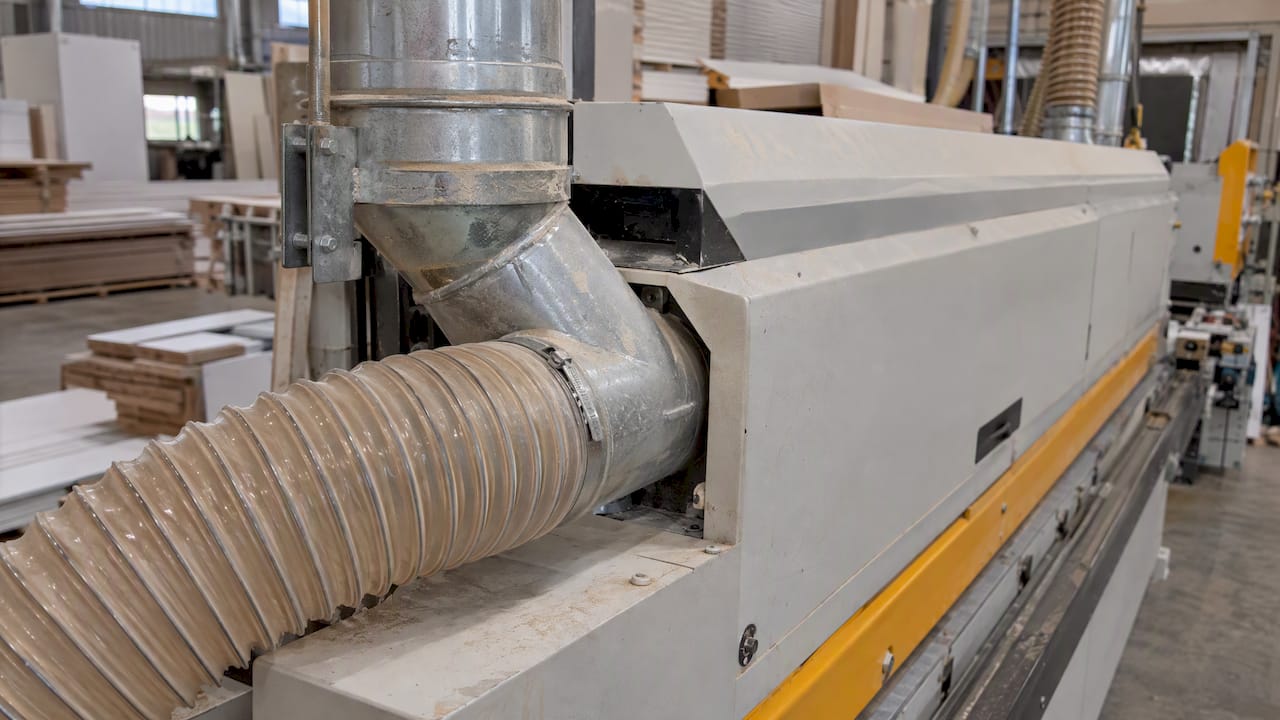
- Check dust extraction capacity against the machine’s outlet size and expected chip load, not just your existing extractor’s spare capacity.
- Plan trolley or conveyor paths so panels move to and from the machine without operators carrying awkward loads by hand.
Dust extraction deserves particular attention. WorkSafe guidance is explicit that extractors handling hazardous dust must be correctly classed as L, M or H, and that domestic HEPA vacuum cleaners are not suitable for commercial use. M and H class units include features such as safe bag removal and filter alarms that general-purpose vacuums lack, and routine airflow checks are part of keeping the system compliant.
Pro Tip: Ask your supplier for the extraction outlet diameter and recommended air volume in writing, then compare it against your current ducting before the machine arrives.
Maintenance and operating costs: glue handling, purging and service planning
The adhesive you choose drives most of your ongoing maintenance work. EVA glue is simpler to manage day to day, but PUR gives better resistance to moisture and heat, which matters for kitchen and bathroom cabinetry exposed to steam and spills. That resistance comes with a cost: PUR requires more frequent purging and stricter cleaning than EVA, because uncured PUR left in the system can set and damage glue lines and feed components.
- Build a daily or weekly purging routine into your schedule if you run PUR, rather than cleaning only after a problem appears.
- Check feed rollers and pressure pads regularly for glue build-up, since residue there affects panel tracking and finish quality.
- Inspect and replace trim knives on a set schedule rather than waiting for visible tear-out on finished edges.
- Budget for glue pot components and seals as wear items, since they degrade faster under PUR use than under EVA.
Shops adopting PUR should plan scheduled short maintenance windows into the production week rather than treating cleaning as a reactive task after a fault. That shift in routine, more than the glue price itself, is the real operating cost difference between EVA and PUR.
How production volume and product mix determine the right machine and automation level
Throughput and product mix, not shop size alone, decide how much automation pays for itself. Before shortlisting machines, answer a few direct questions about your own production.
- How many boards do you run per shift, and does that number spike seasonally around kitchen or shopfitting jobs?
- What share of your panels need curved or radius edges versus straight runs?
- How often do you switch between edge materials or adhesive types in a typical week?
- Would a return system or automated infeed remove a bottleneck you already notice on busy days?
A shop running a handful of boards a day with mostly straight edges rarely needs a return system or laser zero-joint unit. Once volume climbs to the point where operators are waiting on the machine rather than the other way around, automated feed and return systems start to justify their cost. The same logic applies to zero-joint technology: it earns its place when seamless finish is a selling point across most jobs, not an occasional request. Overcapitalising on features your product mix does not call for ties up capital that a compact or mid-range automatic machine would have covered.
Practical buying checklist and questions to ask at RFQ or demo
Work through this checklist before signing, and bring your own panels to any demonstration rather than relying on the supplier’s sample stock.
- Request exact specifications for feed speed, minimum and maximum panel size, and edge thickness range, then confirm them against the product page.
- Ask for a test cut using your own panels and your own edge tape, not a generic demonstration sample.
- During a demo, watch a full changeover between adhesive types or edge profiles and time how long it takes.
- Ask what the daily and weekly cleaning procedure looks like, particularly if the machine runs PUR.
- Confirm local technician availability, typical lead time for a service callout, and what training is included with purchase.
- Clarify warranty scope in writing, including what counts as normal wear versus a covered fault.
- Before delivery, confirm electrical sign-off, verify your extraction system is rated for the machine’s dust output, and agree a commissioning plan with the supplier.
Treating the demo as a working test, not a sales presentation, is the single step most likely to prevent a mismatch between the machine and your actual job mix.
How Anderson can help: start a quote, arrange a demo or get a machine application review
We supply CNC machinery, servicing and parts to various manufacturers, and matching an edgebander to your panel mix is easier with a supplier who checks the fit before you buy. We can run an application review against your panel sizes, edge materials and extraction setup, and confirm power and site requirements as part of planning delivery and commissioning.
If you are weighing up a compact machine against a larger line, our wood machinery range is a practical starting point, alongside the AFS 243, AFS 559-40 and Genesis PLUS product pages.
- Request a quote against your own panel specifications rather than a generic machine listing.
- Ask for a demonstration run using your own panels and edge tape.
- Get a shop requirements check covering power, extraction and floor space before delivery.
Reach out through our wood machinery page to start the conversation on which class of edgebander fits your production.
FAQ
What is the best edge banding machine for small shops?
For a small shop with mixed, lower-volume jobs, a compact automatic machine such as the AFS 243 covers most panel and edge combinations without the footprint or cost of a production line. The right choice still depends on your specific panel sizes and edge materials, which a supplier can confirm against the product specification.
How long will edge banding last?
Durability depends mainly on the adhesive and how the edge is used: PUR-bonded edges hold up better against moisture and heat than EVA, which matters in kitchen and bathroom cabinetry exposed to steam and spills. Quality of application, including correct pressure and temperature during bonding, also affects how long the bond holds under daily use.
What is a good alternative to edge banding?
Solid timber edging or pre-laminated panel edges are the main alternatives to applied edge banding, though both typically cost more in material or labour than a banded edge. Most cabinetmakers use edge banding because it seals the raw panel edge efficiently while matching the panel’s face material.
What is the price of a Homag edgebander?
We do not publish third-party pricing, and Homag pricing is not something we can confirm. For pricing on our own range, including the AFS 243, AFS 559-40 and Genesis PLUS, the specification is available on the relevant product page and pricing is available on request.
Sources
Matching panel mix and throughput to a specific machine is easier against real product specifications than against general feature lists. For compact or entry-level scenarios, the AFS 243 Compact Edgebander suits shops with limited floor space and a mixed, lower-volume job list. For narrow-panel work where reliability on repeat runs matters, the AFS 559-40 Narrow Panel Edgebander is built for that specific panel profile. Shops planning higher-capacity panel processing, including a path toward automation and return systems, can look at Genesis PLUS as a larger production-line reference point.
- Selecting the right portable extractor or industrial vacuum cleaner for hazardous dusts
- 3 ways zero-joint edgebanding can improve profits | Woodworking Network
An application review lets a supplier check your panel sizes, edge materials and extraction setup against the machine before you commit, which is a more reliable path than buying from a spec sheet alone.