

MQL, or minimum quantity lubrication, replaces flood coolant with a fine mist of oil carried to the cutting edge by compressed air. It is also called near-dry machining. Whether it suits your shop depends on the material, the operation and, above all, the machine: MQL needs to be specified for an exact model and configuration, never assumed from a machine family or axis count. If you run metal or aluminium work, our metal machinery range is where to start that conversation.
This guide is about metal and aluminium milling. If your production is kitchens, cabinets, joinery or furniture, the relevant topic is dust extraction on panel and nesting machines, which is a separate matter covered further down.
TL;DR
- MQL delivers a very small amount of lubricant, often in the range of tens of millilitres per hour, instead of flooding the cut with coolant at litres per minute.
- It is a lubrication strategy, not a bolt-on guarantee: results depend on material, tool, nozzle position and the settings you run.
- Published research is strongest for milling and turning of aluminium and steels; grinding behaves differently and needs care.
- MQL fitment is a machine-configuration question. Confirm it for the exact model before you buy; do not infer it from a name.
- Wood-panel nesting uses dust extraction, not liquid coolant or MQL, and belongs in a different buying conversation.
Table of Contents
- What MQL machining actually is
- How an MQL setup works on a CNC machine
- MQL versus flood coolant: what changes
- Which operations and materials suit MQL
- Where MQL does not apply: wood panels and nesting
- Questions to settle before you specify an MQL machine
- Documented facts and general guidance
- Choosing a machine for metal and aluminium work
- Promo: talk to us about your metal application
- FAQ
- Sources
What MQL machining actually is
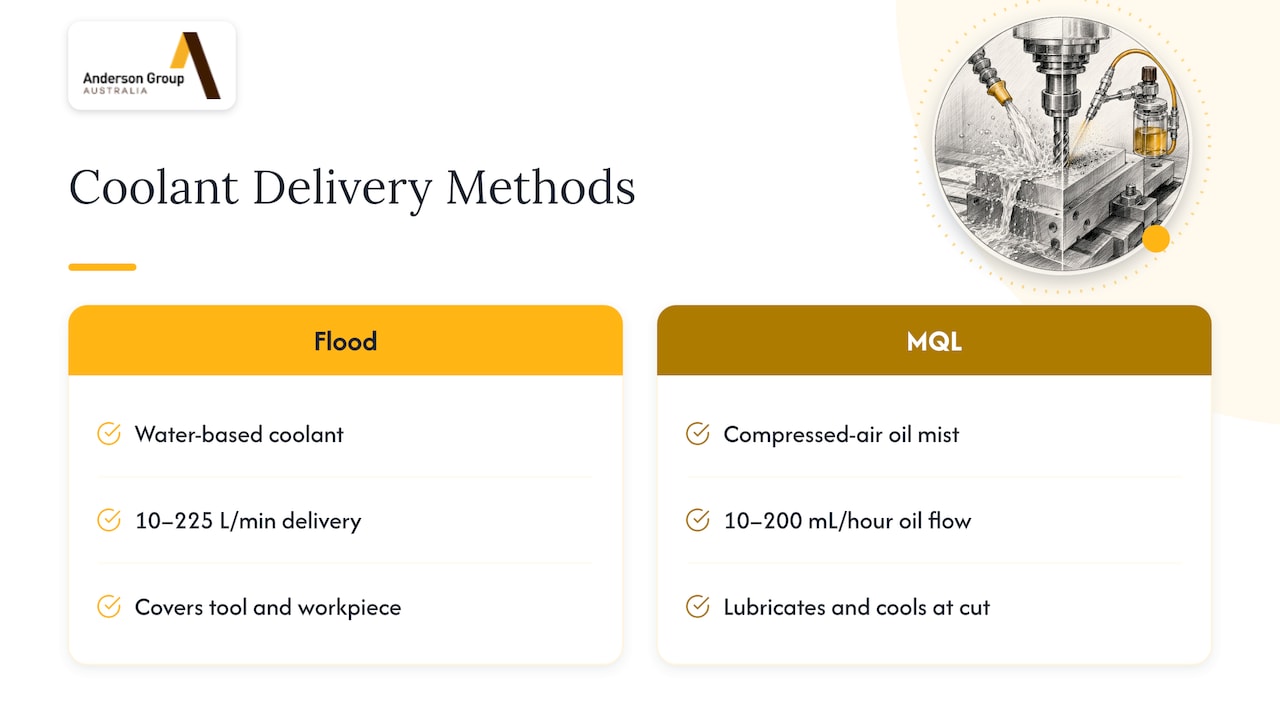
In conventional wet machining, a flood of water-based coolant covers the tool and workpiece. A 2021 review in PMC puts flood delivery at 10 to 225 litres per minute. The same review describes MQL, also called microlubrication or near-dry lubrication, as a mist of a much-reduced volume of fluid carried by compressed air, working as both coolant and lubricant.
The scale of the difference is the point. A 2021 paper in Tribology in Serbia describes classic MQL as feeding very small amounts of lubricating oil with compressed air, with oil flow rates estimated at 10 to 200 mL per hour. That is millilitres per hour against litres per minute. The oil is there to cut friction at the tool tip. The air carries the mist and helps remove heat.
Because so little fluid is used, most of it is consumed at the cut rather than pooling in a sump. That has practical consequences for chips, housekeeping and fluid management, which we cover below.
MQL, near-dry machining and dry machining
The terms overlap. A 2009 article in Cutting Tool Engineering uses MQL and near-dry machining as names for the same practice: a minute amount of lubricant applied precisely at the tool and workpiece interface in place of flood coolant. Dry machining uses no fluid at all. MQL sits between the two: it still lubricates, but with a tiny volume.
How an MQL setup works on a CNC machine
An MQL system has three jobs: meter a tiny amount of oil, mix it with air, and put the mist where it matters. Published studies show a few common arrangements.
- External nozzle. A 2025 Scientific Reports study on machining Monel 400 used oil atomised with compressed air and delivered through a 3 mm nozzle aimed at the tool rake face.
- Dual nozzles. A 2026 study on hard turning used about 40 mL/h at a constant 6 bar of air, with two nozzles aimed at the flank and rake faces.
- Pump, mixing chamber and compressor. A 2025 Springer study on high-speed milling of titanium alloy used this arrangement, with the nozzle 30 mm from the cutting zone.
These are laboratory configurations, and they show the principle rather than a recipe for your machine. In a production shop, the practical questions are where the mist is generated, how it reaches the tool (externally or through the spindle and tool holder), and how the machine’s controller and tool changer work with it. Those are exactly the details that vary by model, which is why exact-model confirmation matters.
MQL versus flood coolant: what changes
Fluid volume and housekeeping
The obvious change is volume. The PMC review above describes MQL as significantly reducing fluid use compared with flood, with lower total energy consumption and manufacturing cost. The Tribology in Serbia paper lists extended tool life, no need to recycle liquids, lower energy consumption, easier chip recycling and better surface quality among MQL’s advantages.
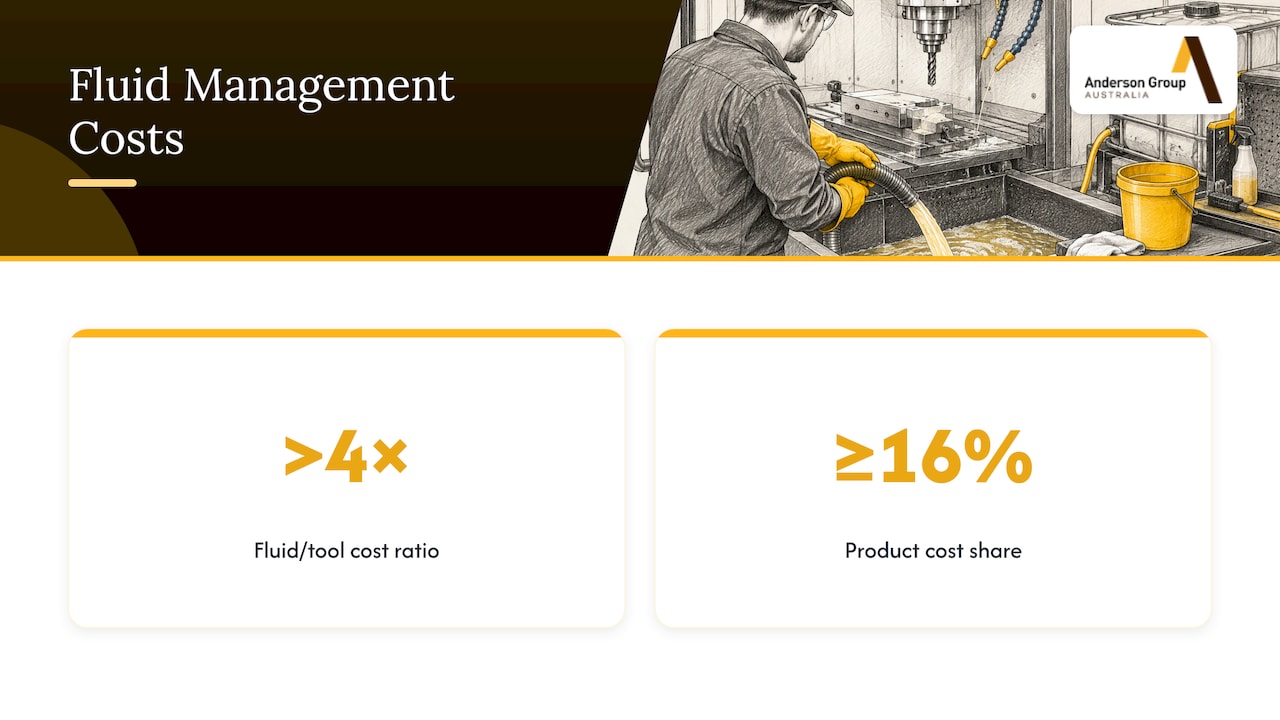
Fluid management is a real cost. A Curtin University review cites studies from the US, Germany and Spain putting cutting-fluid management at more than four times the cost of cutting tools and at least 16% of product cost. The same review notes that recyclers accept only dry chips, so cleaner chips can carry a resale advantage. Your own cost split will differ, so use these figures as a prompt to look at your own fluid, filtration, disposal and chip-handling costs rather than as a forecast.
Thermal behaviour
Flood coolant removes heat by volume. MQL relies on lubrication reducing the heat generated in the first place, with chips carrying away much of the rest. In interrupted cuts, that changes how the tool experiences temperature, and it is one reason MQL is studied so heavily in milling.
Process sensitivity
MQL is not simply flood coolant turned down. Where the tool, material and settings sit outside the range that works, results can be worse. Research on MQL milling of aluminium found that nozzle arrangement and oil flow rate both mattered. In a 2019 experimental study on 6061 aluminium, MQL produced lower surface roughness than dry cutting, and raising the aerosol flow from 26 to 52 mL/h reduced roughness further. Using two nozzles instead of one at 26 mL/h also lowered roughness at the cutting speeds tested, and feed forces fell by up to 18.2%. Those numbers belong to that tool, alloy and rig. They show direction, not a promise for your part.
Which operations and materials suit MQL
The Curtin review finds MQL applicable to turning, milling, drilling and grinding of steels. For this reader, the useful points are these:
| Operation | What the research says | What to plan for |
|---|---|---|
| Milling | A large share of MQL literature; positive results reported for aluminium alloys and steels | Nozzle position, oil flow, tool geometry and cutting parameters |
| Drilling | Applicable, but drilling with MQL needs a pecking cycle to avoid chip clogging and tool failure | Cycle programming and chip evacuation |
| Turning | Widely studied across steels and superalloys | Machine type; this guide concerns machining centres |
| Grinding | Higher grinding temperatures than flood cooling, with superabrasive wheels recommended to compensate | Generally a different machine class |
On materials, the Curtin review reports positive MQL results in milling and turning of aluminium alloys, while noting that the literature on some aspects is limited and further research is recommended. The CTE article above describes MQL as effective for all nonferrous metals and most grades of steel. A 2026 study in IOPscience on MQL milling of aluminium alloy with biodegradable palm oil found that adding fly ash to the oil improved surface roughness by 33.8% and cut tool wear by 70% compared with palm oil alone. That is a research result on a specific oil and additive, not a general benefit of MQL.
For Australian readers, a useful local reference is the Curtin University feasibility study on MQL for end milling aluminium. It used 6061 aluminium with typical CNC milling parameters and reported that a combined cold-air and MQL nozzle could sit closer to the cutting zone than a conventional fluid supply.
Where MQL does not apply: wood panels and nesting
Most of our customers make kitchens, cabinets, joinery and furniture. For them, the cutting environment is different. Panel and nesting machines cut sheet material such as board, and the contaminant to manage is dust and chip, handled by dust collection, not by liquid coolant. MQL is a metalworking lubrication method and does not belong in a nesting or panel-processing specification.
If that is your production, the questions to ask are about extraction, tooling and machine layout. Our wood machinery range is the right starting point, and our guide to nesting machine tooling covers cutter choice and upkeep. Keep dust extraction and liquid coolant as two separate conversations: one does not substitute for the other, and neither tells you anything about the other.
Questions to settle before you specify an MQL machine
The most useful thing you can do before an enquiry is define your application. Work through these.
- Material and alloy. Aluminium, steel, stainless and titanium all behave differently. Aluminium prone to built-up edge is often the case that draws shops to MQL. If you machine mixed metals, our guide on coolant choices for mixed metal shops covers the staining and compatibility questions that arise.
- Operations. Milling, drilling and tapping each place different demands on lubrication and chip clearance. Deep holes and pockets need particular attention, since chips must still leave the cut.
- Delivery route. External nozzles and through-tool delivery are different configurations. Do not assume either from the machine’s name, axis count or spindle type.
- Chip evacuation. Less fluid means less flushing. In aluminium especially, plan how chips leave the work area. Our article on chip evacuation for aluminium explains the pump-based approach.
- Tool life tracking. If you change from flood to MQL, you will want evidence of what happens to tool wear on your parts. Our guide to tool life monitoring from controller data shows how production data can inform that.
- Workholding and pallets. If you run an automatic pallet changer, confirm how any lubrication or coolant arrangement works with it on the exact model.
- Air supply. MQL needs compressed air at a stable pressure. The studies above used constant pressures such as 6 bar, so check your shop’s compressor capacity.
- Extraction and workplace air. Mist is an airborne emission. Check the requirements that apply to your workplace with your safety adviser and the relevant Australian work health and safety regulator before commissioning.
Settings may need to change
MQL is more process-sensitive than flood coolant. The research on aluminium shows that nozzle count, oil flow and cutting speed interact. Expect to revisit feeds, speeds, tool geometry and lubricant amount rather than swapping the coolant system and leaving everything else alone. Nozzle position also matters, since the tool body can shadow part of the cut from the spray.
Documented facts and general guidance
It helps to separate what is on record from what is advice.
Documented in the sources above: the fluid volumes for flood and MQL; the findings on aluminium milling from the 2019 and 2026 studies; the need for a pecking cycle in MQL drilling; the higher grinding temperatures under MQL; the cost share attributed to fluid management in the Curtin review.
General guidance: the checklist above, and the advice to treat MQL as a process change. These reflect good practice rather than a rule that applies to every shop.
Not stated here on purpose: which of our machines can be configured for MQL, through-spindle delivery, or high-pressure coolant. Those depend on the exact model and configuration, and we confirm them against the product page and with you directly rather than from a family name.
Choosing a machine for metal and aluminium work
Our metal and aluminium milling range is the Focaseiki line, kept distinct from our wood machinery. It includes vertical machining centres, machining centres with automatic pallet changers, double column and 5-axis models. The Vertical Machining Centre VMC-600/860/1160 and the VMC with APC are examples of the configurations you may be comparing. The Production Machining Centre with APC and the APC with zero-point system pages show the pallet-handling side.
If you are machining aluminium specifically, our guide to CNC machining aluminium for Australian manufacturers covers machine and tooling choices in more depth.
Before choosing, write down your part material, the largest part, your cycle, whether you run lights-out or attended, and which fluid approach you use today. Bring that to the conversation. We recommend machinery for your own production, and we do not offer subcontract cutting or machining.
Promo: talk to us about your metal application
We supply CNC machining centres, servicing and parts to Australian manufacturers. If you are weighing MQL, flood coolant or another approach for aluminium or steel milling, tell us the material, the operations and the volumes, and we will match them to a model in our metal machinery range and confirm the configuration you need. Where an option such as MQL, pallet changing or through-tool coolant matters, we check it against the exact model and product page before it goes into a quote.
To discuss your application or request a quote, start from our Anderson Group Australia site or the machines page.
FAQ
Is MQL the same as near-dry machining?
Yes, the two names describe the same approach. A very small amount of lubricant is applied at the tool and workpiece interface in place of flood coolant, as described in the Cutting Tool Engineering article. It differs from dry machining, which uses no fluid.
How much lubricant does MQL use?
Published figures vary by study and setup. The Tribology in Serbia paper estimates classic MQL oil flow at 10 to 200 mL per hour. The PMC review puts flood delivery at 10 to 225 litres per minute. Your own rate depends on the tool, material and system.
Does MQL work for aluminium milling?
Research reports positive results, including lower surface roughness than dry milling on 6061 aluminium in the 2019 study. Results depend on nozzle setup, flow rate and cutting speed, so settings usually need adjusting rather than copying from flood. Our aluminium machining guide covers the machine side.
Can any CNC machining centre run MQL?
Not automatically. Whether a model can be fitted with MQL, and how mist delivery works with its spindle, tool changer or pallet changer, depends on the exact model and configuration. Send us your application through the metal machinery page and we will confirm it against the product documentation.
Do wood nesting machines use MQL?
No. Panel and nesting machines are managed with dust extraction and suitable tooling. MQL is a metal-cutting lubrication method. See our wood machinery range for panel processing and nesting.
Sources
- Recent progress and evolution of coolant usages in machining (PMC, 2021)
- Quantity Lubrication and Wiper Geometry Inserts on Titanium (Tribology in Serbia, 2021)
- Curtin University review of MQL machining
- Feasibility study of MQL for end milling aluminium (Curtin University, 2012)
- An experimental study on cutting forces and surface roughness in MQL milling of aluminium 6061 (2019)
- MQL milling of aluminium alloy with palm oil and fly ash (IOPscience, 2026)
- Multi-objective optimisation of Monel 400 machining (Scientific Reports, 2025)
- Sustainable hard turning of gas carburized SAE 8620 steel (Springer, 2026)
- High-speed milling of Ti6Al4V with MQL (Springer, 2025)
- MQL: Lean and Green (Cutting Tool Engineering, 2009)