
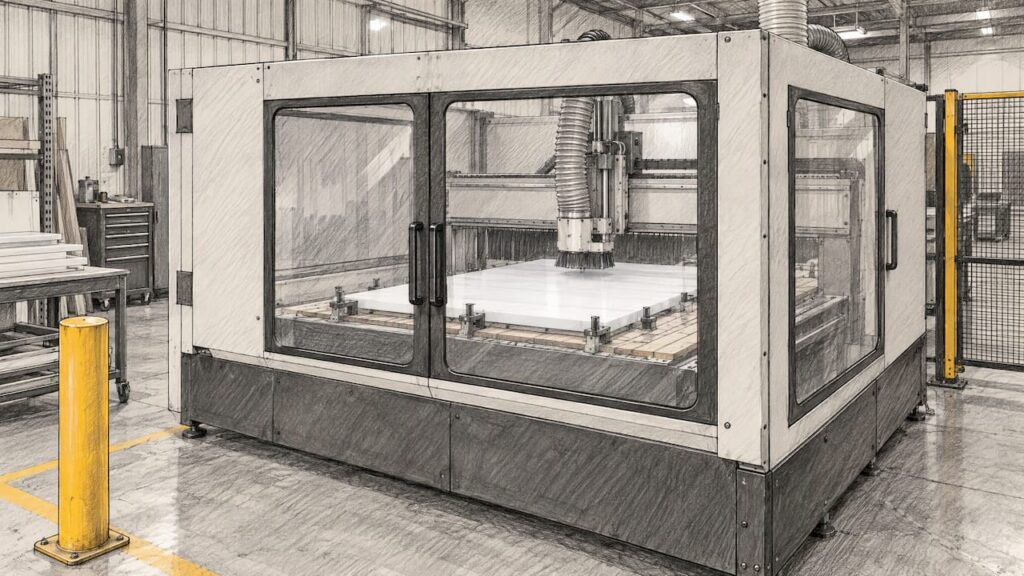
UHMW (ultra-high molecular weight polyethylene, also written UHMWPE) machines easily in the sense that it cuts without much force. It is hard in the sense that matters to a production shop: it smears, moves with temperature and springs back after the cutter leaves. The jobs that go well share four things: sharp tooling, low heat, wide and gentle workholding, and a tolerance that was agreed at a stated temperature. This guide covers each, then what to check when you are choosing CNC equipment for plastics work.
It is written for Australian manufacturers who already run CNC routers, nesting machines or machining centres and are adding UHMW parts: wear strips, guides, liners, chain rails, cutting boards and jigs. We supply machinery, service and parts. We do not offer subcontract cutting or machining, so everything below is about running UHMW on your own production line.
TL;DR
- UHMW expands roughly 17 times as much as steel, so temperature alone can push a part out of tolerance. Agree the inspection temperature before you quote or cut.
- Use very sharp tools. For milling, a polished single-flute spiral cutter is commonly recommended for UHMW-PE, and two or three flutes with a higher helix are also used.
- Support the whole part. Wide, flat contact or vacuum holding stops thin UHMW sheet from buckling, and low clamp pressure stops it from distorting.
- Rough, rest, then finish. Letting internal stress relax before the last pass is the cheapest accuracy improvement you have.
- Do not assume any machine family suits plastics. Confirm the exact model and configuration with the supplier for your material, bed size and extraction.
Table of Contents
- Why UHMW behaves differently from wood, MDF and metal
- Tooling: sharpness matters more than anything else
- Feeds, speeds and chip control
- Workholding: support everything, clamp lightly
- Sequence: rough, rest, finish
- Tolerances and inspection
- Choosing CNC equipment for repeatable UHMW work
- How we can help
- FAQ
- Sources
Why UHMW behaves differently from wood, MDF and metal
If your shop cuts melamine panels and solid timber, you are used to a material that breaks into chips or dust. UHMW does not. It is soft and tough, and it has a low melting point, so friction at the cutting edge softens it rather than shearing it cleanly. A manufacturer guide to machining plastics notes that UHMW has excellent wear resistance and service life, and also that its low melting point and high thermal expansion make limiting heat buildup important.
A 2025 academic paper on low-frequency vibration in UHMWPE machining lists the main difficulties: low thermal conductivity, high thermal expansion and pronounced viscoelastic behaviour. Together these can cause deformation, burrs and dimensional error. The same paper says UHMWPE machining has complexities beyond metal machining. In practice, three things follow:
- Heat stays where it is made. The material does not carry it away, so the cutting zone and the surface get hot quickly.
- The part moves while you cut it. It deflects under tool pressure and then recovers.
- The part keeps moving afterwards. Stress relaxation and temperature change alter the shape after the machine has stopped.
This is why a good wood programme does not simply transfer. Feeds, tool geometry, holding and inspection all need their own settings.
Tooling: sharpness matters more than anything else
One machining shop describes UHMWPE as cutting like wax and smearing, and calls sharp tooling the highest-leverage variable. That is a company’s view, but it matches the technical guidance.
A Mastercam guide to machining plastic parts says to use sharp tools for UHMW-PE. High-speed steel or solid carbide can be used. Milling cutters with two or three flutes and a higher helix help swarf evacuation. A Swedish plastics machinist recommends a single-flute spiral cutter with a polished edge for UHMW-PE milling.
These recommendations differ a little, which is normal. Flute count trades chip clearance against finish and rigidity, and the right answer depends on depth of cut, material thickness and your spindle. A sensible approach for a production shop:
- Dedicate tools to plastics. A cutter that has been used on laminated board or aluminium will not be sharp enough.
- Choose polished, high-rake geometry designed for plastics, and check with the tool maker for UHMW specifically.
- Retire tools earlier than you would for timber. A slightly dull edge rubs and melts the surface before you see it in the finish.
- Keep a tool library with accurate geometry, feeds and speeds. The UNSW advanced manufacturing lab advises detailed tool libraries so toolpaths and collision checks use real numbers.
If you also track tool wear from controller data, our guide to tool life monitoring for CNC production shows how to turn it into a change-out rule. That is especially useful when a dull edge shows up as heat before it shows up as a defect.
Feeds, speeds and chip control
There is no single set of feeds and speeds that suits every UHMW grade, cutter and machine. Treat published numbers as starting points and test on offcuts of the same stock. The direction of travel is consistent, though. A plastics supplier’s guidance for avoiding smearing is to reduce surface speed, increase chipload and cool aggressively. The aim is to cut a real chip instead of rubbing the surface.
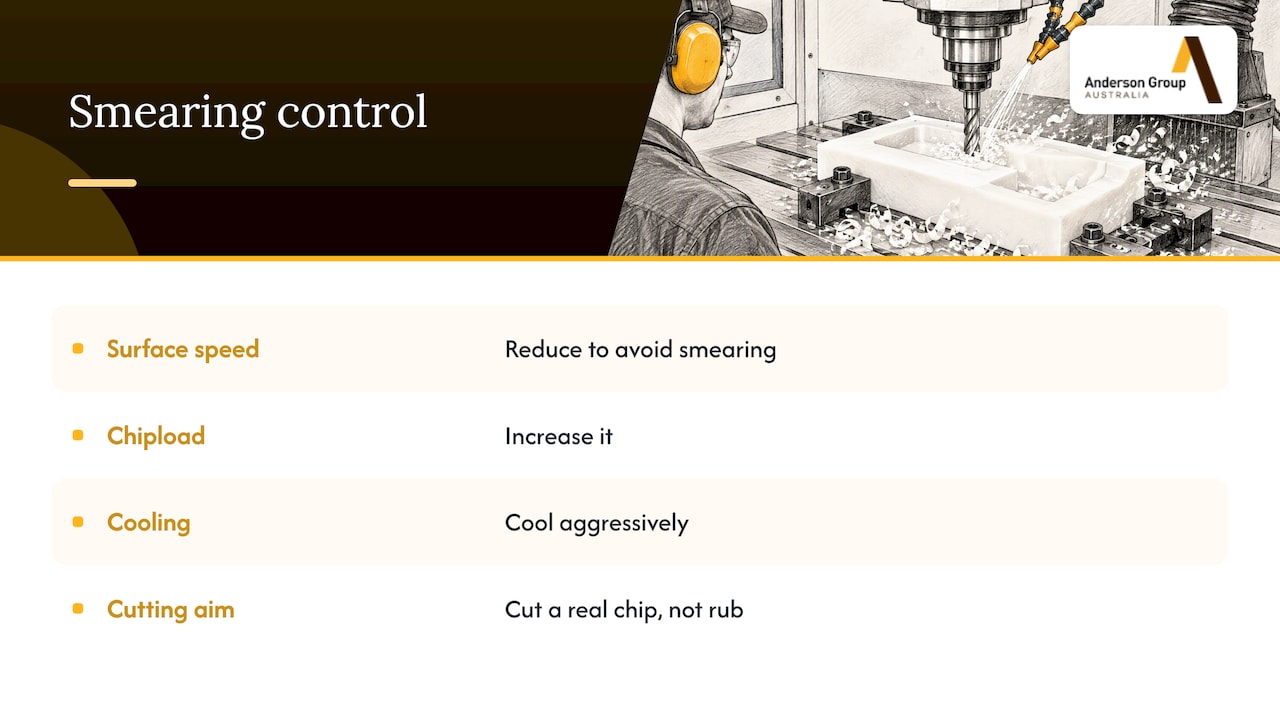
Cooling is where practice divides. The same Swedish machinist suggests a strong, dry air blast for HDPE and UHMW-PE milling, while other shops use liquid. Which one you choose depends on your machine, how you manage swarf, and how clean the part must be afterwards. Test both if your machine allows.
Swarf is the hidden problem
UHMW does not make tidy chips. It makes long, stringy swarf that can wrap around the tool. A 2026 study on data-driven optimisation of processing parameters notes that swarf nests around the tool can change the effective depth of cut and degrade surface finish. So chip management is not housekeeping. It is part of the dimensional result.
For the machine, that means:
- Plan how swarf leaves the cutting zone: air blast, extraction or both.
- Check that your extraction can handle stringy plastic swarf and not only wood dust. Wood dust collection and liquid coolant handling are different systems, and neither should be assumed to cope with plastic swarf.
- Stop and clear the tool if swarf starts to wrap. Letting it build up leads to a melted surface and a bad edge.
Similar heat and chip issues come up with other thermoplastics. Our guides on polycarbonate machining and PVC machining on CNC routers cover tooling, heat and chip control, and apply to some of the same decisions.
Workholding: support everything, clamp lightly
UHMW is springy. It conforms to whatever it is clamped against and then recovers when released. A Ready Plastics guide says UHMW conforms to irregular clamping surfaces, and recommends wide, flat clamping pads with evenly distributed force. For thin sheet, it recommends vacuum fixturing or double-sided tape on a flat tooling plate. It warns against edge-only step clamps, because local deflection can leave the machined surface non-planar.
An academic paper on machining UHMWPE joint implant inserts reports the same behaviour from a different field: flat samples tend to buckle unless held with flat contact or vacuum fastening.
Practical rules for a plastics job on a router or machining centre:
| Situation | Holding approach | Watch for |
|---|---|---|
| Thin sheet or plate | Vacuum table, or tape on a flat tooling plate | Leakage at cut-through edges; use a sacrificial layer or spoilboard |
| Thick blocks | Broad-contact fixtures with distributed clamp force | Over-tightening one point, which distorts the block |
| Turned parts | Custom soft jaws | Jaw pressure marking or ovalising thin walls |
| Complex or thin features | Sacrificial support material or temporary tabs | Removing tabs without leaving witness marks |
The last two rows come from PTS Make’s guidance, which also recommends uniform support under thin sections, low clamp pressure, vacuum tables for sheet, fewer reclamps and double-sided machining where it suits. The clamp should hold the part without visible compression.
On clamp sequencing, a machining fixture study supports staged tightening: bring the forces into a stable range first, then raise them slowly to the target rather than cranking one point. Locators and supports establish position; clamps only add the remaining restraint without distorting the part. Our guide to CNC workholding methods and datum logic goes through datum choice and how to prevent distortion and scrap. It also works for plastics.
Thin walls are a particular risk. If your parts have ribs or slender sections, read our piece on thin wall machining before you programme the toolpath.
Sequence: rough, rest, finish
The order of operations does as much for accuracy as the cutter. Pro Plastics recommends a rough-rest-finish sequence so internal stress can dissipate before final dimensions are cut. It notes that asymmetrical material removal makes parts bow, which is why a rest period matters.
A workable sequence on a flat part:
- Rough both sides evenly, leaving stock on every face. Avoid removing material from one side only.
- Release the part, or at least the clamp pressure, and let it rest.
- Let the part return to shop temperature before the finishing pass.
- Finish with a light, sharp cut and a consistent tool.
- Inspect at the agreed temperature.
For high-volume runs, build the rest period into the schedule: rough a batch, rest the batch, finish the batch. The machine keeps cutting while the parts relax.
Tolerances and inspection
This is where UHMW work most often goes wrong commercially. Pro Plastics says UHMW expands roughly 17 times as much as steel, so temperature changes shift dimensions, and stress relaxation after machining can change the shape. Their advice is to agree the inspection temperature before quoting, because a part can drift out of spec simply from shop temperature changes. They also advise letting machined parts return to shop temperature before final cuts and inspection.
A plastics supplier makes a stronger point: metal-grade tolerances such as IT6 are physically impossible over UHMWPE’s full operating temperature range. It points designers toward DIN 16742, the plastics tolerance standard. If your drawings were written for aluminium or steel, expect to renegotiate them for UHMW.
A checklist before you accept a UHMW job:
- What temperature is the part inspected at, and who measures it?
- Which dimensions are functional (a guide slot, a bearing bore) and which can be looser?
- Does the part see wide temperature swings in service? If so, tight tolerances at 20 °C may mean little in use.
- What surface finish is needed? Smeared or fuzzy edges can be a tooling or heat problem, not only a finishing one. Our guide to CNC surface finish targets explains how to specify and check finish.
Choosing CNC equipment for repeatable UHMW work
The machine matters less than the setup, but some machine decisions make repeatable plastics work easier or harder. Ask these before you buy or repurpose equipment:
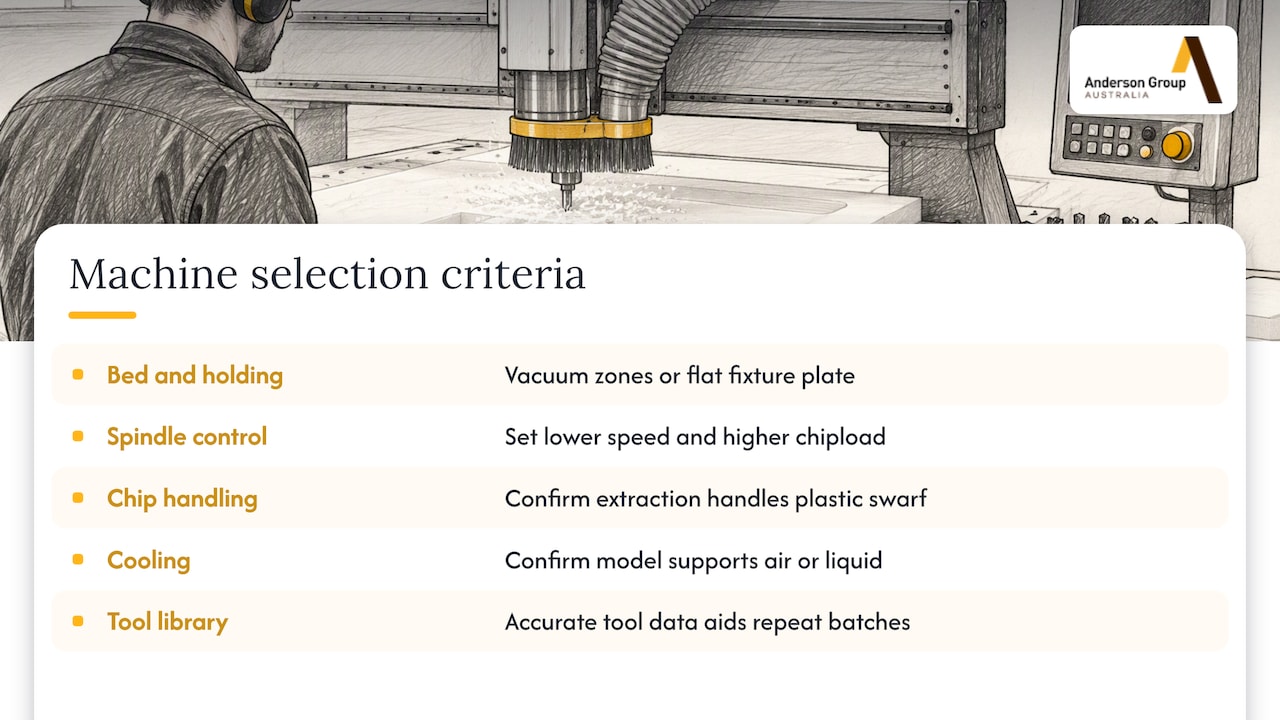
Bed and holding. Is there a vacuum table with zones suited to thin sheet, or a flat fixture plate for tape and broad clamps? The holding method decides most of your flatness result.
Spindle and speed control. You want to be able to set lower surface speeds and higher chipload, not only the high spindle speeds that suit panel work.
Chip and dust handling. Wood dust extraction and plastic swarf removal are not the same problem. Confirm what the extraction on a specific machine can and cannot take, rather than inferring it from the machine family.
Cooling. If you want air blast or liquid, confirm the exact model’s capability. Liquid coolant and through-spindle coolant are not implied by a machine’s name or axis count, and metal-machining coolant needs belong with the metal range. Our guide on coolant choices for CNC explains how fluids behave across materials.
Controller and tool library. Accurate tool data helps you reproduce a job on the next batch, as the UNSW guidance above says.
Process fit. Keep your applications distinct. Nesting and routing of panels, edgebanding, drilling and metal machining are different processes with different machines. A plastics wear-strip job does not turn a nesting router into a machining centre or the reverse.
General guidance above comes from the cited sources. What a particular Anderson or Focaseiki model can do with UHMW is not something this article states: that has to be confirmed against the product page and with our team for your material, sheet size and tolerance.
How we can help
Most of our customers are kitchen, cabinet, joinery and furniture manufacturers, and many of them add plastics and composites alongside wood. Our Advanced Materials Machinery range is the place to start for plastics and composites. If your main work is panel processing and nesting, see our wood machinery. If you cut metal or aluminium parts as well, the separate metal machinery range covers that.
Tell us the material and thickness, the part size, the quantity per week and the tolerance your customer expects. We will help you match that to a machine and configuration, and we will check specifications against the product page rather than a family name. Browse the full machine list or contact Anderson Group Australia to discuss your application or request a quote. We supply machinery, servicing and parts for your own production; we do not cut or machine parts for customers.
FAQ
Is UHMW easy to machine on a CNC router?
It cuts with little force, but it is not forgiving. It smears, swarf wraps around the tool, and the part moves with heat and stress. With sharp plastics tooling, gentle full-surface holding and a rough-rest-finish sequence, it can be machined repeatably.
What cutter should I use for UHMW?
Use a very sharp tool made for plastics. Guidance in the sources covers single-flute polished spiral cutters as well as two- or three-flute cutters with a higher helix, in HSS or solid carbide. Test on offcuts and ask your tool supplier for UHMW recommendations.
Why do my UHMW parts change size after machining?
Two causes: thermal expansion, which is far larger than for steel, and stress relaxation after material is removed. Rest the parts, let them reach shop temperature and inspect at an agreed temperature.
Should I use coolant or air when machining UHMW?
Both are used. One supplier recommends aggressive cooling to prevent smearing, and another recommends a strong dry air blast. Check which your machine supports, and confirm the exact model’s cooling and extraction before you buy.
Can your machines cut UHMW?
That depends on the model, configuration and your application, so we do not make a blanket claim. Send us the material, thickness, part size and tolerance and we will confirm against the relevant product page.
Sources
- Machining Plastics: The Essential Guide to Materials, Tools
- Application of low frequency vibration to the machining of UHMWPE (Taylor & Francis, 2025)
- Machining UHMW: Why Tolerances Slip, and How to Design (Pro Plastics)
- UHMWPE CNC Machining Tolerances: Designer’s Reference (JSLT Polymers)
- On the Machining of Joint Implant UHMWPE Inserts (MATEC Conferences, 2022)
- Plastic milling (Matenco)
- Guide to machining plastic parts (Mastercam)
- Machining UHMWPE (Criterion Precision)
- Machinable Plastics (Interstate Plastics)
- Data-Driven Optimization of Processing Parameters (Springer, 2026)
- Machining UHMW: Feeds, Speeds and Tooling Guide (Ready Plastics)
- UHMWPE Machining Guide: Best Practices (PTS Make)
- Machining fixture for adaptive CNC machining process (ScienceDirect)
- Tools, Feeds and Speeds (UNSW Making)