
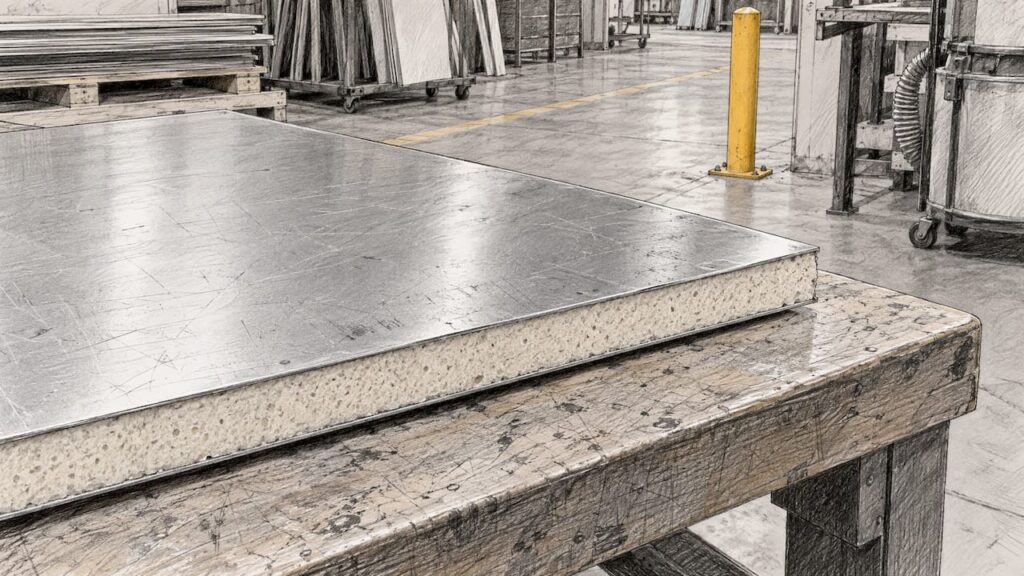
A CNC router can cut some steel jobs, but only a narrow band of them. Thin-gauge steel skins on a panel, cut with the right blade, secure clamping, guarding and cooling, are realistic. Routine production cutting of solid steel is a different job, and it belongs on a machining centre built for metal. If your shop runs wood, panel and nesting work and a steel request has landed on your desk, this guide shows where the line sits, what the thin-skin case demands and how to decide whether to extend your router or add a metal machine.
One point first. Anderson Group Australia supplies machinery for your own production. We do not offer subcontract cutting or machining, so this article is about choosing and running equipment, not about sending steel to us to be cut.
TL;DR
- Thin steel skins on a router are possible under specific conditions: specialised tooling, rigid blade holding, secure clamping, guarding and cooling.
- Most steel stock is cut by dedicated saw, laser or plasma processes, and steel milling is done on machining centres.
- Sparks can ignite material on the machine or in the dust collection, so a wood-dust extraction system needs a fire plan before any steel goes near it.
- There is no universal feed and speed for steel on a router. Settings depend on the material, the tool and how well the part is held.
- For regular steel or aluminium milling, look at the Focaseiki metal machinery range. For wood and panels, stay with a nesting machine.
Table of Contents
- What “cutting steel on a router” usually means
- Why a wood router and a metal machine differ
- The thin-skin case: what the setup needs
- Fire and guarding: the part that catches wood shops out
- Steel composites and other metal-skin sandwiches
- Feeds, speeds and depth: how to approach them
- Router or machining centre: a decision guide
- Where Anderson fits
- Talk to us about your application
- FAQ
- Sources
What “cutting steel on a router” usually means
People type this search for three quite different jobs, and the answer changes with each.
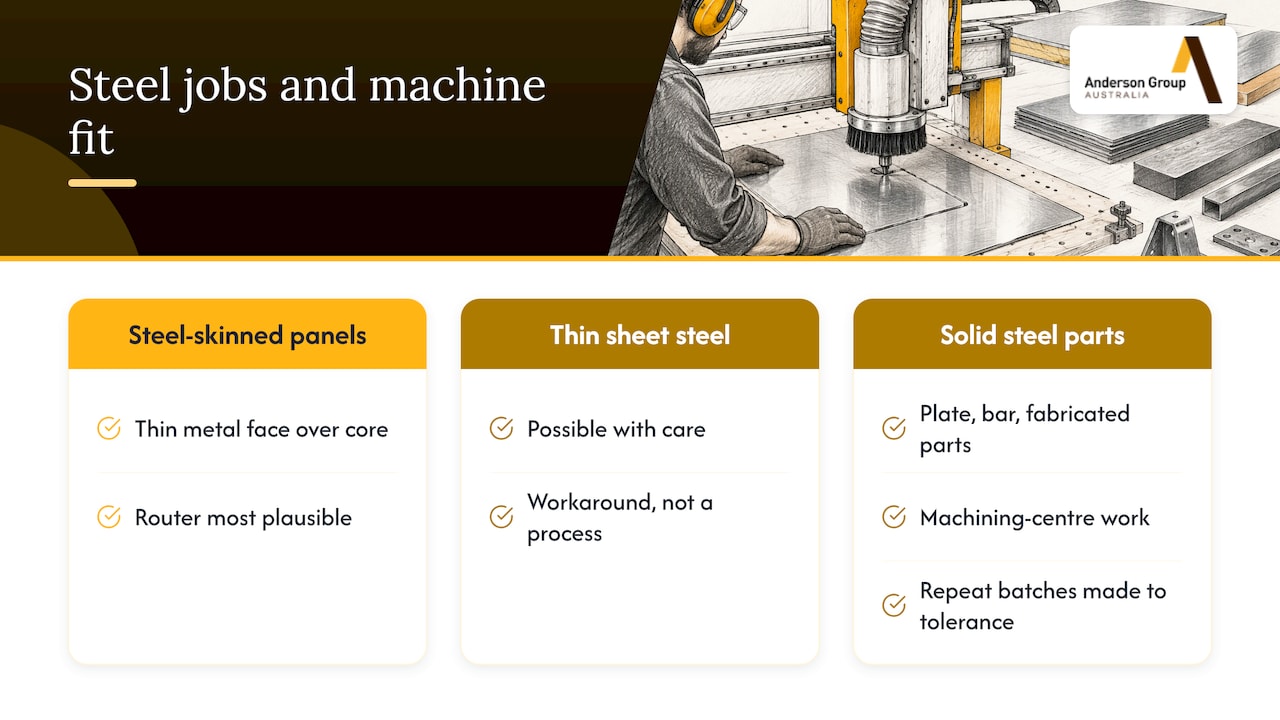
Steel-skinned panels. Some sandwich materials have a thin metal face over a core. Shops that already nest panels are asked to cut them. This is the case where a router is most plausible.
Thin sheet steel. A one-off bracket, a template or a small plate. Possible with care, but it is a workaround, not a process.
Solid steel parts. Plate, bar, fabricated components made to tolerance, in repeat batches. This is machining-centre work.
Woodworking Canada’s article on sawing metal on a CNC router draws the same distinction. It says a standard wood router should not be assumed suitable for all metals. Thin-gauge steel skins can be cut under specific conditions, but most steel stock is generally cut with dedicated cold-saw, laser or plasma processes.
Why a wood router and a metal machine differ
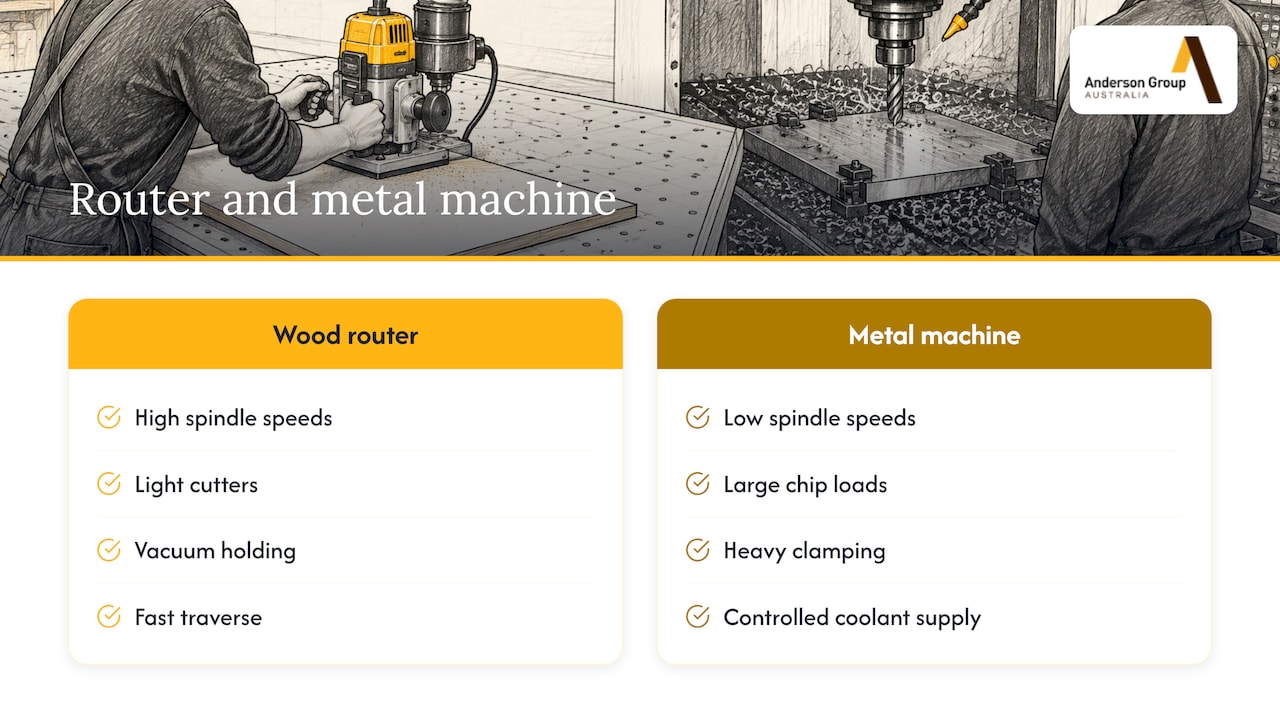
A router built for panels is designed around high spindle speeds, light cutters, vacuum holding and fast traverse. Those are the right traits for melamine, MDF, ply and solid timber. Steel asks for the opposite: low spindle speeds, large chip loads, heavy clamping and a controlled supply of coolant.
The chip question is the heart of it. Steel work-hardens and heats up when a cutter rubs instead of cutting. Taking a proper chip carries the heat away, and that needs a machine with the rigidity and spindle torque to hold the cut. A router at wood speeds will spin the tool far faster than steel tolerates.
The cutter maker’s own data shows how much material and setup matter. The Mitsubishi Materials cutting conditions guide lists cutting speeds, feeds and depths by workpiece material for end mills, and cautions that vibration or poor clamping rigidity can require lower cutting conditions. Lower conditions mean slower production, which is why rigidity decides whether a job is viable.
The thin-skin case: what the setup needs
When a steel skin on a panel is the job, the Woodworking Canada article sets out the practical requirements. Treat the following as general guidance from that source, not as a specification for any Anderson machine.
Tooling
For skins, it recommends saw-blade geometry made for the purpose rather than a wood cutter. Blades under 14 inches generally run at 3,000 to 5,000 RPM, and for steel the spindle speed should sit at the lower end of that range to control heat and limit tip fracture. It also notes that there is no single router parameter, because materials vary.
Blade holding
The blade holder must be rigid. The article advises against shank-style holders and against countersunk blade-to-arbor fastening, because holding pressure and accuracy are critical.
Workholding
Clamping should be secure, using pneumatic or manual clamps. Feed rate depends on material thickness and clamping forces, and a feed that is too slow can overheat the blade quickly. Vacuum alone, the usual way of holding panels, is not the assumption here.
Cooling
The source says steel cutting should not be attempted without misting or cooling. For metal-skin hybrid materials, flood coolant may not be possible because oils or water can contaminate the material, so a misting or other cooling strategy is needed. If your interest is mist or minimum-quantity lubrication on metal, our guide to MQL machining on CNC for metal shops explains how it fits on a metal machine.
Fire and guarding: the part that catches wood shops out
A wood shop is set up around dust extraction. That is exactly what makes steel cutting risky. Woodworking Canada warns that sparks may ignite material on the machine or in the dust collection, and calls for additional fire suppression and guarding in addition to cooling.
Before any steel is cut on a machine that normally handles wood:
- Clear the bed, the extraction hood and the ducting of wood dust and offcuts.
- Decide how sparks and swarf will be kept out of the dust collector.
- Confirm the guarding and fire suppression you have for the job.
- Confirm the cooling method with the supplier of the exact machine.
On standards, ISO 16090-1:2022 specifies safety requirements for milling machines, machining centres and transfer machines intended to cut cold metal and other non-combustible cold materials. Its scope excludes wood-like materials, glass, stone and certain engineered materials. In plain terms, the safety framework for cutting metal is written for metal-cutting machines, and wood-cutting machines sit in a separate framework. That is a strong reason to keep metal on a metal machine.
Nesting extraction and liquid coolant are separate matters. Do not assume a nesting machine’s dust extraction suits steel swarf, and do not assume coolant can be fitted to a machine because of its family name. Confirm both for the exact model and configuration.
Steel composites and other metal-skin sandwiches
Metal-faced panels and fibre composites behave differently from solid steel. Fibre-reinforced polymers are nonhomogeneous and anisotropic, which makes them hard to machine and can impair part quality and surface integrity, according to a 2018 peer-reviewed review in the journal Materials. A 2016 Materials study of CFRP edge trimming lists fibre pull-out, delamination, fuzzing and thermal degradation as risks, and links damage to tool geometry, cutting parameters and fibre orientation. Its flat-edge router tool gave lower cutting force and a better edge in its own tests, a result specific to those conditions.
For composites on a router, our guide on machining carbon fibre without ruining the part goes deeper. For plastics, see polycarbonate CNC machining and UHMW machining.
Feeds, speeds and depth: how to approach them
No article can hand you one correct set of numbers for steel on a router, and any that claims to is guessing. What you can do:
- Start from the tool maker’s data for the exact cutter and the exact grade of steel, such as the Mitsubishi tables above.
- Reduce those conditions if the part is held less rigidly than a machining centre would hold it.
- Keep the cutter cutting. Rubbing and dwelling create the heat that hardens the surface.
- Record the setup and results for your own machine so the next job starts from your data, not from a forum post.
Surface finish, tolerance and repeatability on steel depend on the machine, the tool, the workholding and the material. Quote none of them to a customer until they are confirmed for your exact machine and job. Where a part needs a tight tolerance on metal, that is a specification question for a metal machining centre and its documentation.
Router or machining centre: a decision guide
| Job | Realistic on a wood router? | Better fit |
|---|---|---|
| Steel skin on a panel, occasional | Possible with specialised blade, rigid holder, clamping, guarding and cooling | Confirm setup for your exact model first |
| One-off thin sheet steel | Possible as a workaround | Dedicated cutting process or metal machine |
| Repeat solid steel parts | Not the intended use | Machining centre for metal |
| Aluminium milling in batches | Not the intended use | Machining centre for metal |
| Melamine, ply, MDF, solid timber | Yes, this is its job | CNC nesting machine |
The useful question is not whether a router can do it once. It is how often the work will come, and what a failed or slow job costs you. If steel is a regular line, a machine designed for it protects the router that earns your living on panels.
Where Anderson fits
For wood, our primary focus is kitchen, cabinet, joinery and furniture manufacturers, and our wood machinery range covers nesting and panel processing, including Genesis PLUS and the Anderson range. If your router time is already full of panels, the cleanest answer to a steel enquiry is often a separate machine rather than a compromise on the one you have.
For metal and aluminium, we supply the Focaseiki range, which is separate from the Anderson wood machines. The Focaseiki machining centres on the machines page include these configurations:
- Vertical machining centres VMC-600/860/1160
- VMC-1100/1250/1400
- VMC-1600/1800/2000
- VMC with APC, VMC-600/860/1100APC, where APC means an automatic pallet changer
- Boxway vertical machining centres
- Production machining centres and the version with APC
- APC with zero-point system
Pallet changing, probing, rotary accessories, coolant options and extraction vary by exact model and configuration. Do not read them from a family name or axis count; check each against the product page and confirm it in your quote.
If your work is also moving toward 5-axis, the AXXIOM 5-axis series page is the place to check the documented material application before you assume anything.
Talk to us about your application
Tell us the material, the thickness, the batch size and what else the machine must do. We will match a wood or panel job to an Anderson machine, and a steel or aluminium job to a Focaseiki machining centre, and we will check every specification against the product page. Start from our metal machinery page or the landing page and request a quote.
If you are comparing processes more broadly, our guide to laser cutting or CNC routing sets out the production requirements for each.
FAQ
Can a CNC router cut steel?
Sometimes, within narrow limits. Thin-gauge steel skins can be cut with specialised blades, rigid holding, secure clamping, guarding and cooling. Solid steel in production is normally cut by dedicated saw, laser or plasma processes or milled on a machining centre.
What speed should I run a router at for steel?
There is no single figure. One industry source says saw blades under 14 inches generally run at 3,000 to 5,000 RPM and that steel calls for the lower end, but your cutter maker’s data for your grade and setup governs. Lower the conditions if the part is not held rigidly.
Is it safe to cut steel on a machine with wood dust extraction?
Only with a plan. Sparks can ignite material on the machine or in the dust collection, so clear dust first, add fire suppression and guarding, and keep swarf out of the collector. Confirm the arrangement for your exact machine.
Can I use flood coolant on a nesting router?
Do not assume so. Dust extraction and liquid coolant are separate systems, and coolant fitment cannot be inferred from a machine family. Confirm it for the exact model and configuration, and for metal work look at the metal machinery range.
What should I buy if steel becomes a regular job?
A machining centre built for metal. Share your material, part size and batch quantity with us and we will recommend a configuration from the Focaseiki range, with specifications checked against the product page.
Sources
- Sawing metal on a CNC router, Woodworking Canada
- ISO 16090-1:2022 Machine tools safety, Machining centres
- Recommended cutting conditions, Mitsubishi Materials
- Machining of Fibre Reinforced Plastic Composite Materials, Materials 2018
- High-Speed Edge Trimming of CFRP and Online Monitoring, Materials 2016