
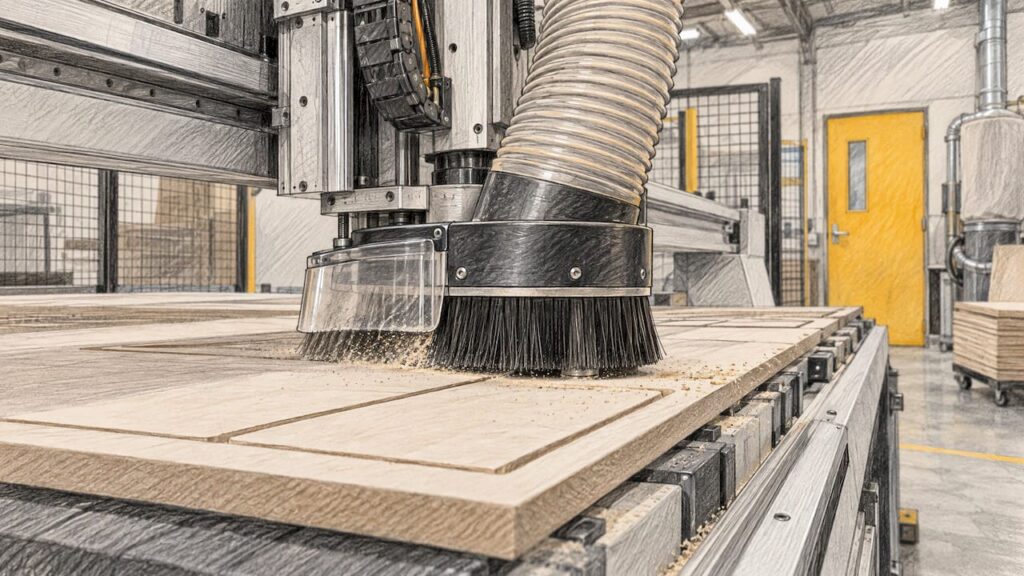
A dust shoe is the hood around the spindle that holds the extraction airflow right at the cutter. On a production nesting router, good design comes down to four things: a skirt or brush that directs air rather than just blocking it, a body that clears the tool, clamps and hold-down, a hose and airflow matched to the dust volume, and a removable section that lets operators change tools in seconds. Get these right and the shoe becomes part of a system that protects your people and your finish quality. Get them wrong and no extractor will make up for it.
This guide is for kitchen, cabinet, joinery and furniture manufacturers choosing or running industrial CNC machines. It is not a build guide for hobby routers. If you are weighing up a nesting machine, the Genesis PLUS CNC nesting machine and the ATS series nesting routers are where to start. Dust shoe and extraction details differ by model and configuration, so confirm them on the relevant product page and in your quote.
TL;DR
- The dust shoe is one part of a chain: shoe, hose, separation and filtration, and a suction source. Its design only works when the whole chain is matched.
- Brush or skirt design shapes airflow. A small controlled gap can capture better than a hard seal, and removable sections save time at every tool change.
- Size the hose to the volume of dust the machine makes, keep runs short, and check clearance to clamps and hold-down through the full toolpath.
- Australian exposure standards are 1 mg/m³ for hardwood dust and 5 mg/m³ for other wood dust, so capture at the cutter matters for compliance as well as cleanliness.
- Dust shoe and extraction options belong to a specific model and configuration. Confirm them for your exact machine before you order.
Table of Contents
- What a dust shoe actually does
- The design features that decide capture
- Matching the hose and airflow to the shoe
- Why capture at the cutter matters in Australia
- Dust shoe design by application
- Fitting, testing and maintaining a shoe
- Questions to settle before you buy a machine
- How we can help
- FAQ
- Sources
What a dust shoe actually does
When a cutter works through sheet material, it throws fine dust and chips in every direction. A dust shoe surrounds the cutter and connects to an extraction hose, so the airflow pulls that waste away at the point where it is made. Capturing it there is far more effective than trying to clean it up from the air or the machine bed afterwards.
The shoe sits at the front of a larger chain. After the shoe comes the hose, then some form of separation and filtration, then the suction source. Each link limits the next. A beautifully designed shoe on an undersized hose delivers little airflow at the cutter, and a powerful extractor feeding a poorly shaped shoe wastes most of its capacity on pulling in room air.
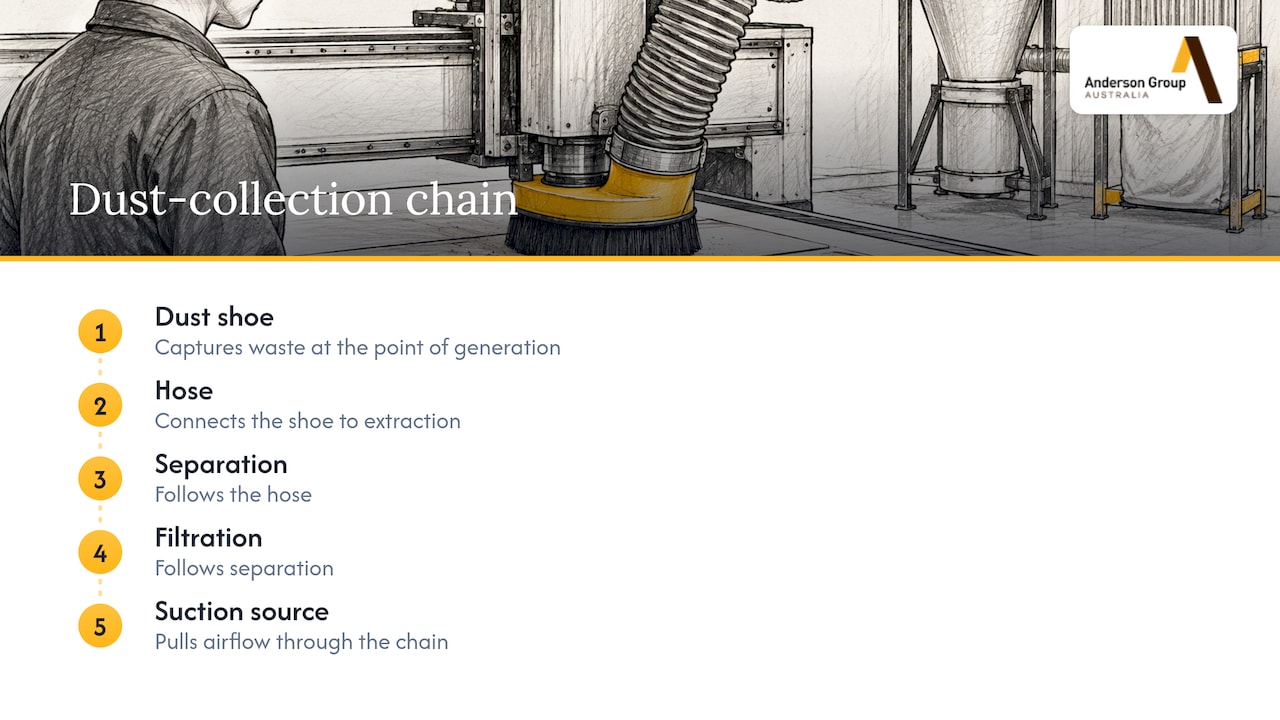
Our guide to effective CNC dust collection for cleaner, safer workshops covers the whole chain. This article stays on the shoe and how it should be specified.
The design features that decide capture
Brush or skirt: direct the air, do not just block it
The obvious idea is to seal the shoe tight against the sheet. In practice, airflow design is more subtle. Woodshop News reports that brushes can shape and direct airflow rather than block it, and that a gap of an inch or less can work when its cross-sectional area is matched to the duct. A small, controlled gap forces air to sweep across the surface under the brush before it rises into the hood, carrying dust with it.
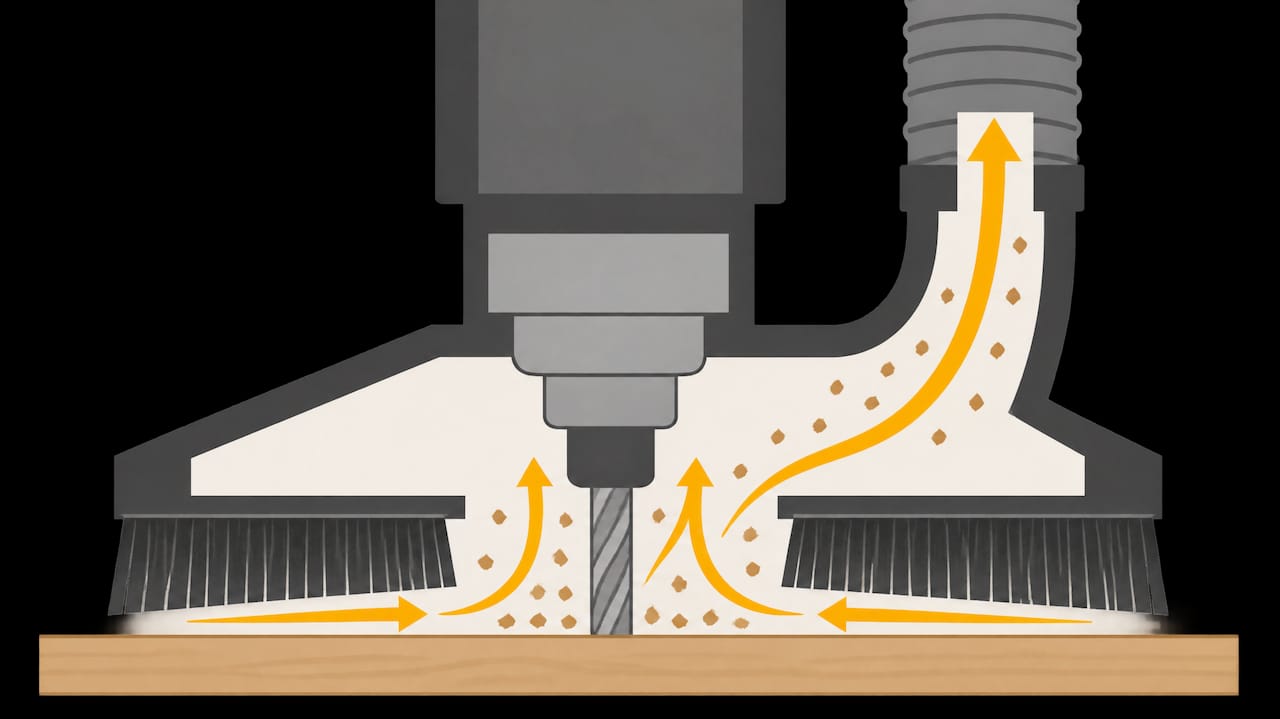
For your purchasing decision, this means the skirt is an engineered part of the airflow path, not a curtain. Look at how the brush height is set, how the bristle length can change, and whether it suits the thickness range of the boards you nest.
Two practical points follow:
- Too little gap drags on the sheet, wears the bristles quickly and can mark delicate surfaces such as melamine or veneer.
- Too much gap lets air and chips escape, and capture drops away.
Set the height, then watch capture and clearance through a full toolpath on offcut material before you run production sheets.
Removable sections for fast tool changes
Nesting work often involves several cutters across a job: a compression router for the profile, a smaller tool for fine detail, and sometimes a drill. If the shoe makes each change slow, operators will leave it off or run it badly adjusted. Woodshop News describes several ways to give tool access: a parking mechanism, a raise and lower mechanism, or magnet-attached removable brushes in different lengths with spacers.
A quick-release or split brush section is a workflow feature as much as a convenience. It decides whether the shoe stays on the machine and stays used. When you assess any machine, ask how the shoe is released for a tool change and how many seconds that takes in practice.
Body shape, size and clearance
The shoe body has to clear the spindle, the tool holder, the longest cutter you plan to use, and everything on the bed that stands proud of the sheet. The details that decide this are:
- spindle or tool-holder diameter and the length the cutter protrudes
- the opening around the tool, which must pass the tool holder and a collet nut with room to spare
- the height of any clamps, hold-down hardware or vacuum fixtures
- the thickest material you routinely cut
- the hose connection size and position
In a nesting job the cutter travels across the full sheet, so the shoe has to pass over every part of it. If your work includes thick laminated panels, fixtures or raised hold-down, say so when you discuss your application. The shoe that suits 16 mm board may not be right for deeper cuts or tall fixtures.
Fixed or height-adjusting shoes
A shoe that moves with the Z axis keeps a constant distance between the brush and the sheet. A fixed shoe relies on the brush flexing across the range of cut depths. For flat sheet processing such as cabinetry parts, constant distance is the cleaner approach to consistent capture. Whichever design a given machine uses, the shoe should be checked at full cut depth, with the spindle off, so you know the tool and holder clear the hood at the bottom of their travel.
Which arrangement belongs to which machine is a model-by-model question. We do not infer dust shoe features from a machine family name, so check the product page and confirm the exact configuration when you request a quote.
Matching the hose and airflow to the shoe
The shoe is only as good as the air arriving at it. Festool Australia’s hose guide advises matching hose diameter to the volume of waste the tool produces rather than the port size, and notes that airflow falls with hose length, so machines that make a lot of waste do better on shorter runs. That principle applies at any scale. A router cutting sheet at production speed produces far more waste than a handheld tool, so the hose and extractor need to be sized for the machine, not for the shoe’s connection spigot.
When planning the extraction side of a nesting installation:
- Keep the run from shoe to main duct as short and straight as you can. Every bend and metre costs airflow.
- Use the duct size your extraction supplier calculates for the machine, not whatever the shoe’s spigot happens to accept.
- Secure the hose joint at the shoe. The shoe moves with the gantry and vibrates, so the connection should be positively fixed and the hose supported so it does not drag on the sheet or pull the shoe off line.
- Allow for the hose to travel across the full bed without kinking or snagging.
If you are choosing between a fixed extraction system and a standalone extractor, settle that before you finalise the machine specification, because the duct connection and any enclosures should be planned together.
Why capture at the cutter matters in Australia
This is the reason the shoe deserves attention on a production floor. Safe Work Australia’s benchmarking study of Australian wood industries reported exposure standards of 1 mg/m³ for hardwood dust and 5 mg/m³ for other wood dust, and found that 72% of hardwood dust exposures measured exceeded the relevant standard. The same study identified local exhaust ventilation, vacuum cleaning rather than compressed air, and external exhaust as best-practice controls.
A dust shoe is local exhaust ventilation in its most direct form. A Queensland Government guideline classifies all wood dust as carcinogenic (Group 1) and says loose dust should be captured at the point of generation using vacuum or exhaust extraction designed to fit the machine.
MDF and other reconstituted boards are central to kitchen and cabinet production, so the fine dust they make is part of daily work. Festool Australia notes that WorkSafe Victoria’s minimum recommendation for on-tool extraction with wood dust, including MDF, is a Dust Class M vacuum. That recommendation is aimed at tool-mounted extraction, but it shows the standard of filtration regulators expect at the point of capture.
Two cautions keep this in proportion:
- A dust shoe on its own does not establish safe air quality. Good capture reduces what escapes into the workshop, but the full capture and filtration system, your housekeeping and your monitoring all count.
- Respirators supplement extraction. They do not replace it.
For the numbers, the limits by wood type and a practical checklist, see our guide to Australian wood dust standards. Your state or territory WHS regulator and a qualified occupational hygienist are the right contacts for exposure monitoring and your legal obligations. If dust is also a fire risk in your shop, our article on combustible dust risks in CNC shops explains why source extraction matters there too.
Dust shoe design by application
Different operations ask different things of the shoe. Keep them distinct when you specify a machine.
| Application | What the shoe design needs to handle | Where to look |
|---|---|---|
| Nesting and routing of sheet (melamine, MDF, plywood) | Constant skirt contact or controlled gap across the full bed, quick tool changes, clearance for hold-down | ATS series and Genesis PLUS product pages |
| Six-sided drilling and routing | Extraction planned around the drilling and routing units for the specific model | ADM 612-MST product page |
| Plastics and composites | Static cling and fine particles, different chip behaviour | Advanced Materials Machinery |
| Metal and aluminium milling | Chips and liquid coolant, not dust extraction | Metal Machinery |
Wood-panel dust extraction is a separate subject from liquid coolant. If your enquiry is about metal machining, coolant systems or any fitment related to them, go to the metal machinery range and confirm compatibility for the exact model. Nothing in a nesting dust shoe design carries across to coolant.
Material choice also changes what the shoe has to cope with. Our guides to plywood machining on a CNC, PVC machining for Australian joineries and phenolic machining cover tooling and dust for those materials.
Fitting, testing and maintaining a shoe
Whatever machine you buy, the shoe is a wear item that needs routine attention. A practical routine looks like this.
- Check the fit at full cut depth. With the spindle off, lower the tool to its deepest working position and confirm the holder and cutter clear the hood.
- Set the brush height for the stock. Adjust for the thickness of the board you are cutting, so the bristles touch with a slight bend rather than dragging.
- Run a full toolpath on scrap. Watch for dust escaping at corners, brush catching on clamps and any point where the shoe meets hold-down hardware.
- Replace worn bristles. Once bristles no longer reach the sheet, capture falls away quickly. Inspect them on a regular schedule rather than waiting for visible dust.
- Plan toolpaths and clamp heights together. If the shoe has to clear fixtures, design the layout so it does.
- Inspect the hose and joints. Cracks, loose clamps and blocked sections reduce airflow at the cutter without any obvious sign at the machine.
Cutters affect capture too. Chip size and the amount of fine dust depend on the tool and the feed, so shoe performance and tooling go together. Our guide to CNC nesting machine tooling covers choosing and maintaining cutters, and how to increase CNC nesting productivity shows how tool changes and setup time fit the bigger picture.
Questions to settle before you buy a machine
A dust shoe is easier to get right when it is part of the machine specification from the start, instead of added after installation. Take these questions into any quote discussion:
- Which shoe and extraction connection come with the exact model and configuration you are considering?
- How is the shoe released or adjusted for a tool change?
- What range of board thickness and hold-down height does it clear?
- What hose size and airflow does the machine’s extraction connection expect?
- Which brush or skirt parts are wear items, and how are they replaced?
- What is the agreed scope for servicing and parts supply for those wear items?
On that last point, service inclusions, response times and maintenance intervals should be confirmed in your agreement rather than assumed.
How we can help
We supply CNC machinery, servicing and parts to Australian manufacturers, with kitchen, cabinet, joinery and furniture makers as our main customers. We help you choose machinery for your own production. We do not offer subcontract cutting or machining.
If you are planning nesting or panel processing, the wood machinery range is the place to see what we supply, and the product pages carry the verified specifications for each model. Tell us your materials, sheet sizes, hold-down method and extraction setup, and we can discuss your application and prepare a quote.

The full range of machining centres is on our machines page.
FAQ
Should a dust shoe seal tightly against the sheet?
Not necessarily. Woodshop News describes how a small, controlled gap between the brush and the work can capture better than a hard seal, because it makes air sweep across the surface before rising into the hood. Too tight a fit drags and wears the brush, while too wide a gap lets dust escape. Set the height and test capture on scrap through a full toolpath.
What hose size should I use with a CNC dust shoe?
Size it to the volume of waste the machine produces, not just to the shoe’s port. Festool Australia’s guidance is that airflow drops as hose length increases, so keep runs short and straight. For a production nesting router, the right size depends on the extraction system, so confirm it for your exact model and setup.
Does a dust shoe meet Australian wood dust requirements by itself?
No. The exposure standards are 1 mg/m³ for hardwood dust and 5 mg/m³ for other wood dust, and the shoe is one part of local exhaust ventilation. The whole capture and filtration system, housekeeping and monitoring all count. Your state or territory WHS regulator or an occupational hygienist can advise on your obligations.
Can the same dust shoe design be used for metal machining?
No. Wood-panel dust extraction and metal machining with chips and liquid coolant are separate problems. For metal, start with our metal machinery range and confirm compatibility for the exact model.
Sources
- Safe Work Australia: Benchmarking of exposures to wood dust and formaldehyde (2008)
- Queensland Department of Education: Industrial technology and design guideline
- Woodshop News: CNC dust collection has many challenges
- Festool Australia: Vacuum hose guide
- Festool Australia: Dust extractor classification guide