
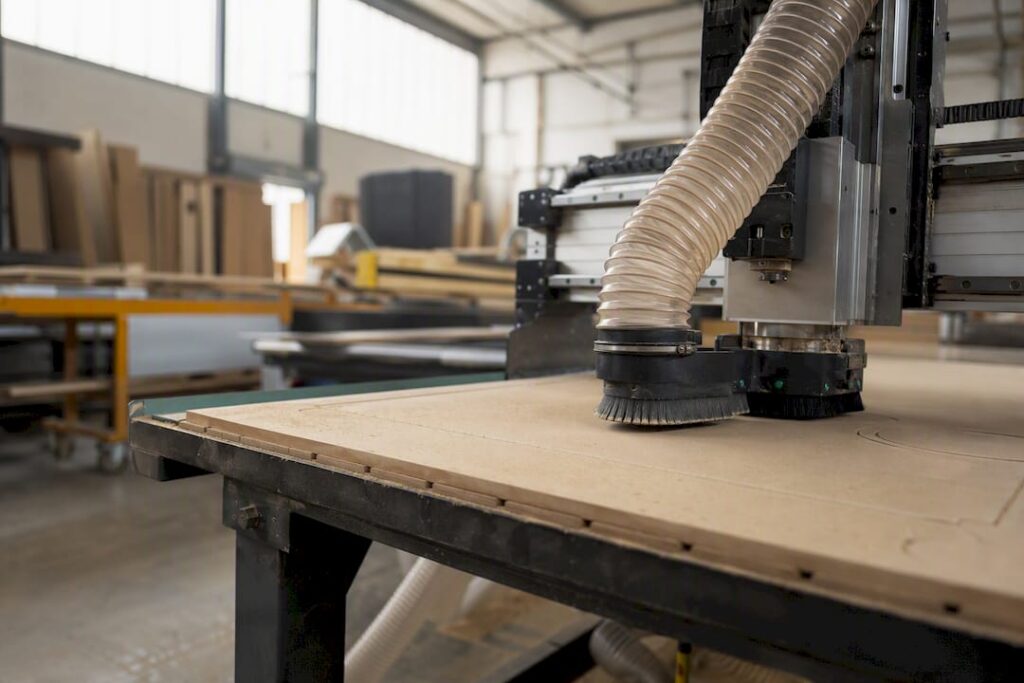
For most individual CNC users, the best setup is a machine-mounted dust shoe feeding a 2.5" grounded hose into a cyclone separator, which then feeds a 5–6 gallon shop vac or a dedicated collector on larger machines. This combination captures dust at the bit before it spreads, keeps your filters clean for longer, and balances suction against airflow instead of chasing raw horsepower.
The logic is simple: source capture beats room cleanup every time, a cyclone stops chips from choking your filter, and a grounded hose stops static from scrambling your controller. Get this right and you cut respirable dust exposure, protect your spindle bearings and linear rails, and stop MDF fines from settling into every seam of the shop.
- Ground every hose from boot to machine chassis, no exceptions
- Keep the shoe’s brush skirt close to the material, not floating above it
- Wear a properly rated respirator during MDF cuts, even with good extraction running
Key Takeaways
Effective CNC dust collection depends on capturing dust at the shoe, pre-separating chips with a cyclone, and grounding every hose to protect both your lungs and your controller.
| Point | Details |
|---|---|
| Cyclone-first design | A separator removes roughly 90 to 95% of chips by weight, extending filter life and keeping suction steady. |
| Match suction to the shoe | Shop vacs suit restrictive dust shoes; dedicated collectors suit trunked, multi-tool shops. |
| Ground every hose | A continuous electrical path from boot to machine ground prevents static-related controller faults. |
| Target real airflow | Aim for roughly 100 to 130 cfm measured at the shoe, not the vacuum’s box rating. |
| Consider integrated extraction | Anderson’s CNC platforms offer built-in extraction options for shops scaling beyond hobby setups. |
Table of Contents
- What is CNC dust collection and why does it matter?
- How do you choose the right dust shoe for your CNC?
- Shop vac, dust collector, or cyclone: which suction source fits your shop?
- How do you size hose and ducting for a CNC router?
- What filters and PPE do you actually need?
- How do you set up and tune a CNC dust collection system?
- What operational habits actually reduce CNC dust?
- How do you maintain a dust collection system and fix common problems?
- What does a CNC dust collection setup cost and how long does it take?
- Where to go for deeper technical detail
- Cnc dust collection for workshop operators: what matters most
- Get the right extraction built into your next machine
- Frequently asked questions about CNC dust collection
- Sources
What is CNC dust collection and why does it matter?
A CNC dust collection system is built from five parts working together: the dust shoe or boot at the cutter, the hose carrying debris away, a cyclone or separator, the suction source (shop vac or dust collector), and the filters that catch what’s left. Miss one link and the whole chain underperforms, according to Carbide 3D’s setup guide.
The stakes are higher than most new CNC owners expect. Fine MDF dust carries formaldehyde residue and respirable particles small enough to lodge deep in your lungs. Left uncollected, that same dust settles into linear guides and ball screws, accelerating wear on components that aren’t cheap to replace. Fine wood dust is also combustible in enough concentration, which is why grounding and sensible bucket choices matter more than they seem to at first glance.
Manufacturer guidance for industrial CNC routers calls for high airflow and large duct sizes, a scale most hobby shops will never need but one that shows how differently CNCs behave compared to a table saw or a static sander, according to Woodshop News. Raw CFM numbers on a vacuum’s box mean little on their own. What matters is airflow measured at the shoe, after hose losses, fittings, and bends have taken their toll.
- Dust shoe or boot: captures at the source
- Hose: moves debris to the separator
- Cyclone/separator: strips out the bulk of the chips
- Suction source: shop vac or dedicated collector
- Filters: catch what the cyclone misses
How do you choose the right dust shoe for your CNC?
The shoe is where dust collection either works or fails. A shoe that floats too high above the material lets dust escape before it ever reaches the hose, while one that’s too tight drags on the surface and fights your Z-axis. The features that separate a good shoe from a bad one aren’t complicated, but they’re easy to overlook when you’re focused on the machine itself.
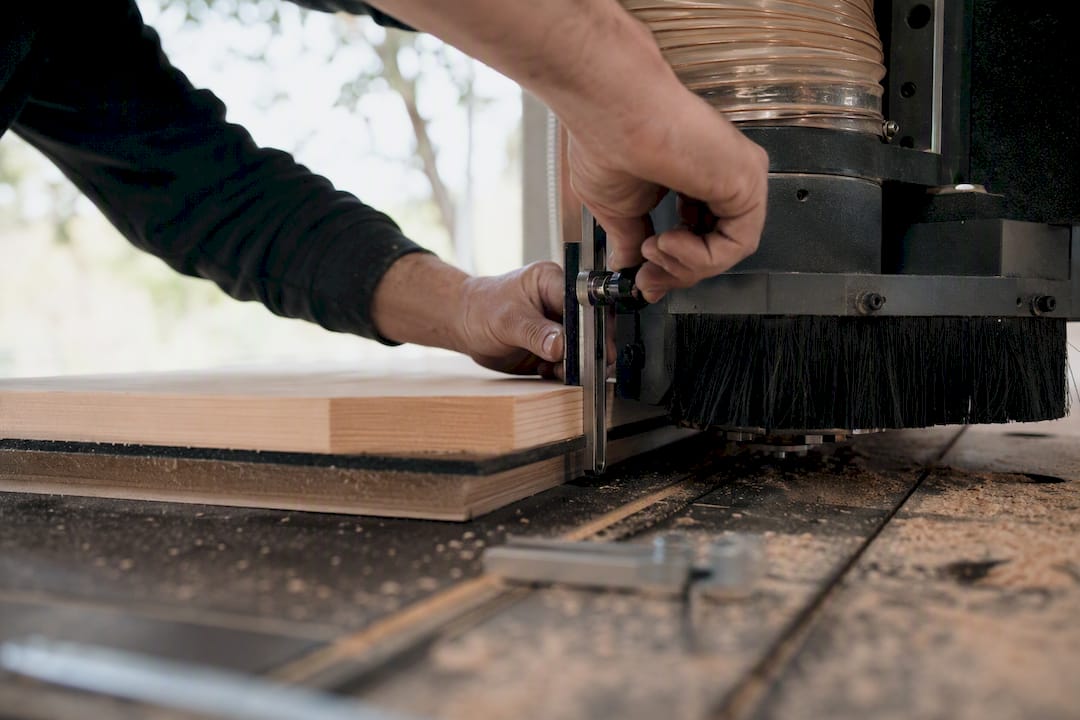
Look for a low-restriction body that doesn’t choke airflow with sharp internal turns, a clear or semi-clear skirt so you can actually watch the bit while cutting, and a removable or hinged base that lets the shoe swing clear for tool changes without unbolting anything. Bristle brushes around the base seal the gap between shoe and material without adding drag.
Buying a shoe usually beats building one for most users, since injection-moulded or CNC-cut polycarbonate and HDPE shoes handle years of contact wear better than a shop-made version. That said, 3D-printed shoes in PETG or ABS are a reasonable stopgap if you’re prototyping a mount for an unusual spindle or router.
- Skirt material: clear polycarbonate for visibility, HDPE for abrasion resistance
- Mounting: check spindle collar diameter before ordering
- Base gap: aim for the brush skirt sitting just above the material, not dragging on it
- Tool-change mechanism: spring-loaded or hinged designs save time over full removal
Pro Tip: Set your brush gap so the skirt just brushes the surface at your lowest planned cutting depth. Too tight and you’ll wear the bristles down in weeks; too loose and you’ll watch dust escape around the base on every pass.
Shop vac, dust collector, or cyclone: which suction source fits your shop?
Match the suction source to the shoe opening, not to the biggest motor on the shelf. A dust shoe port on a desktop or benchtop router is small and restrictive, and that favours a shop vac’s high static pressure over a dust collector’s high-volume, low-pressure airflow, a mismatch Carbide 3D points out often trips up first-time buyers.
A dedicated dust collector earns its place once you’re running larger ductwork, feeding multiple tools from one trunk line, or want to house the motor in another room to cut noise. For a single desktop CNC, though, a shop vac paired with a cyclone typically outperforms a cheap standalone collector, since it keeps filters cleaner and holds suction steady through a whole job, according to CNC Dad’s hobbyist guide.
The cyclone isn’t optional if you want the system to last. Separators pull out a large majority of chips by weight before they ever reach the filter, which means far fewer filter changes and steadier airflow across a long nesting run, per CNC Dad’s measurements. For aluminium or other metal work, a cyclone with a metal collection bucket is strongly recommended. Metal chips are conductive and abrasive, and letting them into a motor or paper filter is asking for trouble.
- Shop vac + cyclone: best for single desktop or benchtop CNCs
- Dedicated dust collector: best for trunked, multi-tool shops
- Cyclone separator: extends filter life and protects against metal chip hazards regardless of suction source
How do you size hose and ducting for a CNC router?
Hose diameter, length, and material all eat into your available suction before air ever reaches the shoe. Flex hose is significantly more restrictive than rigid metal ducting of the same diameter, so every extra metre of coiled flex hose costs you real airflow, a point Oneida Air Systems makes clear in its CNC sizing guidance.
For hobby and desktop CNCs, 2.5 inch hose has become the informal standard because it matches most dust shoe ports and shop vac fittings without needing a reducer at every joint. Larger machines with bigger shoes or trunked, multi-tool setups need 4 inch or larger ducting to keep velocity high enough to carry chips instead of letting them settle in the line.
A practical target for small-bit routing is around 100 to 130 cfm of actual airflow measured at the shoe, not the number printed on your vacuum’s box, according to measurements from Desktop CNC Forge. Box ratings are almost always taken with no hose attached at all, so they overstate what you’ll actually get once resistance from fittings, bends, and hose length is factored in.
To check your own setup, hold an anemometer or even a simple tissue test at the shoe opening while the vac runs on its own hose length. If airflow feels weak, shorten the hose run, remove unnecessary elbows, or step up to a shorter length of rigid ducting for the section nearest the machine. Every 90 degree bend in flex hose costs roughly the same static pressure as several feet of straight run, so fewer, gentler bends beat a tidy-looking loop.
- Standard hobby CNC hose diameter: 2.5 inches
- Industrial or trunked setups: 4 inches or larger
- Target airflow at the shoe: roughly 100 to 130 cfm for small-bit work
- Minimise bends: each 90 degree elbow behaves like several extra feet of straight hose
Grounding deserves its own mention here because it’s separate from airflow but just as important. A continuous electrical path from the dust boot through the hose to machine ground stops static charge building up in non-conductive hose material, according to RealtimeCNC’s grounding documentation. Skip it and you risk controller freezes or false limit triggers that have nothing to do with your G-code and everything to do with static discharge.
What filters and PPE do you actually need?
Stock cartridge or paper filters on most shop vacs weren’t designed for the fine fraction MDF produces, and they’ll clog or pass fine dust straight through long before a dedicated filter would. Upgrading to a 1-micron or HEPA-rated filter matters most during MDF-heavy sessions, where formaldehyde-laden fines are genuinely hazardous to breathe, according to guidance from Woodweb’s knowledge base.
A HEPA filter rated to 0.3 micron catches close to everything a cyclone-fed shop vac will ever see, but it also loads up faster if you skip the cyclone step. That’s the real argument for cyclone-first design: it isn’t just about suction, it’s about making your expensive filter last.
PPE isn’t a fallback for a weak system, it’s a standing requirement whenever you’re cutting MDF or similarly fine-dust materials. A properly fitted P2 or N95 respirator, decent room ventilation, and an ambient air cleaner running during and after long cuts all reduce your exposure meaningfully. For aluminium and other metals, keep the cyclone bucket metal rather than plastic, and treat spark and ignition risk from fine metal dust with the same seriousness Southern Sandblasting and Painting’s safety guidance applies to combustible dust in industrial settings generally.
- Stock paper filters: adequate for hardwood chips, inadequate for MDF fines
- 1-micron or HEPA filters: required for regular MDF work
- Respirator: P2/N95 minimum during MDF sessions
- Metal work: metal cyclone bucket only, never plastic
How do you set up and tune a CNC dust collection system?
Getting a new system running properly takes more than bolting parts together. Work through it in order and you’ll catch problems before they become expensive habits.
- Confirm your dust shoe matches your spindle collar and router diameter before ordering anything else.
- Plan hose routing for the shortest practical run with the fewest bends, and buy hose long enough to be grounded end to end.
- Mount the shoe and check that the brush skirt sits just above the material at your typical cutting depth.
- Run a short length of hose from the shoe to the cyclone inlet, keeping this leg as direct as possible.
- Connect the cyclone outlet to your shop vac or dust collector, and fit a 1-micron or HEPA filter if you’ll be cutting MDF regularly.
- Ground the hose from boot to machine chassis using continuous conductive material or grounding wire.
- Power on and measure airflow at the shoe using an anemometer or a simple draw test before cutting anything.
- Run a test cut on scrap, watching for blow-by around the shoe skirt.
- Adjust brush gap and hose routing based on what you observe, then repeat the test cut.
- Confirm shoe fit and grounding continuity before the first cut, not after
- Watch for visible dust escaping the shoe skirt during the test pass
- Recheck airflow readings monthly, since fittings loosen and hose kinks develop over time
What operational habits actually reduce CNC dust?
Bit choice changes how much dust you generate before extraction even comes into play. Smaller-diameter bits and single-flute geometries tend to throw less material per pass than large multi-flute cutters, though they also cut slower, so there’s a genuine trade-off between dust volume and job time.
Feed rate matters just as much as bit selection. Pushing feed too hard increases chip velocity at the cutter, which is what causes the classic “rooster tail” of dust escaping past the shoe skirt regardless of how good your extraction is, a pattern Woodshop News has documented in classroom settings. Dialling feed back slightly, especially on finishing passes, cuts blow-by noticeably.
Programming a dedicated clean-up pass, running the empty shoe over the cut area at the end of a job, sweeps residual dust into the vacuum instead of leaving it for a shop broom. It’s a small addition to your G-code that pays for itself on every single job.
- Smaller bits and lower feed rates reduce dust volume and escape velocity
- Programme a clean-up pass at the end of nesting jobs
- Empty cyclone buckets before they’re full, not after suction starts dropping
Pro Tip: Add your clean-up pass as a saved subroutine you can call at the end of any job file. It takes thirty seconds to run and saves ten minutes of hand-vacuuming.
How do you maintain a dust collection system and fix common problems?
Most dust collection failures trace back to one of four causes: a clogged or kinked hose, a collapsed section of flex hose, a saturated filter, or a motor straining against restricted airflow. Each shows up as reduced suction at the shoe, so that’s your first diagnostic checkpoint whenever something feels off.
Check hose continuity and grounding connections monthly, since vibration loosens clamps over time. Inspect filters for a fine dust coating that won’t shake loose, a sign it needs replacing rather than cleaning. Confirm the cyclone lid seal is tight, since even a small air leak there tanks suction at the shoe. Listen for motor strain, a higher-pitched or labouring sound usually means restricted airflow somewhere in the line.
- Daily: empty the cyclone bucket if it’s more than half full
- Weekly: check hose for kinks and inspect the shoe skirt for wear
- Monthly: test grounding continuity and inspect filter condition
- As needed: replace filters when suction drops noticeably or dust coating won’t clear
What does a CNC dust collection setup cost and how long does it take?
A budget setup, a mid-range shop vac paired with a cyclone separator, typically runs cheapest and suits most single-machine hobby shops. Stepping up to a mid-range shop vac with HEPA filtration adds cost but pays off quickly if you’re cutting MDF regularly. A dedicated dust collector with upgraded filtration and trunked ducting sits at the top of the range and makes sense once you’re running multiple tools or a larger CNC.
The biggest cost drivers are hose length and diameter, whether you need pre-grounded hose or plan to ground it yourself, any enclosure or soundproofing you add around the motor, and how much trunking a multi-tool shop requires.
From ordering parts to a fully tuned system, most single-machine setups take between one and seven days, largely dictated by shipping time for the shoe and cyclone rather than the install itself. Fitting and grounding the hose, mounting the cyclone, and running test cuts typically takes an afternoon once parts are in hand.
- Budget tier: shop vac + cyclone, suits single desktop CNCs
- Mid tier: shop vac + cyclone + HEPA filtration, suits regular MDF work
- Upper tier: dedicated dust collector + trunking, suits multi-tool or larger shops
- Timeline: roughly one to seven days from order to tuned system, shipping dependent
Where to go for deeper technical detail
For hose sizing, grounding procedures, and filtration upgrades beyond what fits here, these sources go further into the mechanics: Carbide 3D’s setup guide for component selection, RealtimeCNC’s grounding documentation for static troubleshooting, and Oneida Air Systems for airflow and static pressure calculations on larger installs.
Cnc dust collection for workshop operators: what matters most
The conventional advice on this topic obsesses over motor horsepower and CFM ratings printed on a box, and that’s backwards. The number that actually determines whether your shop stays clean is airflow measured at the shoe, after hose losses, after fittings, after every bend you’ve added to make the route look tidy. Chase that number instead of the spec sheet.
Grounding gets treated as an afterthought in most beginner guides, usually a single line buried near the bottom. It shouldn’t be. A static-induced controller freeze mid-job doesn’t just waste material, it teaches you to distrust a machine that was actually working fine. Ground the hose properly from day one and you remove an entire category of mystery faults from your troubleshooting list.
If there’s one habit worth adopting before any hardware purchase, it’s this: build the cyclone into the system from the start rather than treating it as a later upgrade. Everything downstream, filter life, suction consistency, how often you’re stopping to clean, gets easier once chips never reach the filter in the first place.
Get the right extraction built into your next machine
Retrofitting dust collection onto an existing router only gets you so far. If you’re scaling past a single desktop CNC into panel processing, nesting, or multi-tool production work, the extraction needs to be designed into the machine rather than bolted on afterwards. Anderson builds CNC platforms with dust extraction and airflow management considered from the ground up, not added as an accessory once the spindle’s already spinning.
The Genesis PLUS nesting CNC machine is built for exactly this kind of panel processing workload, with the extraction system and its capacity to be specified for the machine, material and production process. If your work runs heavily into MDF or panel materials, Anderson’s woodwork CNC machinery range covers extraction requirements specific to those materials rather than treating every job the same way. Get in touch through Anderson Group Australia to talk through what integrated extraction looks like for your shop’s actual production volume, not just a hobby bench.
Frequently asked questions about CNC dust collection
What CFM do I need for CNC dust collection?
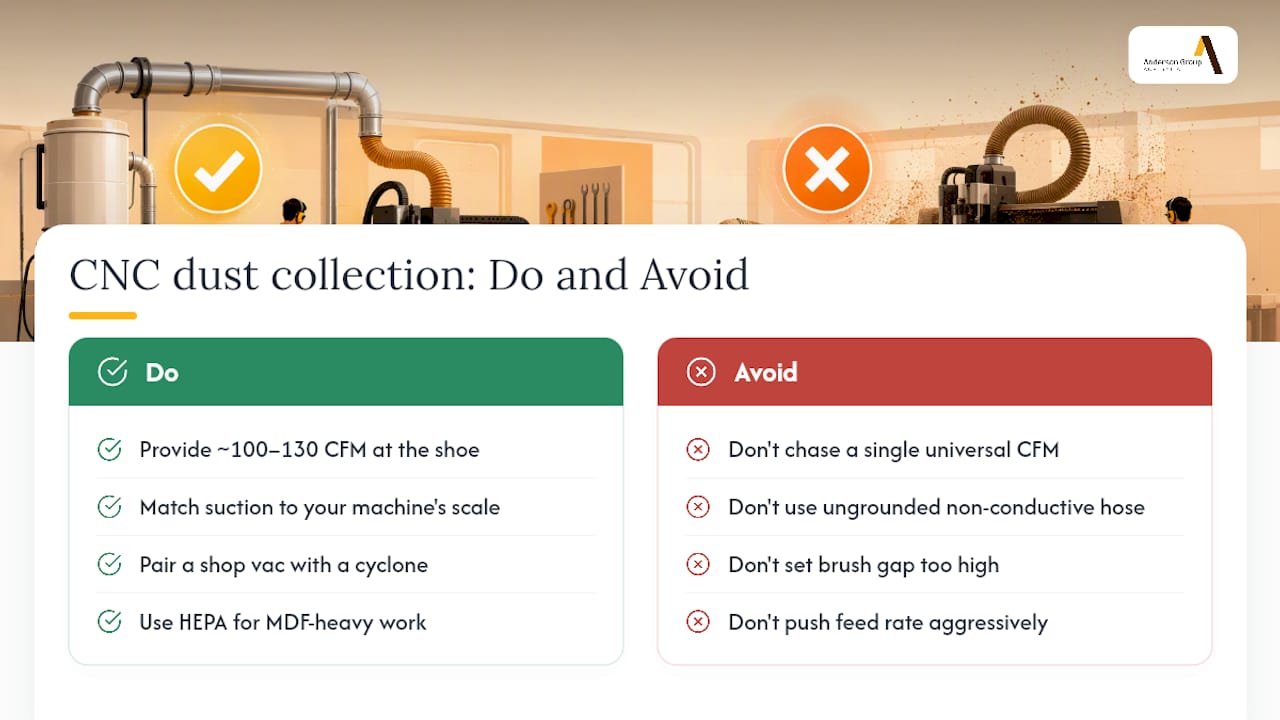
Most desktop and hobby CNCs perform well with roughly 100 to 130 cfm of actual airflow measured at the shoe, according to Desktop CNC Forge’s measurements. Industrial routers need far more, sometimes into the thousands of cfm, which is why matching your suction source to your machine’s scale matters more than chasing a single universal number.
Can I use a regular shop vac for CNC dust collection?
Yes, and for most single desktop CNCs a shop vac paired with a cyclone separator is the recommended setup, since shop vacs deliver the high static pressure a restrictive dust shoe port needs. A dedicated dust collector becomes more useful once you’re trunking multiple tools together.
Do I really need to ground my dust collection hose?
Yes. Ungrounded, non-conductive hose can build static charge that interferes with your controller, sometimes causing freezes or false limit triggers with no obvious mechanical cause, according to RealtimeCNC’s grounding guidance. It’s a small, cheap step to add during install and it removes a whole category of unpredictable faults.
Why does my CNC still throw dust even with the vacuum running?
Usually it’s a brush gap set too high above the material, feed rate pushed too aggressively, or hose resistance robbing you of usable suction at the shoe. Check the shoe skirt height and airflow at the shoe itself before assuming the vacuum is underpowered.
Is HEPA filtration necessary for CNC dust collection?
It’s strongly recommended for MDF-heavy work, since stock paper filters weren’t designed to catch the fine, formaldehyde-laden dust MDF produces, according to Woodweb’s guidance. For hardwood-only shops, a good cyclone with a standard filter may be sufficient, but pairing HEPA with a cyclone gives the longest filter life either way.
Sources
- CNC Dust Collection Guide: Setup & Tips (Carbide 3D)
- Dust Collection for CNC Applications (Oneida Air Systems)
- CNC Dust Collection: The Setup That Actually Works for Hobbyists | CNC Dad
- CNC Dust Collection Guide for Desktop Routers (Desktop CNC Forge)
- Grounding (RealtimeCNC docs)
- CNC dust collection has many challenges | Woodshop News Magazine