
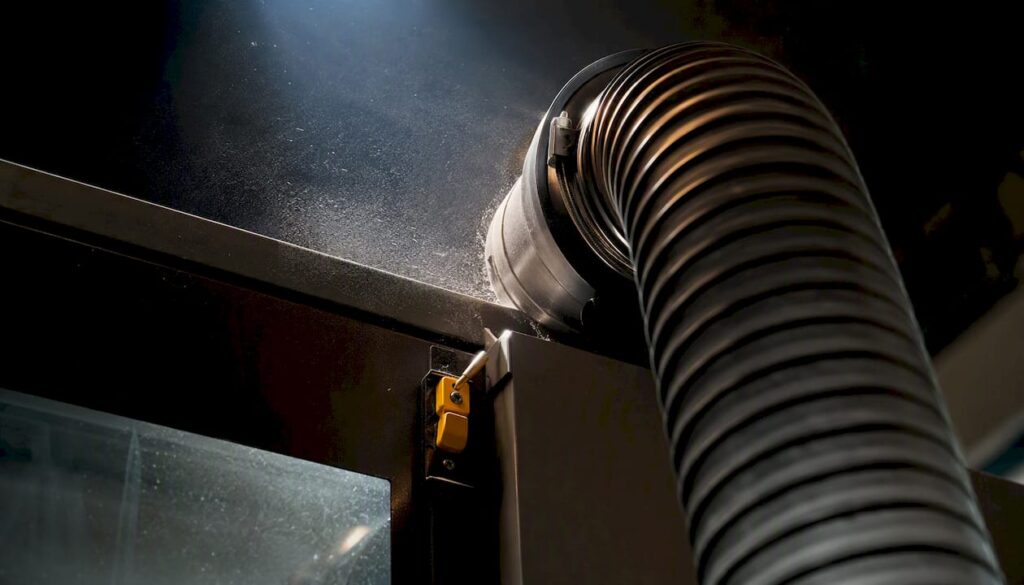
Yes, fine dust from CNC work can be combustible, and the risk is higher than most workshop managers assume. Aluminium, magnesium, MDF, and carbon fibre dust all pose genuine deflagration hazards once airborne in the right concentration. The immediate priority isn’t a new suppression system, it’s stopping dust dispersal at the source: check your extraction is actually capturing fine particulate, and never use compressed air to blow down machines or floors.
TL;DR:
- Dust from materials like aluminum, magnesium, MDF, and carbon fiber can ignite easily once airborne, especially during dry routing, grinding, or vacuuming processes.
- Combustible dust explosions require five conditions to occur simultaneously: sufficient fuel, oxygen, an ignition source, airborne dispersion, and confinement, making control complex.
- Proper engineering controls, such as close-to-tool local exhaust ventilation and matching filter media to dust types, are most effective in reducing fire risk.
- Housekeeping practices, including daily wet wiping and regular duct maintenance, are crucial for preventing secondary dust explosions more than expensive filtration alone.
- Conducting a Dust Hazard Analysis and managing visible dust build-up helps identify risk points and establishes safe collection and suppression strategies.
Table of Contents
- Understanding combustible dust risks in CNC operations
- Which CNC shop materials pose the highest combustible dust risk?
- How do combustible dust explosions actually happen in a CNC shop?
- Engineering controls that actually reduce combustible dust risks in CNC shops
- Housekeeping practices that prevent secondary dust explosions
- When to commission a Dust Hazard Analysis or send samples for lab testing
- Fire detection, suppression and emergency response for CNC dust incidents
- Anderson Group Australia’s shop-floor notes on dust control
- Why most combustible dust advice misses what actually matters
- Anderson Group Australia: machinery built with extraction in mind
- Sources
- FAQ
Understanding combustible dust risks in CNC operations
Combustible dust hazards come down to particle size, not just material type. Once a solid gets ground fine enough, its surface-area-to-volume ratio spikes, and that surface area is what burns. A block of aluminium won’t ignite from a spark. A cloud of aluminium fines suspended in air can propagate flame in milliseconds.
This is different from oil mist, which carries its own fire risk but behaves and disperses differently to dry dust, and needs a separate filtration strategy entirely. Running one collector for both is a common mistake that ends up blinding filters or failing outright.
Several everyday CNC processes generate the fine particulate that matters most:
- Dry routing and milling of MDF, particleboard, and composite panels
- Grinding and finishing passes on metal parts
- Hand sanding and detail work after machining
- Chip and swarf handling where fines settle out of the coarse material
- Vacuuming or blow-down of machine beds and enclosures
That last point deserves a flag on its own. Compressed-air cleaning and dry sweeping are two of the fastest ways to turn a settled dust layer into an airborne fuel cloud, right at the moment someone’s standing next to it.
Which CNC shop materials pose the highest combustible dust risk?
Not every material in your shop carries the same risk profile, and treating them identically is how mixed-metal shops get into trouble.
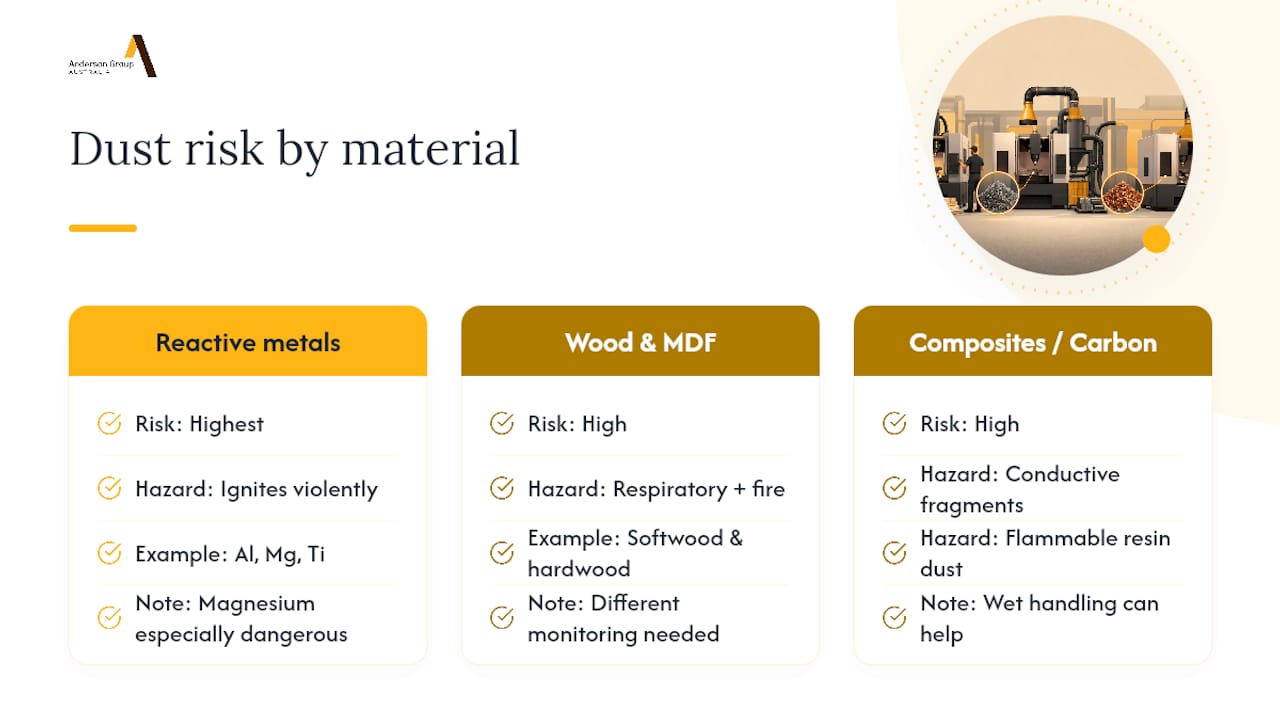
Reactive metals are the sharpest end of this. Aluminium, magnesium, and titanium dust are all combustible, and NFPA 660 and related metal-dust provisions exist specifically because these fines ignite easily and burn violently once dispersed. Magnesium is particularly unforgiving. Fine magnesium dust can ignite from surprisingly low-energy sources.
Wood and MDF dust sits close behind. It’s not just a fire risk. Fine wood dust is a recognised respiratory hazard, which is why Australian exposure standards distinguish between different wood dust categories at all.
Pro Tip: If your shop cuts both softwood and hardwood, don’t assume one filter setting covers both. Hardwood dust carries additional health classifications that change your monitoring obligations.
Composites and carbon fibre bring a double problem: conductive fibre fragments that can short electrical equipment, plus a flammable dust fraction from resin binders. Wet handling changes the equation for all three categories, because water suppresses the dispersal that makes dust dangerous in the first place. However, wet collection isn’t viable everywhere, particularly with electronics nearby.
How do combustible dust explosions actually happen in a CNC shop?
Five conditions have to line up before a dust event happens. Take away any one of them and you don’t get an explosion, which is exactly why the control strategies later in this article target multiple points at once.
- Fuel — combustible dust in sufficient concentration
- Oxygen — normal shop air already supplies this
- Ignition source — a spark, hot surface, or static discharge
- Dispersion — the dust has to be airborne as a cloud, not just sitting on a ledge
- Confinement — an enclosure, duct, or collector that lets pressure build
This five-part model is commonly framed as the combustible dust pentagon, and it explains why the second explosion in an incident is often worse than the first. A small primary event shakes loose every dust layer sitting on beams, ductwork, and machine tops nearby, dispersing it into a much larger cloud that a secondary flame front then ignites.
In CNC environments specifically, the usual ignition culprits are mundane: hot chips flung from a cutting tool, a worn electrical connection arcing inside a dusty enclosure, static discharge building up in plastic ducting, and friction from a jammed bearing or blocked auger running hot enough to ignite settled fines.
Engineering controls that actually reduce combustible dust risks in CNC shops
Regulators consistently rank controls the same way: eliminate or substitute the hazard first, then engineer it out, then rely on administrative procedures, and only then fall back on PPE. WorkSafeBC’s guidance puts engineering controls squarely above training and paperwork, and for CNC shops, that means local exhaust ventilation (LEV) is doing most of the real work.
Good LEV capture happens close to the tool, not somewhere downstream. A hood or shroud right at the cutting point captures fines before they disperse across the enclosure. Duct velocity matters too. Runs that are too slow let heavier metal fines drop out and accumulate inside the ductwork itself, which is its own confinement hazard.
- Size ducting for the material, not just the airflow, since metal fines settle at different velocities to wood dust
- Match filter media to the dust type, because a filter rated for wood fines can blind quickly on oily metal swarf
- Route ducting to minimise long horizontal runs where dust can settle undisturbed
For reactive metals, wet collection is often the preferred approach, because a wet system prevents the fuel-air mixture from ever forming in the first place. Where a dry system is unavoidable, it needs to be explosion-protected, and that design decision should follow a documented Dust Hazard Analysis rather than a guess.
Pro Tip: If your shop mixes aluminium and steel work, don’t assume a single dry collector handles both safely. Cross-contamination between reactive and inert metal fines has caused ignition events that neither metal alone would trigger.
When a dry system is the right call, explosion protection typically comes down to four options: venting to release pressure safely outdoors, chemical or mechanical suppression to extinguish a deflagration before it spreads, isolation devices to stop flame travelling between ducts and rooms, and flame arrestors on smaller lines. NFPA 68 and 69 provide the design basis most engineers work from when specifying which combination a given system needs, and filtration design choices increasingly reference ATEX and UNI EN 1127-1 frameworks for machine-room systems handling reactive dust.
Housekeeping practices that prevent secondary dust explosions
Engineering controls fail quietly if nobody’s maintaining them, and housekeeping is where most shops lose the plot between inspections.
- Clean daily with the right method. Use an explosion-rated vacuum or wet wiping on horizontal surfaces, ledges, and machine tops. Never reach for a compressed-air hose or a dry broom on accumulated dust, both simply re-suspend it.
- Set a filter and duct maintenance schedule. LEV systems lose capture efficiency as filters load up, and a system that “still seems to be working” can be well below the airflow it needs. Test face velocity periodically and log the results.
- Handle collected dust and sludge as hazardous waste, not rubbish. Label containers, keep them sealed, and manage wet sludge from wet collectors separately from dry bin waste. A structured approach to shop-floor waste handling also cuts down on how much fine material accumulates in the first place.
When to commission a Dust Hazard Analysis or send samples for lab testing
A Dust Hazard Analysis isn’t paperwork for its own sake. It’s the document that tells you whether your dry collector needs explosion protection or whether wet collection is the safer call for a given process.
A proper DHA maps every process generating dust, flags points of confinement (ducts, collector housings, enclosed cabinets), and estimates how much dust is generated and how readily it disperses. Regulatory guidance increasingly expects shops to run this proactively rather than after an incident.
- Send dust samples to a lab when you’re unsure whether a new material or blend is combustible, or to confirm particle-size distribution
- Treat visible accumulation on beams, ledges, or duct exteriors as a trigger for action, not just a cleaning reminder
- Use Australian exposure monitoring thresholds as an early warning system. Anderson Group Australia’s breakdown of the 1 mg/m³ versus 5 mg/m³ wood dust standards explains what each threshold means for your monitoring obligations
Fire detection, suppression and emergency response for CNC dust incidents
Detector choice depends on what you’re protecting. Smoke detectors suit general shop areas, flame detectors suit open cutting zones with a fast-developing fire risk, and pressure detectors belong inside collector housings and ducting where a deflagration would build undetected otherwise.
Suppression or venting decisions need to be coordinated with your collection system design, not bolted on afterwards. Retrofitting suppression onto a duct run that was never sized for it rarely works well.
- Shut down spindles and isolate power immediately if you suspect a dust fire or hear a deflagration
- Evacuate the area and call emergency services before attempting to fight anything beyond a small, contained fire
- Preserve the scene afterwards. Photos and undisturbed evidence are what a DHA review needs to work out what actually failed
Pro Tip: Run an evacuation drill that specifically covers a dust-collector incident, not just a general fire drill. Staff need to know the collector room is off limits until it’s confirmed safe, since reopening it too soon risks a secondary event.
Anderson Group Australia’s shop-floor notes on dust control
Extraction only works if it’s designed around the actual dust your machines produce, not a generic spec sheet number. Anderson Group Australia’s guide to effective CNC dust collection walks through capture-point placement and duct sizing decisions that matter more in practice than most manufacturers’ brochures suggest.
A few points worth restating from that guidance and related internal work:
- Match collector type to material category first, then worry about capacity
- Mixed-metal shops need contamination control between reactive and inert metals, which ties directly into coolant selection as well as dust handling
- Reactive-metal work, including titanium machining, carries specific extraction and ignition considerations distinct from standard steel or aluminium jobs
- Monitoring thresholds aren’t just compliance boxes. They’re an early-warning system for control failures before an incident happens
Why most combustible dust advice misses what actually matters
Most combustible dust content aimed at workshops leans heavily on the regulatory framework: the pentagon, the standards, the acronyms. That’s necessary background, but it’s not where shops actually get into trouble.
The real gap sits between knowing the theory and running a Tuesday shift. A shop can have a beautifully documented DHA and still lose the plot because someone grabbed the air hose to clear swarf off a machine bed before a client walkthrough. Compliance paperwork doesn’t stop dust dispersal. Behaviour does.
If there’s one thing the conventional advice underrates, it’s housekeeping discipline over equipment spend. A shop with modest extraction and rigorous daily cleaning is often safer than one with an expensive collector and lax habits. Filters that never get checked and ducts that never get inspected quietly erode every engineering control you paid for.
Start with what generates the most dust and disperses it most easily. For most CNC shops, that’s dry routing of MDF and grinding of reactive metals, not the process everyone assumes is riskiest. Fix capture at the source before spending on downstream protection.
— Anderson
Anderson Group Australia: machinery built with extraction in mind
Choosing the right CNC platform is half the combustible dust equation, because a machine designed with proper enclosure and extraction integration in mind makes every control downstream easier to implement. Anderson Group Australia supplies CNC machinery across wood machining, metal machining, and advanced materials including composites and carbon fibre.

Some CNC machinery manufacturers design their equipment so extraction and dust management are integrated, not added on after installation. If your shop is planning a new installation or reviewing an existing one against combustible dust risk, browse the full range of machining centres and get in touch to discuss how a specific machine configuration fits your extraction setup and material mix.
Sources
- OSHA Technical Manual – Section IV, Chapter 6, Combustible Dusts
- Machining, Tooling & CNC — Oil Mist Collection & Dust Extraction | ICAP
- Combustible dusts | WorkSafeBC
FAQ
What are the potential dangers of combustible dust?
Combustible dust can ignite and deflagrate when suspended in air at sufficient concentration, causing primary explosions that often trigger larger, more damaging secondary explosions from disturbed settled dust.
What are the dangers associated with CNC machines?
Beyond combustible dust, CNC machines carry risks from hot chips, electrical faults near dust accumulations, static discharge in plastic ducting, and friction from blocked or jammed components running hot enough to ignite fines.
What are the five elements of a combustible dust explosion?
The combustible dust pentagon requires fuel, oxygen, an ignition source, dispersion of dust into a cloud, and confinement, all present at once.
What are the OSHA-style requirements for combustible dust?
Guidance from bodies including OSHA and WorkSafeBC emphasises a control hierarchy: eliminate or substitute the hazard first, apply engineering controls like LEV and explosion protection, then administrative controls and PPE, backed by a documented Dust Hazard Analysis.
How do I know if my CNC shop needs a Dust Hazard Analysis?
If you machine reactive metals, produce fine MDF or composite dust, or have visible dust accumulation on ledges and ductwork, a DHA should map your processes and confinement points before an incident forces the question.