
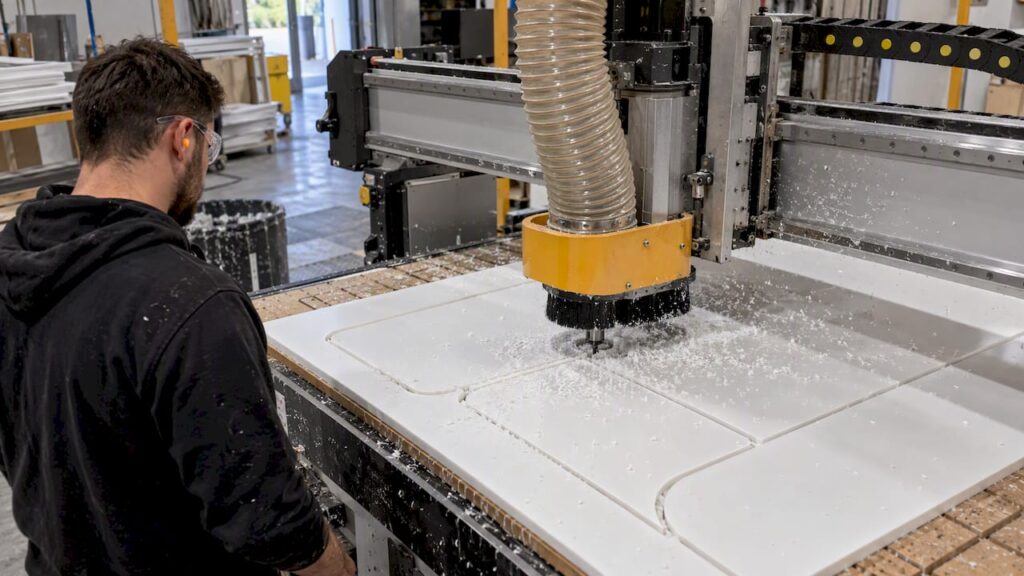
Yes, rigid and foamed PVC can be machined on an industrial CNC router, provided you manage heat, chip evacuation and hold-down from the first cut. Start with a single-flute or O-flute carbide cutter, a feed per tooth of about 0.05–0.2 mm, stable vacuum workholding and extraction at the tool. Melting and airborne contaminants are the main hazards, and Safe Work Australia sets out the duties for PCBUs.
TL;DR:
- Use spindle routing for rigid PVC and structural foam, but hot wire for EPS or XPS; waterjet suits thick cores when heat matters.
- Use a sharp cutter dedicated to plastics and begin at 0.05–0.2 mm feed per tooth, adjusting spindle speed and feed if PVC softens.
- One service provider reports tolerances as tight as ±0.05 mm, but actual results depend on the machine, material, and job.
- Workplaces should use local exhaust ventilation and extraction at the tool, recheck controls periodically, and add respiratory protection when engineering measures are insufficient.
- Test a piece at least 100 × 200 mm, change one setting at a time, and record clean cut settings by sheet brand and thickness.
Table of Contents
- 1. Which CNC methods suit rigid PVC, foam and EPS?
- 2. Which cutters work best on PVC?
- 3. How do you set feeds and speeds for PVC?
- 4. How should you hold PVC and protect its edges?
- 5. What dust and fume controls does PVC machining need?
- 6. What tolerances and applications can you expect?
- 7. How do you fix melting, chipping and rapid tool wear?
- 8. How can we help you machine PVC?
- FAQ
- Sources
1. Which CNC methods suit rigid PVC, foam and EPS?
Match the process to the material family before you touch the programming. Rigid PVC sheet and structural foams such as Komatex or Foamex cut well with a spinning cutter, while expanded foams behave very differently.
- Spindle routing: the default for rigid PVC and structural foam sheet, using variable spindle speeds and vacuum workholding.
- Hot-wire cutting: suits EPS and XPS blocks, where a cutter would tear the cell structure.
- Waterjet: worth considering for thick structural cores where heat is a concern.
- Knife cutting: suits thin, flexible sheet and simple profiles.
Industrial routers process sheets up to 50 mm thick in rigid and foamed PVC. For production runs of flat parts, a nesting or panel router is the natural fit. For complex 3D contours or undercuts in PVC foam, a 5-axis machine finishes the part in a single setup, and our guide to foam machining covers the geometry questions in more depth.
2. Which cutters work best on PVC?
Chip evacuation decides most outcomes. PVC softens when it gets hot, and chips that stay in the cut get dragged around, melt and weld back onto the edge. Choose a cutter suited to the sheet and machine, and check chip evacuation during a test cut.
- Flute count: match the cutter to the material and machine, then check chip evacuation and finish on a test cut.
- Diameter: choose a cutter that suits the part detail and the machine setup.
- Material: use a suitable, sharp cutter and check for rubbing or heat during a test cut.
- Contamination: never run cutters that have previously cut wood without cleaning them first, because resin build-up causes burning.
Pro Tip: Keep a dedicated set of plastics cutters, labelled and stored separately from your timber tooling.
3. How do you set feeds and speeds for PVC?
Surface speed drives heat. If spindle RPM is too high, the excess heat softens the plastic and causes melting or re-welding, so the feed has to keep pace with the spindle. The starting calculations are straightforward:
- Spindle RPM = surface speed (m/min) × 318.06 ÷ tool diameter (mm).
- Feed rate = RPM × feed per tooth × number of flutes.
- Begin at a conservative feed per tooth of 0.05–0.2 mm and adjust from a test cut.
- Apply chip-thinning compensation when the stepover is small, raising the feed so the cutter still takes a real chip rather than rubbing.
- Check whether a finishing pass or adjusted feed is appropriate for the part and machine.
Both formulas come from UNSW Making’s milling guidance.
Rubbing, not cutting, is what melts PVC: a thin chip at high speed generates heat without removing it.
4. How should you hold PVC and protect its edges?
Vacuum hold-down is the preferred method for large panels because it supports the whole sheet and leaves the cutting path clear. Foamed PVC can be vulnerable to clamping pressure, so choose a hold-down method that does not damage the sheet.
- Spoilboard: consider a sacrificial layer under the sheet, and check the cut edge and underside on a test cut.
- Part retention: choose a suitable method for keeping parts secure during cutting, and check that it does not damage small offcuts.
- Toolpath entry and exit: consider how the tool enters and leaves the cut, and check the finished edge on a test piece.
- Extraction: remove chips at the tool as they form, which cuts re-welding and improves the finish.
5. What dust and fume controls does PVC machining need?
PCBUs must manage airborne contaminants, and the primary controls are engineering ones. Safe Work Australia’s fact sheet says local exhaust ventilation and on-tool extraction should be implemented and revalidated periodically.
- Capture at source: use suitable extraction and collection controls, and confirm they are effective for the process.
- Cleaning: avoid practices that can disperse airborne particles, and follow the workplace’s assessed controls.
- Respiratory protection: provide it where engineering controls alone do not keep exposure down.
- Revalidate: periodically check that extraction controls remain effective.
SafeWork NSW makes the same point for woodworking: fine particles from machining are controlled with LEV. For workshop design, read our guides to CNC dust collection and combustible dust risks.
6. What tolerances and applications can you expect?
With variable spindle speeds and stable vacuum workholding, industrial setups can reach tolerances as tight as ±0.05 mm. Treat that figure as a result reported by the linked service provider, not a promise for every machine or job.
- Signage and displays: flat cut-outs and lettering from foamed sheet.
- Housings and panels: rigid PVC enclosures and covers.
- Composite sandwich cores: structural foam cores cut to shape.
- Prototypes: quick-turn shapes before committing to tooling.
Finishing depends on the grade. Foamed PVC takes paint well but shows its edge texture, and rigid PVC can be smoothed or bonded. Design for the material’s edge character rather than fighting it. Enclosed machines help contain particulate, and 5-axis machines suit complex 3D shapes.
7. How do you fix melting, chipping and rapid tool wear?
Work through the symptoms in this order, changing one variable at a time.
- Melting or re-welding: excess heat can soften PVC. Review the feed and spindle settings, chip evacuation and cutter choice, then confirm changes with a test cut.
- Tear-out or chipping: review workholding, cutter choice and toolpath settings, then assess the result with a test cut.
- Rapid tool wear: inspect the cutter and review the material, settings and chip evacuation. Confirm any changes on a sample piece.
PVC and other plastic sheets need a test cut of at least 100 × 200 mm to dial in a clean edge.
Pro Tip: Log the settings that gave a clean test cut against the sheet brand and thickness, so the next job starts from a known baseline.
8. How can we help you machine PVC?
We supply nesting and panel-processing machinery, and advanced materials machines, for manufacturers who need to route foams and structural PVC. Start with our advanced materials machinery range, and see our wood machinery page if your production is mostly panel work. The full machines catalogue shows each family.

Tell us about your part geometry and production volume, and we will help you choose a suitable machine family and configuration, with each specification checked against the exact model. We sell machinery, service and parts, not subcontract cutting. Request a quote or speak to our team to discuss your application.
FAQ
Can PVC be machined on a CNC router?
Yes. Rigid and foamed PVC can be machined on industrial routers. Check the machine’s capabilities and confirm material-specific settings with a test cut. Test on a sample first to confirm a clean edge.
What cutter is best for CNC machining PVC?
Choose a cutter suited to the material and machine, then use a test cut to assess chip evacuation, heat and edge quality.
Why does PVC melt when I machine it?
Too much heat builds up when the spindle runs fast and the feed is too low, so the cutter rubs instead of cutting. Raise the feed per tooth, lower the RPM and extract chips at the tool.
Is PVC machining dust hazardous?
Machining releases fine airborne particles, so PCBUs must control exposure with local exhaust ventilation and on-tool extraction. Avoid compressed air for cleaning and use respiratory protection where controls are not enough.
Sources
- CNC Router Cutting – Associated Plastics
- Advanced CNC Milling: Feeds and Speeds (and more) | UNSW Making
- Fact sheet Risk assessments for airborne contaminants