
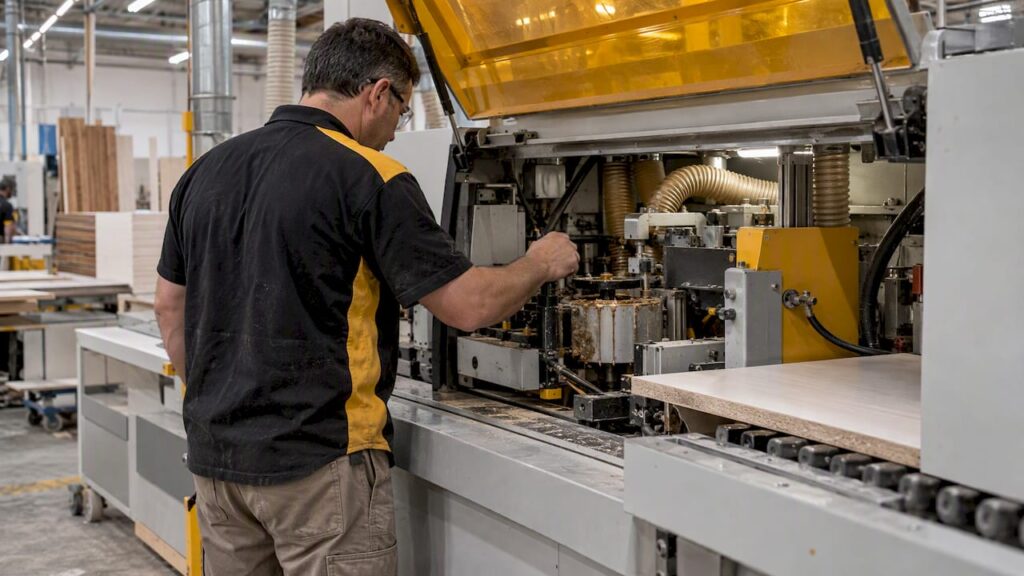
Follow a shift and daily checklist, then weekly and monthly or quarterly rounds, to keep an edgebander clean, calibrated and production ready. The three jobs that matter most are dust extraction with M or H class vacuums, glue pot care and proper guarding and isolation during maintenance. For service, parts or technical support on your edgebander, we are a direct point of contact.
TL;DR:
- Deep clean the glue pot, nozzles, and application wheel weekly; daily checks should confirm glue temperature before production to prevent adhesion failures.
- Collect wood dust with an M or H class vacuum, never a domestic unit, even one with a HEPA filter; verify LEV capture velocity.
- Before maintenance, isolate electrical, pneumatic, and hydraulic sources, lock each one, and confirm stored energy has dissipated before accessing internal parts.
- Inspect cutters and rollers weekly; schedule bearing, belt, electrical safety, and calibration checks monthly or quarterly with competent staff.
Table of Contents
- Shift and daily checklist: pre-start, mid-shift and end-of-shift steps
- Weekly checklist: glue pot cleaning, cutter inspection and roller care
- Monthly to quarterly maintenance: lubrication, bearings and calibration
- Dust control and LEV maintenance: vacuum class and flow verification
- Guarding, isolation and safe work method essentials for maintenance
- Lubrication schedule and glue pot maintenance best practice
- Quick diagnostics for common faults operators see on edgebanders
- Anderson’s role: parts, service and booking maintenance visits
- How often should you inspect an edgebander?
- Contact Anderson for service, parts and maintenance plans
- FAQ
- Sources
Shift and daily checklist: pre-start, mid-shift and end-of-shift steps
A consistent shift routine catches small problems before they become downtime. Operators should work through the same sequence every time, in the same order, so nothing gets skipped when the shop is busy.
- Before start-up, check that all guards are fitted and emergency stops are accessible and functional.
- Confirm glue pot temperature has reached the correct set point before feeding panels.
- Do a quick visual check for chip build-up, glue drips or fluid leaks around the infeed and outfeed.
- During the shift, watch for tracking errors, unusual noise changes or inconsistent glue flow, and stop the machine if any appear.
- At the end of shift, vacuum trimmings and dust with an industrial-rated vacuum rather than a shop broom or domestic unit.
- Wipe down pressure rollers and tracing wheels, clean enclosures and empty dust collection bags before they overfill.
- Log any faults observed during the shift and tag out the machine if it is not safe or fit to run.
Skipping the end-of-shift clean is the fastest way to start the next shift behind schedule, since dried glue and compacted dust are harder to remove once they’ve set overnight.
Pro Tip: Keep a laminated checklist card at the machine so operators tick each step rather than relying on memory during a busy run.
Weekly checklist: glue pot cleaning, cutter inspection and roller care
Weekly tasks target the components that wear fastest under normal production: glue systems, cutters and rollers.
- Deep clean the glue pot, including nozzles and the application wheel, and check the heating element for charred build-up.
- Inspect trim and fine trim cutters for chipped edges, and confirm calibration against panel thickness settings.
- Clean tracing wheels and pressure rollers, checking for wear or flat spots that cause tracking errors.
- Check local exhaust ventilation (LEV) filters for visible clogging and empty dust collector bags before they restrict airflow.
Roller and cutter wear is gradual, so a weekly check is often the first place a quality drift shows up before it’s visible in finished panels.
Monthly to quarterly maintenance: lubrication, bearings and calibration
Deeper service intervals protect the machine’s working life and keep tolerances within spec. These tasks generally need more time and, for some items, authorised or trained staff.
- Regrease bearings and lubrication points following the manufacturer’s recommended type and interval without substituting unspecified lubricants.
- Inspect belts, chains, gearboxes and drive components for wear, slack or unusual noise under load.
- Schedule electrical and safety circuit checks, including interlock testing, by authorised or competent staff.
- Replace consumables that have reached end of life, such as worn seals, filters or glue nozzles, rather than running them to failure.
Electrical and safety circuit checks matter beyond uptime: manufacturer maintenance guidance for safe plant includes testing safety circuits and electrical insulation as part of scheduled service, which supports treating these checks as a fixed calendar item rather than an afterthought, as outlined in the guide to manufacturing safe plant.
Dust control and LEV maintenance: vacuum class and flow verification
Edgebanders generate fine wood dust continuously, and the extraction system needs the same maintenance discipline as the machine itself.
- Use vacuums rated to M or H class per AS/NZS 60335.2.68 for hazardous wood dust, never a domestic vacuum including those with HEPA filters, as outlined in the silica and dust management code of practice.
- Test LEV flow rates with an anemometer or manometer, or have a competent person verify capture velocities at the hood.
- Replace filters on a set schedule and log each change rather than waiting for a visible drop in suction.
- Avoid dry sweeping dust back into the air; use the extraction system or a vacuum fitted with final-stage filtration suited to the dust type.
A properly functioning LEV system is judged by its actual capture velocity, not by the presence of a filter alone, and regular testing by a competent person is the only way to confirm it’s still performing, according to WorkSafe’s LEV guidance. Where exposure is a concern, commissioning occupational hygienist monitoring gives a documented record rather than a guess, a step reflected in a manufacturing airborne contaminants case study. For a deeper look at exposure standards, see our wood dust standards guide.
Guarding, isolation and safe work method essentials for maintenance
Maintenance work on an edgebander should never start until the machine is fully isolated.
- Only remove guards once the machine is stopped, isolated from electrical, pneumatic and hydraulic energy, and locked out with a physical lock on each source.
- Before accessing internal components, perform a try-out to confirm stored energy has fully dissipated.
- Check interlocks, fixed guards and any presence-sensing guards for correct operation each time they’re refitted.
- Keep safe work method statements and training records current for anyone performing maintenance tasks.
Guards exist to be durable and conveniently placed, not to be permanently removed for convenience, and should only come off for maintenance once the machine is confirmed isolated, per WorkSafe’s machinery guarding guidance.
Pro Tip: Tag out a machine the moment it’s flagged unsafe, and leave the tag in place until an authorised person signs off the repair.
Lubrication schedule and glue pot maintenance best practice
Lubrication and glue pot care are two of the most common sources of avoidable downtime on edgebanders.
- Follow the manufacturer’s specified lubricant type and interval for bearings, chains and guide rails rather than a generic shop lubricant.
- Heat down the glue pot before cleaning, and remove charred glue from the pot walls and nozzles using the manufacturer’s recommended method.
- Check thermostat accuracy periodically and log temperature readings to catch drift before it causes adhesion problems.
- Keep spare seals, filters and nozzle parts on hand so a worn component doesn’t stop a production run.
A glue pot left dirty for too long carbonises glue onto the walls, which then flakes into fresh adhesive and shows up as adhesion failures on finished edges.
Quick diagnostics for common faults operators see on edgebanders
Most day-to-day faults fall into a short list of causes that an operator can check safely before calling for service.
- Tracking or feed problems usually trace back to a dirty tracing wheel, a worn pressure roller or a panel that isn’t flat.
- Adhesion failures often come from incorrect glue temperature, the wrong glue type for the material, or a glue pot that hasn’t been cleaned recently.
- Poor trim quality, such as chipping or a rough edge, is commonly a dull or misaligned cutter blade that needs replacement.
- If a check doesn’t resolve the issue, record the fault with as much detail as possible and tag the machine out for authorised service rather than continuing to run it.
Anderson’s role: parts, service and booking maintenance visits
Operator checks cover routine care, but some faults call for a technician and genuine parts.
- We supply parts and service support for edgebanders, with specifications listed on individual model pages such as the AFS 243 Compact Edgebander.
- When operator-level checks don’t resolve a fault, authorised inspection and OEM parts ordering through our team help keep the machine within its original tolerances.
- When enquiring, have the machine model, serial number, the symptom observed and recent maintenance log entries ready, as this speeds up diagnosis.
For specification details on narrow panel edgebanding, including the AFS 559-40 Narrow Panel Edgebander, check the relevant product page before booking a service visit, and browse our broader wood machinery range for related equipment.
How often should you inspect an edgebander?
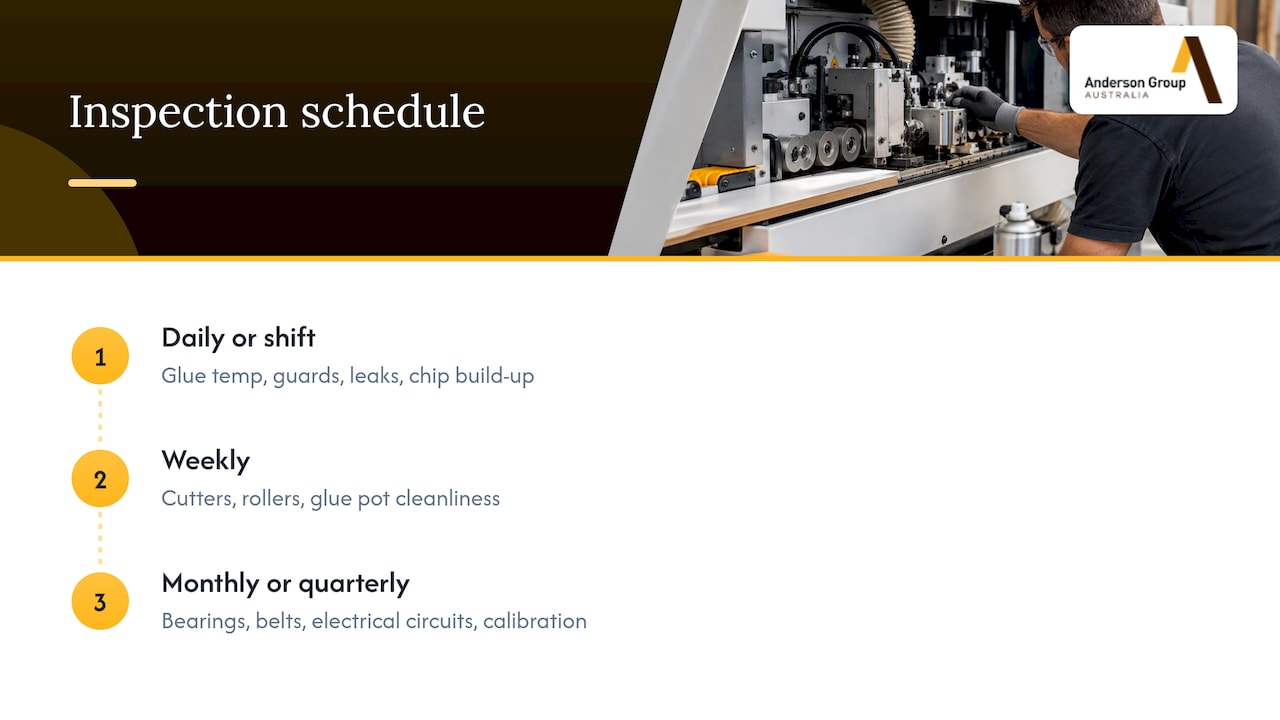
Inspection frequency should depend on machine usage intensity and risk of faults going unnoticed. Daily or shift checks cover quickly changing items such as glue temperature, guard position, obvious leaks or chip build-up to prevent production stops. Weekly checks focus on components that wear over days like cutters, rollers and glue pot cleanliness. Monthly or quarterly checks cover slower degrading items such as bearings, belts, electrical circuits and calibration, which influence long-term accuracy and safety.
Plant and equipment should be inspected and maintained according to manufacturer specifications or by a competent person, and anything tagged as unsafe should stay out of service until it’s checked, a principle set out in Safe Work Australia’s guidance on managing plant risks. Running a fixed schedule, rather than reacting only when something breaks, is what keeps an edgebander producing consistent edge quality shift after shift.
Contact Anderson for service, parts and maintenance plans
A checklist keeps an edgebander running day to day, but some jobs need a technician on site or genuine parts on the shelf. We help kitchen, cabinet, joinery and furniture manufacturers keep their machines calibrated and production ready, with service and spare parts support alongside our wood machinery range.

When you reach out, have your machine model and serial number on hand so we can scope the job quickly. Browse our wood machinery range or get in touch to request a quote or book a service visit.
FAQ
How often should an edgebander’s glue pot be cleaned?
A deep clean of the glue pot, including nozzles and the application wheel, should happen weekly as part of routine upkeep. Daily checks should still confirm the glue has reached the correct temperature before the machine runs.
What type of vacuum is safe for edgebander dust?
Hazardous wood dust should be collected with an M or H class vacuum rated under AS/NZS 60335, never a domestic unit, as outlined in WorkSafe’s dust management code. Domestic vacuums, even HEPA-fitted ones, aren’t built to contain commercial volumes of hazardous dust.
When is it safe to remove a guard for maintenance?
A guard should only be removed once the machine is fully stopped, isolated from all energy sources and locked out with a physical lock, per WorkSafe’s guarding guidance. A try-out to confirm stored energy has dissipated should happen before accessing internal parts.
What’s the difference between weekly and monthly edgebander maintenance?
Weekly maintenance covers fast-wearing items like glue pots, cutters and rollers, while monthly or quarterly maintenance covers bearings, belts, electrical safety circuits and calibration. The deeper tasks generally need authorised or trained staff rather than routine operator checks.
Who should I contact for edgebander parts or service?
For parts and service support on your edgebander, our team can help, with model specifications available on product pages such as the AFS 243 Compact Edgebander. Have your machine model, serial number and a description of the fault ready when you enquire.