
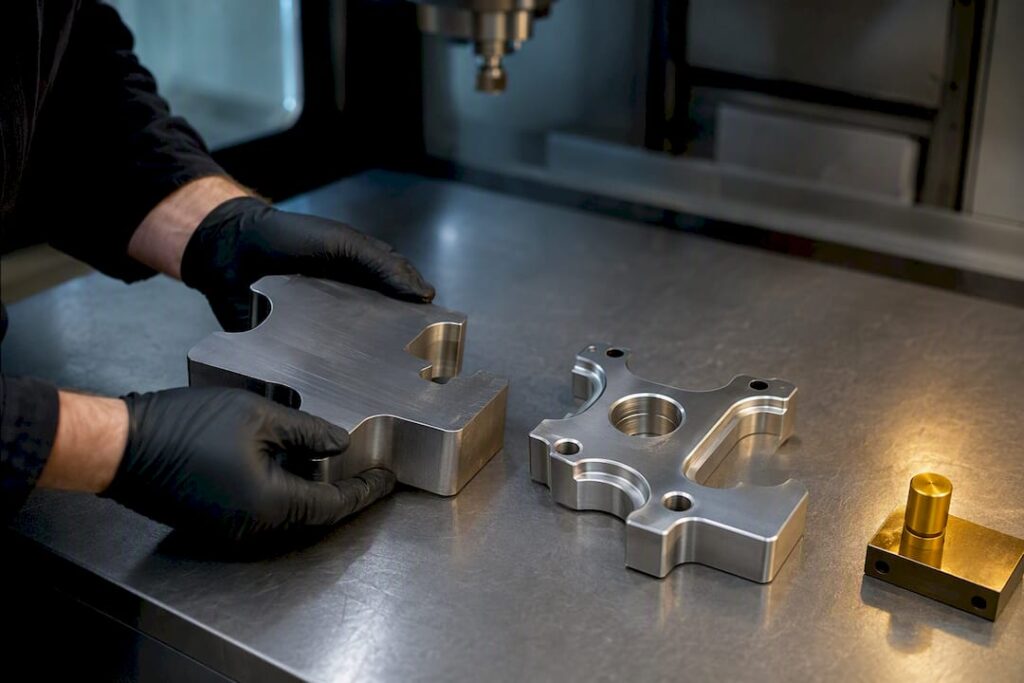
The fastest way to reduce CNC waste is to attack it in this order: design the part to need less material, nest and process panels tightly, optimise the toolpath at the CAM and G-code level, keep tooling inside tight wear limits, and add in-process checks that catch drift before it becomes scrap. Done together, these levers routinely deliver single-digit panel waste in disciplined operations and double-digit scrap cuts where the existing programme is loose. Start with design and nesting. They cost nothing to fix and pay back immediately.
TL;DR:
- Designing parts with minimal stock allowances and shared-edge features significantly reduces material waste before machining begins.
- Using near-net blanks and properly tracking remnants cuts material costs and decreases chips, especially on high-volume or repeat jobs.
- Optimizing nesting layouts and planning fixture zones can lower panel waste to 5-10%, maximizing sheet utilization.
- Applying adaptive toolpath strategies, such as trochoidal roughing, reduces cycle time and material scrap by maintaining constant chip loads.
- Regular machine maintenance and in-process inspections prevent drift-related rejects, saving costs and minimizing scrap from evolving inaccuracies.
Table of Contents
- How design optimisation reduces CNC waste before the first cut
- Material selection and stock management that improve yield
- Cutting panel waste with smarter nesting and part consolidation
- Toolpath and G-code optimisation that cuts waste and cycle time together
- Tooling strategy and tool-life monitoring that stop scrap before it starts
- Process control: catching drift with in-process inspection and SPC
- Recycling chips, managing coolant and closing the material loop
- Shop-floor tactics that turn theory into measurable results
- Lean manufacturing principles that fit CNC operations
- Operator training and best practices that prevent waste at the source
- Real-time monitoring systems that catch waste before it compounds
- How machine maintenance affects your scrap rate
- Weighing the cost against the benefit of each waste reduction technique
- Where to start: a priority roadmap for shop engineers
- Primary sources and Anderson resources
- Sources
- FAQ
How design optimisation reduces CNC waste before the first cut
Waste decisions get made at the CAD stage, long before a spindle turns. A part designed with generous, uniform stock allowance wastes material on every single run, not just the first prototype. Near-net blanks, sized to within a few millimetres of the finished profile, cut removed volume dramatically on high-volume parts, though they only pay off once tooling and setup costs are justified by run length.
Shared-edge design, where adjacent parts on a sheet or bar share a common cut line instead of each getting its own clearance, saves real sheet area on nested layouts. Tolerance relaxation matters too: a feature toleranced tighter than function requires forces slower finishing passes, more tool changes, and a higher chance of an out-of-spec reject.
Before releasing a program to the floor, run three quick checks:
- Does every tight tolerance trace back to an actual functional or mating requirement, or is it inherited from a template?
- Can any feature be simplified (a chamfer instead of a complex fillet, a through hole instead of a blind one) without changing fit or function?
- Is the blank the smallest practical size for the finished part, given the batch quantity and available stock?
Pro Tip: Run a five-minute geometry audit on any part that’s been in production for over a year. Tolerances copied from an old drawing outlive the reason they were set, and they quietly cost you material and cycle time on every single part.
Material selection and stock management that improve yield
Yield starts at the purchasing decision, not the machine. Buying a blank close to the net shape, rather than defaulting to standard stock sizes, cuts both machining allowance and the amount of material that ends up as chips on the floor. For low-volume or prototype work, standard stock still wins on lead time and cost. For repeat production runs, a near-net or pre-cut blank almost always earns back its tooling investment.
Remnant stock is the most underused resource in most shops. Offcuts from previous jobs sit in racks, get forgotten, and eventually go to scrap, when they were often large enough for the next small part.
- Track remnants by size and material grade in a simple log, not just in the operator’s memory.
- Rotate stock on a first-in, first-out basis to avoid material ageing past its certification window.
- Match material choice to the part’s actual load and finish requirement. Over-specifying alloy grade adds cost and, in some materials, increases burr formation and secondary finishing work.
The materials Anderson Group Australia’s CNC machinery processes span timber, ferrous and non-ferrous metals, plastics and composites, and each behaves differently under the cutter in terms of allowance and burr risk.
Cutting panel waste with smarter nesting and part consolidation
Nesting is where sheet-based operations either win or lose the material argument. A poorly nested panel layout can waste 15% or more of a sheet in dead zones between parts. A disciplined layout brings that down to a fraction of that figure.
- Lay out parts on shared edges wherever the design allows, and rotate parts to interlock irregular shapes rather than stacking them on a uniform grid.
- Plan clamp and fixture zones before nesting, not after. An edge reserved for a clamp that could have held a small part is wasted sheet area.
- Validate the nest against a checklist before committing: confirm grain direction (for timber), check that no part sits in a known unusable zone, and confirm tool access for every cut line.
- Use automated nesting software for standard, repeatable panel jobs, but manually tweak the layout for irregular or mixed-batch runs where the algorithm’s default spacing leaves easy savings on the table.
Panel-processing workflows that combine tight nesting with fixture planning cut panel waste to the 5–10% range in many furniture and cabinet operations, which is a realistic target rather than an aspirational one.
Toolpath and G-code optimisation that cuts waste and cycle time together
This is where a machining strategy either compounds your gains or quietly cancels them out. Adaptive clearing and trochoidal roughing keep the tool engaged in the material at a constant chip load, instead of plunging deep and dragging through a corner at full width. That steadier engagement means fewer finishing passes are needed to clean up the roughing marks, which directly reduces both waste and time.
Air cutting is the hidden thief in most programs. Every retract that goes higher than needed, every rapid move that could have been shorter, and every tool change that could have been avoided by resequencing features adds cycle time without adding value.
- Order operations to minimise total tool travel and tool changes across the whole part, not feature by feature.
- Trim retract heights to the minimum safe clearance rather than a blanket default.
- Merge compatible operations where the same tool and setup can finish two features in one pass.
- Push optimisation down to the G-code level, not just CAM, because kinematics-aware NC optimisation catches inefficiencies that CAM-only changes miss.
An experimental study on AI-driven CAM optimisation found waste dropped from 18.9% to 11.2%, average cycle time fell from 42 to 36 minutes, and energy use per part dropped from 14.9 to 12.3 kWh, for an overall cost function reduction of roughly 24.6%. Those numbers came from a controlled experimental setup, not a guaranteed shop-floor result, but they show the scale of what’s on the table when toolpath optimisation is done properly.
Tooling strategy and tool-life monitoring that stop scrap before it starts
Tool wear is the slow drift that turns a good program bad without anyone noticing until a batch fails inspection. Splitting roughing and finishing tools, rather than pushing one general-purpose cutter through both jobs, keeps geometry predictable and stretches usable tool life. Standardise tool geometries across similar jobs so wear behaviour stays consistent and predictable from one setup to the next.
Fixed-time tool changes are a blunt instrument. Pairing a tool-life counter with in-process measurement on the specific features that drift first, an edge chamfer, a bore diameter, catches wear before it produces a reject, and often extends tool life beyond the conservative fixed interval.
- Set wear limits against measured feature drift, not just cycle count.
- Check edge condition and coolant flow at every changeover, not just when a part fails.
- Log tool performance by job so recurring problem tools get flagged early.
Pro Tip: If you’re still changing tools on a fixed schedule, start logging the actual feature that fails first when a tool does wear out. That single data point tells you which measurement to probe in-cycle, and controller-data tool-life monitoring turns that into an early warning instead of a post-mortem.
Process control: catching drift with in-process inspection and SPC
Waste that reaches final inspection has already cost you material, machine time and energy. In-cycle probing on the two or three features most prone to drift, rather than every dimension on the print, gives you an early warning without slowing the cycle down. Feed the probe results into a simple control chart and the trend shows up long before a part fails a spec check.
- Identify the handful of critical features per part that actually drift, and probe those in-cycle rather than trying to check everything.
- Code every defect by operation, feature family and defect type, so a pattern across shifts or machines becomes visible instead of buried in individual reject reports.
- When a suspect part turns up, contain the batch first, then diagnose whether the cause is a one-off (a chipped edge, a bad blank) or systemic (tool wear, a drifting fixture).
This prevention-first approach, measure, prioritise the vital few defect types, then stabilise, consistently cuts scrap faster than adding more downstream inspection ever does.
Recycling chips, managing coolant and closing the material loop
Waste handling is where sustainability and cost control overlap directly. Separating chip types at the source, rather than mixing alloys in one bin, keeps turnings sellable for remelt instead of downgraded to low-value mixed scrap. Briquetting loose chips before they leave the shop improves handling and often improves the price a recycler will pay.
- Keep ferrous and non-ferrous chips in separate bins from the first cut, not sorted later.
- Filter coolant regularly and control tramp oil to stop cross-contamination between material batches, which protects both part finish and coolant life.
- Set a recovery-rate target for chip and coolant reuse, and track it monthly alongside scrap percentage.
Recycled metal recovery is well established across the metals industry, and shops that separate and sell scrap properly turn a cost centre into a modest revenue line.
Shop-floor tactics that turn theory into measurable results
Panel-processing operations that pair disciplined nesting with fixture planning report panel waste in the 5 to 10% range, a realistic benchmark rather than a best-case outlier.
A pilotable checklist for that experiment:
- Pick one machine and one recurring part family, not the whole shop, for the first pilot.
- Record scrap percentage, cycle time, tool cost per part and energy use per part (kWh) before and after any change.
- Run the pilot for a minimum batch size that filters out noise from a single unusual part.
- Compare results against your current baseline, not against the published research figures, since your material, tooling and machine differ from the study setup.
Lean manufacturing principles that fit CNC operations
Lean thinking was built for repetitive manufacturing, and CNC work fits it well once you translate the language. Value stream mapping applied to a CNC job shows exactly where material sits idle between operations, where a part waits for a second setup it didn’t need, and where a batch queues in front of a bottleneck machine. Every one of those delays adds handling risk and, often, adds scrap.
The single-minute exchange of die (SMED) principle, developed for stamping presses, applies directly to CNC setup and changeover. A faster, more repeatable changeover means fewer first-off scrap parts while the operator dials in offsets, and it means smaller batch sizes become economical, which in turn reduces the material tied up in work-in-progress at any given time.
Kaizen, the practice of small continuous improvements driven by the people doing the work, matters more in CNC shops than the theory suggests. An operator who notices that a particular fixture clamp shadows a probe point, or that a specific tool change sequence adds two unnecessary retracts, usually knows the fix before a process engineer would spot it from a report.
Poka-yoke, error-proofing the process so a mistake can’t happen rather than catching it after the fact, shows up in CNC as fixture keying that only allows correct part orientation, or tool-length verification that stops a cycle before a crash. The lean principle that matters most for waste specifically is treating scrap as a defect to eliminate at the source, not a cost to budget for.
Operator training and best practices that prevent waste at the source
Most scrap traces back to a small number of repeated operator decisions, not random error. Standard work instructions that specify exact setup sequences, offset entry methods, and first-off inspection steps remove the guesswork that produces inconsistent results between shifts and between operators.
First-off part verification deserves more discipline than it usually gets. An operator who checks the first part off a new setup against the print, rather than trusting the program because it ran correctly last month, catches fixture shift, wrong offset entry and material mix-ups before they become a batch of scrap.
Cross-training matters more than most shops budget for. An operator who only knows one machine and one job type has no reference point for spotting when something’s off. An operator who’s run three different part families on two different machine types develops an instinct for what a healthy cut sounds and looks like, and that instinct catches problems a checklist misses.
Shift handover is a frequently overlooked waste source. A program running fine at the end of one shift can produce scrap on the next if the incoming operator doesn’t know about a tool nearing its wear limit, a material batch that’s behaving differently, or a fixture that was bumped during cleaning. A two-minute structured handover, covering open issues and any anomalies from the previous run, closes that gap for close to no cost.
Recognise and reward operators who catch problems early rather than only tracking output volume. A shop that measures operators purely on parts-per-hour quietly incentivises skipping the checks that prevent waste.
Real-time monitoring systems that catch waste before it compounds
The gap between a machine that’s drifting and a machine that’s scrapping parts is often measured in minutes, and real-time monitoring is what closes that gap. Spindle load monitoring flags a tool that’s working harder than it should be, often before the part dimension moves out of tolerance. Vibration sensors catch chatter and tool deflection that degrade surface finish long before an operator notices by ear.
In-cycle probing, checking a critical feature while the part is still in the machine rather than after it’s unloaded, is the single most direct link between monitoring and waste prevention. A probe result that’s trending toward a limit lets you adjust an offset or flag a tool change before the next part fails, instead of after ten parts fail.
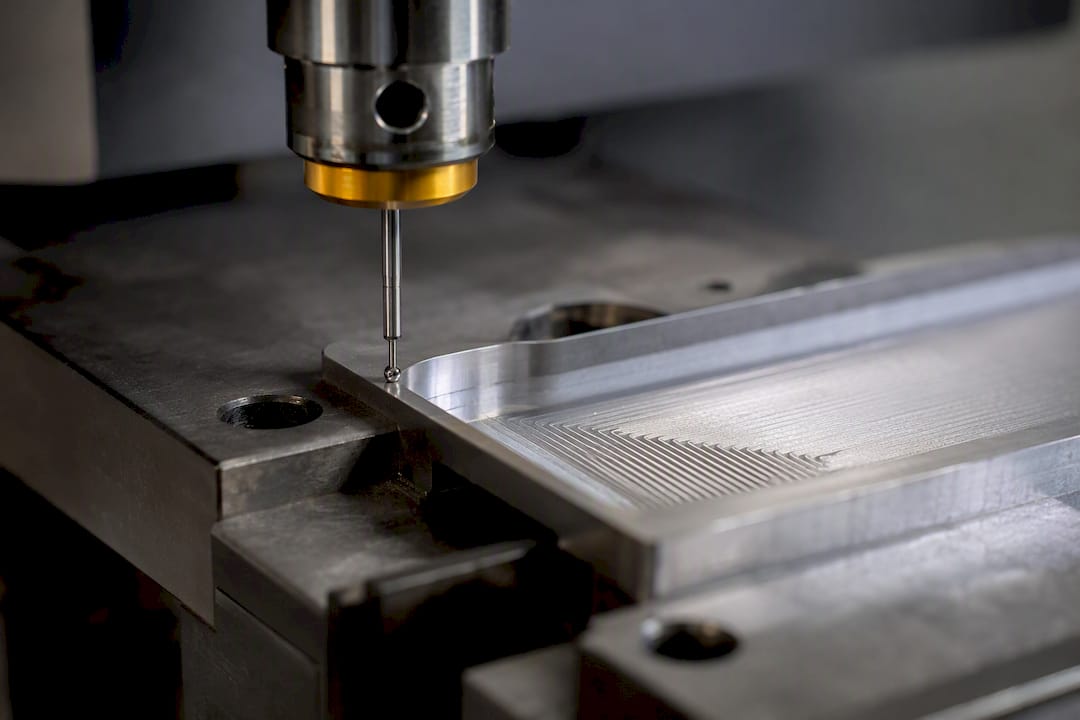
Controller data, pulled directly from the machine rather than from a separate sensor system, gives you feed rate, spindle load and cycle time trends without extra hardware. Pairing that data with tool-life monitoring turns a reactive maintenance schedule into a predictive one, catching wear-driven drift while it’s still a minor correction rather than a scrapped batch.
The practical trap with real-time monitoring is over-instrumenting a machine with more data than anyone reviews. A dashboard nobody checks isn’t monitoring, it’s decoration. Start with the two or three metrics tied directly to your most common defect types, and expand only once those are acted on consistently.
How machine maintenance affects your scrap rate
A machine running slightly out of true produces slightly-out-of-spec parts, consistently, until someone traces the pattern back to the spindle or the ways. Poor maintenance doesn’t usually cause dramatic failures. It causes a slow creep in accuracy that shows up as an increasing reject rate nobody’s connected to a maintenance gap.
Spindle bearing wear changes cutting behaviour gradually, affecting surface finish and dimensional accuracy before it ever throws an alarm. Way and ballscrew backlash, if left unchecked, introduces positioning error that’s inconsistent across the work envelope, meaning some features drift while others stay in spec, which makes the root cause harder to spot without deliberate measurement.
Unplanned downtime has a waste cost beyond the obvious lost production time. A machine restarted after an unplanned stop often needs a warm-up cycle and a first-off check before it’s trusted again, and any part run in that uncertain window carries elevated risk. Scheduled preventive maintenance, tied to actual usage hours rather than a calendar date, keeps that risk window from opening in the first place.
Coolant system maintenance ties directly into part quality too. Degraded coolant concentration or contamination increases thermal variation at the cutting zone, which shows up as dimensional drift on tight-tolerance features long before anyone thinks to check the coolant mix. A maintenance schedule that treats coolant condition with the same seriousness as spindle health closes off one more quiet source of scrap.
Weighing the cost against the benefit of each waste reduction technique
Not every waste reduction tactic deserves the same investment, and the cost-benefit picture varies enormously by technique. Design changes and nesting discipline cost close to nothing to implement, mostly staff time and a willingness to question inherited templates, and they pay back on the very next run. These belong at the top of any priority list regardless of shop size.
Tool-life monitoring and in-process probing sit in the middle. They require some investment in probing hardware or software integration, and setup time to define which features to check, but the payback period is usually measured in weeks once a shop is running any meaningful volume. The cost of a scrapped batch, in material, machine time and rework labour, typically exceeds the monitoring investment within a handful of caught defects.
AI-driven CAM optimisation sits at the higher-investment end, requiring software licensing and a genuine pilot period to validate against your specific parts and machines.
Machine maintenance investment is easy to underweight because its payback is avoided cost rather than visible gain. A scrap batch caused by drifting positioning accuracy costs far more than the preventive maintenance that would have caught it, but that avoided cost never shows up as a line item anyone celebrates. Track it anyway. It’s usually the highest-return category once you measure it properly.
Where to start: a priority roadmap for shop engineers
Fix design and nesting first. They’re free and the payback is immediate. Apply Pareto thinking to your defect log: a handful of defect types usually account for most of your scrap, so chase those before chasing everything at once. Run pilots small, with a clear stop or go metric decided before you start, and once a fix works, write it into standard work, setup sheets, tool-change routines, probing steps, so it survives staff turnover instead of depending on one operator’s memory.

Primary sources and Anderson resources
For deeper reading on the research and methods referenced above:
- AI-powered CAM strategies for reducing material waste and improving efficiency in CNC manufacturing
- CNC scrap rate reduction playbook
- Cut panel waste to 5–10% with CNC panel processing
- Genesis PLUS nesting CNC machine
Sources
- AI-powered CAM strategies for reducing material waste and improving efficiency in CNC manufacturing
- CNC scrap rate reduction playbook
FAQ
What are five practical ways to reduce CNC waste?
Optimise part design for manufacturability, tighten nesting and panel layouts, adopt adaptive roughing toolpaths, monitor tool wear against measured drift rather than a fixed schedule, and add in-process inspection to catch defects before they compound into a scrapped batch.
How do you reduce CNC machining cycle time?
Cut air cutting moves, minimise retract heights, sequence operations to reduce tool changes and total travel, and apply adaptive clearing strategies that keep the tool engaged consistently rather than plunging and retracting repeatedly.
What are seven ways to reduce manufacturing waste overall?
Design for manufacturability, manage stock and remnants systematically, optimise nesting and toolpaths, monitor tooling and machine condition, apply in-process inspection and SPC, recycle chips and manage coolant, and embed lean principles like SMED and kaizen into standard work.
How can a shop reduce manufacturing waste without new capital equipment?
Start with design reviews, nesting discipline and operator standard work, all of which cost staff time rather than capital, before considering monitoring hardware or CAM software upgrades. Panel-processing operations report waste in the 5 to 10% range using exactly this combination.
Does reducing CNC waste also cut cycle time?
Yes, in most cases the same tactics deliver both. The AI-CAM study cited above recorded cycle time falling from 42 to 36 minutes alongside the waste reduction, because efficient toolpaths that remove less unnecessary material also spend less time doing it.