
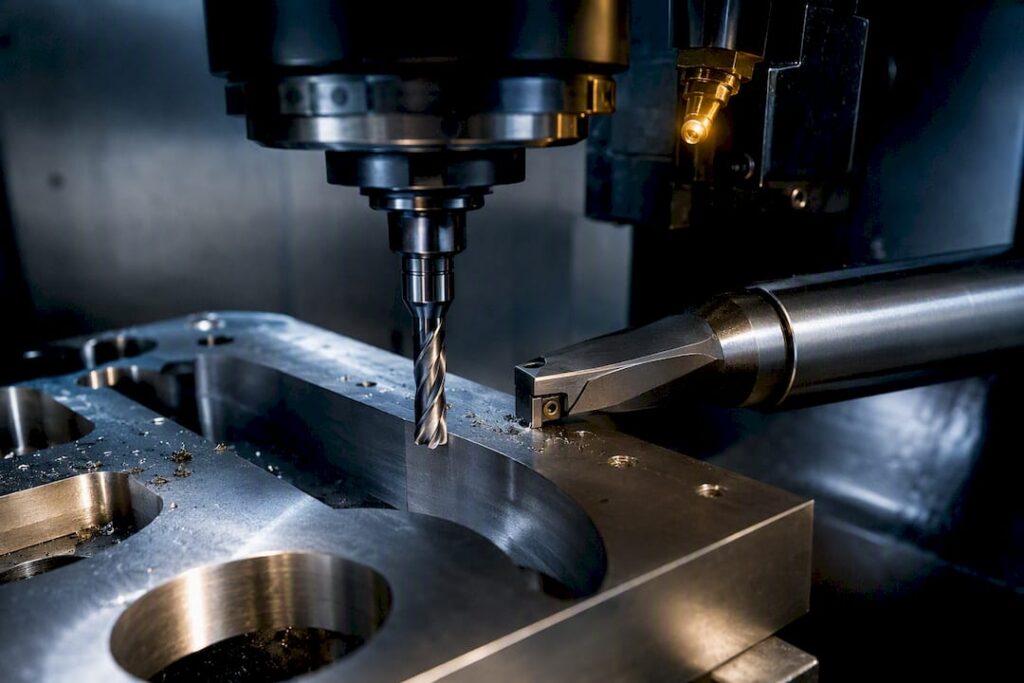
Drill when you need a hole fast. Bore when that hole needs tighter tolerances, better roundness or a correction to alignment. Ream when the job needs a final, precise diameter and a clean finish. Typical drilled tolerances sit around ±0.05 to 0.3mm, boring tightens that to roughly ±0.01 to 0.05mm, and reaming can hold ±0.005 to 0.02mm — bands worth checking against ISO and tolerance guidance before you commit to a process.
TL;DR:
- Boring can correct and refine holes with tolerances as tight as ±0.01mm, making it essential for high-precision, round, or accurately positioned parts.
- Deep, gummy, or hardened materials require boring to prevent wander and ensure consistent diameter and roundness.
- Material and process choices influence results, with high rigidity and proper fixturing being crucial for maintaining concentricity and minimizing taper.
- In high-volume production, in-house boring may be justified for better quality control, while low-volume work often benefits from outsourcing to reduce costs.
- Matching the operation to specific tolerances and surface finish requirements ensures accurate, efficient machining, with clear drawing specifications guiding the process choice.
Table of Contents
- Drilling vs boring CNC: a quick comparison
- How drilling, boring and reaming actually work
- Tooling, fixturing and machine requirements
- Realistic tolerances, finish and how to measure them
- A practical decision checklist for drilling vs boring CNC jobs
- Manufacturer setup checks that catch problems early
- When to bring boring in-house vs subcontract it
- How high-quality CNC machining solutions can help with drilling and boring setups
- Sources
- FAQ
Drilling vs boring CNC: a quick comparison
Drilling wins on speed and cost, boring wins on accuracy, and reaming wins on finish. That trade-off is the entire decision, and it rarely takes more than three questions to resolve.
Drilling uses a multi-point tool plunging axially, which makes it the fastest way to remove material and create a hole from scratch, according to Monroe Engineering. Boring is a single-point radial cut that enlarges or corrects a hole already there, and it’s the operation that actually fixes cylindricity, roundness and location, per Fictiv. Reaming barely removes material at all. It just cleans up the last few thousandths for size and surface finish.
Run through this before you commit a job to the machine:
- Does the print call for a tolerance tighter than ±0.05mm? If yes, drilling alone won’t get you there.
- Does the hole need to be round and centred, not just present? Boring corrects position; reaming does not.
- Is this a one-off or a production run? Boring adds cycle time, so high volumes need it justified by the tolerance, not just the drawing habit.
- Is the material gummy, hardened, or prone to drill wander (stainless, titanium, hardened tool steel)? Expect to bore even mid-tolerance holes.
- Does the surface finish spec call for a mirror bore or bearing-grade fit? Add the reaming pass.
How drilling, boring and reaming actually work
Drilling is straightforward physics: a two-flute (or multi-flute) bit plunges straight into the material, cutting on its outer edges while the point does the initial engagement. That symmetry is also its weakness. Any runout in the spindle, any imbalance in the flutes, and the hole comes out slightly conical or off-centre. Deep holes make this worse, because the drill has more length to flex and wander before it exits the far side.
Boring flips the geometry. A single cutting edge on a bar travels in a controlled radial path around an existing hole, shaving a consistent layer off the wall. Because there’s only one edge doing the cutting, boring can correct whatever error the drill left behind. The catch is rigidity: a long, skinny boring bar reaching into a deep or narrow bore will deflect and chatter, and that deflection shows up as taper or a wavy bore wall.
Reaming sits at the finishing end. It uses several cutting edges taking a very light, uniform pass to true up diameter and polish the wall. Reamers can’t fix a hole that’s off-centre or badly tapered. They just follow whatever path the previous operation already cut, so a bad drilling or boring job upstream ruins the reamed result too.
These three operations run on different machines depending on the shop and the part. Vertical machining centres handle drilling and light boring on prismatic parts. CNC lathes bore rotating parts like bushings and sleeves. Horizontal boring mills and large VMCs handle big castings and structural bores where reach and rigidity both matter, such as engine blocks or hydraulic housings.
Tooling, fixturing and machine requirements
Getting consistent results out of any of these three operations comes down to what’s holding the tool and what’s holding the part, not just the cutting parameters programmed into the control.
- Drills: carbide or coated HSS depending on material; TiN or TiAlN coatings extend life in steel and stainless.
- Boring bars: keep overhang under roughly four times the bar diameter where possible. Anything longer invites deflection and chatter, an issue Tirapid flags as one of the most common causes of taper in boring work.
- Toolholders: hydraulic or shrink-fit holders reduce runout compared with standard collet chucks, which matters more as tolerance tightens.
- Spindles: low-runout, high-rigidity spindles pay for themselves fastest on boring operations, where the tolerance is doing all the work.
Fixturing needs the same attention. Clamp close to the bore, use stabilisers or steady rests on long or thin-walled parts, and where possible reference off a centre that was established in the same setup as the hole. Every re-fixture is a chance to lose concentricity.
Coolant and chip evacuation matter more in deep holes and gummy alloys, where chips can pack against the cutting edge and drag the finish out of spec.
Pro Tip: On deep or blind holes in aluminium or stainless, peck drilling with a through-coolant tool clears chips far more reliably than a single continuous plunge, and it noticeably reduces bore wander.
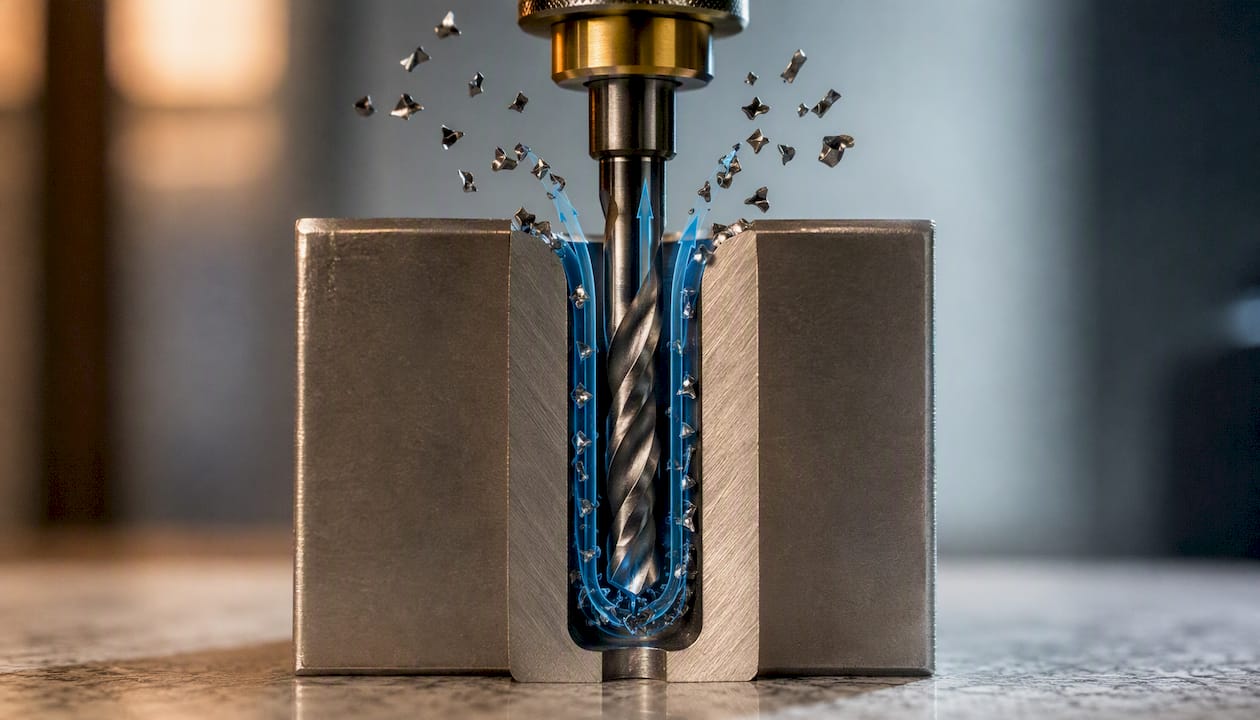
Spindle and coolant choices interact more than most shops assume. If you’re speccing a new machine around boring-heavy work, it’s worth reading up on spindle options that hold up in production and coolant selection for mixed-metal shops before the purchase order goes out.
Realistic tolerances, finish and how to measure them
Drilled holes typically land around ±0.05 to 0.3mm depending on drill quality, depth-to-diameter ratio and material. Boring tightens that to roughly ±0.01 to 0.05mm, and reaming can hold ±0.005 to 0.02mm, according to bands reported by Tirapid. Surface finish follows the same pattern: drilling leaves a rougher wall, boring improves it, and reaming produces the smoothest result of the three.
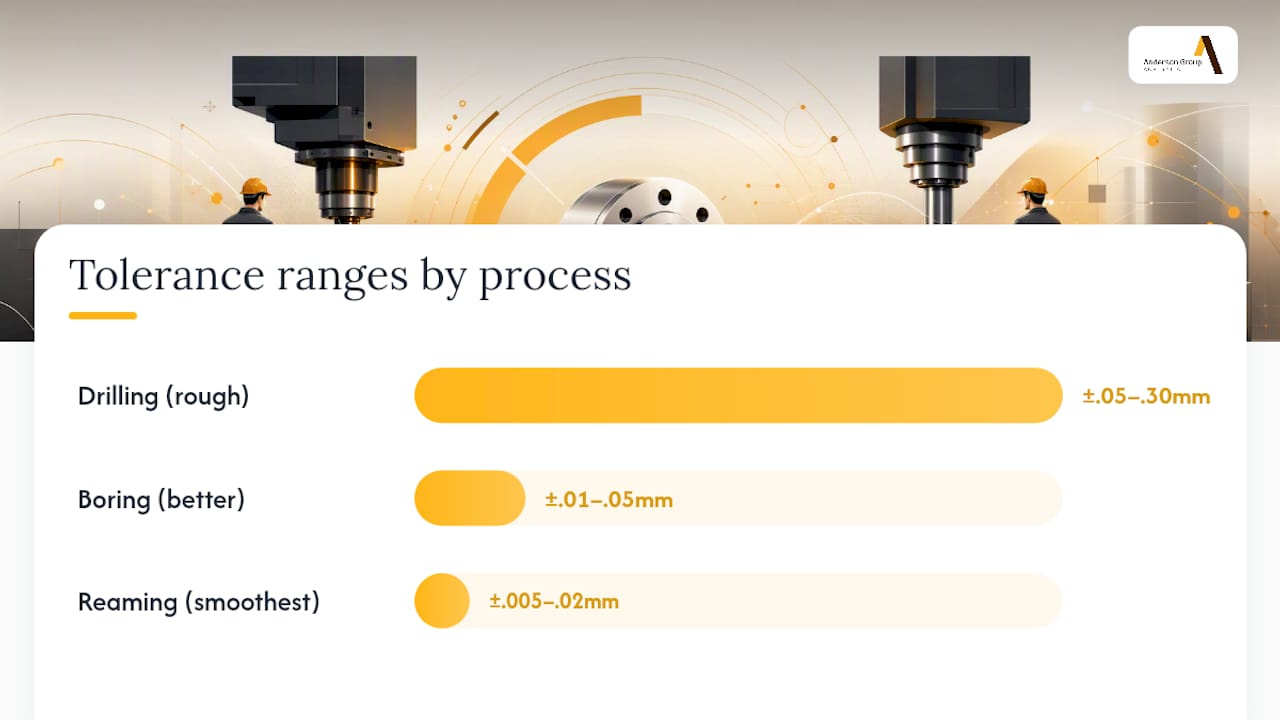
Statistic callout: Drilling ≈ ±0.05–0.3mm, boring ≈ ±0.01–0.05mm, reaming ≈ ±0.005–0.02mm, per Tirapid’s reported ranges. These are starting points, not guarantees. Actual results depend on rigidity, tool condition and material.
Checking the result properly matters as much as cutting it well.
- Plug gauges and bore gauges confirm size quickly on the shop floor.
- Roundness testers or a CMM catch geometry errors a simple gauge will miss.
- NIST metrology guidance is a solid reference when documenting inspection methods for critical bores.
Leave stock for finishing wherever tolerance is tight. Material and thermal expansion both shift final size, especially in aluminium and stainless, so measure at a stable temperature and leave enough allowance for the boring or reaming pass to clean up.
A practical decision checklist for drilling vs boring CNC jobs
Work through these before the part hits the machine, not after the first bad measurement comes back from inspection.
- Confirm the tolerance and roundness spec on the drawing. If it’s a general hole with a loose tolerance, drilling alone is probably enough.
- Check the geometry requirement. If cylindricity or true position matters, plan a boring pass regardless of nominal tolerance.
- Match material to process. Hardened steels and gummy alloys wander more under a drill and often need boring even at moderate tolerances.
- Weigh volume against cycle time. A single boring pass across a large production run adds up fast; confirm it’s actually required before it becomes standard practice.
- Specify stock allowance for finishing operations clearly on the drawing, not just the final size.
Drawing callouts should say exactly what’s expected: “drill only, Ø10mm +0.1/0” for a loose-tolerance hole, or “drill then bore to Ø10mm +0/-0.02” when geometry matters. Add “ream to finish, 0.1mm stock” where a mirror bore or bearing fit is needed. Vague callouts like “drill and finish” are how shops end up quoting the wrong process.
Cost and lead time scale with precision. A drilled hole is minutes of cycle time; adding a boring pass can double or triple that per hole, and reaming adds another setup step. Quote accordingly, and push back on tolerances that are tighter than the application actually needs.
Manufacturer setup checks that catch problems early
Before running production, check spindle runout against the machine’s rated tolerance, seat toolholders correctly (a dirty taper alone can introduce measurable runout), and keep boring bar overhang within the limits noted earlier. Anderson Group Australia’s tolerance guidance tied to ISO 2768 is a useful starting point for setting realistic allowances before cutting begins.
One recurring pattern from shop floors: a part drilled to spec but rejected for roundness gets reworked with a single boring pass, and passes inspection on the next run. The fix wasn’t a new drill. It was the right process for the tolerance.
When to bring boring in-house vs subcontract it
High-precision, high-volume work with traceability requirements usually justifies in-house boring capability. Low-volume or occasional tight-tolerance parts often make more sense subcontracted, until volume or accuracy demands change that maths. Capital and training costs are real; so is the quality control you give up by outsourcing.
How high-quality CNC machining solutions can help with drilling and boring setups
Choosing between drilling and boring often comes down to whether your current machine can actually deliver the rigidity and spindle accuracy the job needs. High-precision machining centres, including vertical machining centres, production machining centres with automatic pallet changing, and 5-axis platforms can be suited to both fast hole-drilling and precision boring work, with installation and tuning support to match.
If you’re evaluating equipment for a mixed drilling and boring workload, two places worth starting are the VMC-1100/1250/1400 series for flexible small-to-mid part work, and the Production Machining Centre for higher-volume runs where cycle time and repeatability both matter. Reach out to request a quote or arrange a site visit through Anderson Group Australia to talk through spindle specification, tooling and expected tolerances for your parts.
Sources
- ISO
- Monroe Engineering — Drilling vs Boring vs Reaming: What’s the difference?
- Fictiv — Drilling, boring and reaming: a precision hole guide
FAQ
What is the difference between boring and drilling?
Drilling creates a new hole with a multi-point tool cutting axially; boring enlarges or corrects an existing hole with a single-point tool cutting radially, which is why boring achieves tighter roundness and tolerance.
Which CNC cycle is best for drilling?
A peck drilling cycle works best for deep or blind holes because it clears chips between passes, reducing wander and heat buildup compared with a single continuous plunge.
What is drilling in CNC?
CNC drilling is an automated hole-making operation where a multi-point rotating tool plunges into the workpiece under programmed feed and speed, typically the first step before boring or reaming when tighter tolerances are needed.
Is directional drilling the same as directional boring?
No. Directional drilling and directional boring both refer to steering a bore path in underground or horizontal applications, but in CNC machining, “boring” specifically means enlarging or correcting an existing hole with a single-point tool, not steering a path.
When should a shop choose boring over drilling alone?
Choose boring whenever the drawing calls for tolerances tighter than roughly ±0.05mm, or when roundness and true position matter more than raw hole size, since drilling alone can’t correct those errors.