
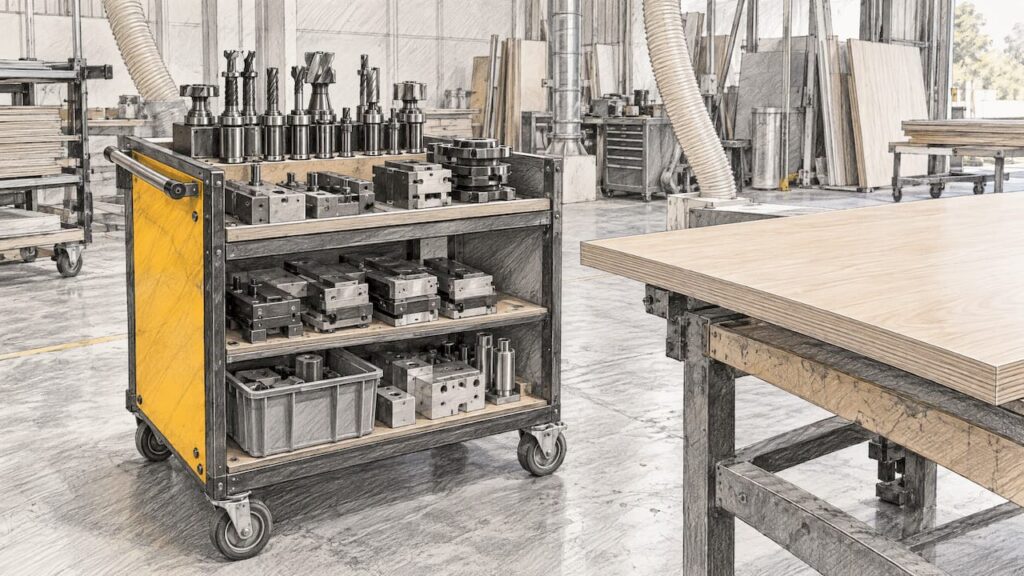
SMED (Single-Minute Exchange of Die) is a method for cutting the time a machine sits idle between one job and the next. On a CNC, that means the minutes between the last good part of job A and the first good part of job B. Most of the saving comes from how the shop prepares and sequences the work, and some of it comes from the machine and workholding you buy. This guide covers both, with a focus on Australian kitchen, cabinet, joinery and furniture manufacturers running nesting routers and panel-processing machines.
If you are choosing or upgrading machinery with changeover in mind, our team at Anderson Group Australia can talk through your application on the wood machinery range.
TL;DR
- SMED is a Lean tool that aims for changeovers under ten minutes, by moving as much setup work as possible to happen while the machine is still cutting.
- Measure from the last good part of the old job to the first good part of the new one, using a clock or video, not memory.
- Work in stages: observe, separate internal from external work, convert internal to external, streamline, then standardise.
- A 2025 machining-centre study reported a 57% cut in changeover time, helped by pre-clamped zero-point fixtures and first-piece inspection.
- Never trade safety or quality for speed. Machine and fixture choices should be confirmed against your own application and the exact model.
Table of Contents
- What SMED means on a CNC
- Why changeover matters to a wood-panel shop
- Step 1: Measure changeover the same way every time
- Step 2: Separate internal from external work
- Step 3: Convert internal work to external
- Step 4: Streamline the remaining internal work
- Step 5: Standardise and keep measuring
- What results to expect
- Where machine choice fits in
- Talk to us about your application
- FAQ
- Sources
What SMED means on a CNC
The name comes from press shops, where dies were swapped between products. Shigeo Shingo, who developed the system, used “single minute” to mean a setup of fewer than ten minutes, a single-digit number of minutes. The same source records that he first separated internal and external setup in 1950, and that in 1969 Toyota asked him to cut a 1,000-ton press setup from an hour and a half to three minutes.
Australia’s national training unit on the subject, MCMT620A Develop quick changeover procedures, describes the key idea as converting internal setup time into external setup time. It also lists variations such as single-digit setup and one-touch exchange.
On a CNC, the “die” is whatever has to change: the fixture or vacuum zone, the tooling, the program and the material. The goal is the same. The spindle should be cutting, not waiting while someone looks for a spanner.
Is SMED Lean or Six Sigma?
SMED is a Lean tool. It grew out of Toyota-era production thinking and is taught in Lean programs as a way to cut changeover waste and enable smaller batches. Six Sigma focuses on reducing process variation, and the two are often used together. Penn State’s equipment efficiency chapter presents SMED within Shingo’s Lean framework.
Why changeover matters to a wood-panel shop
Kitchens and cabinetry are made-to-order. Job sizes are small, product variety is high and customers want short lead times. The Association for Manufacturing Excellence Australia notes in its Lean dictionary that minimising model-change time increases operational flexibility, allows quicker response to demand changes and lets organisations cut inventory.
CBIS, an Australian operations consultancy, makes the same link in its SMED roadmap: shorter lead times need smaller batches, and smaller batches are only economic when changeover is short.
There is also a useful reality check for furniture makers. A 2003 Gottstein Memorial Trust report on CNC furniture manufacturing found average setup times of 9.4 minutes for a basic machine and 9.0 minutes for a CNC machine in the Australian furniture industry. It also noted that quick changeovers came from software, documentation, training and appropriate tooling rather than from the CNC alone. That is a 2003 snapshot, so use it as a reference point and measure your own.
Step 1: Measure changeover the same way every time
You cannot improve a number nobody agrees on. Settle on one boundary rule across machines and shifts. The common definition, used by Four Jaw, runs from the last good part of the previous run to the first good part of the next. Restarting the machine is not the finish line if the first sheet needs adjustment, rework or scrapping.
For a nesting router, that boundary might look like this:
- Start: last good part off the previous nest.
- End: first good part of the next nest, at normal cutting rate.
- Included: clearing the bed, changing tools, loading the new sheet, loading the program, any trial cut and adjustments.
OEE Lab suggests timing from a clock, filming the whole changeover and repeating it for several changeovers with different crews, then looking at the spread between fastest and slowest. Video is especially useful because it shows waiting and walking that nobody mentions when asked. This is general guidance from a method source, not something we have documented in an Anderson customer’s shop.
Step 2: Separate internal from external work
Internal work needs the machine stopped. External work can happen while the machine is still running the previous job. Penn State’s chapter describes this separation as Stage 1 of SMED, where the largest cost gains often appear.
A worked split for a panel shop running a nesting router might be:
| Activity | Typically internal or external | Note |
|---|---|---|
| Clearing finished parts from the bed | Internal | Often shortened by labelling and sorting methods rather than by stopping later |
| Staging the next sheets beside the machine | External | Can be done during the previous cut |
| Pre-loading the program and checking the nest | External | Do it at the workstation, not at the controller |
| Collecting and presetting the next tools | External | Prepare tool holders before the stop |
| Loading the new sheet | Internal | Depends on your loading method |
| First-piece check | Internal | Keep it: quality is not a place to cut time |
The split is an example of how to classify work, not a statement about any particular machine. Your own video will show where the time actually goes.
Step 3: Convert internal work to external
Stage 2 of Shingo’s framework converts internal operations to external ones so they can be carried out while the machine runs, as the Penn State chapter puts it. Practical examples from CNC sources:
- Stage material, tools and paperwork before the machine stops.
- Check and verify the program before the changeover, not during it.
- Preset tools off the machine.
- Use fixtures that are loaded and located offline.
The last one is where hardware comes in. A 2025 study of a machining-centre changeover in Slovakia proposed pre-clamping parts in zero-point systems for fast fixture exchange and quick zero-point identification, and prioritising first-piece inspection. The study reports a 57% reduction in changeover time. The result belongs to that machine and that shop, so treat it as an example of what the approach can achieve, not a promise for yours.
For wood, the concept carries over to how you hold work. Our guide to zero-point fixturing for CNC explains how the approach cuts setup time while keeping accuracy.
Where small changes beat big spend
Much of the waste is not the machine at all. The Virginia Tech and FDMC survey of secondary wood products plants found that “mounting and adjusting” was the most time-consuming setup activity for 46% of responses (13 of 28), across moulders, table saws, shapers and band saws. The same survey found that five of 15 respondents named CNC machines as where they saw the largest setup-time reduction. That is a North American sample of 23 valid responses, so read it as a direction, not a forecast for Australian shops.
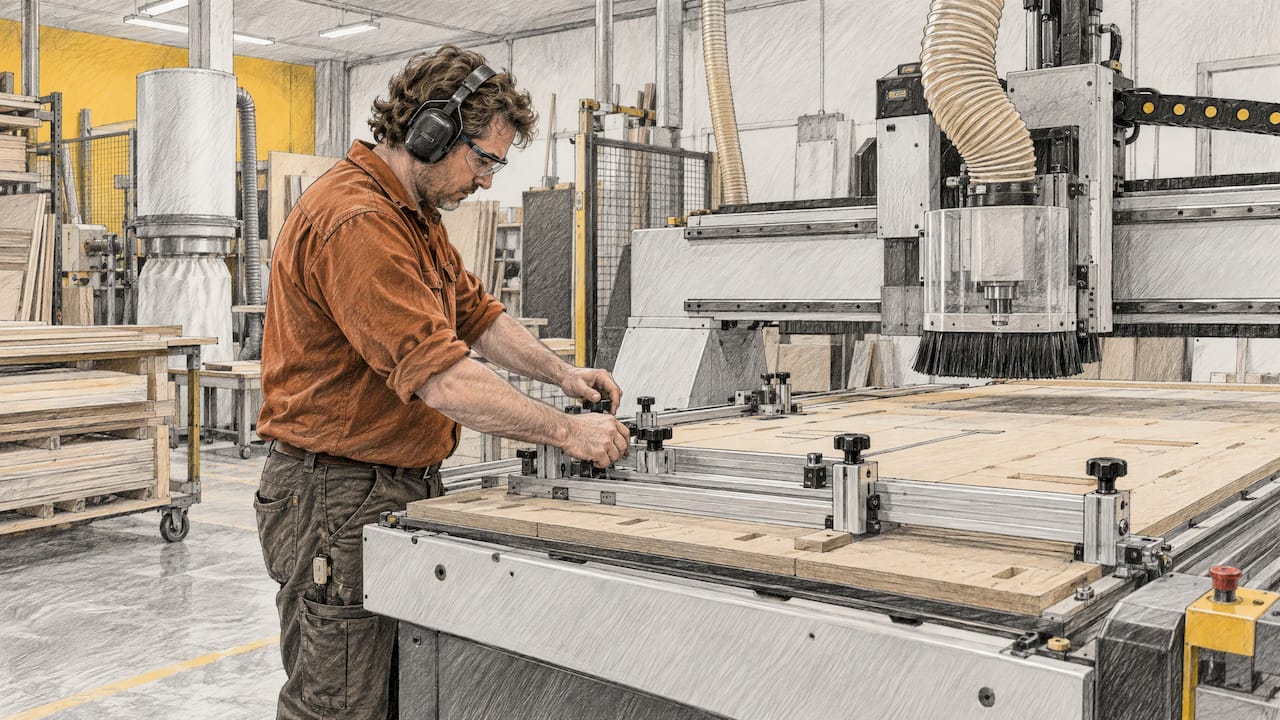
Step 4: Streamline the remaining internal work
Once external work is out of the way, shrink what is left. CBIS lists wastes to remove in this stage, such as late or incorrect tool supply and over-tight nuts, and suggests reducing adjustments so a setup lands right the first time. For routers and drilling machines, that usually points to:
- Standard tool holders and a fixed tool-magazine layout for your common jobs.
- Fixed locating points so a part or fixture goes in one way only.
- Quick-release fastening instead of repeated threading.
- Programs named and stored so the right one loads on the first try.
Safety comes first here. MCMT620A requires that improved changeover procedures build in occupational health and safety, applying ergonomic principles and the hierarchy of control. Activities that cause repetitive strain, back or finger injuries are candidates for improvement. Four Jaw’s James Brook adds that SMED is not a race, and some activities must stay internal for technical or safety reasons. Guarding, isolation and lockout steps stay in place, whatever the stopwatch says.
Step 5: Standardise and keep measuring
A fast changeover that only one operator can do is fragile. CBIS’s final step is to standardise the new procedure with work instructions and operator training. An ISCTE thesis describes a control phase in which KPIs are monitored so improvements are sustained, and standardisation reduces reliance on special skilled workers.
In practice:
- Write a one-page changeover sheet per machine, with photos.
- Train every shift on it, then re-time a few changeovers.
- Log planned changeovers separately from unplanned stoppages, so the numbers stay comparable.
- Review the spread monthly and ask why the slowest was slow.
If you want the data without a stopwatch, our overview of CNC machine monitoring for Australian workshops covers how shops track machine time. Keeping the machine in good order matters too: a CNC preventive maintenance checklist and schedule helps avoid breakdowns being mistaken for slow changeovers.
What results to expect
Published case studies vary widely, and the spread is the lesson. Results depend on the starting point, the equipment and how much of the waste was external work to begin with.
| Study | Setting | Reported result |
|---|---|---|
| Slovakia, 2025 | CNC machining centre | 57% less changeover time |
| Lam, Prakash and Lai, 2017 | CNC facility, jig and fixture redesign | Bottleneck setup from 1.65 to 1.19 hours (27.88%) |
| Şahin and Koloğlu, 2022 | Turning line | Total setup from 1,418 to 930 minutes (34.42%) |
| Garcia-Garcia, Singh and Jagtap, 2022 | Survey of North American secondary wood products plants | 86% of cases reduced changeover time; 93% increased productivity |
Those are other companies’ results in other industries and countries. None describes an Anderson customer, and none is a target for your shop.
Where machine choice fits in
SMED does not start with a purchase. But when you are buying, changeover becomes a selection criterion alongside bed size, throughput and the materials you cut. Keep the applications distinct, because each has a different changeover profile:
- Nesting and routing of sheet material: the ATS series CNC nesting routers and the Genesis PLUS CNC nesting machine are our nesting machines. Changeover here is mostly sheet loading, program and tool management. Our guide to increasing CNC nesting productivity covers the routine around the machine.
- Six-sided drilling and routing: the ADM 612-MST is a six-sided CNC drilling and routing machine, a different job from nesting, so its changeover questions differ too.
- Metal and aluminium milling: our Focaseiki machining centres sit in the metal machinery range. For fixture changes there, the APC with zero-point system is the matching option.
Options such as pallet changing, probing or specific accessories depend on the exact model and configuration. They cannot be assumed from a family name, so confirm them for the machine you are considering. For the wider cost picture, see our piece on CNC lifecycle cost modelling.
Talk to us about your application
We supply CNC machinery, servicing and parts to Australian manufacturers, with kitchen, cabinet, joinery and furniture makers as our main customers. We match woodworking and nesting applications to Anderson machines, and metal and aluminium milling to Focaseiki. Tell us your job mix, batch sizes and how often you change over, and we will recommend machinery for your own production, with specifications checked against the product page.

Start with the wood machinery range or the full machine list, then request a quote for the model that fits. We sell machinery, service and parts, not subcontract cutting or machining.
FAQ
What is SMED in production?
SMED is a Lean technique for reducing the time needed to switch a machine from one product to another. Its target is a changeover in single-digit minutes, achieved mostly by doing preparation while the machine is still running.
What are the stages of SMED?
CBIS describes five: observe and document the current setup, separate internal from external work, improve each element (mainly by converting internal to external), document the new setup and compare times, then standardise with work instructions and training. Penn State’s version groups these into separation, conversion and streamlining stages.
Is SMED Lean or Six Sigma?
SMED is a Lean tool, developed in a Toyota-era production context. Six Sigma is a separate improvement approach aimed at reducing variation, and some shops use both.
How long should a CNC changeover take?
There is no single figure. The SMED aim is under ten minutes, and the 2003 Gottstein report recorded Australian furniture-industry averages of about nine minutes for setup. Your own timed changeovers, measured from last good part to first good part, are the only fair benchmark for your shop.
Sources
- A Revolution in Manufacturing: The SMED System (Shingo)
- MCMT620A Develop quick changeover procedures
- Equipment Efficiency, Penn State
- Lean Dictionary, AME Australia
- SMED – Single-Minute Exchange of Dies, CBIS
- Gottstein Memorial Trust report on CNC furniture manufacturing
- How SMED can reduce inefficiencies in manufacturing processes, Four Jaw
- How to Measure Changeover Time, OEE Lab
- Proposal for streamlining the CNC machine changeover, 2025
- Wood machine set-up study, FDMC magazine
- Automobile manufacturer’s production cell, ISCTE thesis
- Setup time reduction in a CNC production facility through redesign of jigs and fixtures
- A Case Study on Reducing Setup Time Using SMED on a Turning Line
- Optimising Changeover through Lean Manufacturing, MDPI Sustainability 2022