
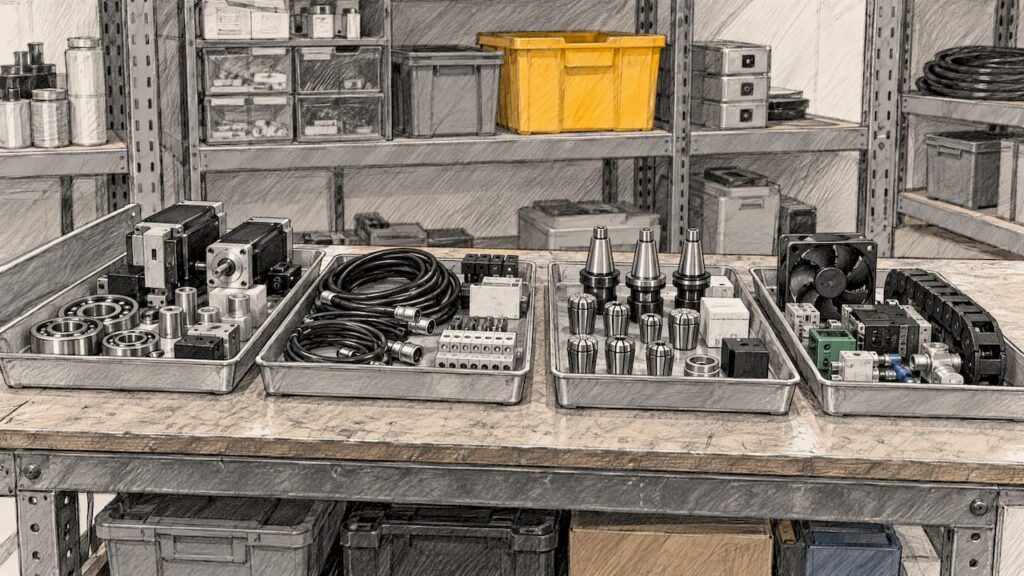
Spare parts availability for a CNC machine is decided before the breakdown, not during it. In Australia, most of that decision comes down to three things: knowing exactly which part your machine uses, knowing where it ships from, and agreeing the scope of support with your machinery supplier at purchase. If you run a nesting router, an edge bander or a drilling centre in a kitchen, cabinet or joinery shop, this article shows how to do all three. At Anderson Group Australia we supply CNC machinery, servicing and parts to Australian manufacturers, so the questions below are the ones we expect from a production manager with a stopped machine.
TL;DR
- Identify parts by exact part number, full model designation and serial number. The same model name can cover different configurations.
- Most CNC components for Australian shops travel a long way, so the order, freight and customs phases all add time. Plan your critical spares around that.
- Build a short critical-spares list from your own failure history and your maintenance schedule, not from a generic catalogue.
- Do not assume stock, response times or service inclusions. Ask for the agreed scope in writing when you buy.
- For Anderson wood machinery, send your enquiry with the machine model, serial number and photos so the right part is matched the first time.
Table of Contents
- What “availability” actually means for a CNC part
- Step one: identify the exact part
- Step two: understand what drives lead time to Australia
- Step three: build a critical-spares list from your own shop
- Step four: when a part is superseded or discontinued
- Step five: agree support before you need it
- Reducing downtime in a panel-processing shop
- Where metal machining differs
- Our wood machinery range and how to reach us
- FAQ
- Sources
What “availability” actually means for a CNC part
A part is available when four things line up: it is the correct part for your exact machine, someone can supply it, it can reach your site within the time your production can bear, and it can be fitted safely. Most delays come from the first item, not the second.
That matters because many Australian wood-panel shops run machines that are imported. Parts for these machines are made overseas, so even a simple wear item may need to travel a long distance. Availability therefore has two layers:
- Local availability: whether anything relevant is held in Australia. Anderson does not publish local stock levels, so if this matters to you, ask your supplier what is held and what is ordered on demand, and have the answer in writing.
- Ordering availability: whether the part can be ordered, how it is shipped, and what documentation it needs.
Treat any promise of a delivery time with care until it is attached to a specific part number and a specific shipping method.
Step one: identify the exact part
The fastest way to lose a week is to order a part that almost fits. Before you contact anyone, collect the following:
- Machine make and full model designation. “Nesting router” is not enough. Anderson’s models are distinct: the ATS series covers nesting, routing and drilling, and the Genesis PLUS is a CNC nesting machine. A six-sided drilling machine such as the ADM 612-MST is a different machine again, with different components.
- Serial number. Photograph the identification plate. The same model name can cover different configurations, so the serial number helps settle which one you own.
- Part number, exactly as marked. Keep every zero, letter and suffix. If a character is unreadable, say so instead of guessing.
- Where the part sits. Name the assembly (for example spindle, vacuum system, tool changer, dust extraction) and, if you have the spare-parts catalogue, the page and item position on the exploded drawing.
- Photos. Take the component from several angles, including any markings.
- Modifications. If the machine has been changed since delivery, say how.
- Delivery location and the date you need it.
This checklist follows the approach in a guide on identifying the right spare part, which stresses stating what is missing rather than guessing. It is general guidance, not an Anderson procedure. For Anderson machines, we ask that you send the model and serial number with your enquiry so the right part is matched to your configuration.
Do not infer options from the family name
A family name or axis count does not tell you what a particular machine carries. Pallet changing, probing, rotary accessories, extraction capacity, linear feedback and through-spindle coolant all depend on the exact model and configuration. If you are ordering a part related to one of these options, confirm that your machine was supplied with it before you order. This is a documented-fact check, and it avoids ordering for a feature your machine never had.
Step two: understand what drives lead time to Australia

Parts that travel to Australia pass through several stages: picking and packing at the source, freight, then customs and local delivery. One Australian importer’s guide puts factory pick and pack at 2 to 10 days, freight transit at 3 to 35 days and customs plus local delivery at 2 to 5 days. Those are general ranges for imported equipment, not an Anderson commitment, and your actual time depends on the part, the origin and the shipping method.
Three practical points follow:
- Air versus sea. Air is faster and dearer. Sea is cheaper and slower. Decide in advance which parts justify air freight, because a stopped production line usually does.
- Paperwork. Customs delays tend to come from unclear descriptions. Use the exact part description and number on every document.
- Distance from a major port. Regional shops may add days to the final leg. Factor this into your own planning.
Australian shops are further from the major machinery-making regions than shops in Europe, and one Australian automation blog argues that this makes critical-spare strategy more important here. It is a reasonable view, and it fits the next step.
Step three: build a critical-spares list from your own shop
You cannot hold everything. You can hold the parts whose failure would stop a production line for longer than you can afford. Work through your machines one at a time and ask three questions about each wear or failure-prone part:
- How long would production stop if it failed tomorrow?
- How long would it take to get one, by the fastest realistic route?
- Does the machine have a work-around? A second machine that can run the same job changes the answer.
A part that stops everything and takes weeks to arrive belongs on the list. A part that can be fitted in an hour and arrives in days, or that only affects one of several machines, often does not.
Typical categories for a panel-processing shop to review, as a prompt rather than a prescription:
| Area | Why it matters | What to confirm |
|---|---|---|
| Consumables on nesting and routing machines (tooling, collets, filters, vacuum components) | Wear on a schedule, so you can forecast use | Your machine’s own maintenance schedule and part numbers |
| Drilling-head and spindle items | Affect cut and hole quality, can stop a line | Exact model and configuration |
| Sensors, switches and safety devices | Small parts, often the cause of a stoppage | Part number from the plate or catalogue |
| Dust extraction components | Wood-panel dust control is a separate system from the cutting head | Whether your machine’s extraction is integrated or separate |
| Electrical and control components | Long lead if specific to the controller | Controller version and serial number |
Your own failure history is the best input. If you keep maintenance records, you already have the data. If you do not, start recording stoppages by machine, part and duration. Our guide to CNC preventive maintenance gives a shop-floor checklist and schedule that helps you predict which parts will wear first.
Step four: when a part is superseded or discontinued
A superseded part is one that is no longer made and has been replaced by one or more newer parts that typically do the same job, a definition set out in a parts user guide from an Australian machinery distributor. The practical consequence for a CNC buyer is simple: the number on your old part may not be the number you order.
When you hit this:
- Give the supplier the old part number and your machine’s serial number, so the replacement can be matched to your configuration.
- Ask whether the replacement needs other changes, such as a different connector, bracket or software setting.
- Record the new number against the machine in your maintenance file for next time.
Do not substitute a lookalike part on a machine with guarding, interlocks or safety-related controls. Replacement parts that affect safety functions should be treated under your risk assessment and the machine safety standards. The AS/NZS 4024 series covers safety of machinery, including risk assessment and the safety-related parts of control systems. Our summary of AS/NZS 4024 actions for Australian PCBUs explains what a business needs to do.
Step five: agree support before you need it
The cheapest time to settle parts and service is when you buy the machine. Questions worth putting to any CNC supplier, including us, before you sign:
- Which wear items are recommended as a starter spares kit for this model and configuration?
- Which parts are held in Australia, and which are ordered from overseas?
- Who diagnoses a fault, and by what route (phone, remote, on site)?
- What does the agreed service scope include?
- How do I place an urgent order, and what information will you need?
We do not publish service inclusions, response times, maintenance intervals or local stock figures for Anderson machines, so confirm the agreed scope for your own purchase rather than assuming it. Our guide to CNC technical support in Australia lists what to expect and what to ask.
Installation and operator training also affect parts demand. A machine that is set up correctly and run by trained operators tends to see fewer avoidable faults. See nesting machine installation and operator training for what to plan.
Reducing downtime in a panel-processing shop
Parts availability is one lever. These are the others, in order of cost:
- Keep clean machine records. Model, serial number, plate photo, part numbers and modifications stored in one place cut the identification step from days to minutes.
- Follow the maintenance schedule. Many failures in vacuum systems, extraction and drive components start as neglected routine tasks.
- Watch for early warning. Simple monitoring of spindle hours, alarms and stoppages shows patterns before a failure. See CNC machine monitoring for Australian workshops.
- Stock the critical list. Hold the few parts that would stop production longest and take longest to arrive.
- Plan production around a second route. If one nesting machine is down, can another machine or process carry urgent orders?
- Send enquiries complete. A request with the plate photo, part photo and part number is answered faster than “the machine won’t start”.
The kitchen and cabinet shops that cope best with a fault are the ones with a short, current list and a clear contact, not the ones with the biggest shelf.
Where metal machining differs
If you run milling or machining centres for metal or aluminium, your parts picture is different: spindles, coolant systems, tool changers and pallet systems vary by model. Do not infer coolant fitment or retrofit availability from a family name; check the exact model. Metal machining enquiries go to our metal machinery range.
Our wood machinery range and how to reach us
Anderson Group Australia supplies CNC machinery, servicing and parts to Australian manufacturers, and wood makes up more than 90% of our customer base. If you are choosing or replacing a machine for kitchen, cabinet, joinery or furniture production, start with our wood machinery range, which includes the Genesis PLUS and the ATS series. Tell us about your application and your parts and service expectations and we will discuss the right machine for your own production. We supply machinery, service and parts; we do not offer subcontract cutting or machining.
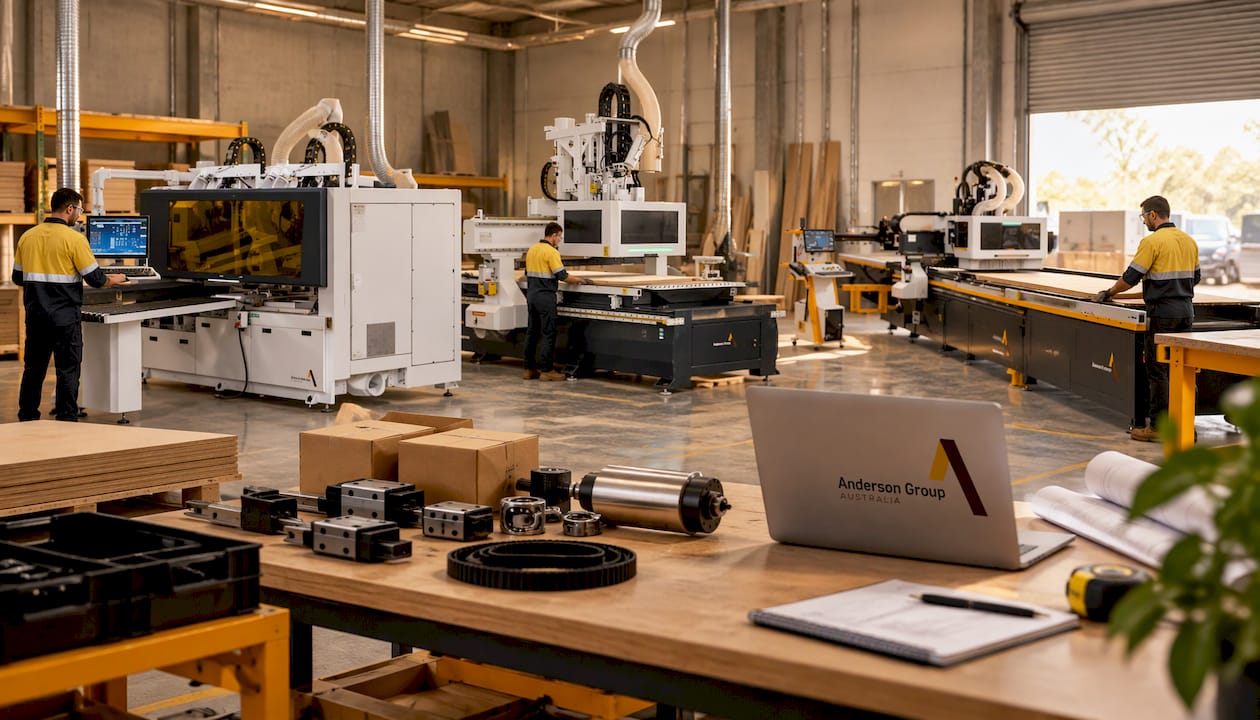
For a part enquiry on an existing machine, send the model, serial number, part number and photos through our website.
FAQ
How do I find the right CNC spare part number?
Check the part’s own markings, your machine’s spare-parts catalogue and your maintenance records. Keep every letter, zero and suffix exactly as shown. If you cannot read a number, send photos and the machine’s serial number so the part can be matched to your configuration.
How long does it take to get CNC parts in Australia?
It depends on whether the part is held locally or ordered from overseas, and on air or sea freight. Imported parts pass through factory picking, freight and customs, and published importer ranges show each phase can take days to weeks. Ask your supplier for the time for your specific part.
Which parts should I keep in stock?
Keep the parts that would stop production longest and take longest to arrive, based on your own breakdown records and your machine’s maintenance schedule. Start with wear items and small safety or control components, then review the list each year.
What should I send when I request a part?
Send the machine make and full model, serial number, a photo of the identification plate, the part number and quantity, the catalogue page and item position if you have it, photos of the component, any modifications, and your delivery location and required date.
Sources
- How to Identify the Right Spare Part: Part Number, Machine and Details
- Spare Parts Strategy for Keeping Imported Equipment Running
- Implementing a Strategic Approach to Critical Spare Parts Inventory
- Hitachi Parts User Guide
- AS/NZS 4024:2019 Series, Safety of machinery