
For CNC machines in Australia, the AS/NZS 4024 series is the primary machinery safety standard, and every PCBU carries duties under the Work Health and Safety Act to run safe plant with safe systems of work. Start today with three actions: run a documented risk assessment against AS/NZS 4024, physically verify your guarding, interlocks and emergency stops are functioning, and produce or update your SWMS and SOPs before the next shift begins.
TL;DR:
- Most older or imported CNC machines in Australia require retrofitting of interlocks, emergency stops, or presence-sensing devices to meet AS/NZS 4024 standards.
- A gap analysis against relevant standards should be conducted before commissioning any secondhand equipment to identify potential non-compliance issues.
- Compliance testing should follow a scheduled regime including daily checks, periodic functional tests, and annual full validations, with detailed records retained.
- Proper installation of safeguards, such as correctly specified light curtains and redundantly wired emergency stops, is crucial to prevent safety failures during retrofits.
- Engaging with experienced providers for compliance reviews and upgrades can save costs and reduce risks versus ad hoc, DIY retrofit efforts.
Table of Contents
- What Australian standards and regulator guidance cover CNC machine safety
- What PCBUs must do under the WHS Act and Codes of Practice
- Guards, interlocks, presence-sensing and emergency stops for CNC
- Risk assessment, SWMS and SOPs for CNC operations
- Retrofitting older or imported CNC machines to Australian standards
- Inspection, testing and maintenance for CNC compliance
- Training, PPE and administrative controls for CNC operators
- Procurement, retrofit and commissioning checklist for compliant CNC machines
- Practical lessons from field upgrades: why engineering-first controls win
- How Anderson Group Australia supports CNC safety compliance
- Sources
- FAQ
What Australian standards and regulator guidance cover CNC machine safety
Two different things govern CNC safety in Australia, and confusing them causes most compliance headaches. The AS/NZS 4024:2019 series is the technical standard, containing 26 parts that specify how guards, interlocks, safety distances and emergency stops should actually be engineered. The Work Health and Safety Act and its Codes of Practice are the legal layer, setting out what a business must achieve, not how.
Standards Australia develops and maintains AS/NZS 4024 jointly with Standards New Zealand, and regulators treat compliance with it as strong evidence you’ve met your “reasonably practicable” duty under WHS law. That distinction matters when an inspector turns up: they won’t cite you for breaching AS/NZS 4024 directly, because it isn’t law in most jurisdictions. They’ll cite you for breaching the WHS Act, and point to AS/NZS 4024 as the benchmark you failed to meet.
For CNC operations specifically, a handful of parts do most of the heavy lifting:
- AS/NZS 4024.1201 covers general risk assessment principles for machinery, the starting point for any CNC safety file.
- AS/NZS 4024.1601 deals with fixed guards, their design and construction requirements.
- AS/NZS 4024.1602 and 1603 address interlocking guards and the prevention of unexpected start-up, both critical on machines with automatic tool changers or pallet systems.
- AS/NZS 4024.1604 governs emergency stop devices, including placement, colour, and function.
- AS/NZS 4024.1801 sets out safety distances to prevent reaching hazard zones, used to size barriers and calculate light curtain approach distances.
State regulators build on this technical base with their own practical material. WorkSafe Queensland’s guide to machinery and equipment safety and SafeWork NSW’s guide to machine safety both translate the standard’s engineering language into hazard identification steps and risk control options a workshop manager can actually action on the floor. Neither replaces AS/NZS 4024. They sit alongside it, showing regulators how a PCBU is expected to apply it in practice.
What PCBUs must do under the WHS Act and Codes of Practice
Every business running a CNC machine in Australia is a “person conducting a business or undertaking” under the WHS Act, and that status carries specific, non-transferable duties. You can outsource the machining. You can’t outsource the responsibility for the people standing next to the spindle.
The core duty is to provide and maintain a safe working environment. In practice, that breaks down into several concrete obligations:
- Maintain plant, systems of work and the working environment so risks to health and safety are eliminated or minimised so far as is reasonably practicable.
- Provide adequate information, training, instruction and supervision for anyone who operates, sets up or maintains the machine.
- Consult with workers on health and safety matters affecting them, including proposed changes to machine guarding or work procedures.
- Ensure machinery is designed, installed and maintained in line with its intended use and manufacturer instructions.
Manufacturers, importers and suppliers of CNC equipment carry a parallel and earlier set of duties. Under the WHS Act, they must ensure plant is designed and manufactured to be safe when used as intended, provide adequate information about safe use (including residual risks), and carry out testing where necessary to verify the equipment performs as claimed. This is why a used CNC machine imported without local documentation is a red flag: the chain of manufacturer and importer duties has effectively been broken, and the buyer inherits the gap.
Regulators use the Model Code of Practice for Managing the Risks of Plant in the Workplace and state-specific guides as the practical yardstick for what “reasonably practicable” looks like. Following a Code of Practice isn’t mandatory in the way a law is, but courts and regulators treat departure from it as something you’ll need to justify. State WorkSafe machine safety guides go further, listing the specific guarding methods, recordkeeping expectations and inspection intervals regulators expect to see documented when they walk through your workshop.
Guards, interlocks, presence-sensing and emergency stops for CNC
Safeguarding a CNC machine isn’t one decision, it’s a stack of decisions, and the standard treats each layer differently depending on where the hazard sits and how often someone needs access.
Fixed guards are the simplest layer: a barrier bolted in place over a hazard zone that’s rarely accessed, sized according to the reach distances in AS/NZS 4024.1801. Movable or interlocked guards cover zones opened regularly, like tool-change doors or work-holding areas, and must be linked to the control system so the machine cannot run with the guard open, per AS/NZS 4024.1602 and 1603. The critical failure mode regulators flag repeatedly is the interlock that’s been defeated with tape or a magnet to speed up cycle changes. A guard that can be bypassed in seconds isn’t a guard.
Presence-sensing devices, such as light curtains, laser scanners and pressure-sensitive mats, protect larger or irregular access zones where a physical barrier would obstruct material flow, common on gantry-style CNC routers and large-format machining centres. SafeWork NSW’s guide sets out approach-distance tables that determine how far a light curtain must sit from the hazard, based on the machine’s stopping time. Get that distance wrong and the light curtain trips too late to matter.
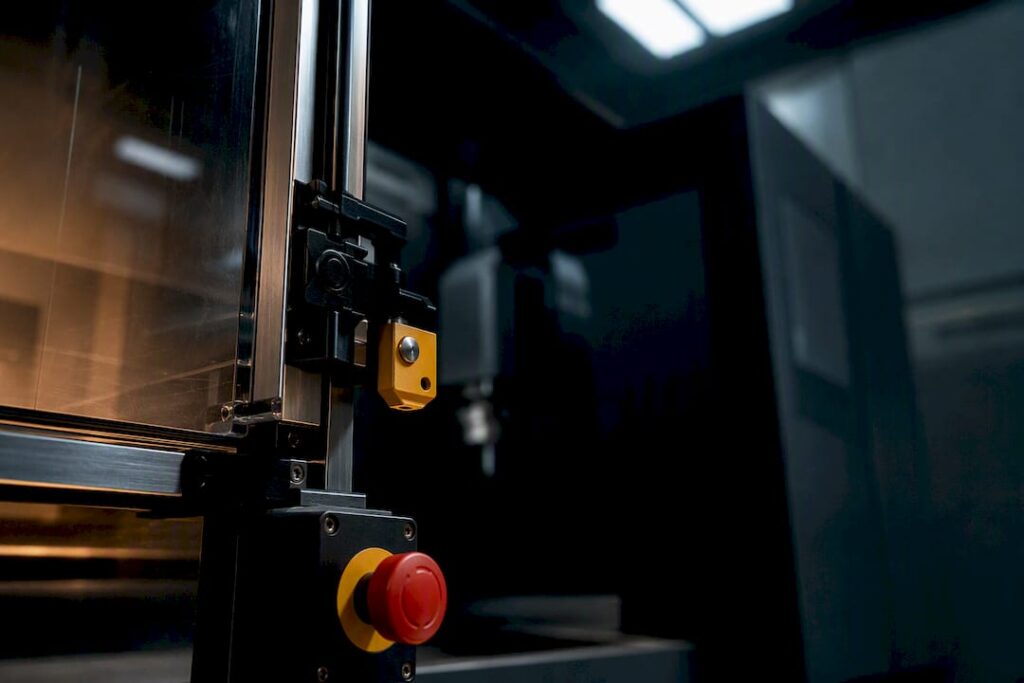
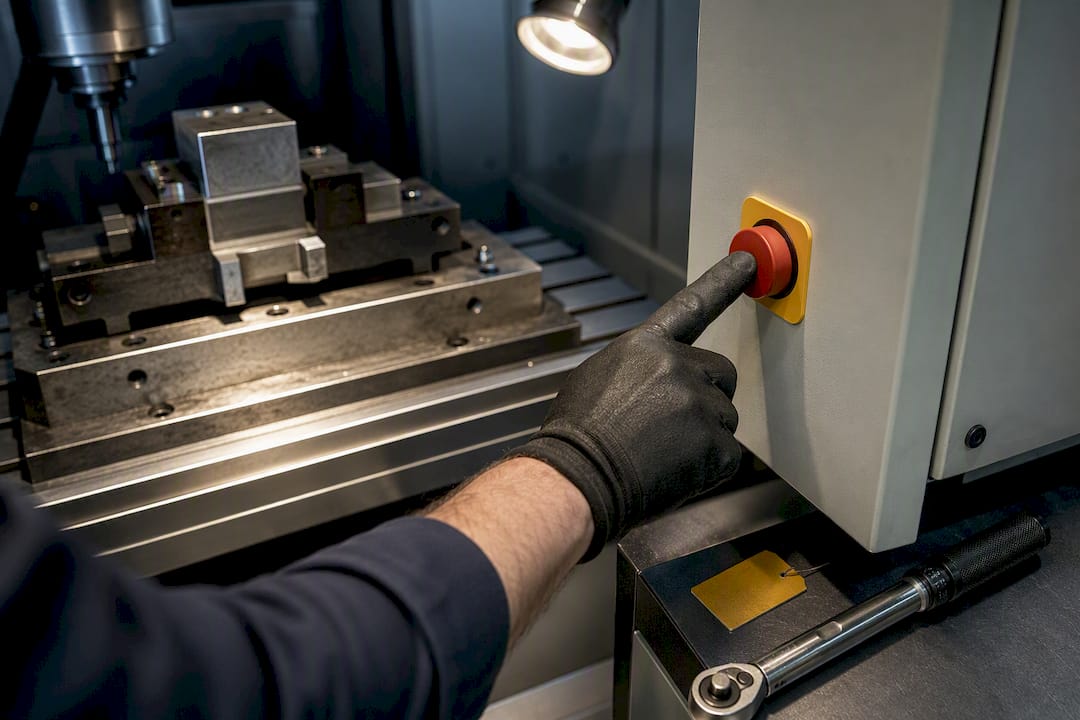
Emergency stop devices are the last line of defence, and AS/NZS 4024.1604 is specific about placement, colour and redundancy: E-stops must be reachable from every normal operating position, wired independently of the main control logic where practicable, and tested regularly rather than assumed to work.
- Fixed guards for rarely accessed hazard zones, sized to AS/NZS 4024.1801 reach tables.
- Interlocked movable guards for doors and access panels opened during normal operation.
- Presence-sensing devices for large or irregular access zones where barriers aren’t practical.
- Redundant, independently wired emergency stops tested on a documented schedule.
Regulator guidance is consistent on one point: elimination of the hazard is always the preferred control before guarding or presence-sensing, and guards themselves must be maintained to remain difficult to bypass.
Pro Tip: Test your emergency stops under load, not just at idle. A stop button that halts a machine cleanly with no material in the spindle can behave very differently when a heavy fixture is mid-cycle. Document the load-tested result, not the idle one.
Risk assessment, SWMS and SOPs for CNC operations
Documentation is where most audits actually get won or lost, because a well-run workshop with no paper trail still looks non-compliant to an inspector who can’t see six months of good habits.
- Identify the hazard. Walk the machine cycle from load to unload and list every point of contact with moving parts, ejected material, coolant mist or laser alignment systems, using AS/NZS 4024.1201 as your framework.
- Assess the risk. Rate likelihood and consequence for each hazard, factoring in how often the guard or barrier is opened and by whom.
- Select controls, following the hierarchy: eliminate, then engineer (guarding, interlocks, presence-sensing), then administer (procedures, training), then PPE.
- Document the outcome in a Safe Work Method Statement for high-risk construction-adjacent work, or a Standard Operating Procedure for routine production tasks. SWMS templates built for CNC and precision machining typically reference the WHS Regulation, AS 4024 parts and the Model Code of Practice directly, and cover recurring hazards like entanglement, ejected swarf and coolant exposure.
- Retain records. Keep risk assessments, commissioning test results and SWMS/SOP revisions accessible for audit, particularly after any retrofit or control change, since a regulator investigating an incident will ask for the paper trail first.
A quick internal review of your CNC uptime and setup procedures often surfaces gaps between what the SOP says and what actually happens on the floor, which is worth catching before an inspector does it for you.
Retrofitting older or imported CNC machines to Australian standards
A machine bought secondhand or imported from a market with lighter safety requirements almost never arrives compliant. Treat that as the starting assumption, not an edge case.
Begin with a gap analysis: walk the machine against the relevant AS/NZS 4024 parts and note every deviation, from missing interlocks to guards that don’t meet the reach-distance tables. Document the gaps formally and build a remedial plan with target dates, because an unactioned gap analysis sitting in a drawer offers no protection if something goes wrong before the fix is made.
The most common retrofit items on older or imported CNC equipment include:
- Interlocking movable guards replacing fixed or absent barriers on access panels.
- Redundant emergency stop circuits wired independently of the main controller.
- Light curtains or safety scanners added to large-format machining or gantry-style routers.
- Safety-rated PLCs replacing relay-based safety logic that can’t be reliably validated.
- Updated guarding on rotating components like tool changers and pallet shuttles.
Second-hand and imported CNC machines commonly need exactly this combination of upgrades before they meet AS/NZS 4024-derived expectations in an Australian workshop.
Deciding between retrofit and replacement comes down to four factors: the residual risk after the best achievable retrofit, the retrofit cost against the machine’s remaining productive life, whether spare parts and safety-rated components are still supportable, and how the machine’s control architecture handles the safety upgrade. A 15-year-old machine with a relay-based safety circuit and no safety PLC pathway is often a harder retrofit than the sticker price suggests. A reliability check before purchase catches this earlier than a post-purchase surprise does.
Inspection, testing and maintenance for CNC compliance
Compliance isn’t a one-off event. It’s a maintained state, and the schedule you run determines whether you can prove that state on the day something goes wrong.
Split your regime into three tiers. Daily pre-start checks cover the basics an operator can verify in under five minutes: guard closure, E-stop function, warning lights, and any obvious damage to interlocks or cabling. Periodic functional testing, typically monthly or quarterly depending on duty cycle, verifies safety devices trip correctly under actual operating conditions, not just at idle. Full validation, done annually or after any control system change, tests safety-related components under fault conditions to confirm fail-safe behaviour, the kind of check referenced in the safety-related control system parts of the AS/NZS 4024 series.
Regulator guidance treats administrative controls like training and signage as necessary but the least effective layer of protection. Engineered and design changes that eliminate or reduce the hazard at the source are consistently ranked ahead of relying on people to follow a procedure correctly every single time.
Good recordkeeping isn’t paperwork for its own sake. Keep:
- Dated pre-start checklists, even when nothing is found wrong.
- Functional test results with the specific device, date and outcome recorded.
- Full validation reports, retained for the life of the machine plus a reasonable buffer after decommissioning.
- Any incident or near-miss reports tied to safeguarding, cross-referenced against the relevant SWMS.
Auditors and insurers both look for the same thing: a continuous record, not a folder that starts three months before the inspection.
Training, PPE and administrative controls for CNC operators
Training and PPE matter, but they’re the layer regulators expect you to lean on least, not most. If your safety plan depends heavily on operators remembering the right procedure every time, the plan has a structural weakness.
Operator competency for CNC work should cover machine-specific setup, safe work procedures and what to do when a safety device trips, with refresher training at a frequency tied to how often the machine or process changes. Training package materials for CNC machining competencies build safety and risk-control elements directly into the required skill set, not as an add-on module.
PPE guidance carries real cautions specific to CNC work:
- Gloves near rotating spindles or tool changers create an entanglement risk that outweighs the cut protection they offer, and many workshops explicitly ban gloves at the point of operation for that reason.
- Eye protection and hearing protection remain appropriate baseline PPE for most CNC operation and setup tasks.
- Respiratory protection matters more in woodworking and composite machining, where airborne particulate exposure is a separate hazard from the mechanical risks discussed here.
Administrative controls, permit-to-work systems, lockout/tagout procedures for maintenance access, and documented supervision arrangements fill the gap between engineered safeguards and human judgement. They work best as a backstop to the guarding and interlocks already in place, not as the primary control.
Pro Tip: Run your lockout/tagout procedure as a physical drill at least once, don’t just file it. Watching a maintenance technician actually isolate a machine reveals gaps a written procedure never will, like a lockout point that’s inconvenient to reach and gets skipped under time pressure.
Procurement, retrofit and commissioning checklist for compliant CNC machines
Buying a new CNC machine should be the easiest path to compliance, because the manufacturer and supplier duties under the WHS Act put the design burden on them, not you. That’s only true if you ask the right questions before signing.
Before purchase, request:
- A declaration of conformity or equivalent documentation referencing the AS/NZS 4024 parts the machine meets.
- Full operating and maintenance manuals, including safety device specifications and testing intervals.
- Confirmation of interlock type, emergency stop redundancy, and presence-sensing specifications where fitted.
- A commissioning risk assessment plan, carried out on-site after installation, not assumed from factory testing alone.
Service expectations matter just as much as the initial specification sheet. A scheduled maintenance plan, confirmed spare parts availability for safety-critical components, and on-site commissioning support all affect how long that compliance actually holds after delivery. A machine with excellent factory specifications and no local parts support is a compliance risk waiting on a twelve-week shipping delay.
A short tender checklist for workshop managers evaluating a new or replacement CNC machine:
| Requirement | What to verify |
|---|---|
| Guarding compliance | Documentation against relevant AS/NZS 4024 parts |
| Interlock and E-stop specification | Redundancy and independent wiring confirmed |
| Commissioning support | On-site risk assessment included or quoted separately |
| Spare parts and service | Local availability for safety-critical components |
| Training provision | Operator and maintenance training included at handover |
Anderson Group Australia’s decades in CNC machining equipment across woodworking, metalworking and advanced materials means these procurement questions come up on almost every serious tender. The answer is rarely “trust the brochure.” It’s “get the documentation in writing before the deposit.”
Practical lessons from field upgrades: why engineering-first controls win
The retrofits that go wrong usually fail on the same two points: approach distances calculated for the wrong stopping time, and safety cabling routed alongside power cables where interference corrupts the E-stop signal at exactly the wrong moment. Both are avoidable, and both get missed when a retrofit is treated as a bolt-on job rather than a proper engineering exercise.
Investing in engineered safeguards, redundant E-stops, correctly specified light curtains, interlocks that can’t be defeated with tape, matters more than any training program, because it removes the assumption that people will always do the right thing under time pressure. Training still matters. It just isn’t the layer that catches the tired operator on a Friday afternoon shift.
If your workshop is weighing a retrofit against a replacement, get a compliance review done before committing capital either way. The gap analysis usually costs far less than the mistake it prevents.
— Anderson
How Anderson Group Australia supports CNC safety compliance
An alternative to guessing your way through a retrofit: instead of piecing together interlocks, light curtains and safety PLCs from three different suppliers, you can get machines and upgrade packages built around the AS/NZS 4024 requirements from the outset.

Our Wood Machinery, Metal Machinery and Advanced Materials Machinery ranges cover furniture, cabinetry, automotive, aerospace, marine and general engineering applications, with the full machines listing available for workshops comparing vertical machining centres, 5-axis platforms and production machining centres against their compliance requirements. For workshops running older equipment, a commissioning risk assessment and retrofit conversation with a knowledgeable provider is the fastest way to find out where a current setup may fall short of AS/NZS 4024 before an inspector tells you.
Get in touch through Andersonaustralia to request a quote or arrange a compliance review for your next machine purchase or retrofit project.
Sources
- Guide to machinery and equipment safety
- Guide to machine safety (SafeWork NSW)
- LMFFM3031B_R1 – Training component (CNC machining)
FAQ
What are the safety rules for CNC machines in Australia?
CNC machines must be guarded, interlocked and fitted with emergency stops in line with the AS/NZS 4024 series, and the PCBU operating the machine must meet WHS Act duties for safe plant and safe systems of work. In practice, that means a documented risk assessment, verified safeguarding, and a current SWMS or SOP for the task.
Are AS/NZS 4024 and ISO standards mandatory in Australia?
AS/NZS 4024 isn’t law in itself, but it’s the technical benchmark regulators use to judge whether a PCBU has met its “reasonably practicable” duty under the WHS Act. Departing from it without a documented justification is a difficult position to defend if an incident occurs or an inspector reviews your safety file.
What are the mandatory safety standards for machinery in Australia?
There’s no single mandatory checklist; obligations flow from the WHS Act, with the AS/NZS 4024 series as the recognised technical standard for machine guarding, interlocks and emergency stops. State WorkSafe guides fill in the practical detail regulators expect to see applied.
Do older or imported CNC machines need to be retrofitted?
Most secondhand or imported CNC machines need some combination of interlocks, redundant emergency stops or light curtains before they meet AS/NZS 4024-derived expectations in an Australian workshop. A gap analysis against the relevant standard parts should happen before the machine goes into service, not after.
Does Anderson Group Australia help with CNC compliance retrofits?
Anderson Group Australia supplies compliant CNC machines across wood, metal and advanced materials, and supports commissioning risk assessments and retrofit conversations for existing equipment. Current pricing and specific package details are available directly through Andersonaustralia.