
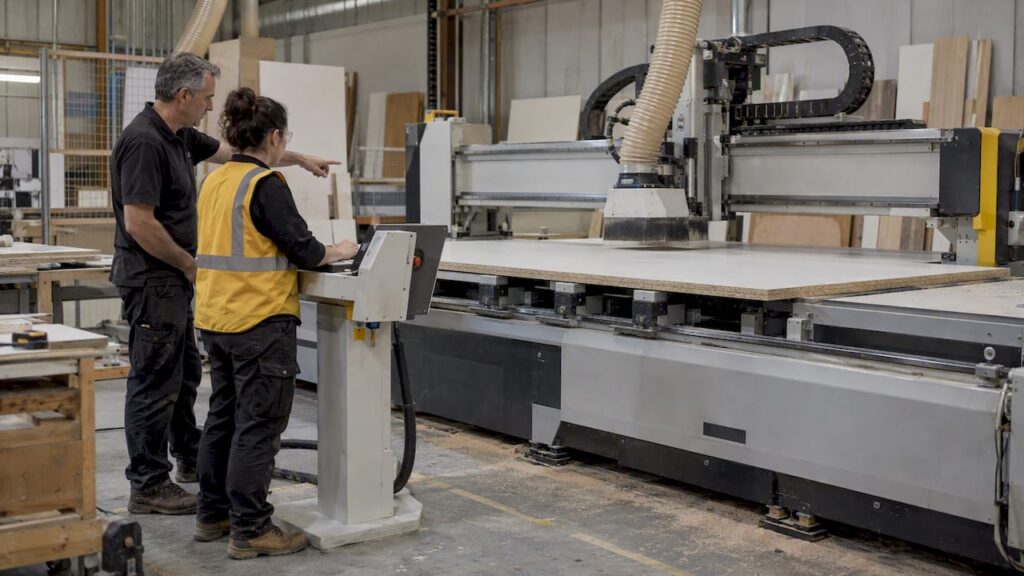
A CNC nesting machine is not finished when the freight truck leaves. Installation, commissioning and operator training decide whether the machine cuts good parts in week two or sits half-used for months. In Australia they are also a work health and safety matter: the business that controls the workplace carries the duty, whoever carries out the work. This guide sets out what to plan, what to ask a supplier, and what to settle in writing before you sign.
It is written for kitchen manufacturers, cabinet makers, joinery shops and furniture makers. Where we describe general practice, we say so. Where something depends on the exact model or your supply agreement, we say that too, because those details should always be confirmed on the machine’s own page and in your quote.
TL;DR
- Under WHS law, your business, as the person with management or control of the workplace, keeps the primary duty. The supplier’s help does not transfer it.
- Treat installation as its own risk phase: power, floor, dust extraction, compressed air and the way the machine sits beside other plant.
- Training should be hands-on, task-specific and repeated for new starters and after changes, not a single demonstration on delivery day.
- Ask in writing what the supplier’s installation, commissioning, training, service and parts scope covers. We do not assume inclusions, and neither should you.
- Match the machine to your panels, parts and volumes first. A family name does not guarantee a particular option.
Table of Contents
- Who is responsible for what
- Before delivery: site preparation
- Installation and commissioning: what happens on the day
- Operator training that holds up
- Service, repairs and spare parts: ask before you buy
- Choosing the machine comes first
- What about finance?
- Talk to us about your application
- FAQ
- Sources
Who is responsible for what
A common assumption is that the supplier “handles compliance”. The model Code of Practice from Safe Work Australia says otherwise: it is aimed at anyone who manages or controls plant in the workplace, or installs, constructs and commissions plant. Your business, as the PCBU, must manage risks across the life of the plant, from purchase to disposal.
In practice that means three things for a nesting machine:
- Competent people do the installing and commissioning. That can be the supplier’s technicians, your electrician and your own maintenance staff, but you should know who is doing what and be able to show they are competent for it.
- Information travels with the machine. The same Code covers providing safety information for installation, testing and maintenance. Ask for the manufacturer’s manual, electrical drawings and guarding and emergency stop details before the machine is switched on, not after.
- Instruction and training are part of the duty. The Code’s reference to WHS Regulation 39 concerns information, training and instruction for people who use plant.
WHS law is administered state by state and the model laws are adopted with variations, so check your own regulator’s requirements as well. Our companion piece on meeting AS/NZS 4024 for CNC machines covers the safeguarding standards side in more depth.
Before delivery: site preparation
Most installation delays come from the building, not the machine. Safe Work Australia’s guidance treats installation as a distinct risk phase, because power supply compatibility, interaction with other plant and environmental factors such as dust and moisture are controlled or created at that point. Generic setup videos cannot cover your site.
Work through this list with your supplier’s documentation for the exact model you are buying:
- Floor space and access. Measure the machine footprint, then add working room for loading sheets, unloading parts, service access and forklift or pallet-jack movement. Our floor space planning guide suggests budgeting well beyond the vendor’s stated footprint. Check door and roller-door heights for delivery too.
- Floor condition. Confirm with the manufacturer what foundation and levelling the model needs. Do not guess from a different machine.
- Electrical supply. Have a licensed electrician check phase, capacity and the isolation arrangements against the machine’s electrical specification before delivery day.
- Compressed air. Get the required pressure and flow from the documentation, and check your compressor and dryer can supply it alongside everything else on the line.
- Dust extraction. A nesting router produces a lot of fine panel dust and chips. Size and route the extraction against the machine’s documented connection requirements. Our guide to CNC dust collection explains how to approach it. Dust extraction for wood panels is a separate system from liquid coolant used in metal machining, and the two should not be mixed up in specifications.
- Material flow. Decide where sheets are stored, where offcuts go and where parts travel next, whether to edgebanding, drilling or assembly.
- Software and network. Plan the PC, CAD/CAM or nesting software licences, file transfer method and backup before the machine arrives.
Installation and commissioning: what happens on the day
Installation is placing, levelling and connecting the machine. Commissioning is proving that it works safely and as specified in your workshop. Treat them as separate steps with separate sign-offs.
A sensible commissioning sequence, as general guidance rather than any one supplier’s procedure:
- Positioning and levelling against the manufacturer’s instructions.
- Utility connection by licensed trades: electrical, compressed air and extraction.
- Safety function checks. Emergency stops, guarding, interlocks and any safeguarding devices are tested and the results recorded.
- Machine setup. Axes, tool changer and vacuum table are checked and any calibration the manufacturer specifies is carried out.
- Software and controller setup. Post-processor, tool library and machine parameters are loaded and checked.
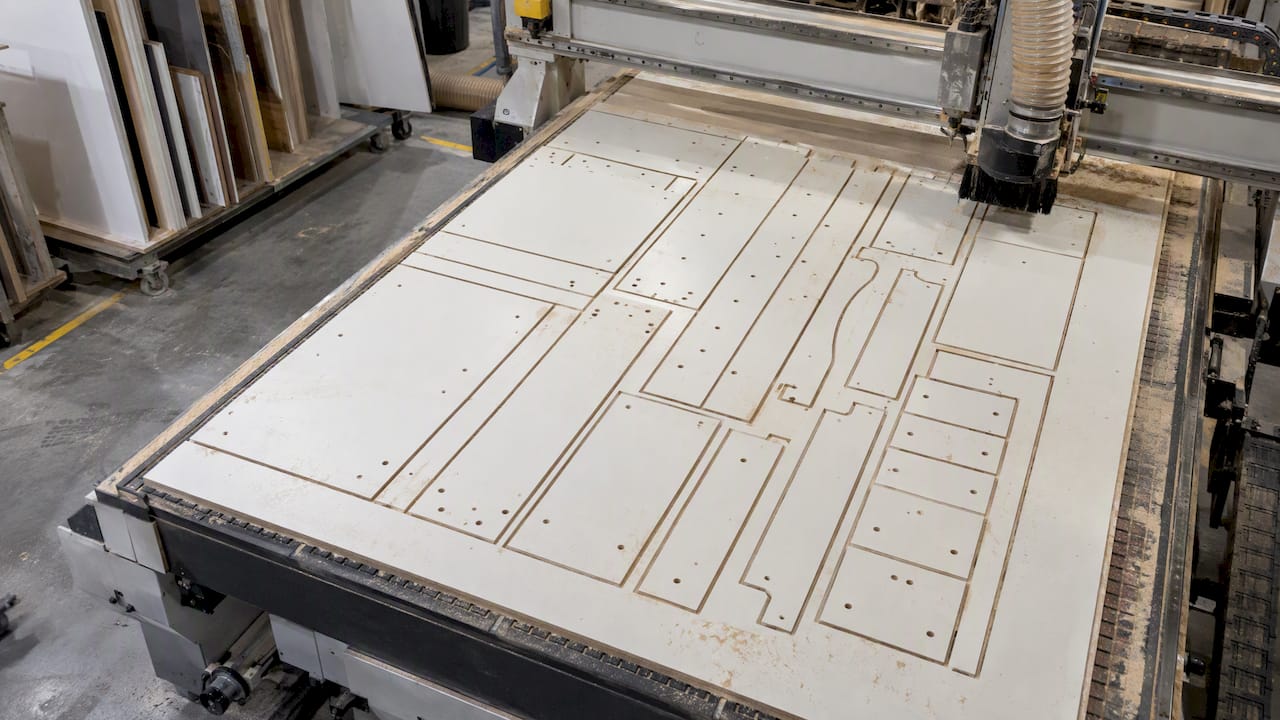
- Test cut on your actual board, such as melamine, MDF, plywood or whatever you run, with a part drawing from your own production.
- Handover record. Keep the checklist, settings, manual and contacts together.
The national training system describes the software side of this as a competency in its own right: FWPTMM4203 Install and commission CNC software. It is a useful reference for what a competent person should be able to do, though the unit does not tell you who your supplier will send.
Run a test cut with your own parts
The most useful acceptance test is a real job. Run a nested sheet of parts you already make, then check part size, edge quality, hole positions and how cleanly the table holds small parts. Our technical team’s view, in our foam machining guide, applies equally to board: choose by the material and part drawings you actually have. Enclosure design, workholding and extraction should be confirmed against your own application rather than assumed from a family name.
We do not publish tolerances or commissioning times for our machines in this article. Ask for the figures for the specific model you are considering, and have them put in your quote.
Operator training that holds up
Safe Work Australia says workers need supervised, hands-on training in the tasks they will perform before they start the job. That guidance covers performing tasks safely and operating machines and equipment safely. It also needs to be given as part of induction and repeated when machinery changes or as refresher training.
For a nesting machine, that translates into three groups of people with different needs.
| Role | What they need to be able to do | Typical gaps |
|---|---|---|
| Operator | Start-up and shutdown, loading sheets, running a nested job, unloading, clearing offcuts, recognising faults, emergency procedures | Skipping daily checks, unsafe clearing of chips near moving parts |
| Programmer / CAM user | Importing drawings, nesting layouts, tool and feed selection, post-processing, simulation | One person holds all the knowledge |
| Maintenance / leading hand | Daily and periodic checks, lubrication, filter and extraction care, fault reporting, isolation before maintenance | Maintenance done without proper isolation, no log kept |
Recognised units as a framework
If you want a formal yardstick, two national units are relevant. MSFFM3044 covers setting up, operating and maintaining CNC sizing machines, and MSFFM3022 covers setting up, operating and maintaining CNC machining and processing centres. Whether either fits your machine is a judgement for you and your registered training organisation. These units are frameworks, not substitutes for training on your specific model.
Do not forget non-routine tasks
The WorkSafe WA woodworking guide is a good reference for the point that guarding is only one part of the answer. Workers should also be instructed on the hazards of moving parts, including during maintenance and troubleshooting, and on the manufacturer’s manual for their specific machine. Build a short, written procedure for clearing jams, changing tools and isolating the machine, and train to it.
Make training stick
- Train on your own jobs, not a sample file.
- Write a one-page start-up and shutdown sheet and keep it at the machine.
- Record who has been trained, on what, and when.
- Schedule a refresher a few weeks after go-live, once real questions have surfaced, and again when staff or software change.
- Keep a second person trained on nesting and tool libraries so one absence does not stop production.
Service, repairs and spare parts: ask before you buy
Installation is a one-off. Service and parts are the relationship that lasts for the machine’s working life. Readers searching for nesting machine servicing, edgebander repairs or edgebander spare parts across Australia are usually asking the same underlying questions.
Put these to any supplier, including us, and get the answers in writing:
- Scope. What is included in installation, commissioning and training, and what is charged separately?
- Servicing. Is there a planned service arrangement, what does it cover, and who does the work?
- Parts. Which consumables and wear parts are held locally, and which are ordered from overseas? We only describe local stock or response times when they are documented, so confirm the agreed scope for your model.
- Documentation. Will you receive parts lists, electrical drawings and manuals in a form your maintenance person can use?
- Remote support. Can the controller be diagnosed remotely, and under what conditions?
- Spares to hold yourself. Ask which small items are worth keeping on the shelf for your model, such as filters and common wear items.
Edgebanders, nesting machines and drilling machines are separate machine types with separate parts and servicing needs. In our range, AFS models are edgebanders, ATS is a nesting, routing and drilling model, ADM is a six-sided drilling and routing model, and ARS is a panel-return system. Say which one you mean when you ask about servicing or parts, so the answer comes from the right documentation.
On a regular basis, machine monitoring can help a workshop see downtime patterns and plan maintenance around them. It is a complement to a service arrangement, not a replacement.
Choosing the machine comes first
Good installation and training cannot fix the wrong machine. Settle these questions before you worry about delivery day:
- Panel sizes and thickness you actually run, and how many sheets a shift.
- Operations in one pass. Nesting, routing and drilling suit different workflows from sizing with a panel saw, edgebanding and then separate drilling. Our guide to nested-based manufacturing compares how cabinet shops organise this.
- Loading and unloading. Manual or automated, and what that does to labour and floor space.
- Options you need. Confirm tool changer, vacuum, labelling, extraction connection and software for the exact model and configuration. Do not infer an option from a family name or axis count.
- Downstream steps. Edgebanding and drilling capacity that can keep up with the nesting output.
For the products themselves, see our wood machinery range, which leads with nesting and panel-processing machines, and the applied guides for cabinet CNC machining, furniture CNC machining and door machining.
What about finance?
Some buyers also ask about edgebander or nesting machine finance. We do not publish finance terms, rates or partners, and nothing here is financial advice. Treat finance as a separate decision: ask your accountant or broker how equipment finance and tax treatment apply to your business, and ask us for a written quote with a clear itemised scope, including installation and training, so the figure you take to a lender is complete.
Talk to us about your application
Anderson Group Australia supplies CNC machinery, servicing and parts to Australian manufacturers, with kitchen, cabinet, joinery and furniture makers as our main customers. We help you choose machinery for your own production. We do not offer subcontract cutting or machining. Browse the wood machinery range, or see the full machine list and ask us about your panels, volumes and site. We will confirm specifications against the product page and set out what installation, training and support apply to your configuration.
If your work is in metal or aluminium rather than panels, that is a separate range, covered on our metal machinery page.
FAQ
Does the supplier handle WHS compliance when installing a nesting machine?
Not entirely. The Safe Work Australia model Code places the primary duty on the person with management or control of the workplace, which is your business. A supplier can install, commission and train, but you remain responsible for managing risks and making sure the people involved are competent.
How long does operator training take?
It depends on the machine, the software and the experience of your people, so we do not quote a standard number. Ask for a written training plan for your model that separates operators, programmers and maintenance staff. Plan for a follow-up session after go-live as well.
Do I need a formal qualification to operate a CNC nesting machine?
The guidance requires practical, task-specific training and instruction rather than one named certificate. Units such as MSFFM3044 and MSFFM3022 can serve as a framework if you want to formalise competence. Check with your state or territory WHS regulator and your training provider about what suits your situation.
What should I ask about servicing and spare parts before buying?
Ask what is included, who performs the work, which parts are held in Australia, and how faults are diagnosed. Get the answers in your quote. Be specific about whether you mean a nesting machine, an edgebander or a drilling machine, as parts and service differ.
Can I use a generic setup video to install my machine?
Not as the plan. Generic videos do not cover your power supply, floor, dust extraction or the other plant around the machine. Use the manufacturer’s documentation for your exact model and your supplier’s commissioning process.
Sources
- Model Code of Practice: Managing risks of plant in the workplace, Safe Work Australia
- Managing the risks of plant in the workplace (November 2024 PDF), Safe Work Australia
- Train workers for their specific tasks, Safe Work Australia
- FWPTMM4203 Install and commission CNC software, training.gov.au
- MSFFM3044 Set up, operate and maintain CNC sizing machines, training.gov.au
- MSFFM3022 Set up, operate and maintain CNC machining and processing centres, training.gov.au
- Woodworking guide, WorkSafe Western Australia