
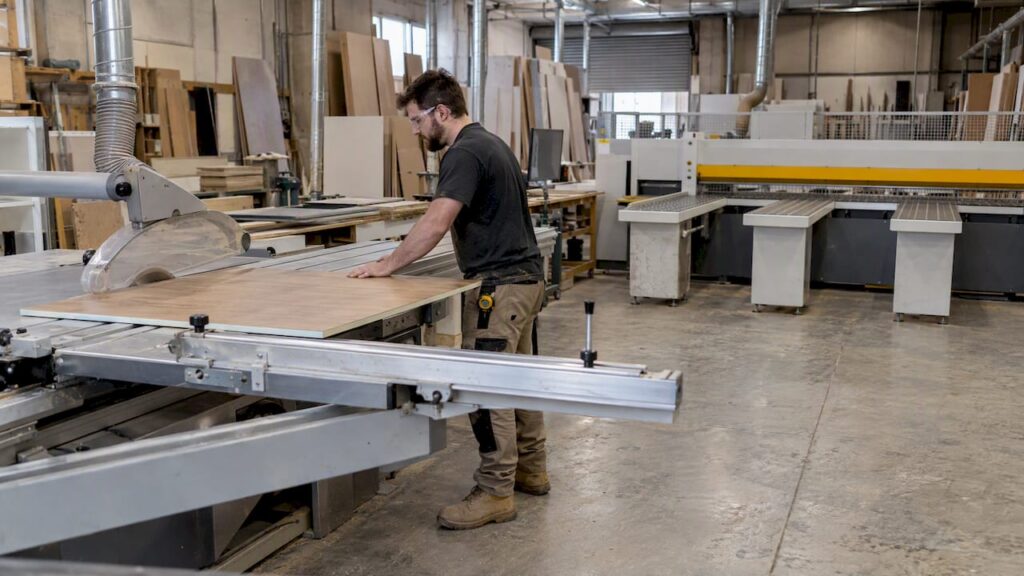
Beam saws suit high-volume, nested panel production where yield and throughput drive the job mix, while sliding table panel saws suit flexible, bespoke or angle-heavy work where setup speed and simplicity matter more than raw output. The trade-off runs in the other direction too: beam saws add mechanical complexity and a higher maintenance burden, while sliding tables ask more of the operator for mitres, bevels and one-off parts.
TL;DR:
- Beam saws gain throughput from stack cutting and nesting, while sliding tables suit changing dimensions, prototypes, and single sheet jobs.
- Before choosing, map the full material path: beam saws need loading, beam travel, and offload zones, while sliding tables require clear carriage runs.
- Beam saw upkeep can involve PLCs, clamps, seals, sensors, and cable carriers; sliding table maintenance centers on blades, riving knives, and carriage bearings.
- Test a typical job on the showroom machine using your own panels, then compare cycle time, material yield, and rework with your current process.
- Before operation, verify top guards, riving knives, interlocks, and documented inspections, and check applicable requirements against AS 1473 and AS/NZS 4024.
Table of Contents
- At-a-glance comparison of capabilities and trade-offs
- How each saw cuts and the practical impact on accuracy and edge finish
- Nesting, stack cutting and real-world throughput differences
- Footprint, feeding and storage implications for shop layout
- Spare parts, likely failure modes and budgeting for upkeep
- Australian guarding guidance, checklists and standards to follow
- A practical decision checklist and scoring prompts for buyers
- How Anderson Group Australia supports selection, supply and servicing
- FAQ
- Sources
At-a-glance comparison of capabilities and trade-offs
The two machine types solve different problems, and the gap shows up clearly once you line up the dimensions that matter for kitchen, cabinet and joinery production.
- Best for: beam saws suit repeat-run, nested panel jobs; sliding tables suit custom, one-off and angled work.
- Cutting method: beam saws use a horizontal beam blade travelling across a stacked, clamped panel pack; sliding tables use a carriage that pushes the panel through a fixed blade.
- Accuracy: both can hold tight tolerances when set up correctly, but beam saws depend more on clamp pressure and beam calibration, while sliding tables depend on fence and carriage alignment.
- Throughput: beam saws win on volume through stack cutting and nesting optimisation; sliding tables win on changeover speed for short runs.
- Typical tasks: beam saws handle repetitive sizing for kitchen carcasses and flat-pack runs; sliding tables handle bespoke joinery, mitres and bevelled edges.
- Footprint: beam saws need a longer, dedicated feed and offload zone; sliding tables need a clear carriage run on one side.
- Maintenance: beam saws carry more electro-mechanical subsystems and a broader spare-parts list; sliding tables are mechanically simpler to service.
- Safety: both require guarding, riving knives and documented checks, with guarding requirements summarised by WorkSafe applying to both machine types.
For a kitchen or cabinet shop running the same door and panel sizes week after week, the beam saw’s nesting advantage compounds fast. For a joinery shop doing bespoke fitouts with varied angles and one-off sizes, the sliding table’s flexibility and shorter learning curve tend to matter more than headline throughput.
How each saw cuts and the practical impact on accuracy and edge finish
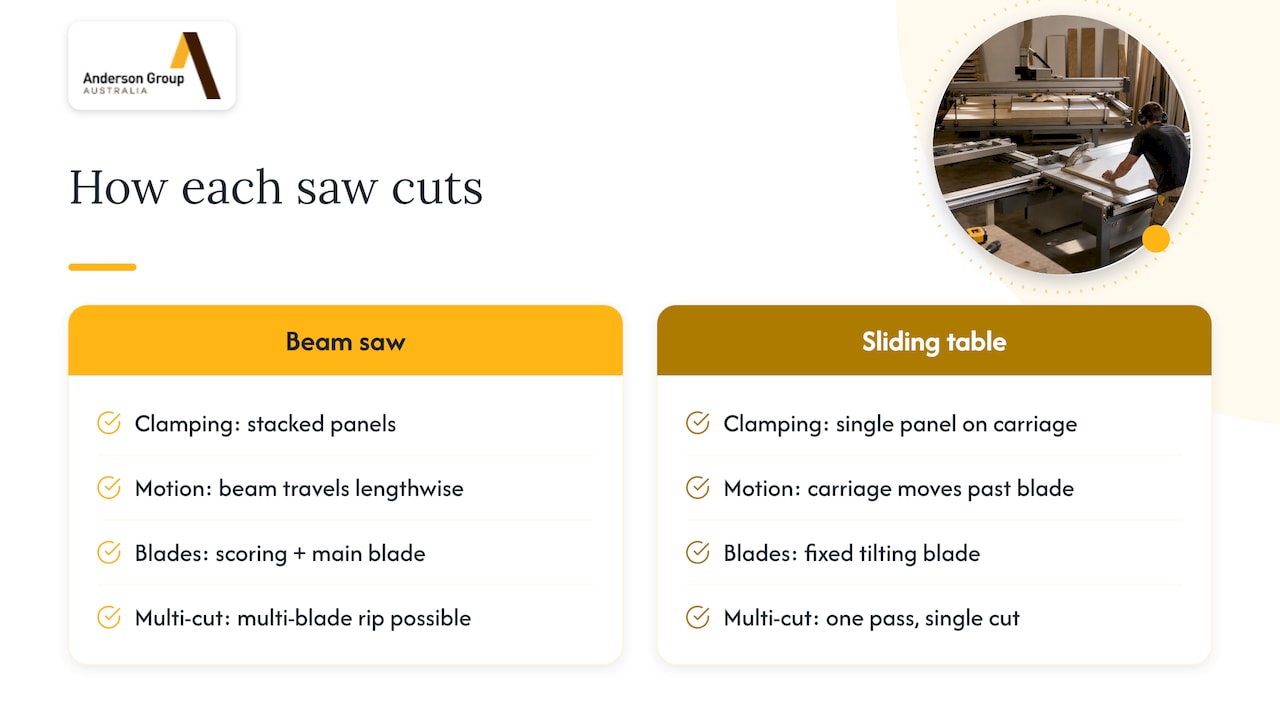
A beam saw holds a stack of panels under a pneumatic or hydraulic clamp while a horizontal beam, carrying the main blade and often a scoring blade beneath it, travels the length of the material. The scoring blade pre-cuts the underside to prevent chipping on laminates and melamine-faced board before the main blade finishes the cut. Multi-blade configurations let some beam saws rip several strips in a single pass, which matters for repeat sizing runs.
A sliding table panel saw works the other way: the panel sits on a moving carriage that the operator pushes past a fixed, tilting saw blade, with a riving knife behind it to stop the kerf closing and kicking the panel back. Bevel and mitre cuts come from tilting the blade and swinging the cross-cut fence, giving the operator direct control over odd angles that would need custom programming on a beam saw. Riving knife and guarding requirements for panel saws are addressed directly in WorkSafe’s FAQ guidance, and the same document applies equally to beam saw guarding.
In practice, verify either machine the same way: check panel flatness after cutting, run a repeatability test by cutting the same dimension several times and measuring variance, and inspect edge finish under raking light for chipping or burn marks from a dull or misaligned blade.
Nesting, stack cutting and real-world throughput differences
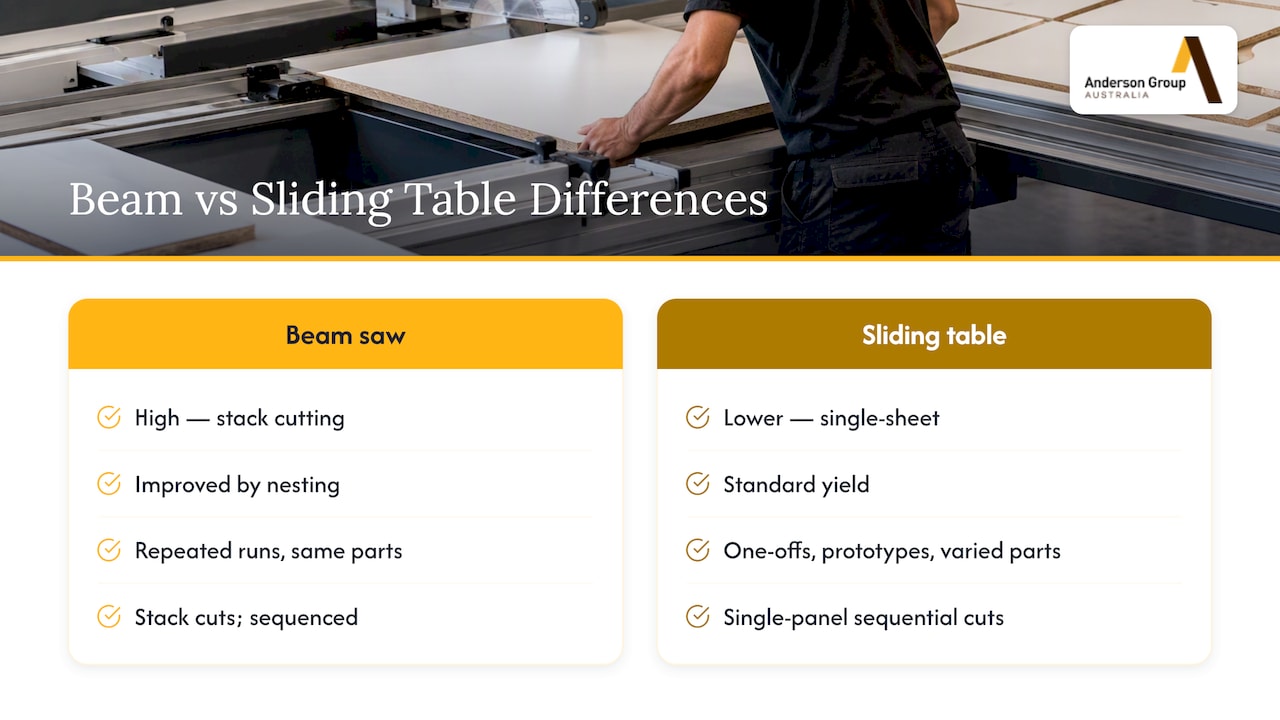
A beam saw’s throughput advantage comes from two linked capabilities: stack cutting multiple sheets at once and nesting optimisation software that works out cutting sequences to minimise offcuts. For a kitchen manufacturer running the same cabinet sizes repeatedly, that combination can meaningfully lift material yield, a point practitioner and industry discussion of beam saw versus sliding table workflows backs up when comparing the two approaches on repeated parts. Our own guide to CNC panel processing workflows covers how nesting-first CNC machinery applies this same logic beyond beam saws specifically.
Sliding tables work best as single-sheet, single-decision tools: load a panel, make the cut, assess it, move to the next. That suits one-off cabinetry, prototype runs and jobs where part sizes change constantly.
Labour patterns differ too. Beam saws need an operator comfortable programming cut lists and monitoring the stack, with less hands-on cutting per part. Sliding tables need an operator skilled at reading the job and setting the fence and angle for each cut, with more direct involvement per piece.
Footprint, feeding and storage implications for shop layout
Sliding table saws need a clear, unobstructed carriage run, often several metres on each side of the blade, free of columns, racking or foot traffic, with expert advice on handling wood waste sustainably available through Operation Good Wood: Dealing with Your Timber and Wood Waste Sustainably. Small shops sometimes retrofit by angling the saw into a corner and feeding from a mobile infeed table rather than a fixed outfeed run.
Beam saws need a longer footprint overall: a loading zone for incoming sheet stacks, the beam travel length itself, and an offload area for cut parts, often supported by a lift table that raises the pack to clamp height automatically. Upstream automation such as conveyors or automated sheet storage pays off more on beam saws because the stack-handling step is already part of the workflow.
For a small to medium cabinet shop weighing either option, map the full material path first, infeed, cutting zone, offload and buffer storage, before committing to a machine footprint, since the saw itself is rarely the layout constraint.
Spare parts, likely failure modes and budgeting for upkeep
Beam saws carry more points of potential failure because they rely on PLC-controlled sequencing, pneumatic or hydraulic clamping cylinders and cable-carrier systems that flex with every beam pass. Over time, cable carriers wear, pneumatic seals degrade and sensors drift out of calibration, so a beam saw operation typically needs a more structured spare-parts inventory and a maintenance technician comfortable with electro-mechanical fault-finding.
Sliding table saws are mechanically simpler: the main wear items are blades, riving knives and carriage bearings, with routine blade sharpening or replacement the dominant maintenance task. That simplicity generally means fewer unplanned stoppages and a shorter list of critical spares to hold on site.
Either way, a preventative maintenance schedule beats reactive repair. Decide up front whether a service contract with guaranteed response times suits your risk tolerance better than in-house maintenance, and factor realistic parts lead times into any production schedule that depends on a single machine.
Australian guarding guidance, checklists and standards to follow
Both machine types sit squarely inside Australian woodworking machinery guarding rules. WorkSafe’s guidance note on safe use of woodworking machinery sets out guard types, fixed, adjustable and interlocking, and references the AS 1473 series and AS/NZS 4024 as the relevant standards for machinery guarding and safety of machinery design respectively.
SafeWork NSW’s saws hazard identification resource groups beam saws and panel circular saws together when identifying hazards, reflecting how similar their core risks are despite the mechanical differences.
Before relying on either machine, run through a short checklist:
- Confirm riving knives and top guards are fitted and correctly adjusted before each shift.
- Check interlocks and moving guards engage properly and stop the blade when opened.
- Record inspection dates and operator sign-off using a documented checklist such as SafeWork NSW’s saws checklist.
AS 1473 and AS/NZS 4024 remain the reference points to check against when procuring new or used machinery, since primary care guidance and standards references help confirm a machine meets current compliance expectations before it goes into service.
A practical decision checklist and scoring prompts for buyers
Score your shop honestly against five factors before committing to either machine type.
- Volume: rate how often you cut the same or similar sizes repeatedly versus one-off dimensions.
- Part mix: note how many jobs need bevels, mitres or irregular angles that a sliding table handles more directly.
- Space: measure your actual available floor length for carriage runs or beam travel and offload zones.
- Maintenance capacity: be realistic about whether you have, or can access, technicians comfortable with pneumatic and PLC fault-finding.
- Flexibility needs: weigh how often job specifications change week to week against the benefit of nesting optimisation.
When you get machines in front of you, ask direct vendor questions: what nesting software ships with the beam saw and how steep is the learning curve, what are typical spare-parts lead times for clamps, cylinders and sensors, and what tolerances can the vendor demonstrate on your own panel stock rather than a showroom sample.
Pro Tip: Before signing, run one of your typical jobs through a demo unit on the actual showroom floor and measure cycle time, yield and rework rate against your current process rather than relying on specification sheets alone.
How Anderson Group Australia supports selection, supply and servicing
We supply CNC panel-processing and nesting machinery for manufacturers, alongside the servicing and parts support that keeps either a beam saw style workflow or a nesting CNC running once it’s on your floor. We recommend machinery based on your actual job mix rather than a generic specification sheet.

- View our Genesis PLUS nesting CNC machine for a panel-processing alternative built around nesting optimisation.
- Browse wood machinery options suited to kitchen, cabinet and joinery production.
- Talk to us about servicing, parts and site layout before you commit to a machine footprint.
If you’re weighing up panel saws, beam saws or a nesting CNC workflow, get in touch with our team to discuss your production mix and book a site discussion or quote.
FAQ
What is the difference between a beam saw and a panel saw?
A beam saw clamps a stack of panels and moves a horizontal beam blade across them, suited to repeat-run nested cutting, while a sliding table panel saw moves the panel past a fixed blade on a carriage, suited to flexible, one-off and angled work. WorkSafe’s guarding FAQ covers guarding differences between the two.
What is the advantage of a sliding table saw?
A sliding table saw gives direct operator control over mitres, bevels and irregular angles without programming, and it needs a simpler mechanical setup than a beam saw. That makes it well suited to bespoke joinery and short-run work where job specifications change often.
What are the three types of table saws?
Table saw types typically fall into cabinet saws, contractor saws and sliding table (panel) saws, with the sliding table variant being the one most relevant to cabinet-making and panel-processing shops. Beam saws sit in a separate category built specifically for stacked, nested panel cutting rather than general table saw use.
What is the best panel saw?
There’s no single best panel saw: the right choice depends on your part mix, volume and available floor space, with sliding tables favouring flexible, bespoke work and beam saws favouring high-volume nested runs. Practitioner discussion comparing the two machine types notes many shops keep both because each covers a distinct job type.
Sources
- Guidance note – Safe use of woodworking machinery (Guarding)
- Saws: hazard identification | SafeWork NSW
- Beam Saw Versus Sliding Table Saw (forum discussion)