
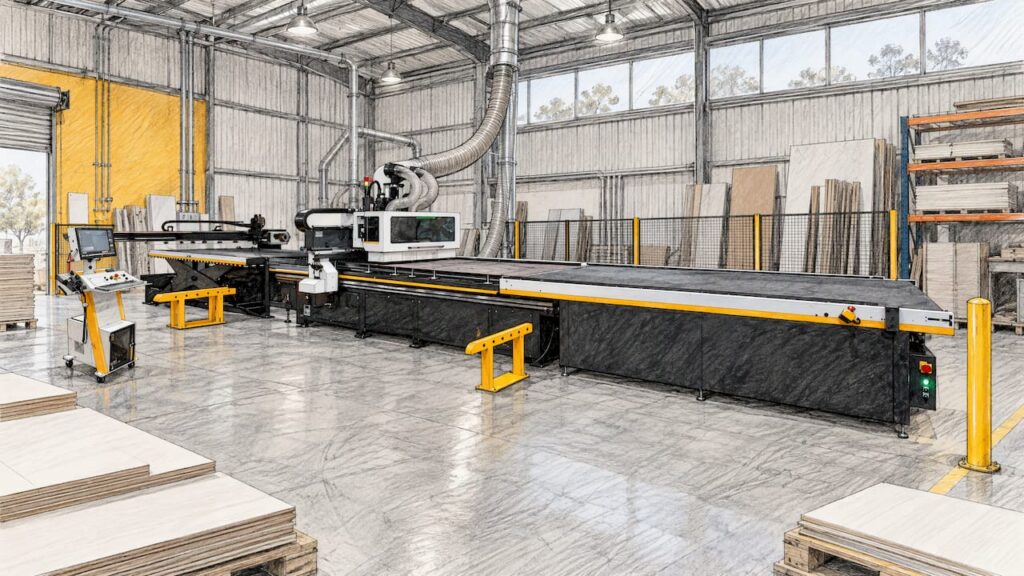
A 3 axis CNC machine moves a cutting tool along three straight lines: X (left to right), Y (front to back) and Z (up and down). For flat panel work, that is the core of most kitchen, cabinet, joinery and furniture production. If your parts are cut from sheet, machined from the top face and then moved on, three axes are usually all the geometry you need. The decisions that matter are bed size, spindle and Z travel, tooling, dust extraction, material handling and the support behind the machine.
This guide is for Australian manufacturers choosing a machine for their own production. It covers what a 3 axis machine does, where it sits in a wood workflow, what to check on a specification sheet, how to think about budget, and when a fourth or fifth axis earns its place.
TL;DR
- A 3 axis machine moves the tool along X, Y and Z only. It suits flat sheet and top-access work, which covers most panel-based cabinet and furniture parts.
- A “3 axis CNC router” and a “3 axis CNC machine” overlap in wood: both describe the same X, Y, Z motion, but configuration (bed, spindle, tool changer, material handling) separates a light-duty router from a production machine.
- Judge a machine on bed size against your sheet size, Z travel, spindle, tool changer, dust collection and service, not on axis count alone.
- Budget for the whole installation: freight, rigging, electrical work, tooling, software, training and maintenance, not only the machine.
- Confirm any capability against the exact model’s product page or with our team, because options differ between models and configurations.
Table of Contents
- What a 3 axis CNC machine actually does
- Where a 3 axis machine fits in a wood production line
- Bed size, Z travel and the specifications that matter
- Precision: what to expect and what to ask
- What a 3 axis machine costs in Australia
- 3 axis, 4 axis or 5 axis?
- Is a 3 axis machine enough for your shop?
- Our wood machinery for flat-panel production
- Service, parts and keeping the machine running
- FAQ
- Sources
What a 3 axis CNC machine actually does
On a milling or routing machine, the three axes describe how the tool and workpiece move relative to each other. UNSW Making’s CNC milling introduction explains that the X and Y axes control horizontal shifting of the workpiece at a constant height, while the Z axis provides the vertical travel of the spindle. On a gantry-style panel router the arrangement is a little different, with the bed fixed and the gantry and spindle moving, but the result is the same: the tool can reach any X, Y position over the sheet and plunge to any depth within its Z range.
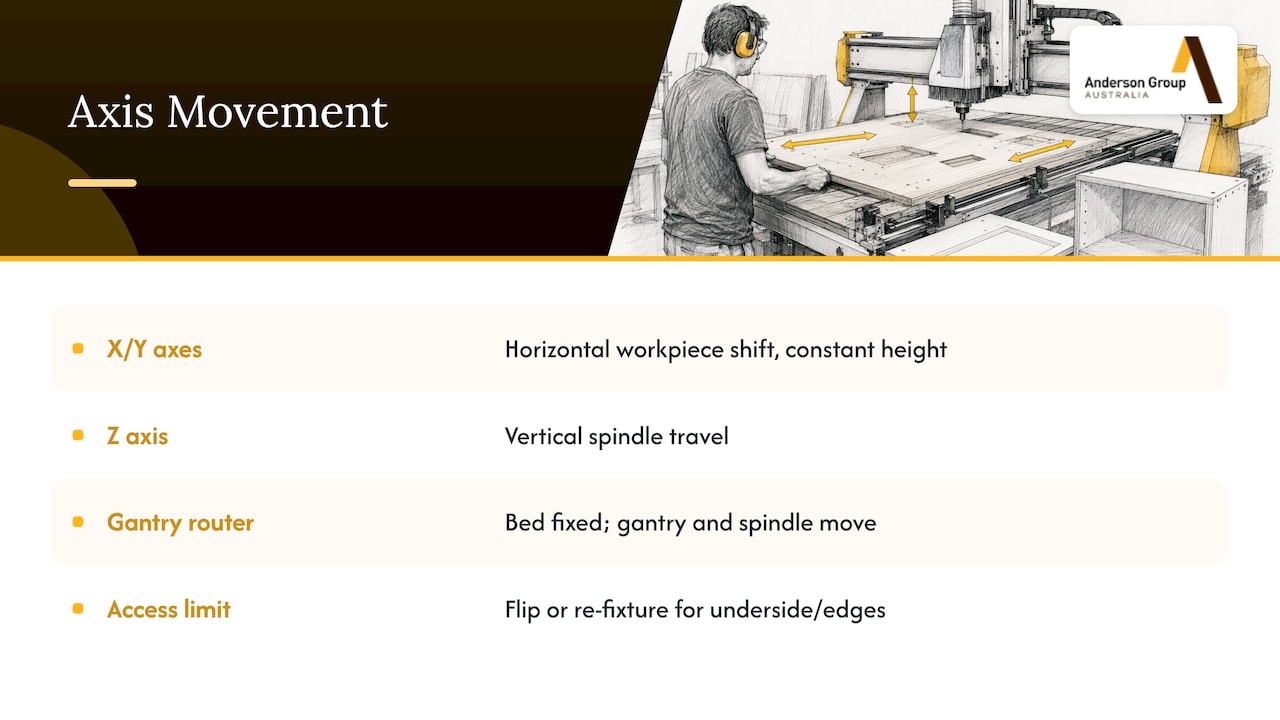
That has a practical consequence. The tool always approaches from above. Anything you can cut, drill or profile from the top face is within reach. Anything on an underside or an edge needs the part flipped, re-fixtured or moved to another process.
What this means for panel work
A kitchen carcass or a vanity unit is mostly flat parts: sides, tops, bases, shelves, doors, drawer components. Each is cut from a sheet, may have pockets, grooves, hinge bores or dowel holes on one face, and is then edged and assembled. A 3 axis machine covers that profile directly.
Woodshop News describes the 3 axis system as the most common CNC configuration, appropriate for a wide range of fabrication from cabinets to signs and furniture. The same article notes that by flipping stock or using creative fixturing, a 3 axis machine can often cut two-sided jobs or parts with three or more faces.
Where a 3 axis machine fits in a wood production line
In a cabinet or joinery shop, the same words get used for quite different machines. Keeping the applications separate makes the buying conversation shorter.
| Application | What it does | Anderson model family |
|---|---|---|
| Nesting and routing | Cuts parts from full sheets, profiles, pockets and drills on the top face | ATS (nesting, routing and drilling) |
| Edgebanding | Applies edge material to cut panels | AFS (edgebanders) |
| Six-sided drilling and routing | Machines panels on multiple faces | ADM |
| Panel return | Returns panels to the operator or the next stage | ARS (panel-return system) |
We keep these model families distinct because they solve different problems. A nesting machine is not an edge bander, and an edge bander does not cut sheets. Whether a particular ATS configuration is the right one for you depends on your sheet size, part mix, volumes and loading method. Check the exact model and configuration on our wood machinery page or talk to us about your application before assuming a capability.
Nesting on a flat bed
Nesting is the main way a 3 axis machine earns its keep in a cabinet shop. Parts are laid out on the sheet by software, cut in one pass of the programme and then removed. The machine needs enough bed to take your standard sheet, enough hold-down to keep small parts from shifting, and dust extraction that suits the material. For a deeper look at the cabinet workflow, see our guide to cabinet CNC machining for kitchen and cabinet makers. If plywood is your main material, plywood machining on a CNC covers tooling, hold-down and machine choice.
Drilling and routing in the same programme
Many panel machines combine routing with drilling, so one set-up cuts the outline and produces the holes. Which drilling options a given machine has depends on the model. We do not assume a drilling head, a tool changer or any accessory from a family name, so confirm the exact configuration before you rely on it.
Bed size, Z travel and the specifications that matter
Specification sheets are long. For a 3 axis panel machine, a handful of numbers decide most of the fit.
Bed size
Woodshop News states that a 4’ x 8’ bed can usually handle a full sheet of plywood or MDF, while 5’ x 10’ beds are favoured for 10’ long sheet goods such as solid surface countertop materials. Australian panel suppliers commonly sell 2400 x 1200 mm sheets, and that is the size many entry routers are built around. One example is an auction listing for a machine with a 2400mm x 1200mm bed for full sheet processing. If you buy longer sheets or want to nest oversize parts, confirm the usable cutting area, not just the table size, because clamps and tool paths reduce it.
Z travel
For sheet goods, the same Woodshop News piece says a 4 inch vertical (Z) travel may be all that is required, while most solid wood applications benefit considerably from more vertical travel. If you cut solid timber components, thick laminated blanks or use tall tooling, ask about Z clearance under the spindle with your longest tool fitted.
Spindle and tooling
Spindle power and speed range affect which materials you can cut cleanly and how fast. Chip evacuation and tool choice matter just as much. We do not publish a universal spindle recommendation here, because the right answer depends on your material, tool diameter and feed rate. Use the figures on the product page for the model you are considering and discuss your parts with us.
Tool changer
A tool changer lets one programme use several tools without an operator stopping the machine. For jobs that need a roughing cutter, a finishing profile cutter and a drill, it removes manual changeovers. It is a configuration option, so confirm that the model you are looking at includes it.
Dust collection
Wood-panel nesting generates a lot of fine dust and chips. Extraction has to be planned as part of the installation: connection points, ducting, a suitable collector and the electrical supply to run it. Ask which extraction connections the exact model provides, and work through the safety side with a qualified person for your site. For workplace dust obligations in Australia, start with your state or territory work health and safety regulator. Dust extraction for wood panels is a separate subject from liquid coolant on metal machines, and the two should not be mixed up.
Hold-down and material handling
Vacuum hold-down is common on flat-bed routers, with pods or a spoil board. Part size, material porosity and the amount of offcut waste all influence how well a part holds. Loading and unloading is the other big factor: at higher volumes, hand-loading full sheets becomes the limit on output, not the cutting speed. Talk through your daily sheet count when you discuss options.
Precision: what to expect and what to ask
Any claim about tolerance needs a context. Machine accuracy, tool wear, material movement, fixturing and temperature all affect the finished part.
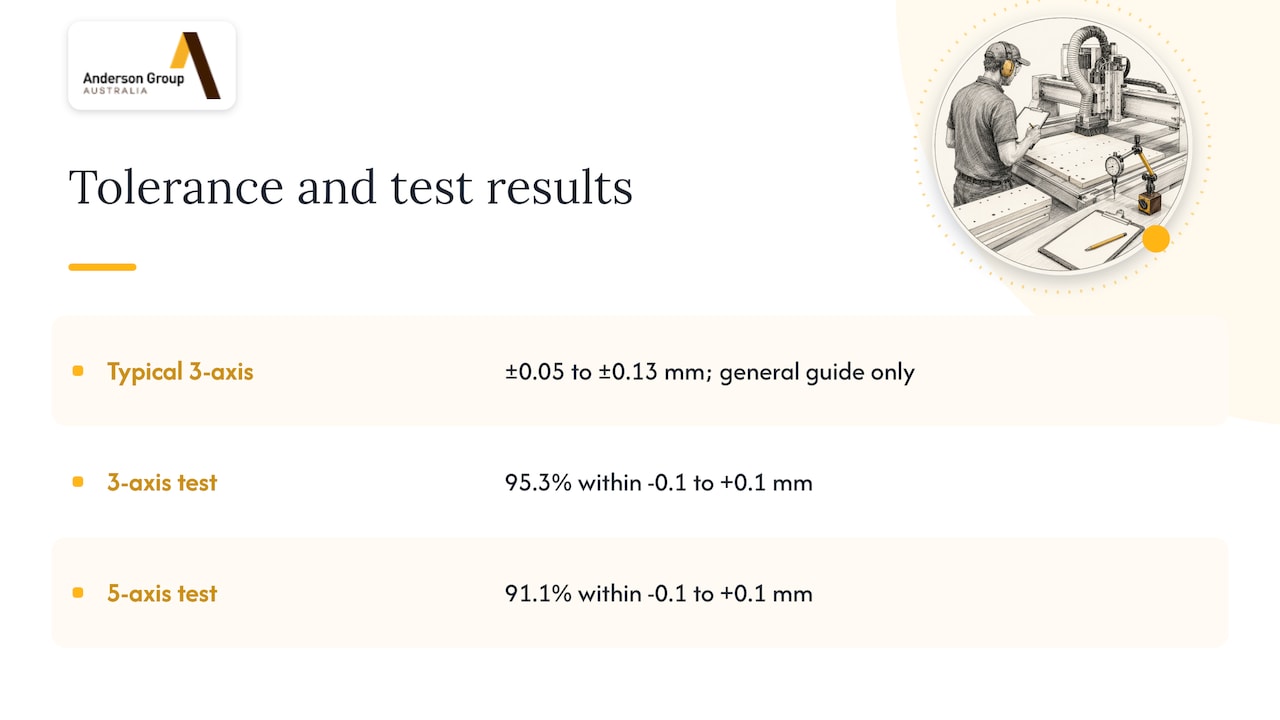
HPPI, a US machining company, puts typical 3 axis tolerances at roughly +/-0.05mm to +/-0.13mm (+/-0.002" to +/-0.005"). That is a general guide for the process, not a figure for any Anderson machine. We do not state tolerances for our machines unless they are documented on the product page for that model and configuration.
A Japanese prefectural research report on laminated plywood furniture parts gives a useful real-world feel. It found that 95.3% of 3 axis points fell within -0.1 to +0.1mm of the CAD data, against 91.1% for 5 axis. The report concerned a specific test and process, so treat it as an illustration, not a prediction for your parts. For cabinet work, part-to-part consistency and fit of joints matter more than the headline figure. For more on how datum choices affect accuracy, see our guide on CNC workholding methods and datum logic.
What a 3 axis machine costs in Australia
There is no single price, and we do not publish prices for resold machines. What we can offer is context, and a way to think about the total.
An Australian equipment finance provider lists quality 3 axis woodworking routers at $30,000 to $80,000, with entry woodworking and signage routers (2400 x 1200 working area) at $30,000 to $70,000, and production cabinet routers with a tool changer and pod-and-rail bed at $80,000 to $220,000. Those are market ranges from a finance page, not Anderson prices, and they will move. For a quote on a specific Anderson machine, we need your application.
The purchase price is only part of it
An Australian finance broker points out that the true cost of a CNC machine goes beyond the advertised price. A complete budget may include finance, freight, rigging, electrical upgrades, installation, tooling, software, training, energy, insurance, maintenance and downtime. A machine that looks cheaper at the start may not be the cheapest over its working life.
For a way to put numbers on this, read our guide to CNC lifecycle cost modelling. Build your own figures from your own quotes, power costs and labour rates.
Paying for it
Many Australian manufacturers finance machinery over several years. Whether you suit an asset loan, lease or working-capital facility depends on your accountant’s advice and your lender. If you are comparing structures, this overview of equipment loan versus working capital explains how the two differ in general terms, though the lender products it describes are American. Speak to your accountant or an Australian finance broker about what applies to your business.
3 axis, 4 axis or 5 axis?
The right answer is the one your parts require. Woodshop News describes the difference simply: a 4 axis machine rotates and positions stock about a rotary axis for parts such as spindles or furniture legs, and a 5 axis machine can move the spindle in three axes and rotate it in two directions, so the tool approaches from almost any direction, subject to mechanical limits.
| Question | 3 axis | 5 axis |
|---|---|---|
| Flat panels, pockets, grooves, top-face drilling | Direct fit | Capable, but more machine than the job needs |
| Parts with features on several faces | Needs flipping and re-fixturing | Can reach more faces in one set-up |
| Curved or sculpted shapes | Limited | Better access to complex geometry |
| Programming and set-up | Simpler | More complex |
HPPI notes that extra axes improve access to complex geometry and can reduce set-ups, but that programming, set-up and verification become more complex. The Japanese plywood report mentioned above also compared the two: finishing took 37 minutes on 3 axis and 106 minutes on 5 axis for the test part, though 5 axis was expected to make hand polishing easier. That tells you the extra axes bring extra process time as well as extra access.
For most kitchen and cabinet shops, flat-sheet work is the bulk of the day, which is why a 3 axis nesting machine is usually the first CNC they consider. If you machine sculpted chair components, curved architectural joinery or compound-angle parts, read 5-axis CNC for woodworking: where it pays off. Metal and aluminium work is a separate range: for 5 axis machining of metal, see the Focaseiki 5-axis vertical machining centre. Do not assume pallet changing, probing, rotary accessories or other options from the axis count alone. They depend on the exact model.
Is a 3 axis machine enough for your shop?
Work through these questions before you speak to any supplier:
- What is your standard sheet size? The usable cutting area has to take it with room for clamps and tool paths.
- What materials do you cut? Melamine board, MDF, plywood, solid timber, solid surface and plastics each put different demands on tooling, hold-down and extraction.
- How many sheets a day? At volume, loading, unloading and offcut handling decide throughput.
- Do your parts need work on more than one face? If yes, consider fixturing strategies, a separate drilling machine, or a different machine type.
- Who will program it? Check software, post-processor and training with the specification.
- What support do you need locally? Service, parts and training after installation matter as much as the machine on day one.
The flat-panel version of this reasoning is well covered by the Woodshop News piece: three axes are all that is needed for jobs that can be cut using a vertical spindle.
Our wood machinery for flat-panel production
We supply CNC machinery, servicing and parts to Australian manufacturers, with a primary focus on kitchen, cabinet, joinery and furniture makers. Our nesting, routing and panel-processing machines are listed on the wood machinery page, and the full range is on our CNC machinery range page.
We help you choose machinery for your own production. We do not offer subcontract cutting, machining or finished-part manufacturing. Tell us your sheet size, materials, part mix and daily volume, and we will point you to the model and configuration that matches, with specifications taken from the relevant product page. Use the enquiry options on our site to discuss your application or request a quote.
Service, parts and keeping the machine running
A CNC router is a production tool, so what happens after installation matters. Wear parts, spindles, vacuum systems, dust collectors and tooling all need attention over the life of the machine. We supply servicing and parts as part of our business. For the exact scope of service, response times and maintenance schedules that apply to your machine, confirm the agreed terms with us when you enquire, because they depend on the model and your arrangement.
Plan for the operator side too: a trained operator, a clear maintenance routine and sensible spares keep a machine productive. Zero-point and repeatable fixturing also reduces set-up time on machines where it applies; our guide on zero point fixturing explains the principle, and drilling versus boring decisions are covered in when to bore or drill on CNC.
FAQ
What is a three axis CNC machine?
It is a computer-controlled machine whose tool moves along X, Y and Z. In panel work that means the spindle can reach any point over the sheet and move up and down, so it cuts, routes and drills from the top face. Parts needing work on other faces have to be repositioned.
Is a 3 axis CNC router the same as a 3 axis CNC machine?
The motion is the same. In woodworking, “router” usually means a flat-bed machine for sheet and panel work, while “machine” or “machining centre” can also describe metal-cutting machines. What separates them in practice is configuration: bed, spindle, tool changer, hold-down and extraction.
How much does a 3 axis CNC machine cost in Australia?
Australian finance listings put quality 3 axis woodworking routers at about $30,000 to $80,000, and production cabinet routers with tool changers higher, up to $220,000. Those are market ranges, not our prices. Freight, installation, tooling, software and training add to the total, so ask for a full quote.
What is the difference between 3 and 5 axis CNC?
A 3 axis machine moves the tool in three straight lines. A 5 axis machine adds two rotations, so the tool can reach more faces and complex shapes in one set-up. Flat-panel cabinet parts rarely need it, while sculpted or compound-angle parts may.
Can Anderson cut my parts for me?
No. We supply machinery, servicing and parts for your own production, and we do not offer subcontract cutting or machining. We can help you choose a machine that suits your parts.
Sources
- Basic CNC Milling: Introduction, UNSW Making
- Know your options when CNC shopping, Woodshop News
- SCM Pratika 310 MFV listing, Grays
- What is CNC Milling?, HPPI
- Gifu Prefecture research report on 3 axis and 5 axis machining (PDF)
- CNC Machine Loans Australia
- CNC Machine Costs: Finance, Installation and Tooling
- Working Capital vs. Equipment Loan