
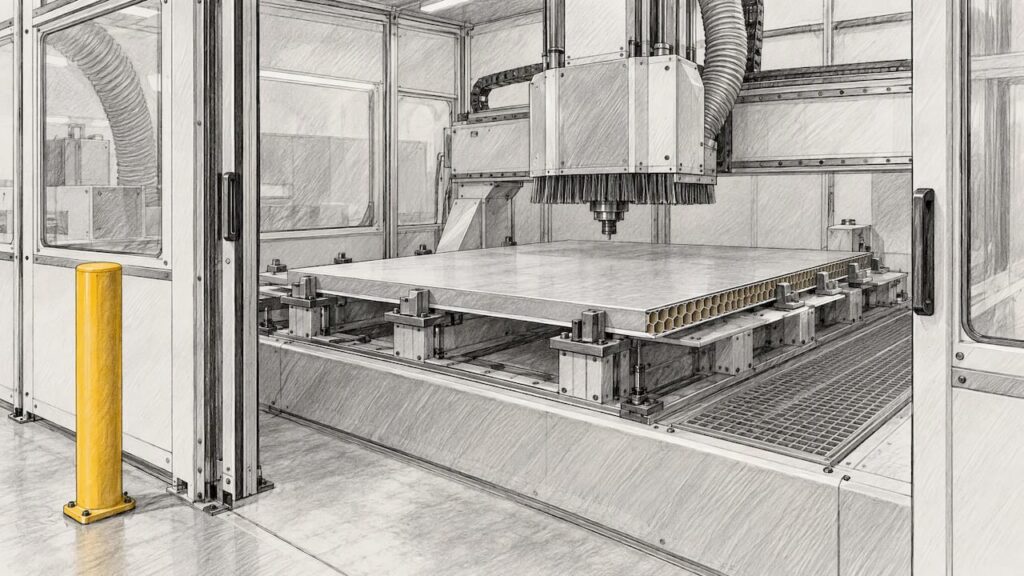
Honeycomb sandwich panels are machined with CNC milling, routing or sawing, and sometimes ultrasonic-assisted cutting. The hard part is not the machine axis count. It is cutting thin cell walls cleanly while the panel is held without crushing the core. This guide covers how that works for aluminium, Nomex (aramid) and other honeycomb cores. It also covers how to hold the panel, what to ask about tooling, how to handle dust, and what to confirm about a machine before you buy.
We supply CNC machinery, servicing and parts to Australian manufacturers. We do not offer subcontract cutting or machining. Where this guide gives general guidance, it says so, and anything about a specific Anderson or Focaseiki model should be checked against that model’s product page.
TL;DR
- A honeycomb panel is two skins bonded to a thin-walled core, so cutting has to avoid tearing, burring and cell-wall buckling.
- Research on Nomex shows ultrasonic-assisted cutting lowers cutting force and burrs compared with conventional milling, but conventional CNC milling on 3-axis and 5-axis centres remains a documented route.
- Holding the panel fully and evenly matters as much as the cutter. Vacuum, tape and backing boards are the usual approaches.
- Speeds, feeds and tool geometry published by suppliers are starting points. Prove them on offcuts of your own panel.
- Choose a machine by the exact model and configuration, not the family name. Aluminium honeycomb belongs on the metal range, and wood-faced or lightweight furniture panels belong on the wood range.
Table of Contents
- What composite honeycomb actually means
- Why honeycomb is difficult to cut
- Cutting methods compared
- Holding the panel without crushing it
- Tooling and starting parameters
- A trial-cut routine that protects your panels
- Dust, swarf and worker safety in Australia
- Choosing a machine for honeycomb work
- Talk to us about your honeycomb application
- FAQ
- Sources
What composite honeycomb actually means
The phrases composite honeycomb, honeycomb core and honeycomb panel describe different things, and the machining differs for each.
A honeycomb sandwich panel has facing skins bonded to a honeycomb core. Hexcel’s design guide explains that the skins carry bending stresses while the core resists shear and keeps the skins apart, with adhesive joining the parts so they act as one unit. It lists aluminium, Nomex (aramid), Korex, Kevlar, fibreglass and carbon honeycombs, with many core, facing and adhesive combinations. The Composites Knowledge in Practice Centre adds that cores can be metallic or non-metallic honeycomb, foam or wood, and that the core’s purpose is to space strong face sheets away from the neutral axis.
In practice, you will meet three situations:
- Bare core, cut to shape before skins are bonded. This is the most delicate case, because nothing supports the cell walls.
- Finished sandwich panel, cut or trimmed after bonding. The cutter has to pass through skin, core and the opposite skin.
- Lightweight furniture and cabinet panels with a paper or similar honeycomb core and thin skins. These are cut on panel-processing machines, a different job from aerospace-grade aramid or aluminium core.
Before you ask anyone about a machine, write down which of these you are cutting, the core material, the cell size, the skin material and the panel size. Every later decision follows from that.
Why honeycomb is difficult to cut
The cell walls are very thin and there is a lot of air in the structure. A critical review of Nomex honeycomb processing explains that thin walls, the cellular geometry, entrapped air, soft phenolic resin and brittle aramid fibres all interact during cutting. It reports that continuous tool contact in conventional processing can cause delamination, tearing, burrs, cracks and cell-wall buckling.
Aluminium core has its own pattern. A 2021 study on ultrasonic cutting of aluminium honeycomb notes that milling is the most common method but can leave tearing burrs, cell-wall cracks, depressions and deformation because the thin-walled structure has low rigidity. A 2024 study on PCD circular-saw machining lists milling, drilling, grinding and sawing as the aluminium-honeycomb processes, and burrs, scratches, cracks, deformation, oxidation and tool wear as the typical defects.
That list is your inspection checklist. Whatever process you choose, look for those defects on the first trial cuts.
Cutting methods compared
| Method | Where it is documented | What to know |
|---|---|---|
| Conventional CNC milling or routing | Nomex and aluminium honeycomb | Continuous tool contact. The most common method, but prone to burrs, tearing and cell-wall damage without careful tooling and fixturing. |
| Ultrasonic-assisted or rotary ultrasonic cutting | Mostly Nomex, also aluminium, in academic studies | Intermittent contact. Studies report lower cutting force, heat and tool wear. Needs specialised spindle or tool equipment. |
| Circular sawing (including PCD blades) | Aluminium honeycomb | Good cutting efficiency and adaptability, but surface quality depends on tooth design, holding method and sawing parameters. |
| Drilling and grinding | Aluminium honeycomb | Listed as processes in the literature, used for specific features. |
What the ultrasonic research shows
If you are cutting aramid core to a high finish, the ultrasonic literature is worth reading. Xiang and colleagues (2019) found that ultrasonic sliding cuts aramid fibres more effectively than ordinary cutting and improves burr and tearing performance, and that the tool’s inclined angle strongly affects cutting force.
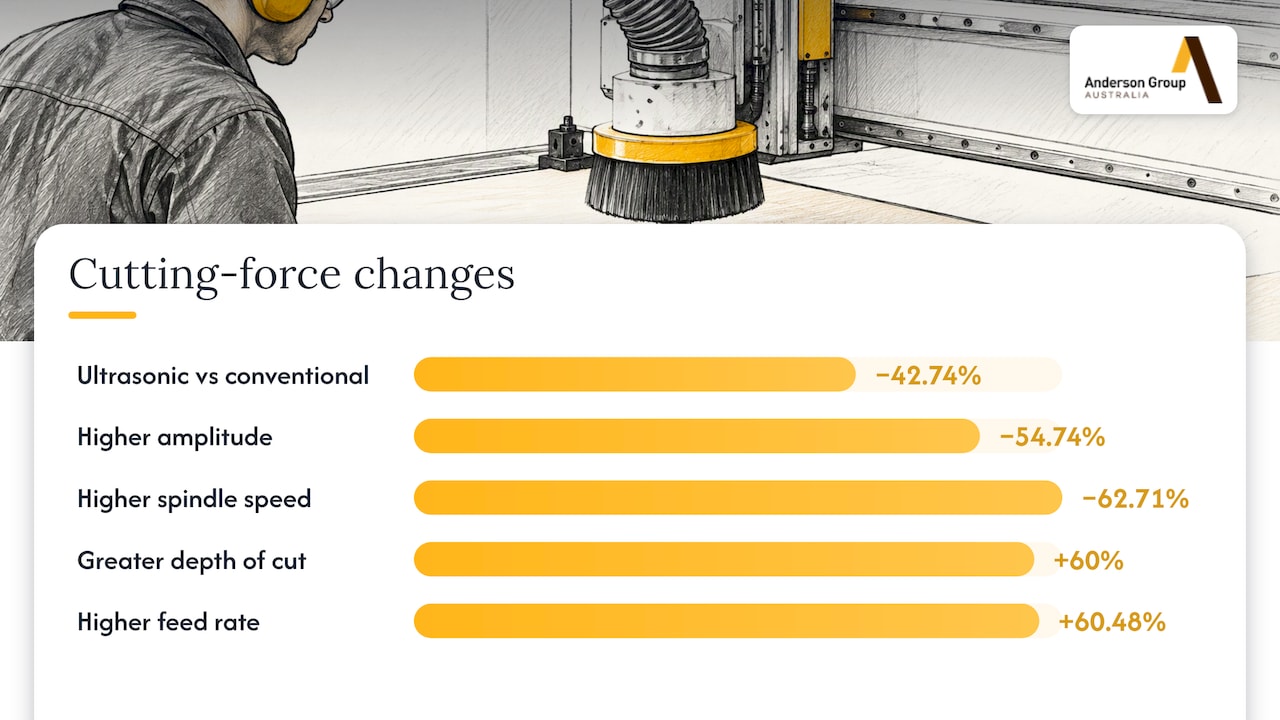
Mughal and colleagues (2023) found ultrasonic machining reduced cutting force by up to 42.74% against conventional machining. Burr formation was about 5% for forces of 3 N or less, compared with at least 30% in conventional cutting. In the same study, higher ultrasonic amplitude and spindle speed reduced cutting forces by up to 54.74% and 62.71%, while higher depth of cut and feed rate raised them by up to 60% and 60.48%.
A 2023 thin-edge study reported a 33.5% cutting-force reduction when a 1° variable-angle pass was compared with fixed 10° ultrasonic vibration. It is relevant if you machine thin, fragile edges.
These are laboratory results on specific setups. They show which variables matter (depth, feed, spindle speed, amplitude, tool angle). They are not settings to copy onto your machine.
Conventional CNC for larger parts
The same Nomex review identifies bridge-type multi-axis gantry CNC machines for large workpieces and 3-axis or 5-axis machining centres for other work, and describes specialised equipment and cutting tools as desirable. Machine type is therefore a question of workpiece size and contour, not just axis count.
Holding the panel without crushing it
Most honeycomb damage starts at the fixture, not the cutter. A panel that flexes or vibrates will tear cells whatever tool you use.
The documented approaches are:
- Full support. A 2024 aluminium-honeycomb study reports that completely fixing the honeycomb improves milling quality. It also discusses ice fixation and liquid-nitrogen cooling to suppress defects, while noting industrial limits such as fixture size, cost and lower efficiency.
- Vacuum. A metals routing provider says vacuum holds larger aluminium honeycomb panels to the table during cutting, while smaller parts may need screws or special fixtures.
- Tape and backing. For undercut or edge-fill operations, one supplier knowledge-base page recommends double-sided tape and Masonite backing on both sides of the panel to support the skins, with consistent clamping pressure.
General guidance, not a documented rule: keep clamping pressure even, avoid point loads over open cells, and support the panel right up to the cut line. Our guide to CNC workholding methods and datum logic covers how to set datums so a part does not distort. If you run repeat jobs and want faster changeovers, zero-point fixturing is worth understanding.
Tooling and starting parameters
Tool makers publish honeycomb-specific cutters. The CoreHog catalogue describes solid-carbide sandwich-panel cutters for full-depth finishing of carbon-laminate panels with Nomex or Kevlar cores, aiming to reduce flagging and delamination. Those are the supplier’s own claims, not independent validation.
The same catalogue gives practical adjustments:
- Ramp into the material rather than plunging.
- Reduce depth of cut or stepover if the cells tear.
- Increase feed or reduce spindle speed if the cut face gets too hot.
- Validate speeds and feeds against the treatment, fixturing and the individual job.
For aluminium core, a supplier parameter page suggests a starting chip load of 0.05 to 0.10 mm per tooth. For a 12 mm tool it suggests 5,000 to 7,000 rpm and 800 to 1,200 mm/min. It recommends sharp, high-helix carbide end mills with large gullets and polished or ZrN-coated flutes to clear aluminium chips and reduce build-up. These are commercial starting points. Prove them on representative offcuts, with your actual cell size and foil gauge, before cutting production panels.
For wider aluminium process context, see our guide to CNC machining aluminium and the note on chip evacuation for aluminium. If your sandwich panels use carbon-fibre skins, our carbon fibre machining guide covers that side of the job.
A trial-cut routine that protects your panels
This is general guidance rather than a documented procedure. It uses the variables the research identifies.
- Cut offcuts from the same batch, with the same skins and core, as your production panel.
- Start with the tool maker’s conservative parameters and change one variable at a time: depth of cut, feed, or spindle speed. The studies above show depth and feed push forces up, while spindle speed (and amplitude, for ultrasonic) pull them down.
- Inspect the cut edge for burrs, torn or buckled cells, skin delamination and heat marks.
- Record the settings that gave a clean edge, along with tool condition after the run, so you can see wear trends.
- Only then move to production panels.
Dust, swarf and worker safety in Australia
Honeycomb machining makes fine particles and, with aluminium, metallic swarf. In Australia, Safe Work Australia’s exposure standards document (January 2024) says exposure must be assessed in the worker’s breathing zone, and that engineering controls must be applied before relying on respiratory protective equipment.
In practical terms, ask early about enclosure and extraction at the cutting point. Extraction for wood-panel dust is a separate matter from metal swarf and liquid coolant, so do not assume one system covers both. Confirm the exact configuration of any machine, and speak with your workplace health and safety adviser about the materials you plan to cut, including the resin systems and fibres in the panel.
Choosing a machine for honeycomb work
Match the machine to the panel, not to the word honeycomb.
Aluminium honeycomb core and metal-skinned panels. These fall under metal machining. Our Focaseiki range is the one to look at, including the 5-axis vertical machining centre for contoured parts and the double column machining centre for larger workpieces. The full line-up is on our metal machinery page. A 5-axis machine does not by itself tell you about vacuum tables, probing, rotary accessories or coolant. Confirm those on the exact model page and with us.
Aramid, fibreglass, carbon and other advanced-material cores. Start with our advanced materials machinery page and tell us the core and skin materials. Ultrasonic spindles are specialised equipment. If your process depends on one, raise it at the first conversation so we can check what can be configured.
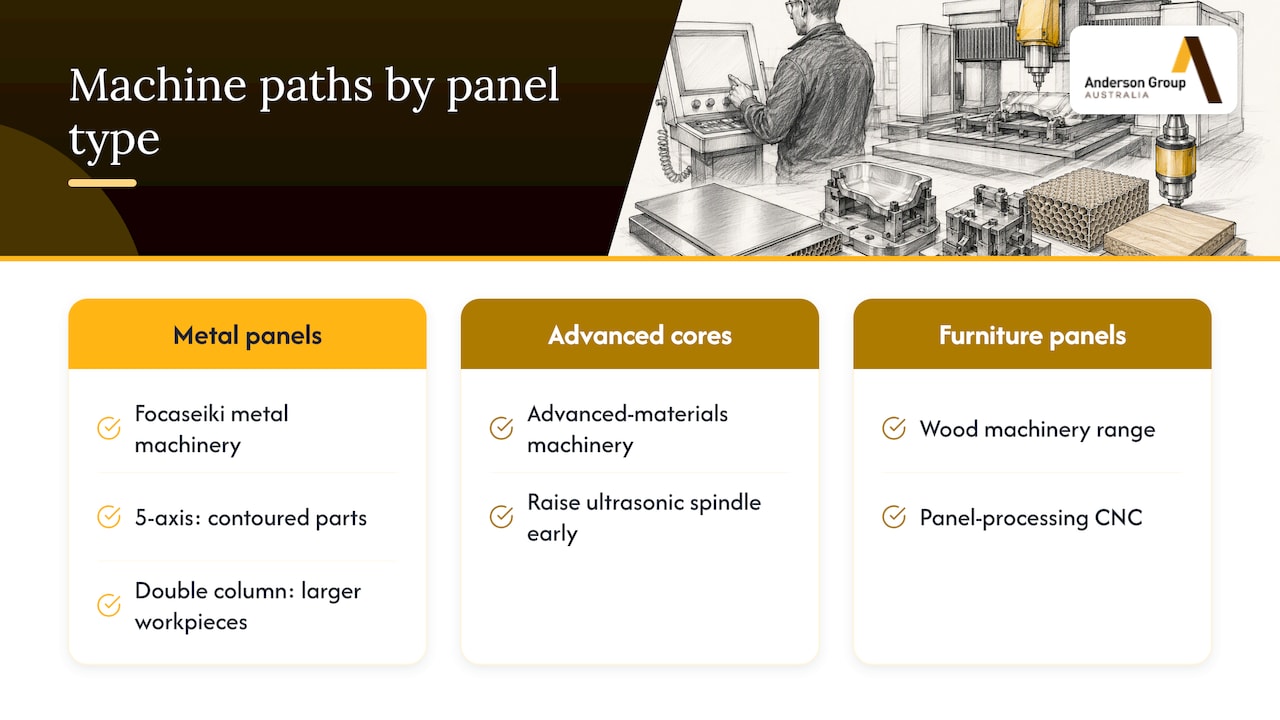
Lightweight furniture and cabinet panels. Honeycomb-core panels used in furniture are cut in the panel-processing world. See our wood machinery range and our guide to CNC panel processing for manufacturers. The same rule applies: describe the actual panel construction, because core density and skin thickness change the tooling and hold-down.
Questions to settle before you buy
- What is the largest panel and the thinnest edge you will cut?
- How will the panel be held: vacuum, fixture, tape and backing?
- Do you need dust extraction, enclosure or coolant, and is each one confirmed for the exact model?
- Is the cutter you intend to use compatible with the spindle speed range of that model?
- Who will service the machine and supply parts locally?
Talk to us about your honeycomb application
We supply CNC machinery, servicing and parts to Australian manufacturers, and we help you choose a machine for your own production. We do not cut or machine parts for customers. Tell us your panel construction, size, material and volumes, and we will point you to the matching range and confirm the options on the exact model. Start at the Anderson Group Australia site or go direct to the machine listings.

Bring a sample of the panel and your drawings to the conversation. It makes the machine and tooling questions far more concrete.
FAQ
Can you cut aluminium honeycomb on a standard CNC machining centre?
Milling is the most common method for aluminium honeycomb, according to the 2021 ultrasonic cutting study, but it can cause burrs and cell-wall damage. Results depend on tooling, holding and parameters. Confirm the exact model and configuration for your job with us before you commit.
Why does honeycomb tear or delaminate when cut?
Thin cell walls, air in the cells and the resin and fibre combination make the core hard to cut. The Nomex processing review links continuous tool contact to tearing, burrs, cracks and buckling. Sharp tools, full support and conservative depth and feed reduce the risk.
Is ultrasonic cutting better than conventional milling for honeycomb?
Academic studies on Nomex report lower cutting force and fewer burrs with ultrasonic cutting. These are laboratory results, and ultrasonic equipment is specialised. Whether it suits you depends on the core material, finish requirement and volume.
What speeds and feeds should I use?
There is no universal setting. Suppliers publish starting ranges, such as 0.05 to 0.10 mm per tooth for aluminium honeycomb, but you should prove them on offcuts of your actual panel. Reduce depth or stepover if cells tear, and adjust feed and speed if the cut face heats.
Do you machine honeycomb parts for customers?
No. We supply machinery, servicing and parts, and we help you choose a machine for your own production. We do not offer subcontract cutting or machining.
Sources
- Hexcel, Honeycomb Sandwich Design Technology
- Composites Knowledge in Practice Centre, Cores and inserts
- Processing technologies for Nomex honeycomb composites, review
- Ultrasonic Vibration Assisted Cutting of Nomex Honeycomb
- Investigation of rotary ultrasonic vibration assisted machining of Nomex honeycomb
- Enabling Thin-Edged Part Machining of Nomex Honeycomb
- Simulated and experimental study on the ultrasonic cutting of aluminium honeycomb
- Investigating damage mechanisms of honeycomb cores machined with PCD circular saws
- CNC Routing Aluminum and other Metals, H&H Metals
- CNC Honeycomb Machining Parameters for Aluminum Core Panels
- CoreHog Composite Catalog 2016
- Safe Work Australia, Workplace exposure standards for airborne contaminants, January 2024