
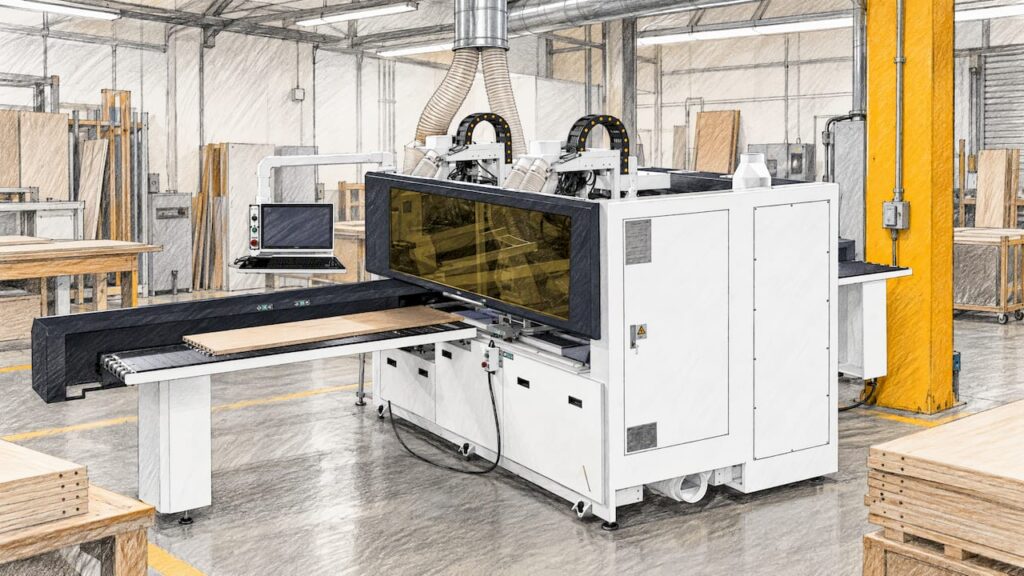
A drilling block is a multi-spindle tool that drills a row of holes in one plunge, usually at 32 mm centres for cabinet and furniture panels. A CNC drilling head is the same idea seen from the machine side: the unit that carries those spindles and bits. On a kitchen, cabinet or joinery CNC, the block or head decides how many holes you make per Z-axis pass. The machine’s spindle, tool interface and control decide whether a given block can be used at all.
This guide is for Australian manufacturers choosing or specifying drilling on a panel-processing CNC. It separates documented facts from general guidance, and it does not assume that any one machine accepts any one block.
TL;DR
- A drilling block drills several holes per plunge. A drilling head is the unit that holds and drives the spindles on the machine.
- The main selection points are spindle count, spindle pitch, drive shank, bearing type, maximum RPM and runout.
- Most aftermarket blocks began as accessories for handheld machines, so fitting one to a CNC spindle usually needs a purpose-made adapter or toolholder.
- Drilling on nesting routers, dedicated drilling machines and six-sided drilling and routing machines are different applications. Confirm the exact model and configuration before you assume a capability.
- To discuss your own production, start from our wood machinery range and request a quote.
Table of Contents
- What a drilling block is, and how it differs from a drilling head
- Why a block changes your throughput
- How a block is called from the program
- Spindle count, pitch and the other specs that matter
- Fitting a block to the machine spindle
- Bits, shanks and round holes
- Which materials and operations
- Drilling on a nesting router versus a dedicated drilling machine
- Questions to settle before you request a quote
- Talk to us about your drilling application
- FAQ
- Sources
What a drilling block is, and how it differs from a drilling head
The terms overlap, and shops use them loosely. It helps to separate three things.
- Drill block (gang drill block): a tool body holding several spindles on a fixed pitch, driven from a single drive shank or spindle interface.
- Drilling head: the unit on a machine that carries one or more blocks or spindles. On dedicated drilling machines it is a permanent part of the machine. On a router it is often a tool you load.
- Drill guide block: a different tool entirely. In general machining, a drill block can also mean a guide that holds a bit at the right angle and position. One machining explainer describes a metal or hard plastic body with guide holes. That is not what cabinet makers usually mean when they search for a CNC drilling block.
In woodworking CAM, drilling blocks and horizontal spindles are treated as specific tool types. SWOOD CAM’s feature presentation lists them as tools the software manages, which tells you they are handled in programming rather than as an afterthought.
Why a block changes your throughput
The gain is simple arithmetic. According to one CNC router guide to 32 mm line boring blocks, a five-spindle block at 32 mm centres drills a full row in one Z pass. A nine-spindle block (a 128 mm pattern length) covers a typical door or drawer cluster in two plunges rather than nine.
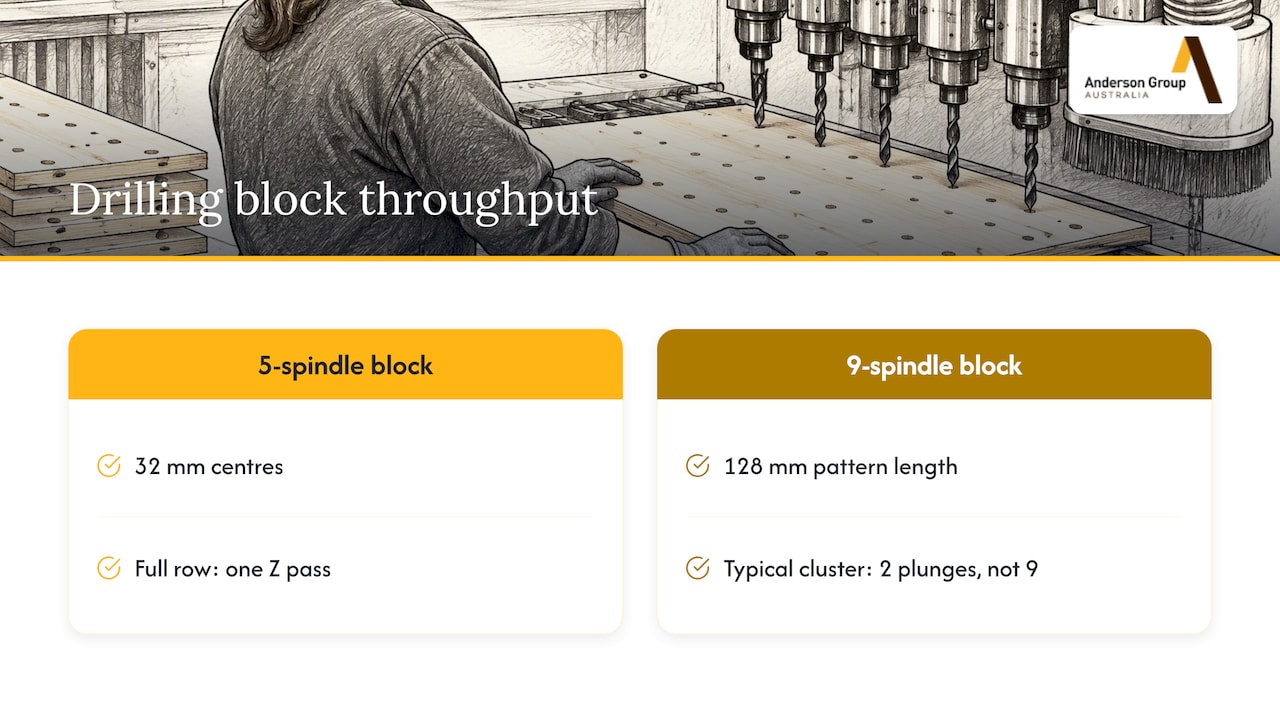
For a shop making cabinet carcasses, that is the difference between one hole at a time and a whole system-hole row at a time. It is also why drilling is a core part of the comparison in our guide on CNC drilling versus manual drilling for cabinetry.
We do not publish cycle-time figures for our machines in this article, and nothing here should be read as a promised saving. Your result depends on panel mix, hole patterns, programming and the exact machine.
How a block is called from the program
A block with several spindles is useful only if the control can call it cleanly. Some router controls handle this with binary drill block codes. CIMTEC’s RouterCIM documentation explains that each drill is identified by a value that can be added to others. That lets one line of NC code call several drills together, instead of one T-code per line. In that scheme, M91 tells the machine it is using the drill block with binary codes, and M92 or M93 can call a second block or both blocks together.
This is one software and control convention, not a universal standard. Other controls and post-processors work differently. When you talk to a supplier, ask how your CAM output will call the block on the exact machine you are considering.
Spindle count, pitch and the other specs that matter
The guide above lists the parameters it uses to select a multi-spindle line boring block. These are published ranges from that guide and are useful for framing a conversation. They are not specifications of any Anderson machine.
| Parameter | Typical range or options | Why it matters |
|---|---|---|
| Spindle count | 3, 5, 7, 9, 13 | Holes per plunge, and total block width |
| Spindle pitch | 32 mm standard, 21 mm on some systems | Must match your hole system |
| Drive shank | 10 mm, 12 mm, 13 mm, 1/2 inch | Determines how the block connects to the spindle or adapter |
| Drill shank | 10 mm most common | Sets which bits you can run |
| Bearing type | Ball bearing strongly preferred for CNC duty | Duty cycle and speed capability |
| Maximum continuous RPM | 3,000 to 6,000 (sleeve), 6,000 to 12,000 (ball bearing) | Must suit your spindle and the bit |
| Block mass | 1.5 to 4 kg for a 5-spindle block | Load on the tool interface and tool changer |
| Spindle runout | 0.02 to 0.05 mm TIR, lower is better | Hole quality and bit life |
Two practical points follow from the table. First, block mass matters if the block is loaded through an automatic tool changer. Second, the pitch should be settled by your hole system before anything else. A block that does not match your hardware pattern is a block you cannot use.
Fitting a block to the machine spindle
This is the part most guides skip. The same source explains that most aftermarket gang drill blocks began as accessories for handheld portable machines used in cabinet installation. They are built around a round drive shank meant for a hand drill chuck. Adapting one to a CNC spindle is described as the central mechanical challenge. Production routers commonly use ISO 30, HSK 63F, BT 40 or CAT 40 tapers, which call for a custom adapter or a dedicated toolholder blank.
The guidance for buyers is straightforward:
- Find out the tool interface on the machine you are considering.
- Ask whether a purpose-made drilling unit exists for that exact model and configuration.
- Do not assume a handheld-style block can be adapted safely. Ask the machine supplier what has been confirmed.
Our guide to CNC spindle options covers spindle choices in more depth, including what matters for production duty.
Bits, shanks and round holes
Hole quality depends as much on the bit and holder as on the block. A CNC tooling guide from a tooling supplier makes several points that suit panel work:
- For through holes, use V-Point bits to prevent surface tear-out.
- For hinge pockets, use a hinge boring bit.
- For blind holes, use a brad point or dowel bit.
- A standard 10 mm shank bit with a set-screw flat, held in a collet-style holder, can produce oval holes because the shank cannot be clamped evenly. The fix described is a small adapter with a plain 10 mm cylindrical shank that takes the flatted bit.
- For CNC use, the guide recommends the 70 mm bit length over the 57 mm length.
The same guide gives recommended speed and feed pairs for its tooling. Treat them as that supplier’s starting guidance for its own bits, not as a universal prescription. Your bit maker’s data for your material and bit takes precedence.
| Spindle speed | Feed rate (supplier guidance) |
|---|---|
| 3,000 RPM | 1 to 2 m/min |
| 4,500 RPM | 1.5 to 2.5 m/min |
| 6,000 RPM | 2 to 3.5 m/min |
| 9,000 RPM | 2.5 to 5.5 m/min |
If you are weighing drilling against boring for a particular hole, our article on when to bore or drill on a CNC sets out the decision.
Which materials and operations
CNC drilling creates round holes in wood, plastic and metal, and CNC units can hold multiple bits, as an Australian steel fabrication explainer notes. Our focus is different. About nine in ten of our customers work in wood, so this article centres on panel drilling for kitchens, cabinets, joinery and furniture.
Metal drilling is a separate application with different tooling, heat control and, often, coolant. A peer-reviewed study on drilling temperature and hole accuracy in CFRP and titanium stacks found that drilling temperature affected hole accuracy, and that the delay time between drilling operations influenced temperature. That is an aerospace stack-drilling result, not a guide to drilling melamine panels. We mention it only to show why metal enquiries should not be treated like wood-panel enquiries. If your need is metal or aluminium, see our metal machinery range.
Dust extraction for panel work is also a separate subject from liquid coolant. Do not assume either from a machine’s family name.
Drilling on a nesting router versus a dedicated drilling machine
These are different applications and it pays to keep them apart.
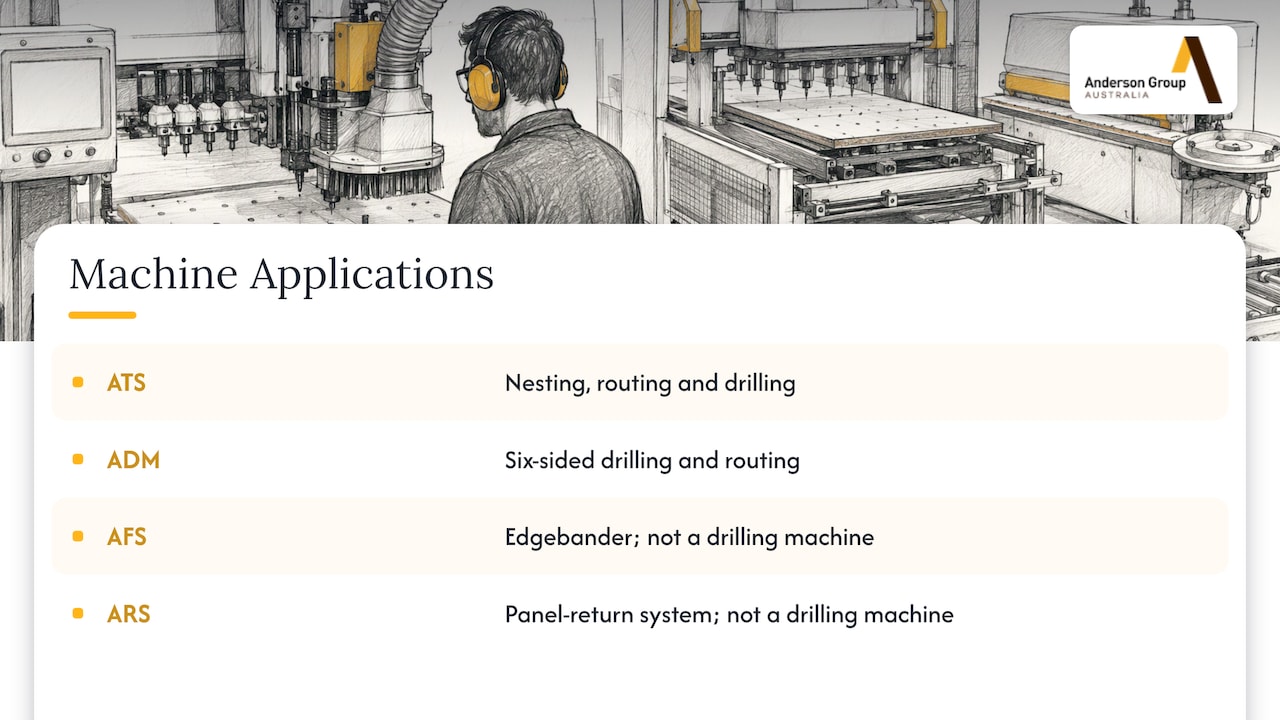
Nesting and routing with drilling. Our ATS range is nesting, routing and drilling. If your work is sheet-based, with parts cut from full panels and holes drilled in the same cycle, this is the type of machine to discuss. Our Genesis PLUS nesting CNC machine page is the place to check documented specifications. Which drilling unit or block configuration is available on a given model must be confirmed against that model’s page and with our team, rather than assumed from the machine name.
Six-sided drilling and routing. Our ADM range is six-sided drilling and routing. This suits parts that need holes and routing on several faces.
Edgebanding and panel return. AFS models are edgebanders (edge banding machines), and ARS is a panel-return system. Neither is a drilling machine. They sit in a different part of the line, though they affect how drilled panels flow through your shop.
For productivity on the nesting side, our guide on how to increase CNC nesting productivity covers the factors outside the drilling head.
Questions to settle before you request a quote
General guidance, not a prescription. Work through these with your own production in mind.
- What hole system do you drill? Pitch, bit diameter, depth and edge-to-hole distances.
- Which faces? Face only, or edges and ends too. That points toward either a nesting router with drilling or a six-sided machine.
- How many panels, how many holes? A job shop with varied parts has different needs from a shop repeating a few carcass types.
- Which tool interface does the machine have? This governs which drilling units and toolholders are possible.
- How are blocks loaded? Manually or through a tool changer. Block mass matters here.
- What does your CAM and post-processor output? Confirm it can call the block and handle the spindle selection.
- How will you service it? Drilling spindles and bits are wear items. Ask what spare parts and service are available for the exact model, and confirm the agreed scope in writing. We do not state service inclusions or response times in general terms.
Print your top ten part types with their hole patterns and bring them to the conversation. It speeds up the answer to nearly every question above.
Talk to us about your drilling application
We supply CNC machinery, servicing and parts to Australian manufacturers, with a primary focus on kitchen, cabinet, joinery and furniture makers. We help you choose machinery for your own production. We do not offer subcontract cutting or machining.
If you are comparing nesting, routing and drilling options, start with our wood machinery range, then tell us about your panels, hole patterns and volumes so we can point you to the right model and confirm its configuration against the product page.
To request a quote, use the enquiry options on the Anderson Group Australia website.
FAQ
Is a CNC drilling block the same as a CNC drilling head?
Not exactly. A block is a multi-spindle tool body that drills a row of holes per plunge. A drilling head is the unit that carries and drives spindles or blocks on the machine. In practice, shops use the terms interchangeably, so confirm which one a supplier means.
What spindle pitch should a cabinet drilling block have?
The usual standard is 32 mm, with 21 mm used on some systems, according to a guide to 32 mm line boring blocks. Your hole system decides this. Match the pitch to the hardware you actually drill for.
Can I fit any gang drill block to my CNC router?
No. Many blocks were designed for handheld machines and have a round drive shank. A CNC spindle with an ISO 30, HSK 63F, BT 40 or CAT 40 taper needs a suitable adapter or toolholder. Confirm the exact model and configuration with the supplier before buying.
Why do my drilled holes come out oval?
One cause described in a tooling guide is a bit with a set-screw flat held in a collet-style holder, which cannot clamp evenly. An adapter with a plain cylindrical shank is the fix it describes. Check your bit and holder combination first.
Does Anderson offer subcontract drilling?
No. We supply machinery, servicing and parts for your own production. We do not offer subcontract cutting, machining or finished-part manufacturing.
Sources
- SWOOD CAM presentation and features
- What is a drill block in CNC or machining
- Binary drill block code, RouterCIM help
- Selecting 32 mm line boring drill blocks for CNC routers
- CNC tooling guide
- What is CNC drilling
- Application of ANN for analysis of hole accuracy and drilling temperature (PMC)