
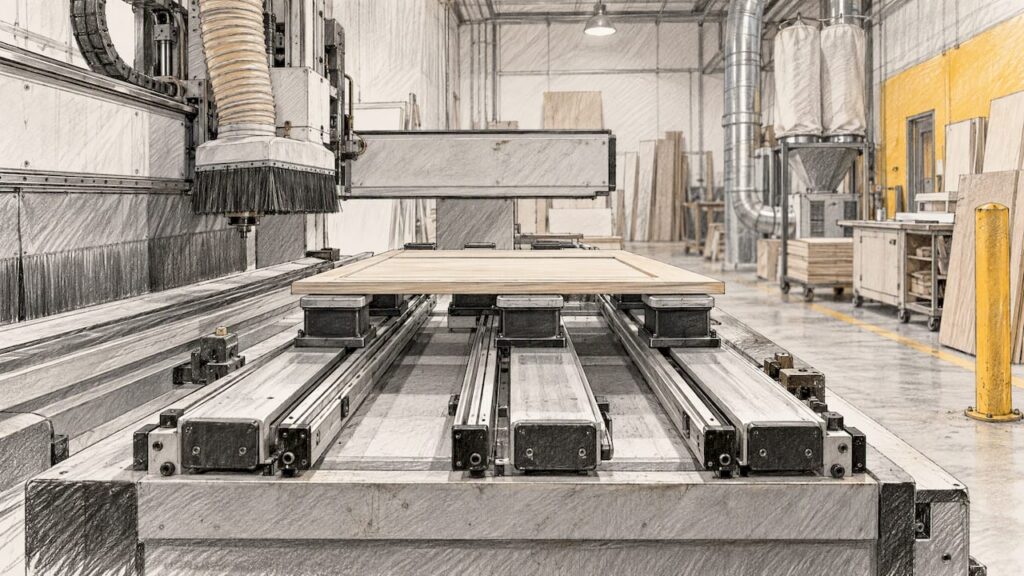
Pod and rail fixturing holds a workpiece on movable vacuum pods that sit on rails, instead of on a full-bed vacuum table. It suits shops that machine solid wood, small parts and profiled edges, where the part needs clearance underneath. Shops that cut most of their work as full sheets of melamine, MDF or plywood usually get more from a flat nesting table. This guide explains how each works, how to decide between them, and what to check for your own production.
TL;DR
- Pod and rail tables use movable consoles with vacuum pods, which hold the part and leave clearance between the part and the machine table (VacuPedia).
- They are typically used for solid wood, furniture panels, MDF and plywood, especially where you need edge profiling, undercuts or flexible set-ups.
- A flat vacuum table suits shops that nest most of their parts from full sheets. Pods suit small parts, full edges and solid wood.
- Vacuum pump sizing, seal quality and part size decide whether either method holds reliably.
- Anderson’s documented wood machine for sheet nesting is the Genesis PLUS. Talk to us about your parts before you settle on a fixturing method.
Table of Contents
- What pod and rail fixturing actually is
- Which jobs suit pod and rail
- Pod and rail versus a flat vacuum table
- Vacuum, pumps and air: what to check
- Repeatable registration for drilling and grooving
- Programming and software
- Where nesting fits in a cabinet shop
- A checklist for Australian buyers
- Talk to us about your parts
- FAQ
- Sources
What pod and rail fixturing actually is
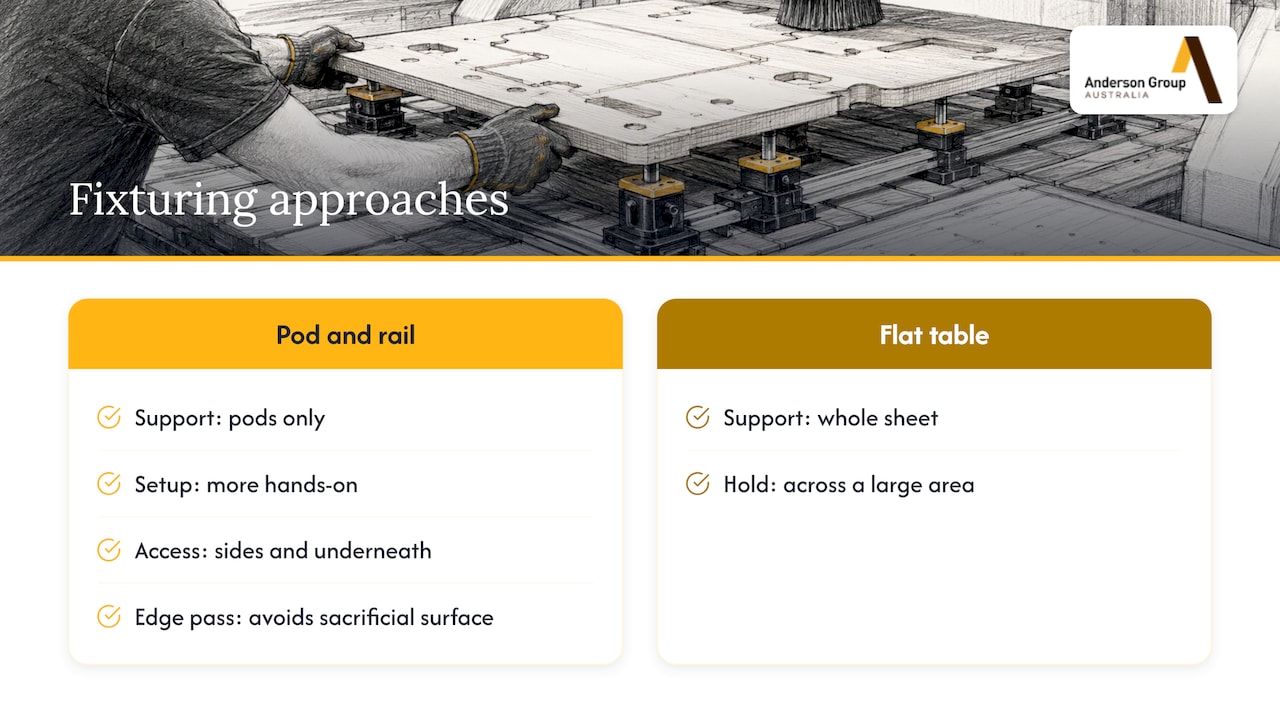
A pod and rail machine has a bed made of rails (or consoles) that can be repositioned. Each rail carries vacuum pods, which are blocks with a sealing surface that grip the underside of the workpiece. You place the rails and pods to suit the part, load the part on top, and the vacuum clamps it. The part sits clear of the machine bed, so a tool can pass through the edge without touching a sacrificial surface.
That is the key difference from a flat table. A flat table supports the whole sheet and holds it across a large area. A pod and rail setup supports the part only at the pods, so the set-up is more hands-on, but the part is accessible from the sides and underneath.
K1 and K2 pod systems
Two pod designs come up in supplier literature. They differ in how the pod is locked to its rail.
- K1 (single circuit): these systems are hose-free. The pods are pre-fixed to the rail mechanically with levers, and vacuum is used only to clamp the workpiece (Schmalz).
- K2 (dual circuit): one vacuum circuit stabilises the pod on the console, and the second generates the holding force between the pod and the workpiece (VacuPedia).
Schmalz notes that K1 blocks are used on single-circuit pod and rail CNC machines and are pre-fixed with mechanical levers during loading, to prevent unintended movement during set-up. K2 blocks are used on two-circuit systems (Schmalz). Which one a machine uses is a configuration question for the exact model, so confirm it with the supplier before you assume either.
Which jobs suit pod and rail
Pod and rail tables are mainly used to machine furniture panels, MDF, HDF, solid wood, plywood and other wood-based materials (VacuPedia). In practice the strongest cases share a few traits.
- Solid wood components. Table legs, frames, rails, chair parts and similar pieces that are cut from timber rather than sheet.
- Edge profiling and undercutting. Because the part is raised on pods, a cutter can run the full edge profile in one pass.
- Small parts. Woodweb contributors describe pod and rail machines as invaluable for bullnose edges and small parts that are awkward on a flat vacuum table (Woodweb forum, 2011). Treat that as shop-floor opinion, not a specification.
- Frequent changes of part shape. Pods are repositioned for each job, which suits mixed, low-volume work.
- Very high holding force. Schmalz says aluminium vacuum pods are an efficient solution in stair and window production or for clamping solid wood workpieces (Schmalz).
Offcuts are another practical point. Pod and rail machines let offcuts from solid wood parts fall clear of the bed, which reduces the risk of crash damage during production (Woodweb).
Pod and rail versus a flat vacuum table
The question most buyers ask is not which method is better in the abstract, but which fits the parts they cut every day. The comparison below is general guidance drawn from the sources cited in this article, not a statement about any one Anderson model.
| Factor | Pod and rail | Flat vacuum (nesting) table |
|---|---|---|
| How the part is held | Vacuum pods on movable rails | Vacuum across the bed, usually through a spoilboard |
| Best material form | Solid wood, panels, shaped blanks | Full sheets: melamine, MDF, plywood |
| Edge access | Part is raised, so full edge profiling and undercuts are possible | Part sits on the table, so tooling cuts into a sacrificial surface |
| Set-up | Pods and rails positioned per job | Sheet loaded and nested, little fixture set-up |
| Small parts | Valuable for small parts and full edges | Can be harder to hold unless supported by nesting strategy |
| Offcut clearance | Offcuts fall clear of the bed | Offcuts stay on the table until unloaded |
| Vacuum demand | Lower airflow, higher absolute vacuum | Larger pump, higher pumping speed |
The Woodweb discussion puts the decision simply: nesting suits shops that nest most of their parts, while pods are valuable for small parts, full edges and solid wood, and a pod and rail machine is recommended if little or no nesting is needed (Woodweb, 2011). That thread is more than a decade old, so use it as a framework for your own questions, not as current machine data.
A quick way to decide
Look at one typical week of work and sort it.
- Count the parts by origin. How many come from full sheets, and how many from solid timber or pre-cut blanks?
- Check edge requirements. Do parts need a profiled or undercut edge, or just a clean square cut?
- Check part size. Are many parts small enough that holding area becomes the problem?
- Check volume and changeover. Are you running repeat sheet jobs, or constantly changing shapes?
If most answers point to full sheets, repeat cabinet parts and square edges, a nesting machine is the natural fit. If they point to solid wood, profiles and small parts, a pod and rail configuration deserves a close look.
Vacuum, pumps and air: what to check
Fixturing fails more often from vacuum supply than from the table itself. A few principles hold for both methods.
Atmospheric pressure does the holding. The cnc-tool technical white paper explains that the force pushing the part down comes from atmospheric pressure above the part, not from suction itself. It adds that vacuum hold-down with oil-less dry rotary claw pumps or regenerative blowers is the most common method in the wood, plastic and composite industries, and that pump sizing must account for part size, density and porosity (cnc-tool.com).
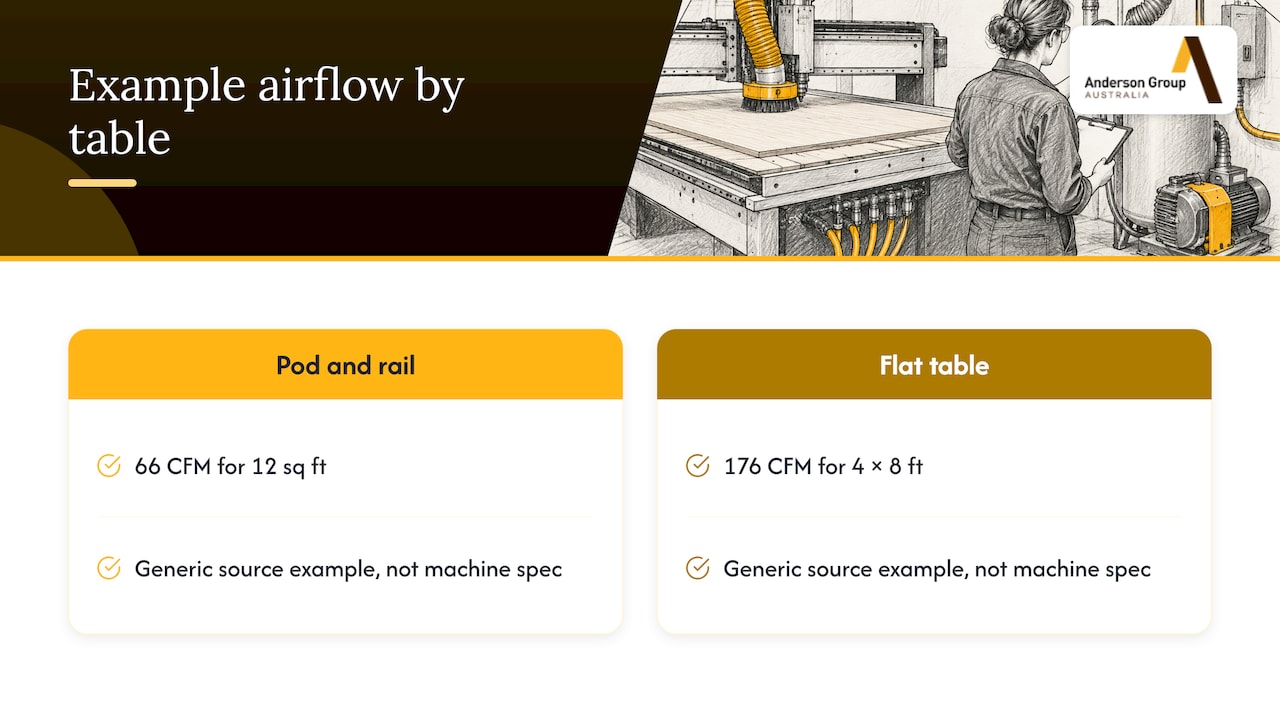
Pods need less airflow. The same paper says pod and rail tables use small suction cups that need far less airflow than full-table systems. It gives, as an example, about 66 CFM for a 12 square foot pod and rail table, against 176 CFM for a 4 ft x 8 ft flat table (cnc-tool.com). These are the author’s figures in imperial units for a generic example. Your machine’s actual requirement depends on its own configuration, so ask for the vacuum specification of the exact model.
Pump capacity follows the clamping method. Busch Australia notes that nesting generally needs a larger pump with higher pumping speed than console vacuum blocks, and that you should keep lines short and seals tight (Busch Australia, 2021). A tighter seal in the lines and clamping devices lets the pump work more effectively, while longer lines and more connections raise the leakage risk (Busch Australia).
For a wider look at when vacuum hold-down works and when it needs help, see our guide on vacuum fixturing for CNC.
Parts that need more than vacuum
Parts that are too small, or have uneven surfaces, may need mechanical clamping on top of the pods. The cnc-tool white paper says some pod and rail machines offer pneumatic clamps at 90 to 120 psi to grip parts with little to no movement during processing (cnc-tool.com). That is a supplier’s general statement. Whether a given machine offers such clamps is an option to confirm for that exact model and configuration.
Repeatable registration for drilling and grooving
Where a pod and rail machine is used for point-to-point work, the rail design matters for accuracy. One industry knowledge-base article on the Weeke BP 12, a machine from another manufacturer, describes air-released brakes locking the carriages so that positions stay repeatable for drilling and grooving (Industrial Monitor Direct, 2026). It is a reference to how rail locking can work, not a description of any Anderson machine.
Keep that distinction in your own buying. Nesting, routing, drilling and edgebanding are separate applications, and a fixturing method that suits one does not automatically suit another. If drilling is the main job, our guide on when to bore or drill on a CNC covers the decision on its own terms.
Programming and software
The machine is only half of the system. Your CAM or cabinet software must output code for the machine type you buy. Mozaik’s version 13 release added support for single-part machining centres, including point-to-point pod and rail machines, with post processors planned for Biesse, Homag and SCM machines handling .cix, .mpr and .xcs files (Mozaik Version 13). That tells you the software side of pod and rail is maturing. It does not tell you which post processors suit another brand’s controller.
Before buying, ask for the following in writing:
- The file formats and controller the machine accepts.
- Whether a post processor exists for the software you already run.
- Who supports the programming set-up locally.
Where nesting fits in a cabinet shop
Most kitchen and cabinet manufacturers cut the bulk of their parts from sheet. For that work a flat-bed nesting machine is the production tool. Anderson’s documented wood machine for sheet nesting is the Genesis PLUS nesting CNC machine. Check its current specifications on that page, and ask us to confirm the configuration you need, such as table size, drilling, loading and unloading options, before you rely on any capability.
If you are weighing a nesting machine, these guides cover the practical side:
- How to size a nesting machine for your production capacity
- Choosing and maintaining nesting cutters
- Plywood machining: tooling, hold-down and machine choice
Pod and rail fixturing and sheet nesting are two answers to two different part mixes. Many shops run mostly sheet work, with the occasional solid timber or profiled component. Describing that mix honestly when you enquire is the fastest way to get a sensible recommendation.
A checklist for Australian buyers
Use this before you request a quote on any CNC with vacuum fixturing.
- Part mix. Write down the percentage of sheet parts, solid wood parts and small parts.
- Materials. List the exact boards and timbers, including thickness and surface finish. Porosity affects vacuum holding.
- Edge work. Note whether you need profiling, undercuts or only straight cuts.
- Vacuum supply. Ask what pump type and capacity the configuration needs, and whether it is included. Confirm the electrical supply at your site.
- Clamping options. Ask which exact model offers extra mechanical clamping for small or uneven parts, if you need it.
- Software. Confirm the CAM or cabinet software output and post processor for the controller.
- Service and parts. Ask what the agreed service scope is and how spare seals, pods and filters are supplied. Do not assume inclusions, response times or local stock until they are confirmed in writing.
Talk to us about your parts
We supply CNC machinery, servicing and parts to Australian manufacturers, mainly kitchen, cabinet, joinery and furniture makers. We help you choose machinery for your own production. We do not offer subcontract cutting or machining.
If you cut mostly sheet, start with our wood machinery range. Send us your part list and materials, and we will discuss which machine and configuration fit your application, or contact Anderson Group Australia to request a quote.
FAQ
Is pod and rail better than a flat table?
Neither is better for every shop. Pods suit small parts, full edges and solid wood, while nesting suits shops that cut most parts from full sheets (Woodweb, 2011). Compare them against your own weekly part mix.
Does pod and rail need a smaller vacuum pump?
In general, yes. Pods use small suction cups that need far less airflow than a full-table system, and a nesting setup generally needs a larger pump (cnc-tool.com; Busch Australia). Confirm the exact requirement for the machine you are considering.
What is the difference between K1 and K2 pods?
K1 pods are pre-fixed to the rail with mechanical levers, and vacuum clamps only the workpiece. K2 systems use two vacuum circuits: one stabilises the pod on the console and the other holds the part (Schmalz).
Can small or uneven parts be held on pods?
Sometimes they need extra help. Small or uneven parts may require mechanical clamping in addition to the pods, and some machines offer pneumatic clamps for this (cnc-tool.com). Ask whether your target model offers that option.
Sources
- How a CNC Vacuum Pod Works, VacuPedia
- K1 vacuum clamping blocks, Schmalz
- K1 vacuum clamping blocks, Schmalz (en-de)
- Flat Table Versus Pod and Rail CNC Machines, Woodweb
- Technical White Paper CNC Fixturing, cnc-tool.com
- Vacuum in Woodworking Part 3, Busch Australia
- Weeke BP 12 reference, Industrial Monitor Direct
- Mozaik Version 13