
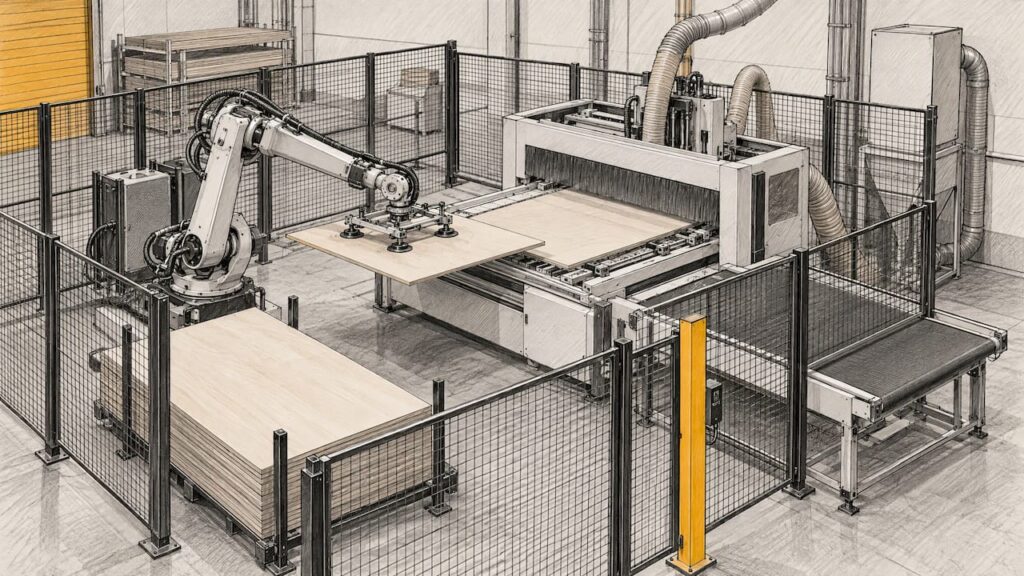
Robotic CNC tending means a robot loads raw material into a CNC machine and unloads the finished parts, so the machine keeps cutting while people do other work. For an Australian manufacturer the real question is whether your parts, volumes and machine suit it. This guide covers how a robot loader fits into a CNC cycle, which applications suit it, what to plan for on safety and programming, and how to assess it step by step. It leans towards panel and cabinet production, with a section on metal machining.
TL;DR
- A tending robot handles the repetitive steps around the machine: picking up stock, loading it, removing parts and placing them on a stack, pallet or conveyor.
- It pays off when the same part families run repeatedly and an operator spends much of the shift loading and unloading instead of preparing the next job.
- Safety is designed at cell level. Current robot-cell safety requirements sit in ISO 10218-2, and your integrator and safety adviser apply them to your site.
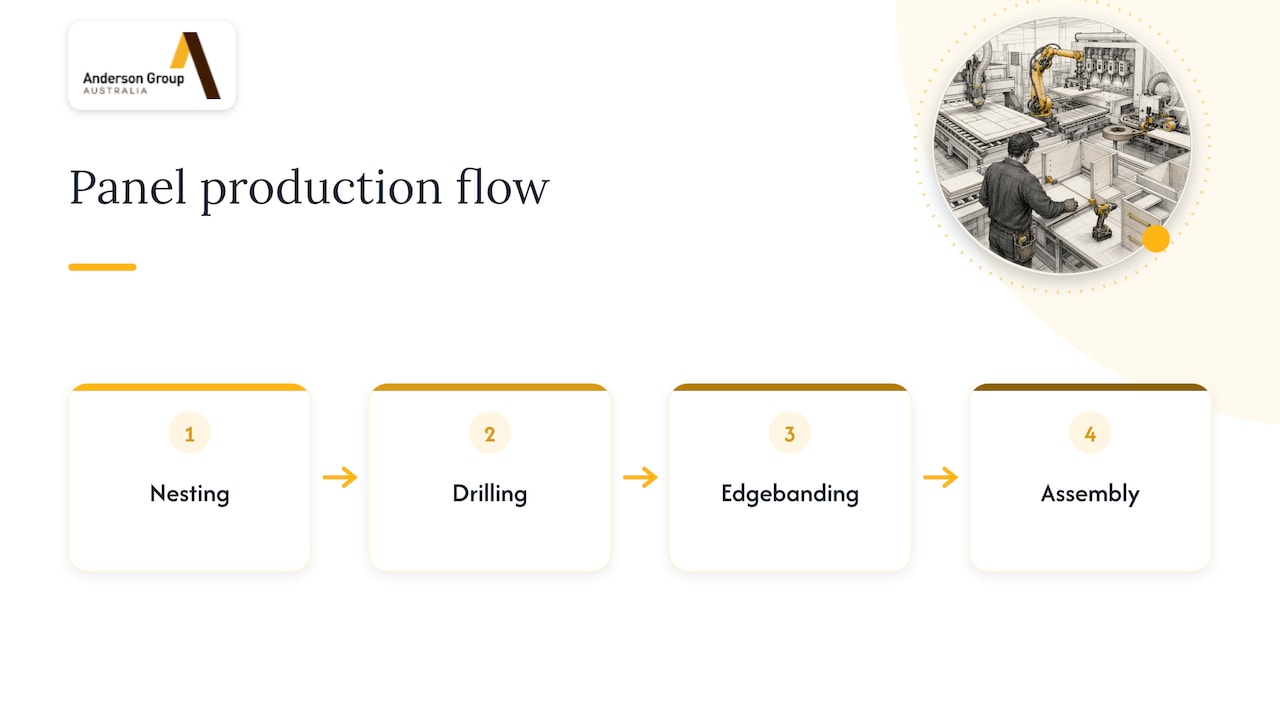
- Panel work (nesting, drilling, edgebanding) and metal machining need different handling, so assess each application separately.
- Start with your own part list, cycle times and floor space, then talk to your machinery supplier about the machine and cell together.
Table of Contents
- What robotic CNC tending actually is
- How loading and unloading fit into a production cycle
- Where robotic tending suits, and where it does not
- What to assess before you invest
- Safety and integration
- How to assess whether it suits your shop
- How Anderson can help
- FAQ
- Sources
What robotic CNC tending actually is
A CNC machine cuts to a program, but it does not feed itself. Someone has to put a sheet or blank in, start the cycle, take the parts out and clear the table. Robotic tending, also called a robot loader or robotic loading, automates those handling steps.
The robot is a tool for handling, not for cutting. The machine keeps its own controller and program. The robot is usually fitted with a gripper suited to the workpiece (vacuum cups for flat panels, mechanical grippers for metal blanks) and works to its own program, coordinated with the machine by signals between the two controllers.
There are two broad layouts:
- Robot outside the machine. The robot sits beside the machine, reaches in through a door or loading opening, and places parts. This is the most common setup for metal machining centres and lathes.
- Robot inside or integrated with the machine. One Australian automation case describes moving the robots inside the machines, which cut loading and cycle time, kept oil off the floor and removed the need for guarding around an outside robot. The source is an AMTIL case study on a precision manufacturing site. Whether this layout is possible depends entirely on the machine.
For flat panels, the equivalent is often a gantry-style or robotic handling system that lifts a sheet from a stack onto the machine bed and moves cut parts to an outfeed. The principle is the same: handling is automated, cutting stays on the CNC.
How loading and unloading fit into a production cycle
A tended cycle repeats the same sequence. Here it is for a typical machining centre:
- The robot picks a blank or sheet from an infeed (a stack, rack, tray or pallet).
- The machine door or loading position opens and the robot places the workpiece in the fixture or on the bed.
- The robot retreats, and the machine receives a start signal once the area is clear.
- The machine cuts. The robot can use this time to prepare the next piece, inspect, or deposit a finished part.
- On completion the robot removes the part and puts it on an outfeed.
- The cycle repeats until the infeed is empty or a stop condition occurs.
The gain comes from step 4. While the machine cuts, the operator is free to set up the next job, check quality or run another machine, rather than standing at the door.
One Australian robot-loading supplier reported systems that could configure up to four product types and eight CNC programs for runs exceeding 24 hours without operator intervention, according to AMTIL’s profile of that business. That is one supplier’s reported capability, not a benchmark for every cell, but it shows why tending and unattended running are linked. Our guide to lights-out machining covers what it takes to run CNC unattended.
Where robotic tending suits, and where it does not
The best candidates share a few traits: repeatable parts, steady demand and a bottleneck at the loading step. The table below separates applications so they are not blurred together. It is general guidance, not a statement of what any particular Anderson model includes.
| Application | Typical handling task | What decides the fit |
|---|---|---|
| CNC nesting and routing of sheet material | Lifting full sheets on, moving cut parts off, stacking or labelling | Sheet size and weight, part mix, whether parts are sorted for the next process |
| Drilling and boring of panels | Feeding panels in, taking them out in sequence | Panel sizes, orientation, sequence with downstream edgebanding |
| Edgebanding | Returning or feeding panels to the edge bander | Line layout, panel return flow, operator numbers |
| Metal and aluminium machining | Loading blanks or part-machined components into vices or fixtures | Part weight, fixture design, repeatability of the blank |
| Service and repair | Not an application of tending | Handled as a separate service enquiry |
Keeping these separate matters because the handling problem is different in each. A sheet of 18 mm melamine board behaves nothing like a machined aluminium blank. A nesting cell produces many different part shapes from one sheet, while a metal cell often makes the same part repeatedly.
Panel and cabinet production
Most cabinet, kitchen and joinery shops cut parts from standard sheets on a nesting machine, then move parts to drilling, edgebanding and assembly. The handling steps around that flow are heavy and repetitive: loading sheets, unloading dozens of parts, sorting them and carrying them on. Automating some of these steps is what people usually mean by robotic loading in a wood shop.
Before thinking about automation, many shops get more from tightening the basics. Our guides on increasing CNC nesting productivity and cabinet CNC machining for Australian kitchen and cabinet makers cover the machine side of the flow. Tending adds the most when those fundamentals are already running smoothly, because a robot repeats whatever process it is given, good or bad.
For wood machinery on our range, see our wood machinery page. Anderson’s range keeps nesting, routing and drilling machines, edgebanders and panel-return systems as distinct product families, so tell us which step of your flow is the constraint and we can talk through the right one.
Metal and aluminium machining
Tending is more common in metal machining, where parts are smaller, repeat often and fit grippers and fixtures well. The Focaseiki machining centres on our metal machinery page serve metal and aluminium manufacturers. Whether a given centre can be tended by a robot depends on the exact model and configuration: door opening, fixture or vice, automatic pallet changing if fitted, and signals between machine and robot. Do not assume any of those from a family name or axis count. Confirm them for the specific model on its product page or in a discussion with us.
An Australian tool manufacturer featured by AMTIL reported that robot loading reduced rejects by roughly 10 to 15 per cent on some machines compared with hand loading, and that each machine’s efficiency could rise by around 60 to 70 per cent. The company itself called these figures “probably” values, so treat them as that site’s own estimates in the AMTIL case study, not a promise for yours.
What to assess before you invest
This is general guidance. Use it as a checklist for a conversation with a machinery supplier and a robot integrator.
Your parts and volumes
List the parts you would load. For each, note dimensions, weight, material, how it arrives (stacked, racked, loose) and how many are made per shift. Tending suits families of parts that share a handling method. A very mixed, one-off job shop spends more time reprogramming and changing grippers than it saves.
Machine readiness
A robot needs a machine that can be loaded by something other than a person. Questions to settle with your supplier, for the exact model:
- Can the machine door or loading area be opened and closed automatically, and can the machine accept a start signal from the robot cell?
- How is the workpiece held (vacuum bed, clamps, fixture, vice) and can that be released and re-clamped automatically?
- Is there an automatic pallet changer or other automation on this configuration, or does it need adding? Do not infer it.
- How are chips, dust and offcuts cleared so the next part sits correctly? For wood panels, dust extraction is a separate matter from coolant in metal work.
Part presentation and gripping
The robot cannot pick what it cannot find. Parts need to arrive in a repeatable position, on a pallet, in a rack or tray, or with vision to locate them. Grippers must match the surface: vacuum for flat panels with suitable surface and porosity, mechanical for machined metal. Ask how the gripper will be changed when part families change.
Programming and changeover
Plan who will program and maintain the robot, and how long a changeover between part families takes. A cell that takes hours to retrain for each new job removes the benefit on short runs. Ask whether your own staff can edit pick positions and counts, or whether every change needs the integrator. Machine monitoring helps you see where time goes, and our overview of CNC machine monitoring for Australian workshops explains how to measure it.
Floor space and flow
Map the cell on your actual floor. Allow for the robot’s reach, the infeed and outfeed, guarding or sensors, and clear paths for forklifts and staff. In panel shops, think about where cut parts go next, because moving them off the machine only to pile them up at the next station shifts the bottleneck.
Safety and integration
A robot cell is a machine system, and the safety of the whole cell has to be designed, not just the robot. The international standard for robot applications and cells, ISO 10218-2, is aimed at integrators and covers hazards and safety requirements for robots with their end-effectors integrated into complete applications. Its sections include risk assessment, cell integration, safeguarding, commissioning, validation and maintenance, as shown in the ISO/FDIS 10218-2 preview.
The 2025 editions of Parts 1 and 2 replace the 2011 versions, and the new Part 2 incorporates requirements for collaborative applications that previously sat in a separate technical specification, per the Association for Advancing Automation FAQ on the update. Which edition and which Australian adoption applies to your project is something to confirm with your integrator and your safety adviser. Under Australian work health and safety laws you also carry duties as the business operating the plant, so involve your WHS officer from the start.
Practical points to raise at the design stage:
- A written risk assessment for the whole cell, including how operators enter the area for setup, clearing jams and maintenance.
- How the machine, robot and any safety devices behave if one stops or faults.
- Who is trained to restart the cell, and how.
- Maintenance access to both the robot and the machine, and who services each.
How to assess whether it suits your shop
A sensible Australian assessment runs in order:
- Find the real bottleneck. Time a few shifts. If operators wait on the machine, more automation will not help; if the machine waits on operators, tending may.
- Clean up the process first. Stable programs, consistent material and good nesting make any cell more reliable. Our playbook to reduce CNC waste and the guide to improving CNC uptime are good starting points.
- Define the parts and the target. Pick the part families that make up most of your run time and describe what a good result looks like in your own terms.
- Check the machine. Confirm with your supplier the exact model’s suitability for loading by a robot, and what options are documented.
- Get the cell designed and risk-assessed together. Machine supplier, integrator and your own team should agree on responsibilities in writing.
- Plan service and parts. A cell that stops needs fast answers. Ask the agreed scope of service for both machine and robot, because inclusions and response times differ by arrangement.
- Trial on one machine. Prove the process on one cell before copying it across the shop.
Build your business case from your own numbers: hours saved, scrap avoided, shifts covered. Published figures from other sites are useful context but not a forecast for you.
How Anderson can help
Anderson Group Australia supplies CNC machinery, servicing and parts to Australian manufacturers, with most customers in kitchens, cabinets, joinery and furniture. We help you choose machinery for your own production. We do not offer subcontract cutting or machining.
If you are weighing automation around a panel flow, or considering a metal machining centre you want to feed with a robot, we can talk through the application and the exact machine you would need. Start with the machines page to see the range, then tell us about your parts and volumes and request a quote.
For wood and panel applications, start at wood machinery. For metal and aluminium milling, see our metal machinery range. Specifications are confirmed against the relevant product page, so we will tell you what a given model documents and what needs checking.
FAQ
What does a robot loader do on a CNC machine?
A robot loader picks up raw stock, places it in or on the machine, and removes the finished part after the cycle. The CNC still cuts to its own program. The robot only handles the workpiece, which frees the operator for other tasks.
Can robotic loading be used for woodworking and nesting?
Yes, handling automation exists for panel work, such as lifting sheets onto a bed and moving cut parts to an outfeed. What suits your shop depends on sheet size, part mix and what happens to the parts next. Nesting, drilling and edgebanding each have different handling needs, so assess them separately.
Does any CNC machine accept a robot?
No. The machine needs a way to receive start and stop signals, open and close access, and release and re-hold the workpiece automatically. Confirm each of these for the exact model and configuration before you plan a cell, rather than assuming from the family name.
Is a robot cell safe to run beside operators?
It can be, if the whole cell is risk-assessed and safeguarded. Cell-level requirements are set out in ISO 10218-2, and your integrator and WHS adviser apply them to your site and your obligations in Australia.
Sources
- AMTIL: Bringing Australian-made agility to automation worldwide
- AMTIL: Automated Solutions Australia, a precision transformation
- ISO/FDIS 10218-2 preview
- Updated ISO 10218: answers to frequently asked questions