
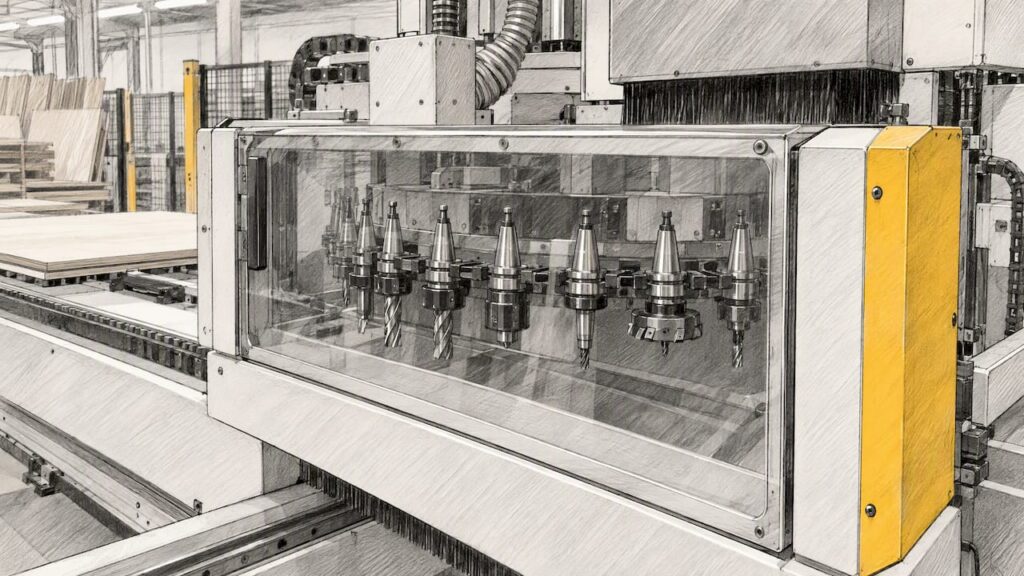
Tool magazine capacity is the number of tool pockets a CNC machine can hold ready for automatic changes. Typical figures run from about a dozen on a small disc magazine to 60 or more on a chain magazine, but the right number for your shop is not the biggest one on the spec sheet. It is the number that covers the tools your regular jobs call for, plus spares, without paying for a magazine you will never fill.
This guide explains what capacity means, how magazine types differ, what the research says about changeovers, and how to size a magazine for panel work and for metal work. We keep the two apart, because a nesting router and a vertical machining centre solve different problems.
TL;DR
- Capacity is the count of tool pockets in the automatic tool changer (ATC) magazine. Disc and drum designs generally hold about 12 to 50 tools, and chain designs are used when you need more than 50.
- Size the magazine from your own tool list: every tool across your regular jobs, plus sister tools for the ones that wear fastest.
- Too small a magazine means manual tool swaps between jobs. Too large means paying for pockets that stay empty.
- Capacity differs by model and configuration. Confirm the exact figure for the machine you are quoting; do not assume it from the family name or axis count.
- For wood and panel work, talk to us about your cabinet or joinery production. For metal and aluminium milling, the Focaseiki range is the one to ask about.
Table of Contents
- What tool magazine capacity actually means
- Magazine types and the capacity they usually offer
- How ATC and the magazine work together
- Why capacity matters for changeovers and efficiency
- Sizing a magazine for panel and cabinet production
- Sizing a magazine for metal and aluminium milling
- A buyer’s checklist before you ask for a quote
- Talk to us about your application
- FAQ
- Sources
What tool magazine capacity actually means
A tool magazine is the storage unit that holds the cutting tools a machine can pick up automatically. Siemens describes it as a protected storage location from which the required tool can be reached quickly, and notes that its SINUMERIK control can manage up to 1,000 tools in its tool data. That number is a software limit, not a physical one.
This is the first thing to separate when you read a spec sheet. There are two different questions:
- Physical capacity: how many tools can sit in pockets on the machine right now.
- Tool management: how many tools the controller knows about, including tools stored on a shelf and loaded when needed.
Siemens’ own guidance treats these as separate planning issues: tools must be organised both physically in the magazine and virtually in the CNC so that changes happen correctly and without errors (Siemens tool management guide). A controller that tracks hundreds of tools does not give you a magazine that holds hundreds.
Capacity is not the same as tools you can use at once
Pockets are also not all equal. Large-diameter or heavy tools may need neighbouring pockets left empty, and each machine has a maximum tool diameter, length and weight. Those limits sit alongside the headline count on the manufacturer’s data sheet. A 24-tool magazine that cannot take your largest face mill is a smaller magazine for your purposes.
Magazine types and the capacity they usually offer
Design sets the practical range. The figures below are general ranges from technical references, not Anderson specifications for any particular model.
| Magazine type | Typical capacity | Where it tends to fit |
|---|---|---|
| Hat-type | 8 to 24 tools | Compact machines, simple tool lists |
| Vertical disc | 16 to 32 tools | General milling, mid-size vertical machines |
| Radial disc and chain | 40 or 60 tools | Complex parts, longer tool lists |
The ranges above come from Drake Machinery’s tool magazine guide, which also says the right figure depends on magazine type and machine application. A university lecture on CNC automation puts it a little differently: disc and drum magazines carry about 12 to 50 tools, with a larger disc diameter providing more pockets, while chain magazines are used when more than 50 tools are needed.
Chain magazines and sister tools
Chain designs have another advantage beyond count. The same lecture notes that a chain magazine can be duplicated, so a second magazine can supply a duplicate tool when the active one is worn (NPTEL CNC automation lecture). Whether through a second magazine or spare pockets, the principle is the same: holding a sister tool lets the machine keep running when the first tool reaches the end of its life.
That ties directly to how you monitor wear. Our guide on controller data and tool life monitoring covers how to know when a tool should be swapped, which is the information you need to decide how many sister tools to reserve pockets for.
How ATC and the magazine work together
The automatic tool changer (ATC) is the mechanism that moves a tool between the magazine and the spindle. The magazine is the storage, the ATC is the hand. On a vertical machining centre, the control calls a tool number, the magazine positions that tool, and the changer swaps it with the one in the spindle. On a router with a gantry-mounted or linear magazine, the machine may travel to the tool rack instead.
Three specifications matter when comparing the changer side, and all of them sit on the model’s data sheet rather than on the family name:
- Tool selection method. Random selection lets any tool occupy any pocket, and the control tracks where each one is. Fixed selection returns each tool to its own pocket.
- Tool-to-tool and chip-to-chip times. These tell you how long the machine stands still on each change.
- Maximum tool diameter, length and weight, which decide what you can actually load.
As a worked example of how a data sheet reads, the Focaseiki manufacturer lists the VMC 1250 (1350) at 24 tools (30 tools) with random tool selection, a maximum tool diameter of 80 mm and a maximum tool weight of 7 kg. This is the manufacturer’s published information for that model, quoted to show which lines to look for. It is not a statement about every machine in the range. Ask us to confirm the magazine size, tool limits and configuration of the exact model you are considering before you plan around any figure.
Why capacity matters for changeovers and efficiency
Capacity matters most when your tool list is longer than your magazine. A 2026 peer-reviewed study of CNC production found that when magazine capacity is below aggregate tool requirements, performance depends on job sequencing, tool insertion and removal, tool sharing and tool-location decisions, and these constraints can affect utilisation, throughput and responsiveness in high-mix production (Springer, 2026).
In plain terms: if every job you run fits in the magazine at once, changeover between jobs is just a program change. If it does not, someone has to stop the machine, pull tools, load others and often re-measure them.
Tool order is also a lever
Capacity is not the only variable. An earlier peer-reviewed Springer study of rotating magazines with buffered tool changes found that optimising tool order can reduce waiting time. In its experiments, savings of 50% to 70% were typical against random tool order, especially when the magazine was large, cutting times were short and tool-use frequencies were uneven (Springer, 2004). That is a result from the study’s own test conditions, not a promise for any shop. It does show that how you sequence tools can matter as much as how many pockets you buy.
Sizing a magazine for panel and cabinet production
This is where most of our customers sit: kitchen, cabinet, joinery and furniture manufacturers. We do not publish a universal “right number” for panel work, and none of the sources above supplies one, so what follows is general guidance, not documented Anderson specification.
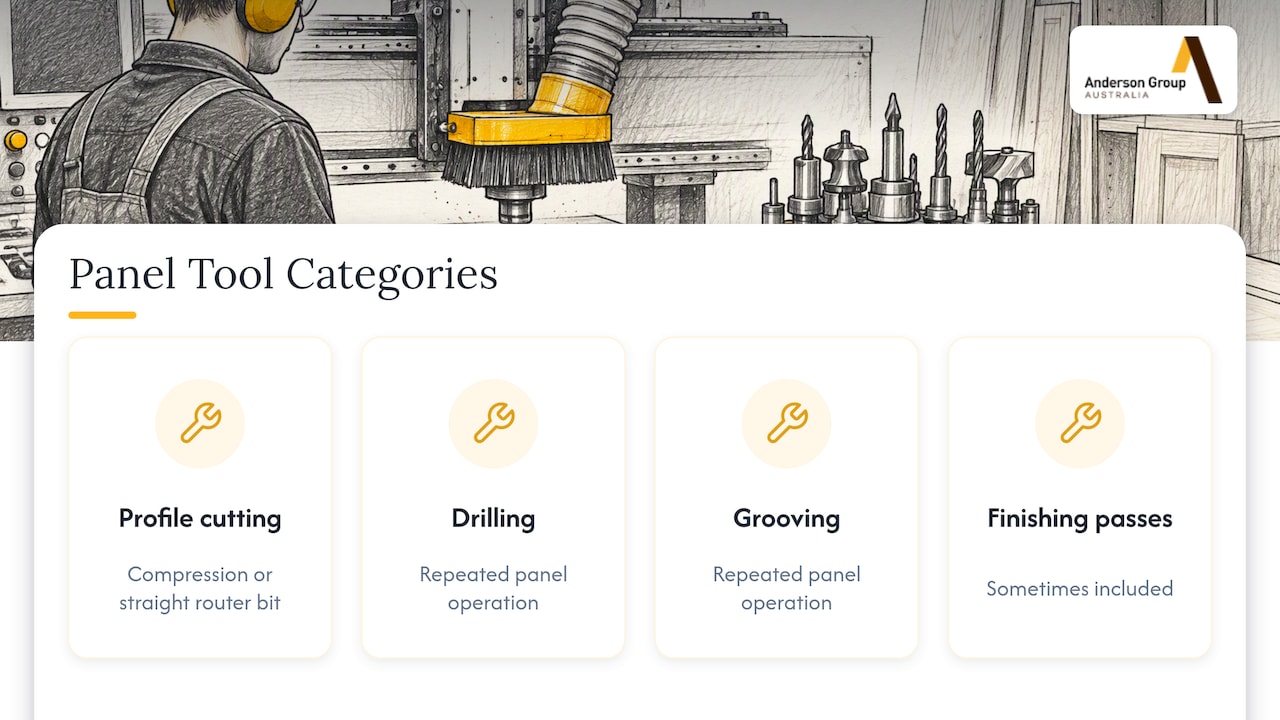
Panel-processing tool lists are usually shorter than metal-cutting lists, because the work repeats a small set of operations: cutting profiles with a compression or straight router bit, drilling, grooving and sometimes finishing passes. Your count comes from the jobs, not from a rule of thumb.
A simple way to count
List the tools for each product family you run, then merge:
- Core cutters. The router bits you use on most sheets, for example your standard cutting bit and any finishing bit.
- Drills and special tools. Hinge-cup, dowel and shelf-pin drilling, grooving and any profiling cutters.
- Material-specific tools. Different bits for melamine-faced board, MDF, plywood, solid timber or laminates, if you cut them regularly.
- Sister tools. Duplicates of the items that wear fastest, so a worn bit does not stop the shift.
- Margin. A few empty pockets for a new product line or a trial tool.
Add the five groups. If the total is comfortably inside one magazine, you will rarely touch the tools between jobs. If it spills over by a handful, decide whether a larger magazine or a small tool-list discipline is the better answer.
Keep nesting, drilling and edgebanding separate
Tool-magazine planning looks different on each process, and mixing them gives a wrong count:
- Nesting and routing: the ATC serves the router spindle. Your count is mostly cutters and a few profile bits. Our nesting productivity guide looks at what else limits throughput on the sheet.
- Drilling and boring: the ADM is our six-sided drilling and routing model and the ATS is our nesting, routing and drilling model. Drilling-heavy work may rely on dedicated drill heads rather than a tool-changer pocket per bit, so check how each model handles it. Our article on when to bore or drill explains the process difference.
- Edgebanding: AFS machines are edgebanders. An edge bander does not use a CNC tool magazine in this sense, so it should not enter the count at all.
As a result, one “tool magazine capacity” figure cannot be compared across an edgebanding machine, a nesting router and a six-sided drilling centre. Ask about each process on its own terms.
Do not infer options from the family name
Whether a particular wood machine has an automatic tool changer, how many positions it holds and what spindle sits behind it depends on the exact model and configuration. We do not assume pallet changing, probing, extraction capacity or other options from a family name or axis count, and you should not either. Review the machine pages, then ask us to confirm the configuration in writing. You can start at our wood machinery range, which leads to the nesting and panel-processing models, including Genesis PLUS and the Anderson range.
Spindle choice also affects which tools you can hold and how they behave in production. Our guide to CNC spindle options covers that side.
Sizing a magazine for metal and aluminium milling
Metal work is a separate product range. The Focaseiki vertical and production machining centres serve metal and aluminium manufacturers, and here magazine count tends to matter more, because one part can need a roughing mill, a finishing mill, drills, taps, a boring head and a chamfer tool.
The same counting method applies, with three changes:
- Tool lists are longer per part. Tapping and boring add tools that panel work rarely needs.
- Tool size and weight are real constraints. Check maximum diameter, length and weight for your biggest cutters, as in the data sheet example above.
- Repeat orders drive the decision. If you run the same parts again and again, leaving a dedicated set loaded saves setup time. If you run many one-off parts, capacity buys flexibility.
If you machine aluminium, our aluminium machining guide covers the process side, and the coolant guide for mixed metal shops covers fluids. Coolant is separate from magazine count. Whether a model can take high-pressure or through-spindle coolant depends on the exact model and configuration, so we confirm compatibility for the specific machine before you commit.
You can see the range on our metal machinery page, and the Focaseiki Production Machining Centre page describes its tool changer as large and aimed at reducing downtime on multi-tool operations. It does not give a count in the text we reviewed, so ask us for the figure for your configuration.
A buyer’s checklist before you ask for a quote
Bring these to the conversation and the quote will be faster and more accurate:
- Your full tool list for the jobs you run most, with diameters, lengths and any heavy tools.
- The materials you cut, and the share of each.
- How often you change product lines, and how many tools change when you do.
- Which tools wear fastest, and whether you hold sister tools.
- Whether one operator runs the machine or whether it runs unattended for long periods.
- Floor space and the position of any loading or unloading equipment.
Our guide to improving CNC uptime is a useful companion when you are deciding whether more automation or better routines will recover more hours.
Talk to us about your application
We supply CNC machinery, servicing and parts to Australian manufacturers, with kitchen, cabinet, joinery and furniture makers at the centre of what we do. We help you choose machinery for your own production. We do not offer subcontract cutting or machining.
If you are comparing panel-processing machines, start with the wood machinery range and send us your tool list and product mix. For metal and aluminium milling, the machining centres page lists the vertical, production, double column and 5-axis options. We will confirm the magazine size, tool limits and configuration of the exact model against its product page, and talk through your application before you request a quote.
FAQ
How many tools should a CNC tool magazine hold?
Enough for every tool in your regular jobs, plus sister tools for the fast-wearing ones and a few spare pockets. Technical references put disc and drum magazines at roughly 12 to 50 tools, with chain designs used above that. Count your own tool list first, then compare machines.
What is the difference between a tool magazine and an ATC?
The magazine stores the tools, and the automatic tool changer is the mechanism that moves them between storage and the spindle. Some machines use a disc that carries tools to a changer arm, and others move the spindle to a rack. The data sheet should state both the capacity and the changer’s tool-to-tool time.
Is a bigger magazine always better?
No. A larger magazine reduces manual swaps when your tool list is long, but it adds cost and size, and extra pockets sit empty if your jobs use a small tool set. Research on tool sequencing also shows that the order in which tools are used can change waiting time as much as capacity does.
Does the family name tell me what the machine can hold?
No. Magazine size, tool limits and options such as pallet changing, probing or coolant systems differ between models and configurations. Ask us to confirm the exact model you are considering, and check the figure against its product page before you rely on it.
Sources
- Siemens SINUMERIK tool management for milling
- Drake Machinery: CNC tool magazine
- NPTEL: CNC automation, tool magazines
- Springer (2026): tool indexing, switching and loading problems in CNC production
- Springer (2004): optimal tool magazine operation, rotating magazines