
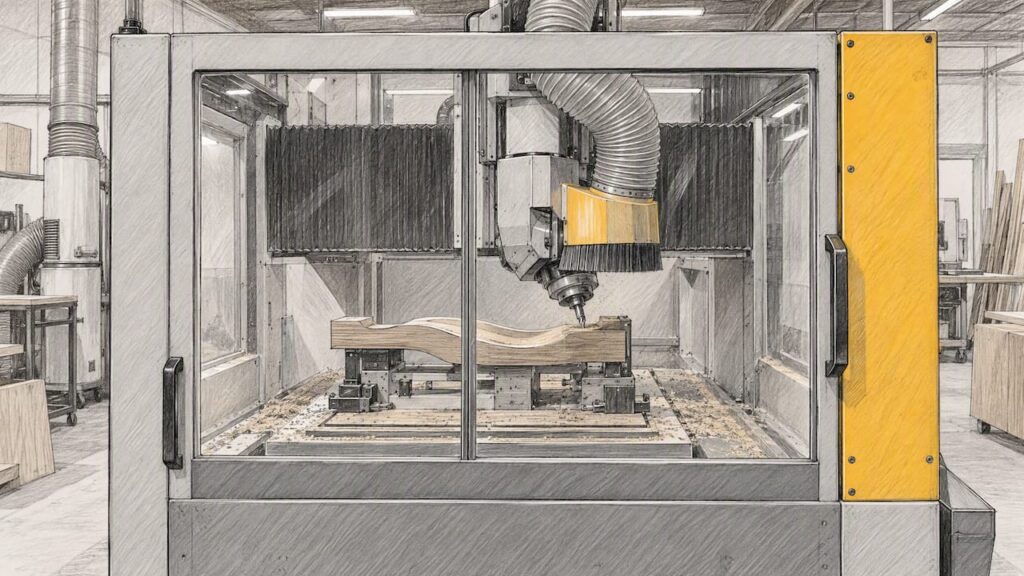
A 5-axis CNC machines wood by tilting and rotating the tool or the workpiece, so it can reach the top, sides and ends of a part in a single setup. That pays off on sculpted solid-wood parts, angled joints, undercuts and anything that would otherwise need several fixtures. It does not pay off on flat sheet work such as kitchen and cabinet carcasses, where a nesting CNC is faster and cheaper per part. This guide helps Australian manufacturers work out which side of that line their production sits on before they ask for a quote.
TL;DR
- 5-axis suits freeform surfaces, undercuts and parts that need three or more fixtures. Flat panel and sheet work is better served by a 3-axis nesting machine.
- The two common layouts are trunnion (the table rotates and tilts) and swivel-rotate (the spindle swivels). Each trades work volume against part weight.
- Tooling, CAM software and operator training are a real part of the cost, not an afterthought.
- Anderson’s documented 5-axis machines, the MASS-B and AXXIOM, are listed for composites, plastics and non-ferrous materials. Our wood panel and nesting work sits in the wood machinery range.
Table of Contents
- What 5-axis means for a woodworking shop
- What 5-axis does that a 3-axis router cannot
- Where 5-axis is the wrong tool
- Trunnion or swivel-rotate: choosing a layout
- Anderson 5-axis machines: what is documented
- Tooling, programming and people
- Fitting 5-axis into a scalable Australian operation
- Questions to settle before you request a quote
- How we can help
- FAQ
- Sources
What 5-axis means for a woodworking shop
A standard router moves along three linear axes: X, Y and Z. A 5-axis machine adds two rotary axes, so the tool and part can be oriented relative to each other while the cutter moves. Common configurations use X, Y, Z plus either A and C or B and C rotary axes, as Engineering.com explains. In practice, “5-axis” can mean two different things:
- Simultaneous 5-axis: all five axes move together while cutting, which is what produces smooth curved surfaces.
- 3+2 (positional) machining: the rotary axes tilt to an angle and lock, then a normal 3-axis toolpath runs. This covers a large share of cabinet and joinery needs, such as angled drilling or machining a sloped face.
When you speak to a supplier, ask which of the two the quoted configuration is intended for. It changes the control, the software and the price.
What 5-axis does that a 3-axis router cannot
A 3-axis router can only approach from above. A 5-axis machine can approach from almost any angle and machine the sides, ends and top of a part without moving it. Woodshop News reports that this can shorten setup times and reduce errors, though the workpiece may still need to be turned over to machine its bottom face.
The practical gains for a woodworking business come down to four things:
- Fewer setups. Each re-clamp is a chance for the part to shift. One clamping means one datum.
- Undercuts and compound angles. Features that a vertical tool simply cannot reach.
- Shorter tools. Tilting the head lets a shorter, stiffer cutter reach into a pocket, which generally gives a cleaner finish than a long tool on a vertical axis.
- Sculpted surfaces. Curved chair parts, bannister components, architectural mouldings and decorative shapes.
A Swiss example shows the range: Von Rickenbach describes 5-axis machining of three-dimensional solid-wood shapes, instrument parts, furniture components and loudspeaker casings. Notice what is absent from that list: flat-sheet kitchen carcasses.
Where 5-axis is the wrong tool
This is the part many guides skip. According to one machining company’s analysis, 5-axis machining pays for itself when a part has freeform surfaces, undercuts or features that would need three or more fixtures. Large flat sheets are slower and more expensive on a 5-axis centre than on a router.
For a kitchen, cabinet or joinery shop, that matters. If most of your day is cutting 2400 x 1200 mm sheets of melamine, plywood or MDF into carcass parts, the cost driver is sheet yield, load and unload time, and labelling. A 3-axis nesting machine is built around exactly those. Our guides on increasing CNC nesting productivity and lifting yield with a nesting-first workflow cover that side in detail.
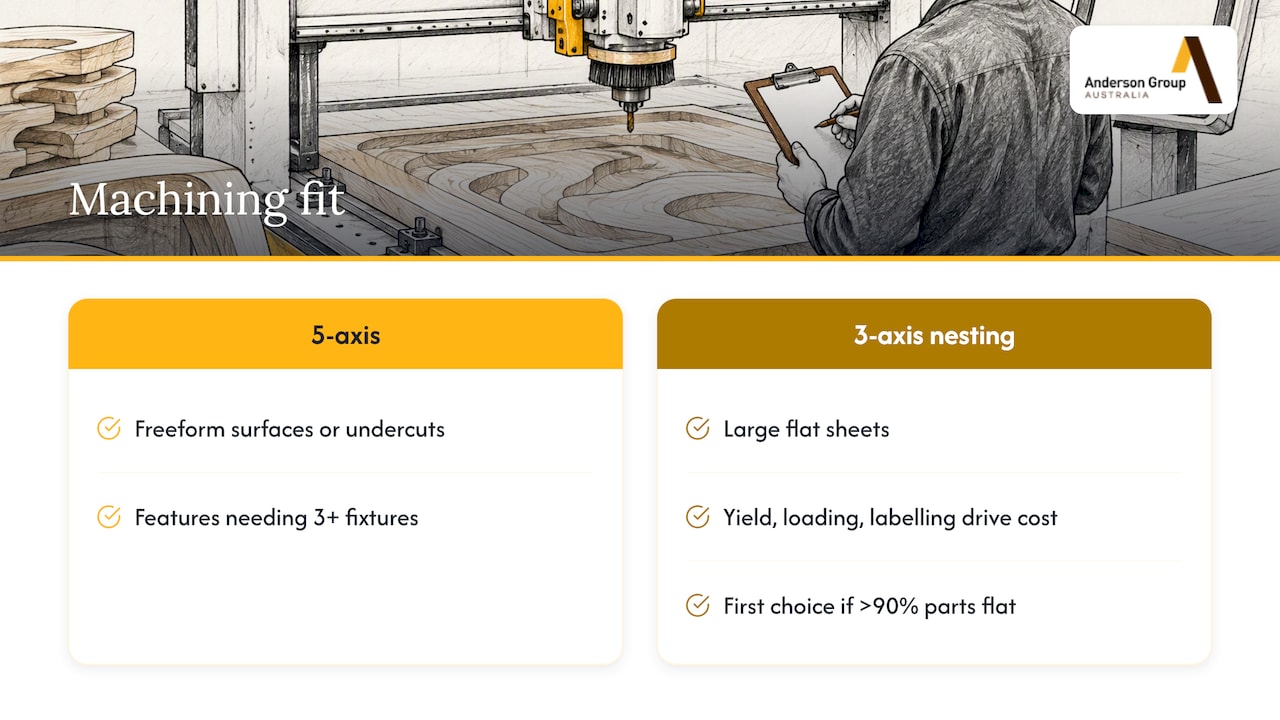
Simple rule of thumb, which is general guidance rather than a documented figure: if more than about nine in ten of your cut parts are flat and cut from sheet, a nesting machine is your first purchase and 5-axis is a later, separate decision.
A quick comparison
| Job | Better fit | Why |
|---|---|---|
| Kitchen and cabinet carcass parts from sheet | 3-axis nesting CNC | Yield, speed and automation around sheet handling |
| Sculpted or curved solid-wood parts | 5-axis | Surface access and fewer setups |
| Angled joinery, compound-angle cuts | 5-axis or 3+2 | Tool orientation relative to the part |
| Long linear trim and mouldings | 5-axis with suitable travel | Work envelope can fit the piece without joins |
| Edge finishing of panels | Edgebanding machine | A separate process, not a CNC router task |
| Six-sided drilling of panels | Dedicated drilling/routing machine | Throughput on repetitive hole patterns |
For long trim, the same machining company notes that a 5-axis machine with 4,000 mm of travel can fit linear work without joints. Always check the stroke of a specific model against your longest part.
Trunnion or swivel-rotate: choosing a layout
The layout affects what you can actually put on the machine. Trunnion-style machines move the rotary axes through the table and offer larger work volumes, while swivel-rotate machines swivel the spindle and can support heavier parts, per the Engineering.com overview.
That is a useful starting frame for wood, but the following questions matter more than the label:
- Part size and weight. Your largest and heaviest workpiece, including its fixture.
- Stroke. X, Y and Z travel with the tool and head at their working angle, not just at zero.
- Rotary range. How far the tilting axis and the rotating axis actually travel.
- Table and hold-down. Vacuum tables suit panels; solid timber often needs clamps or dedicated fixtures.
- Tool capacity. How many tools the magazine holds and how they are changed.
- Dust extraction. Wood chips and fine dust are very different to aluminium swarf. Ask what extraction the exact model is built for.
- Controller and software compatibility. More on this below.
Anderson 5-axis machines: what is documented
We supply wood machinery to Australian kitchen, cabinet, joinery and furniture makers, and we keep each machine’s documented application separate. Our 5-axis machines are listed for specific materials, and wood is not the headline application for either of the two below. Specifications here come from the product pages, and you should confirm anything else with us for your configuration.
MASS-B enclosed 5-axis centre
The MASS-B is an enclosed 5-axis machine listed for composites, advanced materials and non-ferrous materials. The page documents:
- A retractable roof for switching between enclosed and open operation
- A 26 HP liquid-cooled spindle
- A push-pull flow dust collection design
- 40-tool capacity across two 20-position carousels
- A Renishaw TS-27R tool measuring system
- For the MASS-B 3719IP: X 3700 mm, Y 2850 mm, Z 1200 mm, with an application listed as aluminium and composites
AXXIOM 5-axis series
The AXXIOM series is listed for plastics, aluminium and composites, with a fixed bridge and moving table design. The AXXIOM-1631IP is documented with:
- X 2200 mm, Y 3700 mm, Z 1000 mm
- B axis ±105°, C axis ±200°
- A 1600 x 3100 mm table
- Applications listed as plastic trimming and composites
If you are a woodworker curious about these machines, the honest position is this: they are documented for other materials, and we do not claim solid-wood performance for them. If your parts are timber, sculpted or angled, tell us the species, part dimensions and volume and we will advise what is suitable, or say plainly when it is not.
For metal and aluminium milling rather than wood, our separate Focaseiki range includes a 5-axis vertical machining centre. That range serves metalworkers and is a different product line from the wood machinery.
We do not infer features from a family name or axis count. Pallet changing, probing, rotary accessories, extraction capacity and coolant options need to be confirmed for the exact model and configuration.
Tooling, programming and people
The machine price is only part of what a 5-axis system costs.
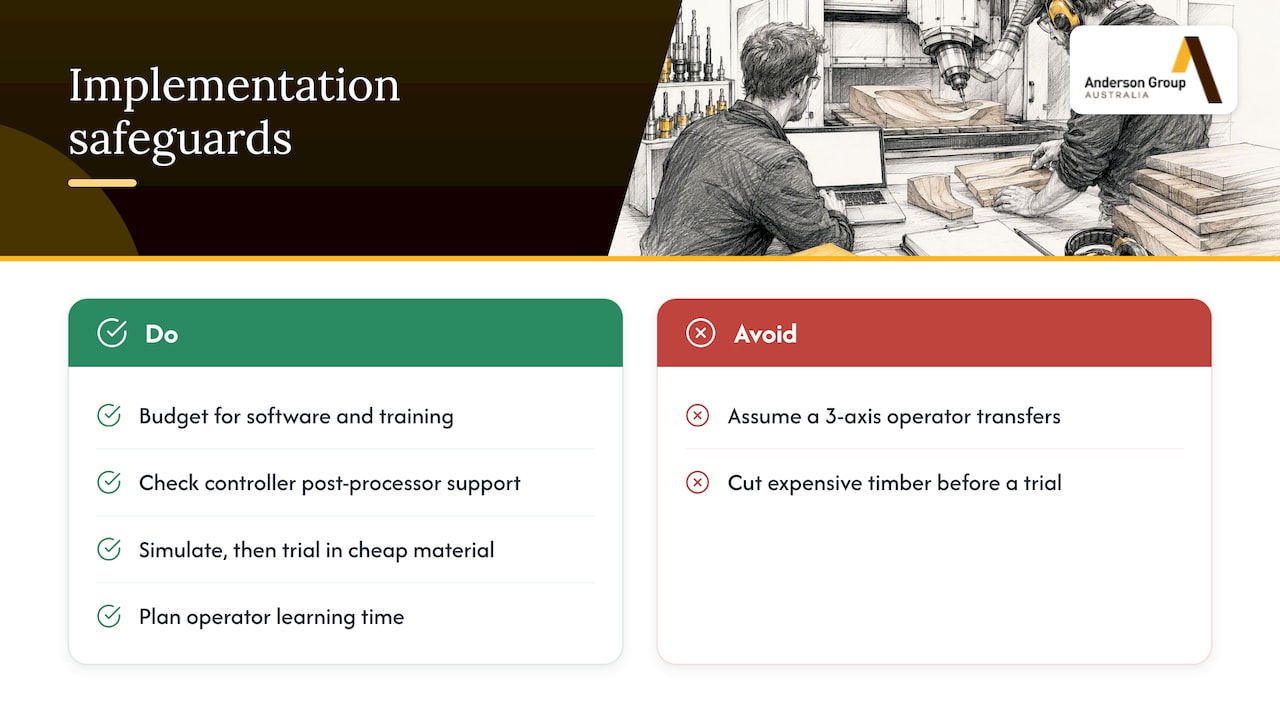
Tooling. The company analysis cited above warns that on a tilting head, deep hogging passes in hard maple can chatter. Programmers compensate with shallower step-downs and higher feed rates. Rigidity and cutter choice decide surface quality as much as the axis count does. Tool holders, long-reach cutters and measurement all add up.
CAM software. You cannot hand-write 5-axis toolpaths. CAM packages convert a 3D model into 5-axis G-code and simulate it to catch collisions. Hexagon-owned ALPHACAM is one example; an Australian user, Stonnington Group, reported that choosing software was an expensive process and that onsite training was how they learned it. Budget for software and training from the start, and check post-processor support for the controller on your machine.
Operators. A 5-axis operator needs to understand work offsets, tool length compensation and collision risk. Plan for time on the learning curve, and do not assume a 3-axis router operator can step straight across.
Process verification. Run a simulated cut, then a trial in cheap material, before touching expensive timber. That is general practice rather than an Anderson-documented procedure.
Fitting 5-axis into a scalable Australian operation
Most Australian wood manufacturers grow in a recognisable order, and 5-axis tends to come late. A sensible path looks like this:
- Get the sheet flow right first. A nesting CNC handles the carcass and panel volume. Reducing waste is usually the largest early lever; see our shop floor guide to reducing CNC waste and our notes on machining plywood.
- Keep each process in its lane. Edgebanding on an edgebander, drilling on a drilling machine and routing or nesting on a nesting CNC. Our model families are distinct: AFS are edgebanders, ATS is nesting, routing and drilling, ADM is six-sided drilling and routing, and ARS is a panel-return system.
- Protect uptime. Before adding a more complex machine, make sure servicing and spare parts for the first are sorted. Our article on improving CNC uptime is a practical starting point.
- Add 5-axis when a repeating part justifies it. That means a part type you are currently outsourcing, hand-finishing or fixturing three times. Count the jobs before you count the axes.
If some of your work is thin sheet profiling in non-wood materials, it may also be worth reading laser cutting versus CNC routing to decide which process fits.
We do not publish ROI figures or typical payback times, because they depend entirely on your parts, volumes and labour costs. Work them out from your own job data.
Questions to settle before you request a quote
- What are your three highest-value parts, and how many setups does each need today?
- What material and thickness range will the machine cut, and is it solid timber, panel or both?
- What are the largest dimensions and heaviest weight, including fixtures?
- Which CAM software and file formats do you use now?
- Who will program and operate it, and what training is needed?
- What dust extraction, power supply and floor space can the site provide?
- What service and parts arrangement do you expect after installation? We only describe service inclusions that are documented, so please confirm the agreed scope with us for your machine.
How we can help
Anderson Group Australia supplies CNC machinery, servicing and parts to Australian manufacturers, with kitchen, cabinet, joinery and furniture makers as our main customers. We sell machinery for your own production; we do not offer subcontract cutting or machining.
If you are weighing nesting against 5-axis, start with the wood machinery range, or browse the full CNC machinery range. Send us your parts, materials and volumes and we will discuss your application and quote against the exact product page specifications.
FAQ
Is a 5-axis CNC worth it for a cabinet or kitchen manufacturer?
Usually not as the first machine. Flat sheet parts are cut faster and more cheaply on a 3-axis nesting CNC. 5-axis becomes worthwhile when you have curved, angled or undercut parts that need several setups today.
Can a 5-axis machine cut wood as well as aluminium?
It depends on the exact model. Each machine is built and documented for particular materials, and dust extraction, spindle and hold-down differ between wood and metal work. Check the product page application and confirm with the supplier before assuming a machine suits both.
What is the difference between 3+2 and full 5-axis?
In 3+2, the rotary axes tilt the part or tool to an angle and lock, then a 3-axis toolpath runs. In full 5-axis, all five axes move together during the cut. 3+2 is simpler to program and handles many angled-face jobs; full 5-axis is needed for continuous curved surfaces.
What software do I need?
You need CAM software that generates 5-axis toolpaths and simulates collisions, plus a post-processor matched to your machine’s controller. Allow for training time as well as the licence.
Sources
- The What, Why and How of 5-Axis CNC Machining, Engineering.com
- Upgrading to a 5-axis CNC, Woodshop News
- CNC technology, von Rickenbach
- 5 Axis CNC Wood Machining: Where It Fits and Where It Does Not
- Stonnington Group extend their possibilities in designs