
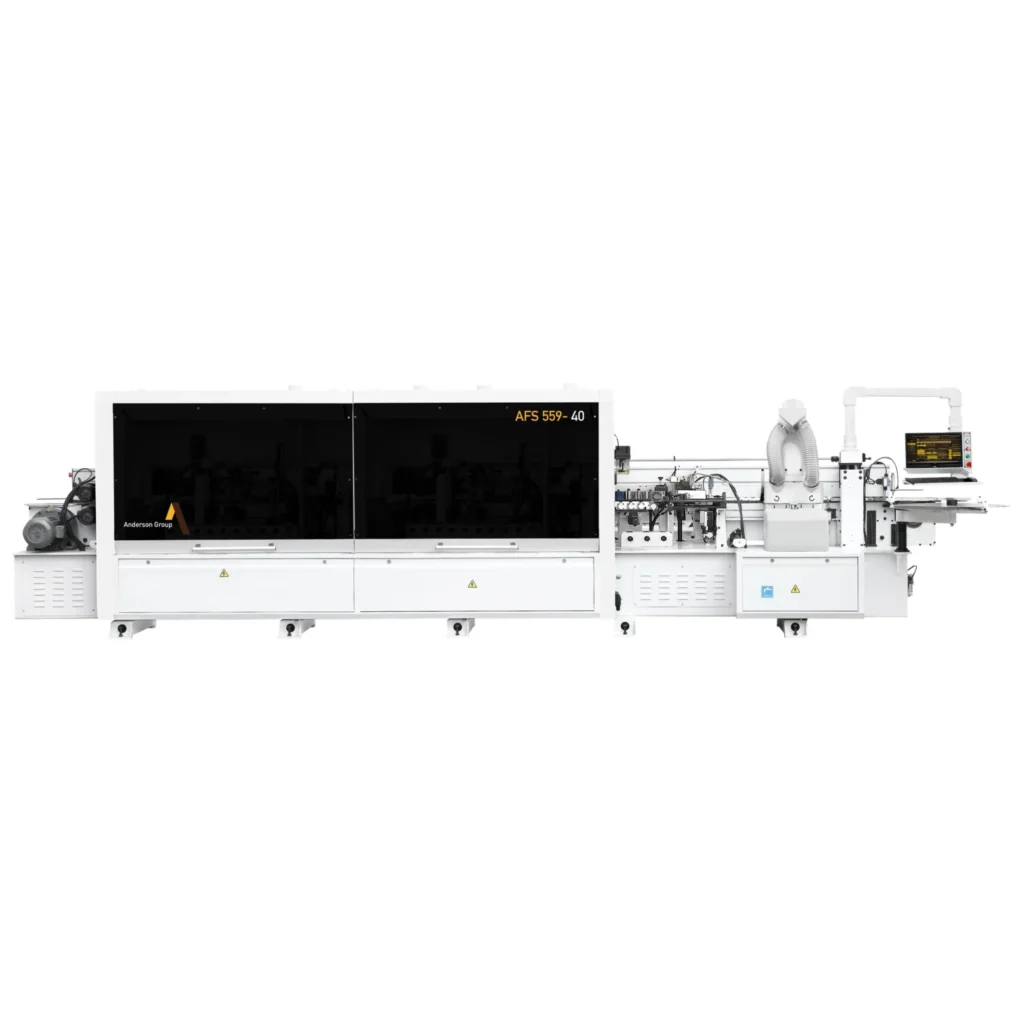
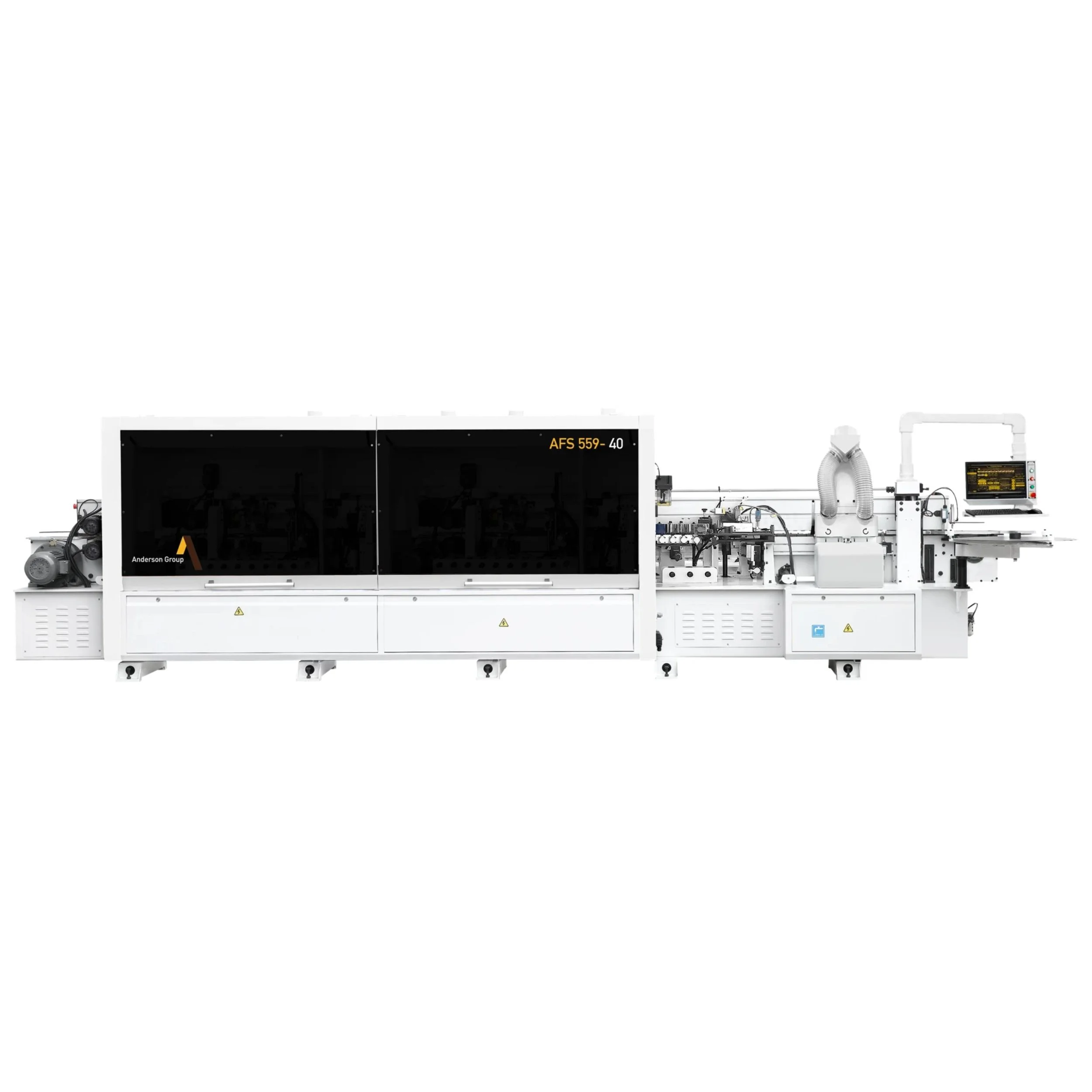
Narrow cabinet components need an edgebander that can feed, support and finish the actual part size. The Anderson AFS 559-40 is designed for panel work down to 40 mm wide, alongside everyday cabinet panels. This guide explains that capacity and the checks to make before choosing a machine for fillers, rails and other narrow components.
In this guide
- What 40 mm capability means
- Glue and finishing units
- Sample-part checks
- Compare the AFS models
- Where thin-wall machining fits
- Request a quote
What 40 mm capability means
The 40 mm figure is the minimum workpiece width. The published AFS 559-40 specification also gives a minimum workpiece length of 120 mm and a panel thickness range of 10–60 mm. All relevant limits must be considered together when assessing a part.
- Minimum workpiece width: 40 mm
- Minimum workpiece length: 120 mm
- Workpiece thickness: 10–60 mm
- Edge-tape width: 13–63 mm
- Edge-tape thickness: 0.4–3.0 mm
- Feed-speed settings: 15, 18 or 20 m/min
- Working air pressure: 0.65 MPa
These figures are from the AFS 559-40 product page and specification download, checked on 18 October 2026. Confirm the proposed configuration and the suitability of your specific part geometry, substrate and edging before ordering.
Glue and finishing units
The machine’s 3.7 kW diamond pre-milling unit prepares the panel edge. Its quick-melt glue system supports EVA and PUR adhesives, followed by a four-wheel pressure system.
Pneumatic two-position fine trimming, two-motor corner rounding and radius scraping support changes between edging thicknesses. Floating flat scrapers and twin buffing wheels complete the finishing sequence. The published configuration also includes PC touchscreen control, automatic lubrication, front and rear cleaning sprays, and tracing bearings for notch and hinge-hole work.
For a buyer, the useful demonstration is a finished sample of the part you make: inspect the bond, trimming, corners and surface on your own material. Ask the supplier to demonstrate the finishing settings your edging requires.
Sample-part checks
- Measure the whole component. Record width, length and thickness, plus any notches, holes or other features that affect handling.
- Bring representative materials. Include the substrates, surface finishes, edge tapes and adhesive requirements used in production.
- Check the finish. Review edge preparation, bonding, trimmed edges, corners and any marks on the face.
- Review handling. Confirm how the narrowest parts are presented, supported and collected using the machine’s documented operating method.
- Test a realistic job change. Include the edging and panel-thickness changes your operators make during a normal shift.
Minimum dimensions alone do not establish that every component will run successfully. Sample testing and the manufacturer’s operating requirements should guide the final selection.
Compare the AFS models
- AFS 243: compact automatic edgebander; 65 mm minimum width, 120 mm minimum length, 10–45 mm panel thickness. Published feeding speed is 8–12 m/min, with corner rounding at 8 m/min.
- AFS 559-40: 40 mm minimum width, 120 mm minimum length and 10–60 mm thickness, with pneumatic two-position finishing.
- AFS 568 PRO: servo-controlled finishing, a continuous top feed belt and closed PUR/EVA adhesive delivery; 60 mm minimum width, 120 mm minimum length and 10–60 mm panel thickness.
The narrowest part is one selection factor. Also compare your job mix, finishing requirements, changeovers, available space and handling arrangement.
Where thin-wall machining fits
Thin-wall machining concerns cutting a slender feature while controlling deflection and vibration. CNC routing may be used to cut or shape a cabinet component before edging. Edgebanding then applies and finishes edge tape. A panel’s width and its wall or section thickness describe different dimensions, so a 40 mm edging capacity does not establish a thin-wall machining capability.
If your project includes both routing and edging, bring the drawing and explain each operation. That lets us assess the cutting machine, workholding and edgebander as separate steps in the same production process.
Request a quote
Tell us your smallest and largest parts, panel and edge materials, daily volumes and available floor space. Include any existing router or handling equipment that the edgebander needs to work alongside.
Before installation, confirm power, compressed air, suitable source extraction, guarding and access requirements for the supplied machine. Follow its documentation for adhesive handling, cleaning and lubrication, with trained operators and site-specific isolation procedures.
Discuss narrow-panel edgebanding with Anderson Group Australia