
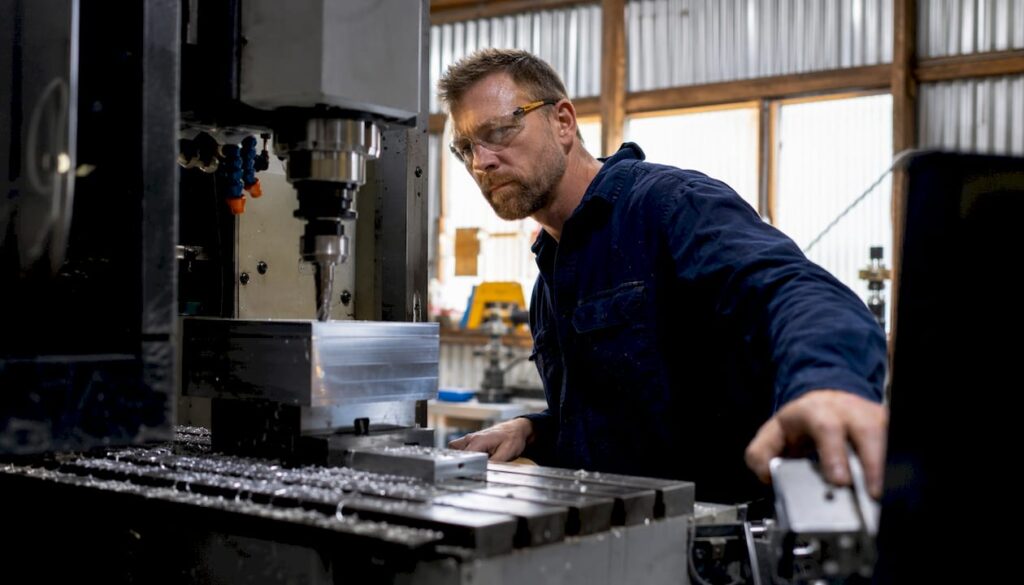
For production-scale aluminium work, you need a rigid vertical machining centre or 5-axis machine with a high-torque spindle capable of a suitable speed range, an automatic toolchanger, and active chip evacuation. Those three features are non-negotiable. Everything else is configuration.
Procurement checklist — copy into your RFQ:
- Spindle: minimum spindle speed with torque curve supplied by vendor
- Axis rigidity: request repeatability specification and thermal-stability data
- Toolchanger: minimum 20-station ATC; specify HSK or BT toolholding
- Chip management: flood coolant or air blast with conveyor or vacuum extraction
- Local service: Australian-based technician, spare-parts stock, and documented SLA
Pro Tip: Procurement teams often over-specify spindle RPM and ignore torque. A 24,000 RPM spindle with low torque will chatter through aluminium profiles. Ask for the full torque curve, not just the peak speed figure.
Aluminium machines considerably faster than steel, reducing machine-hour costs, tool wear, and cycle time. That productivity advantage only materialises when the machine, tooling, and process are matched correctly. That productivity advantage only materialises when the machine, tooling, and process are matched correctly.
Table of Contents
- What machine features matter for CNC aluminium machining?
- Tooling and feeds and speeds for aluminium
- Workholding and machining strategy for precision aluminium parts
- How aluminium affects cycle time, cost, and lead time
- How to evaluate CNC vendors in Australia
- Which Anderson machines suit your aluminium production needs?
- What validates an Anderson machine purchase?
- Key takeaways
- A supplier’s perspective on getting aluminium machining right
- Andersonaustralia: machines, support, and next steps
- Useful sources
What machine features matter for CNC aluminium machining?
Spindle power and speed work together, not independently. High RPM without adequate torque produces chatter and poor surface finish, particularly on thicker sections and structural profiles. Specify both: a torque curve from the vendor is a reasonable ask on any serious bid.
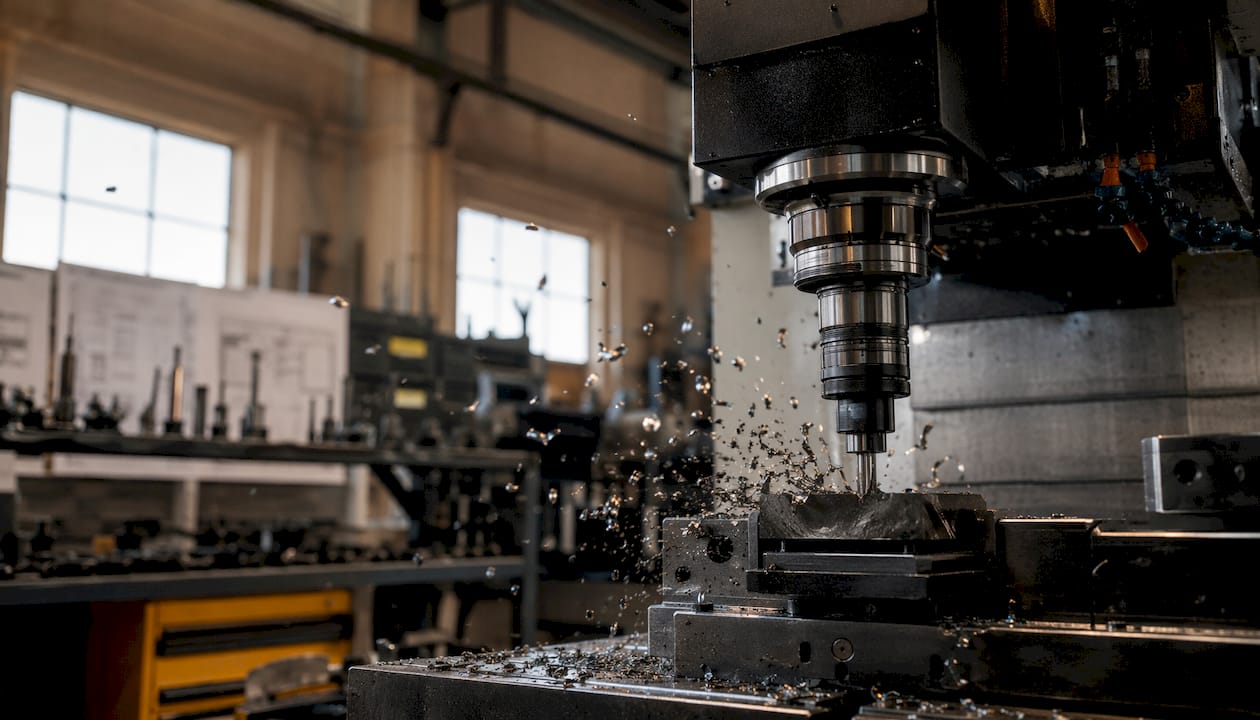
Machine rigidity and thermal control are the primary drivers of dimensional accuracy. A stiff machine in a thermally stable environment allows larger depths of cut and higher feeds with predictable results. For tight-tolerance aluminium parts, thermal growth over a long production run is a real accuracy risk.
Key specs to request from any vendor:
- Spindle power appropriate for part size and batch volume
- Speed range suitable for aluminium machining with full torque curve
- Axis repeatability: very tight tolerance suitable for precision parts
- Toolchanger: 20–60 stations; HSK-A63 or BT40/BT50 toolholding
- Enclosure: full enclosure preferred for chip and coolant containment
Chip management is where many buyers underestimate the machine requirement. Aluminium produces long, stringy chips that wrap around tooling and contaminate the work envelope. Flood coolant, air blast, and a chip conveyor or vacuum extraction system are not optional extras for production work.
| Use case | Spindle RPM | Axis count | Toolchanger | Enclosure |
|---|---|---|---|---|
| Prototype / one-off | appropriate speed range | 3-axis | sufficient tool stations | Optional |
| Small-batch precision | appropriate speed range | 3 or 4-axis | sufficient tool stations | Recommended |
| Mid-volume housings | suitable speed range | 4 or 5-axis | sufficient tool stations | Required |
| High-volume production | suitable speed range | 5-axis or VMC | sufficient tool stations | Required |
Pro Tip: Match machine class to part geometry before batch size. A complex 5-axis part at low volume still needs a 5-axis machine. Buying a 3-axis VMC to save cost and then re-fixturing four times per part costs more in labour than the machine saving.
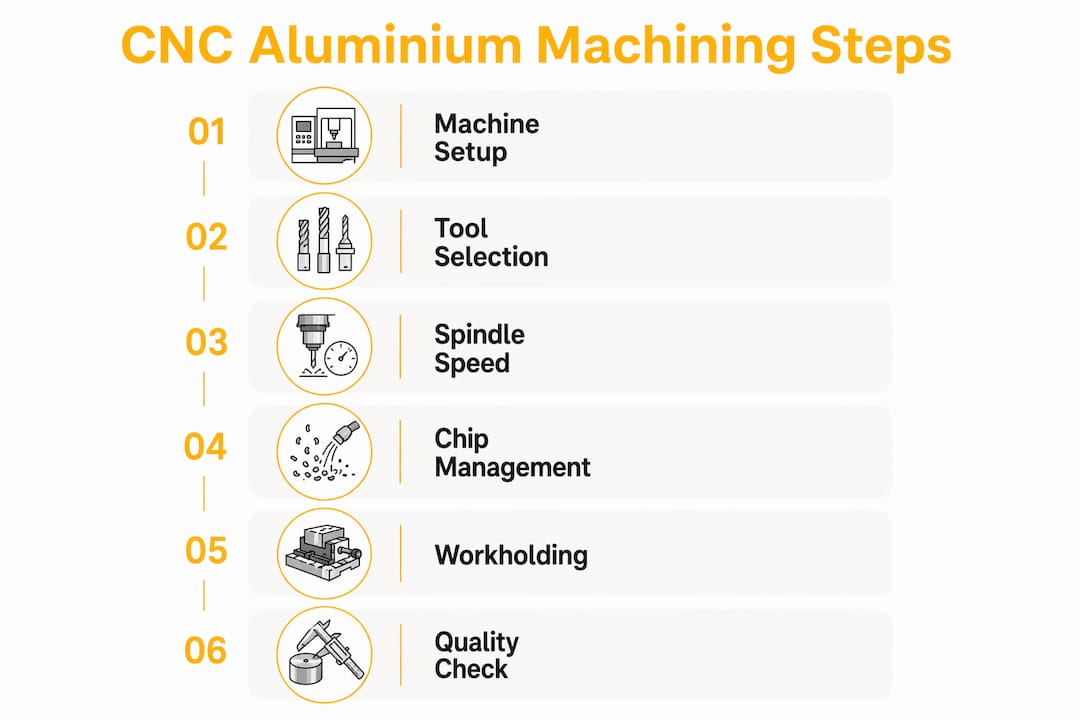
Tooling and feeds and speeds for aluminium
Sharp, aluminium-specific tooling is the single biggest variable in part quality. The wrong cutter produces built-up edge, poor finish, and heat damage regardless of how well the machine is specified.
Cutter selection priorities:
- Single-flute or 2-flute high-helix end mills for general milling and profiling
- ZrN-coated solid carbide O-flute bits for sheet and panel work on CNC routers
- Ball-nose carbide for 3D contouring and curved surfaces
- typical helix angles in the mid-30s to mid-40s degrees for roughing; 45° favoured for finishing passes
- Carbide end mills are the standard for production, offering better edge retention and resistance to built-up edge than HSS
For production runs, indexable tooling becomes cost-competitive once volumes justify the insert cost. For prototypes and small batches, solid carbide is the practical default.
Polished flutes and active chip clearance reduce chip welding to the cutter. Air blast or flood coolant with soluble oil is the standard approach. Dry cutting is a false economy: the heat it generates shortens tool life and degrades surface finish.
| Parameter | Starting range | Notes |
|---|---|---|
| Spindle speed | suitable RPM range | Adjust for cutter diameter |
| Feed rate | typical millimeter per minute range | Higher for larger flute count |
| Chip load per tooth | typical values variant with cutter specification | Verify against cutter spec sheet |
| Axial depth of cut | ranges from half to twice cutter diameter | Shallower for thin walls |
| Radial depth of cut | roughly one-third to half cutter diameter | Climb milling preferred |
Pro Tip: Inspect cutters periodically during a new process. Built-up edge starts small and invisible. By the time finish quality drops noticeably, the cutter has already been damaging parts for a run.
Workholding and machining strategy for precision aluminium parts
Aluminium deforms under excessive clamping force. Thin-wall parts and large panels are particularly vulnerable. Use step clamps, sacrificial plates, or vacuum fixturing where the part geometry allows. The goal is secure holding with the minimum force that prevents movement.
Fixturing checklist:
- Use sacrificial spoilboard or sub-plate to protect the machine table
- Apply step clamps at rigid sections, not over unsupported spans
- For thin-wall parts, consider vacuum fixturing or low-force toggle clamps
- Sequence operations to machine the most rigid features first, leaving thin walls for final passes
Toolpath strategy matters as much as fixturing. Frequent, shallower passes outperform single deep cuts for chip removal and part accuracy. Climb milling is preferred for aluminium: it produces a better surface finish and reduces the tendency for the cutter to push material rather than cut it.
Use an arc-off retract motion when exiting a profile. A straight retract leaves a small notch at the exit point — a common finishing defect on precision aluminium parts that is entirely preventable in CAM.
For in-process verification, set probe cycles at datum features after roughing and before finishing. First-off reports and CMM-ready datum structures should be part of the process plan from day one, not an afterthought.
Pro Tip: Schedule long production runs to start in the morning after the machine has reached thermal equilibrium. Dimensional drift from thermal growth is most pronounced in the first 20–30 minutes of operation.
How aluminium affects cycle time, cost, and lead time
Aluminium’s machinability advantage over steel translates directly into lower machine-hour cost per part. Faster cycle times mean more parts per shift and lower amortised machine cost. That said, the per-part cost picture is rarely just about cutting time.
Main cost drivers to model:
- Material grade (6061 is the general-purpose choice; 7075 is harder to machine and more expensive; 5083/5052 for marine/corrosion applications)
- Tolerances and surface finish requirements
- Secondary operations: deburring, anodising, hard-coat, plating
- Inspection: CMM inspection and finishing costs often dominate per-part price for tight-tolerance parts
- Tooling consumption and replacement frequency
| Cost element | Small job | Mid-volume | High-volume |
|---|---|---|---|
| Setup and fixturing | High per-part | Amortised | Minimal per-part |
| Machine time | Dominant | Moderate | Low per-part |
| Tooling | Low | Moderate | Significant |
| Inspection | High per-part | First-article + sampling | Statistical sampling |
| Secondary ops | Per-part | Batch | Batch / inline |
For Australian manufacturers, expect 2–6 weeks for first-article approval on a new part, depending on complexity and inspection requirements. Steady-state production lead times vary by batch size and machine availability. Pallet systems and auto pallet changers (APC) become worth the investment when you are running multiple part numbers on a single machine or need unattended overnight production.
How to evaluate CNC vendors in Australia
Vendor capability is not just about the machine specification on a data sheet. The questions that separate a reliable supplier from a marginal one are about service, support, and accountability after the sale.
Vendor capability checklist:
- Authorised service network with Australian-based technicians
- Local spare-parts stock and documented lead times for critical components
- On-site commissioning and operator training included in the contract
- Warranty scope: what is covered, for how long, and what the response-time SLA is
- Acceptance test protocol: run-off test, dimensional report, surface-finish verification
Essential technical questions for your RFQ or vendor meeting:
- What is the spindle torque curve at operating speed?
- What is the axis repeatability specification and how is it measured?
- What is the toolchanger cycle time (tool-to-tool)?
- How does the machine manage thermal growth over a full production shift?
- What is the maximum chip load the machine is rated for in aluminium?
Red flags to watch for:
- Tolerance claims stated without a measurement standard or test method
- No Australian service capability or reliance on overseas technicians for warranty work
- Long lead times (more than 2 weeks) for common consumables or wear parts
- Vague warranty language that excludes tooling damage or operator error without definition
Pro Tip: Write acceptance criteria into the purchase contract before signing, not after delivery. Specify the run-off test conditions, the tolerance mapping method, and the surface-finish standard. A vendor unwilling to commit to written acceptance criteria is telling you something.
Local after-sales support and a measurable SLA are frequently worth more than a marginal price saving on the machine itself. A machine sitting idle waiting for an overseas technician costs far more per day than the discount it came with.
Which Anderson machines suit your aluminium production needs?
Andersonaustralia’s machine range covers the full spectrum from prototype work to high-volume production, with models matched to part complexity, tolerance requirements, and batch cadence.
| Anderson machine | Best use case | Key capability |
|---|---|---|
| VMC-1100/1250/1400 | Small-to-medium precision parts, small batch | High-rigidity 3-axis VMC, tight repeatability |
| Boxway VMC series | Medium-volume housings and brackets | Boxway guideways for heavy-duty rigidity |
| AXXIOM 5-Axis Series | Complex geometry, multi-face parts | 5-axis simultaneous, precision aluminium components |
| MASS-B Enclosed 5-Axis | High-accuracy enclosed production | Full enclosure, chip and coolant containment |
| MASS-5 Large-Scale 5-Axis | Structural plates, large aerospace/marine parts | Large work envelope, 5-axis simultaneous |
| Production Machining Centre | High-volume repeat production | Automation-ready, high throughput |
For prototype and low-volume work, the VMC-1100/1250/1400 delivers the rigidity and repeatability needed without over-investing in automation. The Boxway VMC series suits mid-volume aluminium housings and structural brackets where guideway stiffness matters more than raw speed.
The AXXIOM 5-Axis Series handles complex multi-face aluminium parts in a single setup, cutting re-fixturing time and cumulative tolerance error. The MASS-B Enclosed 5-Axis adds full enclosure for chip and coolant containment, making it the right choice when the production environment or part cleanliness requirements demand it.
For large structural aluminium plates and aerospace or marine components, the MASS-5 provides the work envelope and 5-axis capability that smaller machines cannot match. High-volume repeat production is where the Production Machining Centre with APC earns its keep: pallet automation reduces operator intervention and enables unattended runs.
RFQ paragraph for procurement teams: “We require a CNC machining centre suitable for aluminium alloy parts (6061/7075) with a minimum spindle speed of 12,000 RPM, documented torque curve, axis repeatability of ±0.005 mm or better, 20-station ATC minimum, flood coolant and chip conveyor, and Australian-based commissioning and service support. Please provide comparable machine options from your current range with full specification sheets and SLA documentation.”
What validates an Anderson machine purchase?
Andersonaustralia has been supplying industrial CNC equipment in Australia since 1972. That history means established service infrastructure, local spare-parts availability, and a commissioning process built around Australian manufacturing conditions.
Acceptance criteria checklist for delivery:
- Run-off test completed at the buyer’s facility with agreed aluminium test piece
- Dimensional report against drawing tolerances, signed by both parties
- Surface-finish verification on representative features
- Spindle torque curve and thermal-stability data supplied with machine documentation
- Operator and maintenance training completed before sign-off
Documentation to request at purchase:
- Spindle torque curve at rated speed
- Machine thermal map (growth over a full production shift)
- Axis repeatability report (measured to ISO 230-2 or equivalent)
- Toolchanger cycle-time specification
- Warranty terms with explicit SLA for on-site response in Australia
Anderson Group Australia’s metalwork CNC machinery range is designed for the demands of production aluminium machining — from tight-tolerance VMC work to large-scale 5-axis structural parts. Commissioning, training, and local service support are part of every machine supply.
Key takeaways
Precision aluminium machining requires a rigid machine, aluminium-specific tooling, and active chip management — every other specification decision follows from those three.
| Point | Details |
|---|---|
| Three non-negotiables | Specify rigidity, a high-torque spindle with full torque curve, and active chip evacuation in every RFQ. |
| Tooling standard | Carbide end mills with ZrN coating or polished O-flute geometry are the production baseline for aluminium. |
| Process discipline | Shallower, frequent passes with climb milling outperform deep cuts for part quality and tool life. |
| Total cost modelling | Include deburring, anodising, and CMM inspection as explicit line items — they often dominate per-part cost. |
| Andersonaustralia | The VMC-1100/1250/1400, AXXIOM, MASS-B, MASS-5, and Production Machining Centre cover prototype to high-volume aluminium production with Australian service support. |
A supplier’s perspective on getting aluminium machining right
The most common problem Australian manufacturers bring to us is a machine that was specified on spindle speed alone. They bought a fast spindle, skipped the torque conversation, and are now running conservative feeds to avoid chatter — which defeats the productivity argument for aluminium in the first place.
The second most common issue is chip management treated as an afterthought. Aluminium chips are not like steel swarf. They accumulate fast, wrap around tooling, and contaminate the work envelope in ways that cause real dimensional problems on long runs. A chip conveyor and flood coolant system are not optional for production work.
Getting the machine class right from the start — matched to part geometry, tolerance, and batch size — is what separates a productive aluminium cell from an expensive one. That is the conversation worth having before you sign a purchase order.
Andersonaustralia: machines, support, and next steps
Australian manufacturers specifying aluminium production equipment get more than a machine from Andersonaustralia. You get commissioning by local technicians, operator training, documented SLAs, and a service network that has been operating in Australia since 1972.
The AXXIOM 5-Axis Series and MASS-B Enclosed 5-Axis are the starting point for most precision aluminium enquiries. For high-volume production, the Production Machining Centre with APC is worth a conversation about cycle time and automation ROI.
Concrete next steps:
- Book a site demonstration on the machine class that matches your part family
- Request a sample run on your actual aluminium part with a first-article report
- Ask for a written quote that includes commissioning, training, and SLA terms
- Contact Andersonaustralia at andersonaustralia.com to start the technical brief
Useful sources
Technical references:
- Aluminium CNC machining: tooling, spindle speed and chip evacuation — JLCCNC: tooling selection and chip management fundamentals
- Aluminium machining best practice: passes, feeds and chip control — Xometry Pro: feeds and speeds principles and pass-depth strategy
- How machine rigidity and thermal management affect aluminium milling — Mekanika: rigidity and thermal-stability guidance
- Best CNC router bits for cutting aluminium — ToolsToday: ZrN-coated tooling and O-flute selection
- CNC aluminium machining: materials, cost and finishing — WeldoMachining: cost drivers and secondary operations
- Arc-off retract and router tips to avoid profile notching — Make It From Metal: retract strategy and finishing defect prevention
- Aluminium CNC machining overview — Dassault Systèmes: alloy selection and process overview
Andersonaustralia machine pages:
- VMC-1100/1250/1400 Vertical Machining Centre
- Boxway VMC Series
- AXXIOM 5-Axis Series
- MASS-B Enclosed 5-Axis
- MASS-5 Large-Scale 5-Axis
- Production Machining Centre with APC
- Andersonaustralia metalwork machinery overview