
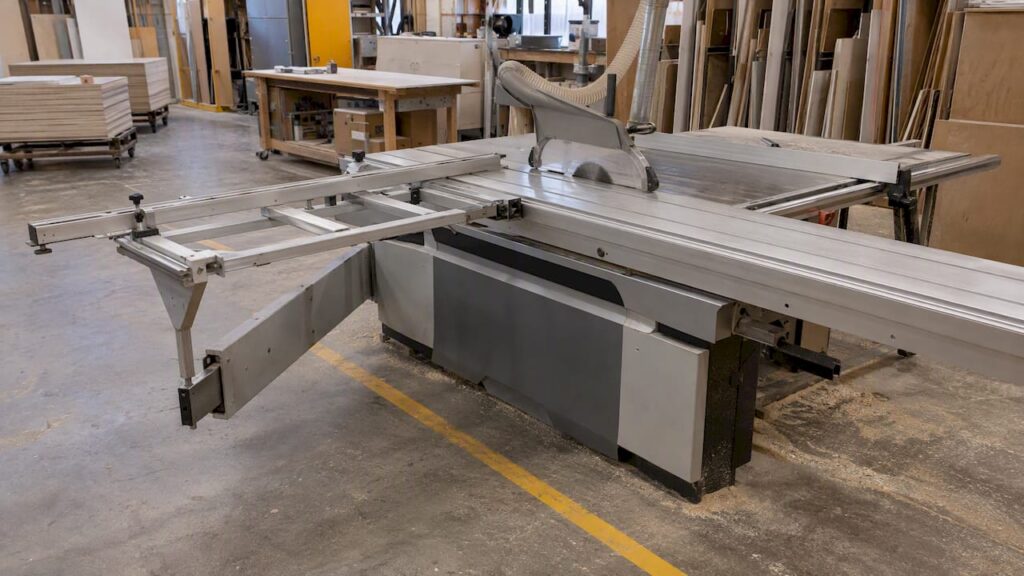
For most cabinetmakers, a sliding table panel saw is the right starting point, because it balances accuracy, sheet capacity and footprint better than vertical or beam alternatives. The right choice still depends on material mix, floor space, power supply and production volume. This guide works through the specs, workshop fit, safety controls and a buying checklist so you can match a saw to your shop rather than the other way around.
TL;DR:
- A 10 ft slide can crosscut a full sheet in one pass, but the shop needs clear floor space roughly twice its length.
- For daily melamine or veneer work, a 5 hp main motor, separate 1 hp scorer, and digital fence support repeat sizing; verify scorer power independently.
- Before ordering, confirm the machine’s phase requirement; shops with single phase service may need a phase converter or electrical upgrade, which should be budgeted upfront.
- Plan effective local exhaust ventilation for the saw and appropriate housekeeping. Dust Class M recommendations for portable-tool and cleanup vacuums should not be treated as a rating for every fixed-plant extraction system.
- Compare full quotes, including freight, installation, optional extras, consumables, extraction, and servicing, because headline machine prices omit ongoing and setup costs.
Table of Contents
- Panel saw types: slider, vertical, beam and how they compare to a table saw
- Key specifications that determine accuracy, capacity and suitability
- Workshop and installation constraints: phase power, clearance and site-readiness
- Match the saw to your production profile
- Safety, dust control and OHS essentials you must plan for
- Maintenance, consumables and routine setup costs to budget for
- Short buying checklist and questions to ask your supplier or rep
- How Anderson Group Australia supports machine selection, verified specs and post-sale service
- FAQ
- Sources
Panel saw types: slider, vertical, beam and how they compare to a table saw
A sliding table saw, often just called a slider, pairs a sliding carriage with a scoring blade that pre-scores the underside of the panel before the main blade finishes the cut. That combination is what prevents chipping on melamine and veneered panels, making it the default choice for cabinet and joinery shops cutting coated board daily.
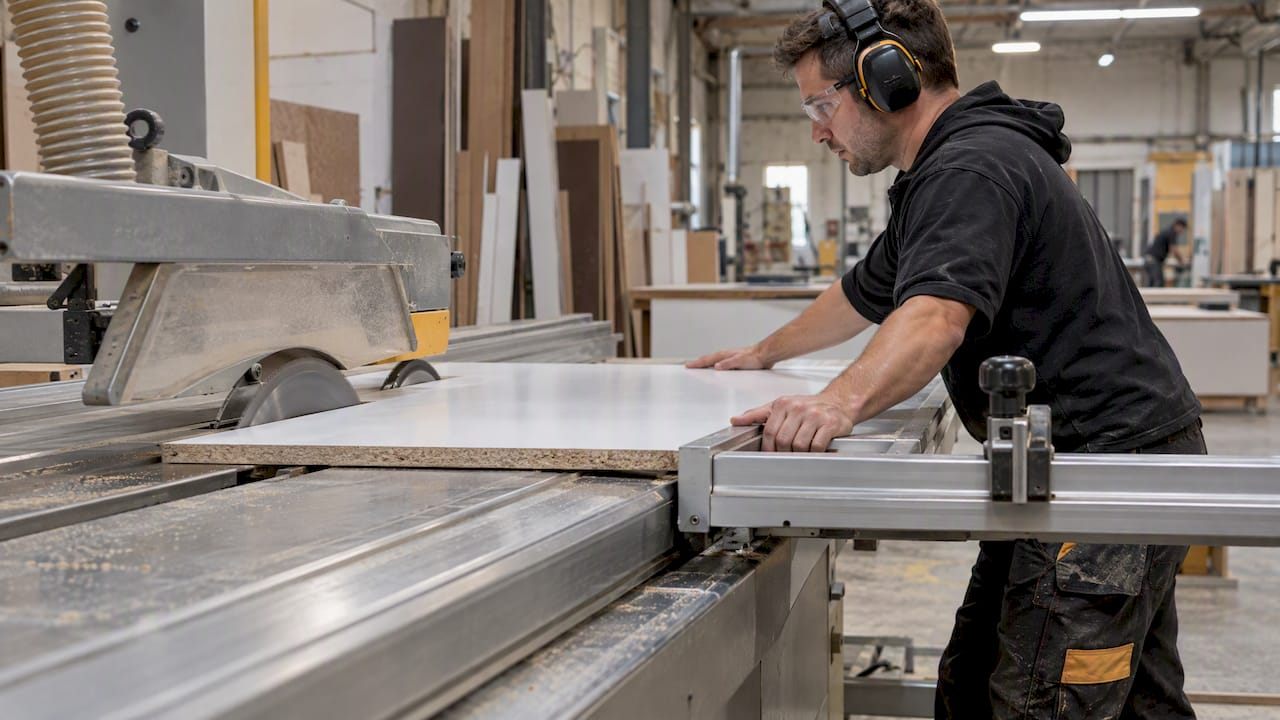
Vertical panel saws stand the sheet upright and run the blade along a track, trading some accuracy and speed for a small footprint. They suit shops tight on floor space or those cutting panels only occasionally.
Beam saws sit at the production end: fully automatic infeed, programmable cutting lists and high throughput, usually justified only once cutting volume supports the investment.
- Sliding table saws: best general-purpose choice for cabinet and joinery work.
- Vertical panel saws: smallest footprint, suited to low-volume or space-constrained shops.
- Beam saws: highest throughput, suited to continuous production runs.
Compared to a standard table saw, a dedicated panel saw adds a sliding carriage and scoring capability that a table saw with a sled cannot match for repeatable, tear-free crosscuts on full sheets. For a deeper look at when a beam saw earns its place over a slider, see our comparison of beam saws and sliding table saws.
Key specifications that determine accuracy, capacity and suitability
The main motor drives the primary blade and should be sized to your heaviest material, not your average job. A 5 hp main motor paired with a 1 hp scoring motor is a common specification for cabinet shops cutting melamine and veneered board through regular shifts.
- Main motor power: match to your heaviest panel and duty cycle, not just occasional jobs.
- Scoring motor: a separate scoring unit, commonly around 1 hp, is what keeps the bottom face of coated panels clean.
- Slide length: a 10 ft slide lets most shops crosscut a full sheet in one pass rather than flipping it.
- Rip fence type: manual fences suit low-volume work, digital readout fences speed up repeat cuts, and CNC-driven fences suit shops running frequent size changes.
- Dado capability: only relevant if your work calls for grooving, but worth confirming if it does.
Slide length has the biggest knock-on effect on your shop layout, since it dictates how much clear floor space you need either side of the saw.
Pro Tip: Ask for the scoring motor’s independent power rating separately from the main motor, since some listings bundle the two figures in a way that overstates scoring performance.
Workshop and installation constraints: phase power, clearance and site-readiness
Before you order, confirm whether your shop runs single-phase or three-phase power. Not checking phase availability is one of the most common procurement pitfalls, and if you need three-phase but only have single-phase service, budget for either a phase converter or an electrical upgrade as a line item in the quote.
Clear floor length matters just as much. A practical rule of thumb is to allow roughly twice the slide length as clear linear space to cover carriage travel plus infeed and outfeed handling.
- Confirm single-phase vs three-phase supply and cost any upgrade before ordering.
- Measure clear length at twice the slide length, plus doorway and aisle clearance for delivery.
- Check freight and rigging access: liftgate, forklift or crane needs, and floor load rating.
- Plan electrical and dust extraction hookups so they’re ready before delivery day.
Match the saw to your production profile
A hobby or part-time shop cutting the occasional sheet is usually well served by a vertical panel saw or an entry-level slider with a manual fence. A small-batch cabinet or joinery shop cutting melamine and veneered panels daily benefits from a 5 hp slider with scoring and a digital readout fence, which speeds up repeat sizing without the cost of full CNC control.
Continuous production shops running plywood and thick hardwood alongside coated board should look at higher-powered sliders or step up to a beam saw, where programmable cutting lists remove manual fence adjustment altogether. Our guide to nesting-first CNC workflows covers how panel processing changes at that volume.
- Hobby or occasional use: vertical saw or entry slider and a manual fence may suit; provide effective dust controls for the machine and task.
- Small-batch cabinet shop: 5 hp slider with scoring and digital fence for coated panels.
- Continuous production: higher-powered slider or beam saw with programmable fence control.
Budget for more than the machine price: blades, scoring blade replacement, dust extraction and servicing all add to total cost of ownership over the saw’s working life, and that ongoing spend should factor into which fence and automation level you choose.
Safety, dust control and OHS essentials you must plan for
Plan source extraction for the saw with the machine supplier and a competent extraction specialist. WorkSafe Victoria’s wood-dust guidance describes local exhaust ventilation close to dust-generating points, including fixed machinery connected to a central dust collector. Confirm the saw’s required airflow, connection sizes and hooding arrangement as part of the installation design.
The guidance recommends minimum Dust Class M for portable-tool dust collectors and for industrial vacuums used in cleaning. That recommendation should not be applied as a blanket M/H classification for every fixed-plant extraction system or saw hood.
For housekeeping, use suitable vacuum or wet-cleaning methods and prevent dust build-up. Avoid dry sweeping that raises dust and do not use compressed air to blow settled wood dust off benches, surfaces or clothing. Inspect and maintain extraction so it continues to work effectively.
Check the requirements applying in your state or territory and arrange competent advice where exposure controls or monitoring needs are uncertain. Include guarding, operator training and safe isolation procedures in the installation and operating plan.
Maintenance, consumables and routine setup costs to budget for
Keeping a panel saw accurate over time comes down to routine checks rather than major servicing. Scoring blade alignment and fence calibration drift with use, so building a simple schedule protects cut quality.
- Check scoring blade alignment and fence calibration on a set schedule, not only when cuts start drifting.
- Budget for consumables: scoring blades, main blades matched to material, dado stacks where used, and arbors and guards as they wear.
- Prefer a supplier that stocks spare parts locally and offers servicing, since downtime on a production saw is costly regardless of the machine’s purchase price.
- Dress or replace the main blade on a schedule tied to material hardness and usage hours rather than waiting for visible tear-out.
Short buying checklist and questions to ask your supplier or rep
Before requesting a quote, measure your site and write down your power supply. Then put these questions to any supplier:
- What power phase does the machine need, and is a scoring blade included standard?
- What airflow, duct connections and hooding does the saw require, and how will extraction performance be checked?
- What’s the slide length, and does our clear floor space support it?
- What’s the warranty period, and how is servicing and spare parts access handled locally?
- What’s the expected lead time, and what’s included versus listed as an optional extra?
Compare quotes line by line rather than on the headline price alone, since installation, freight and optional extras can shift the total meaningfully between suppliers.
How Anderson Group Australia supports machine selection, verified specs and post-sale service
We supply CNC woodworking and panel-processing machinery, along with servicing and spare parts, to manufacturers in related industries. If you’re comparing sliding table saws against panel-processing alternatives, we can walk through verified specifications against the actual product page rather than a generic listing.

- We supply wood CNC and panel-processing machines through our Wood Machinery range.
- We provide servicing and spare parts support after the sale, not just at the point of purchase.
- We help you match machine specification to your material mix and production volume before you commit.
If you want to discuss your shop’s power, space and production needs against a specific model, get in touch through our Wood Machinery page to request a quote.
FAQ
What is a panel saw?
A panel saw is a woodworking machine designed to crosscut and rip large sheet materials like plywood, MDF and melamine-faced board into smaller panels. Sliding table, vertical and beam saws are the three main types, each suited to different shop sizes and production volumes.
How do I choose between a sliding and vertical panel saw?
Choose a sliding table saw if you cut coated panels regularly and have floor space for the slide length, since the scoring blade and carriage give cleaner, more accurate cuts. Choose a vertical panel saw if floor space is limited or panel cutting is occasional rather than daily.
What is the best saw for cutting wood paneling?
For melamine, veneered board and plywood, a sliding table saw with a scoring blade is generally the better option because the scoring pass prevents chipping on the panel’s underside. A vertical saw can handle the same materials at lower volume but with less consistent edge quality.
What size slide length do I need?
A 10 ft slide is a common choice for shops that want to crosscut a full sheet in a single pass, but you need clear floor space roughly twice the slide length to accommodate carriage travel plus infeed and outfeed handling.
Do I need single-phase or three-phase power?
Check your shop’s existing electrical supply against the machine’s requirement before ordering, since many panel saws run on three-phase power. If you only have single-phase service, budget for either a phase converter or an electrical upgrade as part of the total installation cost.
Sources
- Wood dust health hazards and control | WorkSafe Victoria
- Sliding Panel Saw Buying Guide — Sawtooth Supplies
- Power supply standards and procurement pitfalls | Power Supplies (Australia)