
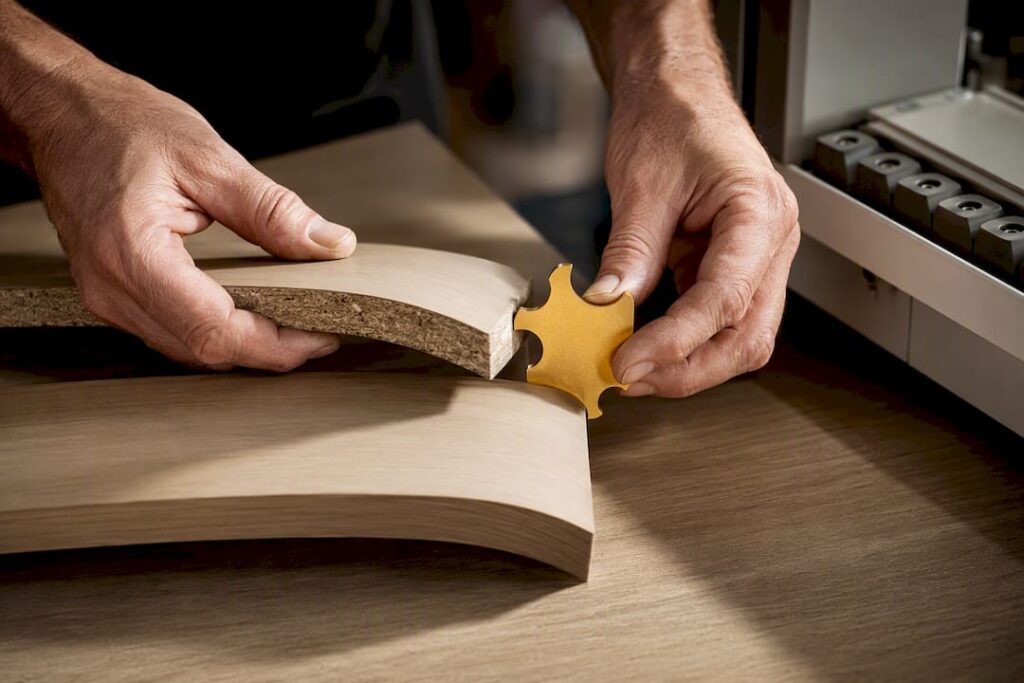
An edgebander applies tape or veneer to the raw edges of panels, then trims, mills and finishes that edge to match the board face. For many cabinet, joinery and furniture manufacturers, a single sided automatic edgebander with hot melt and modular trimming stations is the sensible starting point, moving up to continuous feed or PUR capable machines only when volume demands it. The sections below cover specifications, safety, servicing and cost so you can match a machine to your production reality.
TL;DR:
- A single-sided automatic edgebander with hot melt adhesive is suitable for most cabinet and joinery shops with moderate daily volumes, while PUR machines are only necessary when moisture resistance or invisible glue lines are critical.
- Feed speed and conveyor type are crucial for throughput; faster chain or tracked conveyors are better for continuous operations, whereas belt conveyors suit lower-volume or occasional use.
- Proper safety measures include fixed guards, accessible emergency stops, and dust extraction systems to prevent health hazards and reduce machine wear.
- Maintenance tasks such as cleaning the glue pot, inspecting knives, and stocking wear parts are essential for avoiding downtime and maintaining finish quality over time.
- Lead times depend on machine class and site readiness; ensuring electrical, dust extraction, and space preparations before delivery can significantly reduce installation delays.
Table of Contents
- What an edgebander does and where it fits on the shop floor
- Key features and technical specs buyers must compare
- Matching edgebander types to your production needs
- Safety, guarding and compliance checklist for edgebanders
- Maintenance, servicing and spare parts that keep an edgebander running
- Budgeting for the purchase, installation and running costs
- Installation, commissioning and operator training checklist
- Total lead time from order to delivery and installation
- Consumables and their ongoing cost impact
- Questions to ask suppliers before you commit to a purchase
- Key brands and market leaders in edgebanders
- Warranty and after-sales support to expect from a reputable supplier
- How Anderson Group Australia supports your edgebanding and panel processing purchase
- Sources
- FAQ
What an edgebander does and where it fits on the shop floor
An edgebander’s job is straightforward: apply edge tape or veneer to a panel, trim the overhang, mill the profile and buff it to a finish that matches the board face. Most machines handle melamine, laminate, veneer and PVC or ABS banding on particleboard, MDF and plywood substrates.
- Kitchen cabinet doors and carcases need consistent, fast edge finishing across repeat batches.
- Benchtops and shelving often require thicker banding and tighter tolerance on square edges.
- Flat-pack furniture components favour higher feed speeds since panel counts are high and finish tolerance is more forgiving.
The finish level and daily panel count you need are what should decide which machine class to shortlist, not the sticker price alone.
Key features and technical specs buyers must compare
Feed speed and conveyor type set your daily throughput ceiling. A slow conveyor on a high volume shop creates a bottleneck no matter how good the finish is. Faster tracked or chain conveyors suit continuous runs, while smaller belt driven units suit lower volume joinery work.
The glue system matters as much as feed speed. Hot melt EVA is the standard for melamine and laminate work and suits most cabinet and joinery shops. PUR adhesive gives a stronger, more moisture resistant bond and a near invisible glue line, but it needs dedicated tank management and supplier support for cleaning and handling.
- Pre-milling squares the panel edge before banding to improve bond quality.
- Trimming and corner rounding stations shape the banded edge to the panel profile.
- Scraping and buffing remove excess glue and polish the finished edge.
- Banding width and thickness range determines which board types and edge styles you can run.
- Control and HMI features, including recipe memory, cut changeover time when switching between panel types.
Check the machine’s electrical draw and dust extraction requirements before you finalise a floor plan, since both affect installation cost.
Pro Tip: Ask any supplier for the minimum banding radius and the maximum panel length the machine can handle before you compare price quotes, since these two figures rule out unsuitable models fastest.
Matching edgebander types to your production needs
Machine classes range from handheld tools to full production lines, and the right choice depends on daily volume and labour model rather than budget alone.
- Portable and bench top edgebanders suit one off jobs and site work but are too slow for repeat cabinet production.
- Entry-level compact automatics suit small shops moving beyond manual taping; upgrade once queueing at the bander becomes a daily bottleneck.
- Automatic single sided machines with modular stations (pre-mill, trim, corner round, buff) are the standard choice for continuous cabinet and joinery runs.
- Continuous feed production edgebanders suit high volume flat-pack and panel processing operations running multiple shifts.
- PUR capable machines are worth considering when moisture resistance or a near invisible glue line is a genuine product requirement, since they add servicing complexity.
Safety, guarding and compliance checklist for edgebanders
Before you sign off on a machine, work through a formal safety checklist rather than relying on a walkthrough. SafeWork NSW’s edge bander checklist covers guarding, emergency stop accessibility, operator training and workspace clearances, and is a practical reference to work through with any supplier before purchase.
- Guarding should include fixed guards on fixed hazards, interlocked guards on access points and adjustable guards where the operator needs to view the work.
- Lock-out/tag-out procedures must be in place for any maintenance or clearing of jams, per WorkSafe WA’s guarding guidance.
- Emergency stops need to be reachable from the normal operating position, not just at the control panel.
- Operator training and documentation should be provided by the supplier as part of handover, not left to the buyer to arrange separately.
Dust extraction and machine life are directly linked. Inadequate capture at the trimming and buffing stations creates a health hazard and accelerates wear on moving parts, so extraction should be specified and commissioned as part of the machine purchase, not bolted on afterwards.
Maintenance, servicing and spare parts that keep an edgebander running
Daily and weekly checks are what keep an edgebander in service between major overhauls. Clean the glue pot regularly, inspect trimming knives and pressure rollers for wear, and keep conveyor and feed mechanisms lubricated according to the manufacturer’s schedule.
- Glue pot cleaning prevents residue build up that affects bond quality on the next run.
- Knife and cutter inspection catches chipped or dulled edges before they show up as finish defects.
- Roller and belt checks identify wear before it causes feed inconsistency.
- Stocking common wear parts locally, such as trimming blades and pressure rollers, avoids production stoppages waiting on freight.
Preventative maintenance contracts with an authorised local service agent reduce unplanned downtime and give you a documented service history, which matters for warranty claims and resale value. A CNC preventive maintenance checklist sets out the kind of routine that applies equally to edgebanders on a mixed CNC and panel-processing floor.
Pro Tip: Build a simple daily log for glue pot temperature, knife condition and any unusual noise, and review it weekly. Small deviations caught early are far cheaper than a mid-run breakdown.
Budgeting for the purchase, installation and running costs
Capital cost scales with machine class: portable and entry-level compact automatics sit at the lower end, automatic single sided machines with multiple modular stations cost more, and continuous feed production lines represent the largest investment. Installation adds to that base figure.
- Dust extraction sized correctly for the machine’s capture points is commonly under-budgeted and should be quoted as a line item.
- Electrical supply upgrades, including three-phase capacity, are often needed for larger machines and should be confirmed before delivery.
- Foundations, conveyors and commissioning labour add to the installation cost beyond the machine price itself.
- Consumables, including edge tape, glue and wear parts, are an ongoing operating cost that scales with panel throughput.
Size the machine to your realistic daily and weekly panel count rather than a best case forecast, since an oversized production line sitting idle costs more than a correctly sized entry-level automatic running at capacity.
Installation, commissioning and operator training checklist
Preparing the site properly before delivery avoids the most common causes of installation delay.
- Confirm floor space and clearances, including conveyor infeed and outfeed runs and space for operators to move panels safely.
- Check floor load rating where a heavier continuous feed machine is being installed.
- Confirm electrical supply, including phase and incoming power capacity, matches the machine’s requirements.
- Arrange dust extraction hookups sized to the machine’s capture points before commissioning day.
- Run factory acceptance tests on sample panels representative of your actual product mix, not just the supplier’s demonstration stock.
- Complete operator training and handover documentation so staff understand routine adjustments, not just the start and stop sequence.
A supplier that walks through each of these steps before delivery, rather than leaving them to be discovered on install day, is worth prioritising over one offering only a price and a delivery date.
Total lead time from order to delivery and installation
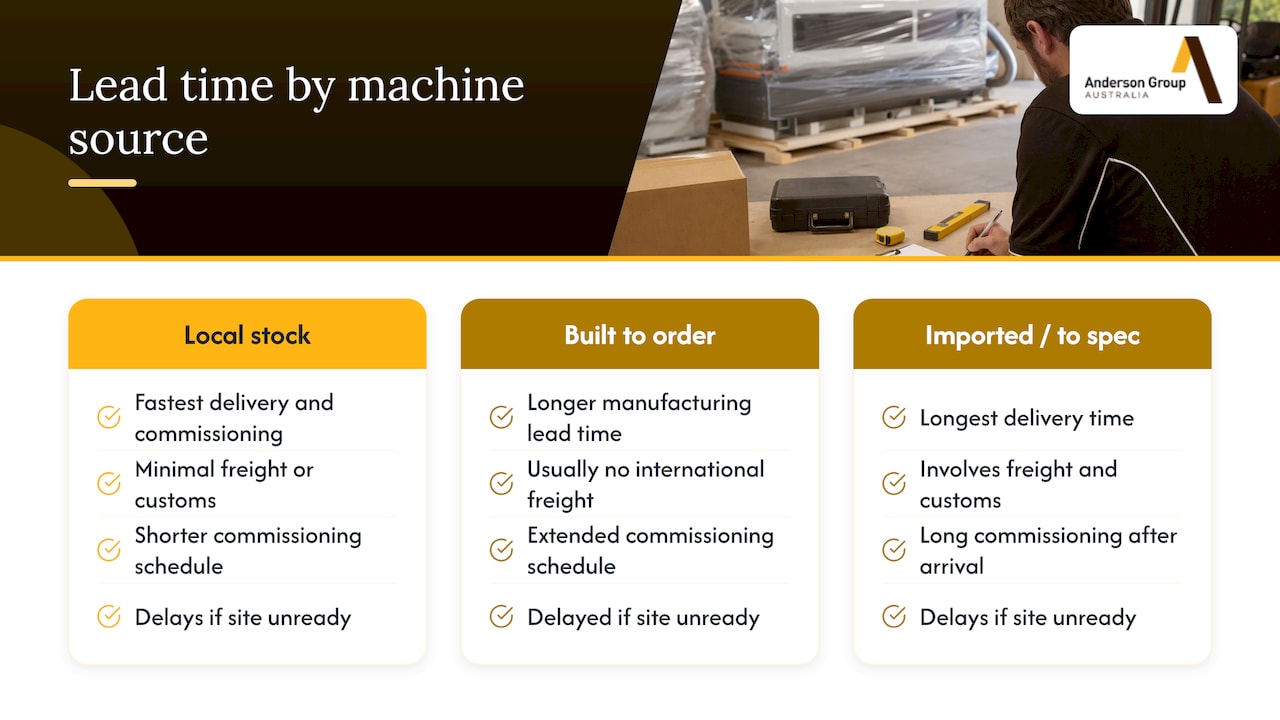
Lead time on an edgebander depends on whether the machine is held in local stock, built to order, or imported to a specification. A compact automatic model already in a supplier’s local inventory can be delivered and commissioned faster than a continuous feed production line that is built or shipped to order, since the larger machine typically involves freight, customs clearance and a longer commissioning schedule once it arrives.
Site readiness affects the timeline as much as the machine itself. If electrical supply, dust extraction ductwork and floor space are confirmed and prepared before the machine arrives, commissioning can proceed on delivery. If any of those are outstanding, installation is delayed regardless of how quickly the machine itself was shipped.
Ask any supplier for a written estimate that separates manufacturing or shipping lead time from on-site installation and commissioning time. That breakdown lets you plan your own production schedule around the transition, including which jobs to bring forward and which to hold until the new machine is running. Because lead times vary by machine class, stock availability and site readiness, treat any timeline as an estimate to confirm directly with the supplier for your specific model and location rather than a fixed industry figure.
Consumables and their ongoing cost impact
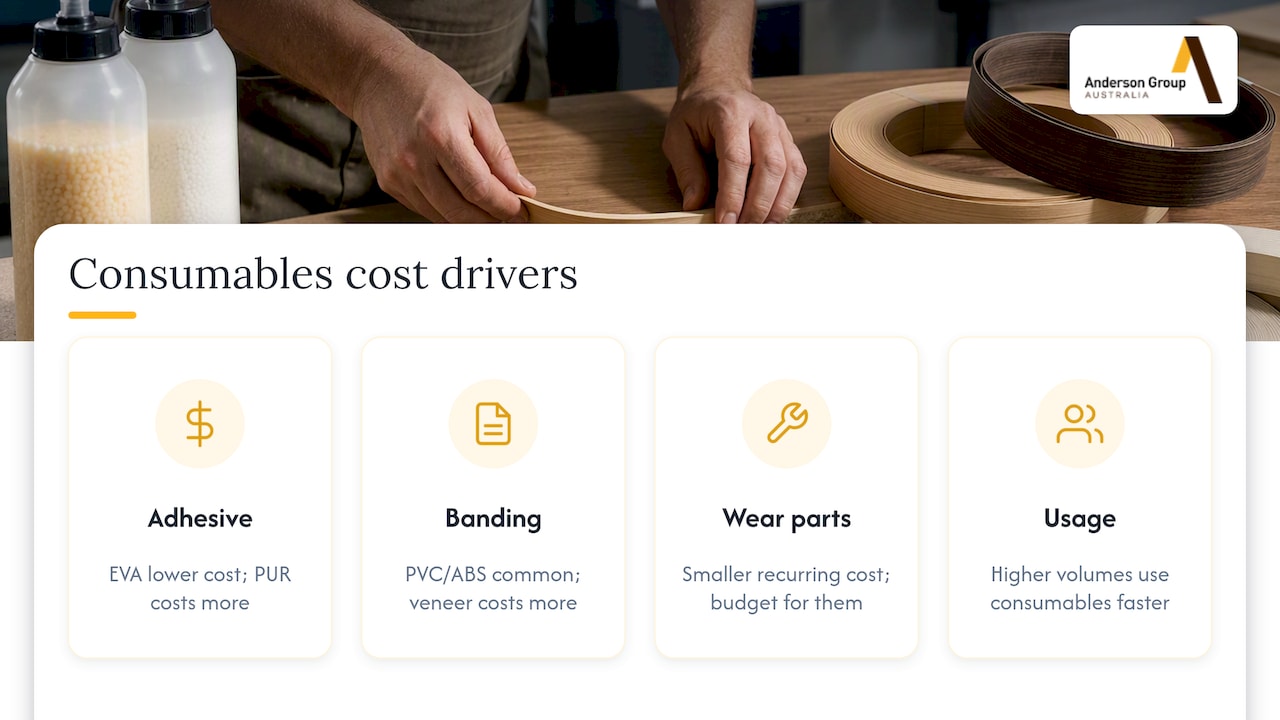
Two consumable categories drive the bulk of an edgebander’s running cost: adhesive and banding material. Hot melt EVA glue is the standard choice for melamine and laminate work and is generally the lower cost, easier to manage option for shops running a single shift. PUR adhesive costs more per unit and requires more careful tank management, but it delivers a stronger, more moisture resistant bond and a less visible glue line, which matters for products exposed to humidity or heavy use.
Banding material itself varies in cost by substrate and finish. PVC and ABS banding are common for melamine and laminate panels, while timber veneer banding suits higher end furniture and joinery work where the edge needs to visually match a timber veneer face. Thicker banding generally costs more per metre but can reduce the need for secondary finishing in some applications.
Wear parts, including trimming knives, pressure rollers and glue application rollers, are a smaller but recurring cost that should be budgeted alongside adhesive and banding rather than treated as an unplanned expense. Shops running higher volumes or switching frequently between banding types will use consumables faster, so factor your actual product mix into a running cost estimate rather than relying on a supplier’s headline consumable price alone.
Questions to ask suppliers before you commit to a purchase
A short list of pointed questions during supplier evaluation reveals more than a spec sheet comparison alone. Ask what training is included with delivery, whether commissioning and factory acceptance testing are part of the quoted price, and what the standard warranty period covers.
Confirm whether spare parts are stocked locally or need to be ordered from overseas, since that affects how quickly a breakdown can be resolved. Ask for a written maintenance schedule and whether a preventative maintenance contract is available, and check whether the supplier’s own technicians handle servicing or whether it is subcontracted.
On the safety side, ask the supplier to confirm the machine’s guarding meets the guarding hierarchy set out in WorkSafe WA’s guidance, and that emergency stops, interlocks and lock-out/tag-out points are documented in the handover pack. A supplier unwilling to walk through the SafeWork NSW checklist item by item is a warning sign worth taking seriously.
Finally, ask how the machine integrates with your existing panel processing workflow, particularly if you are running or planning a nesting-based CNC line. A nesting-first CNC workflow changes the panel sizes and edge profiles an edgebander needs to handle consistently, so this question is worth raising early rather than after delivery.
Key brands and market leaders in edgebanders
The edgebander market spans manufacturers offering everything from compact entry-level automatics through to continuous feed production lines with PUR capability. Buyers typically compare machines on feed speed, glue system flexibility, module configuration and after-sales support rather than brand name alone, since specification and local servicing matter more to daily output than badge recognition.
For cabinet, joinery and furniture manufacturers assessing their broader panel processing setup, Anderson Group Australia’s wood machinery range, including the Genesis PLUS platform, is worth reviewing alongside any dedicated edgebander shortlist, particularly where a shop is planning its CNC nesting and edge finishing stations as a connected workflow rather than as separate purchases.
Warranty and after-sales support to expect from a reputable supplier
A standard manufacturer’s warranty on a new edgebander typically covers defects in parts and workmanship for a defined period, though the exact term and what it covers varies by supplier and machine class, so confirm the specifics in writing before you order rather than assuming a default term applies.
After-sales support should extend beyond the warranty period. Look for a supplier offering documented preventative maintenance schedules, access to genuine spare parts without long freight delays, and technicians who can attend site or provide remote diagnostic support when an issue arises. A supplier that treats installation, training and ongoing servicing as part of the same relationship, rather than a one-off transaction, is generally the safer long-term choice for a production shop that cannot afford extended downtime.
How Anderson Group Australia supports your edgebanding and panel processing purchase
Industrial woodworking and panel-processing machinery, along with servicing and parts, are supplied to kitchen, cabinet, joinery and furniture manufacturers. We help you choose machinery suited to your own production, with specifications checked against the relevant product page before you commit.
Compare the AFS 243 compact automatic edgebander, the AFS 559-40 narrow-panel edgebander for components from 40 mm wide, and the AFS 568 PRO edgebander with servo-controlled finishing and a top feed belt. Match the specifications to your panel sizes, adhesive and finishing requirements.
- Review the Anderson wood machinery range for specifications on panel-processing machines including Genesis PLUS.
- Browse the full machines listing for product pages, specifications and enquiry routes.
- Ask about installation, commissioning and preventative-maintenance support as part of your purchase discussion.
| Support stage | What Anderson provides |
|---|---|
| Pre-purchase | Verified specifications on product pages for wood and panel-processing machines |
| Installation | Commissioning support for delivered machines |
| Ongoing | Servicing, parts and preventative-maintenance contract options |
Pro Tip: Bring your daily panel throughput figure and your current edge finish requirements to the first conversation. It sharpens which machine class we recommend and shortens the quoting process.
If you are weighing up an edgebander alongside a CNC nesting upgrade, our wood machinery page is the place to start. Get in touch to request a site assessment or discuss your application and receive a quote suited to your production volume.
Sources
FAQ
What does an edgebander do?
An edgebander applies tape or veneer to the raw edge of a panel, then trims, mills and buffs that edge to match the board face. It is a standard finishing step in cabinet, joinery and furniture production after panels are cut to size.
What is the best tool for trimming edge banding?
Trimming is handled by dedicated trim stations built into the edgebander itself, typically paired with scraping and buffing modules that finish the edge after trimming. Standalone hand trimmers exist for touch-up work but are not a substitute for a machine’s integrated trim stations on production runs.
How much does an edgebanding machine cost?
Capital cost varies significantly by machine class, from portable and entry-level compact automatics through to continuous feed production lines, and no single figure applies across the market. Ask suppliers for a written quote that separates machine price from installation costs such as dust extraction, electrical upgrades and commissioning.
What are the disadvantages of edge banding?
Edge banding can be vulnerable to moisture ingress and delamination at the glue line if the wrong adhesive is used for the application, particularly with hot melt EVA in humid or wet-use settings. It also adds a visible seam at the panel edge that some buyers prefer to avoid on premium furniture, though PUR adhesive can reduce how visible that seam is.