
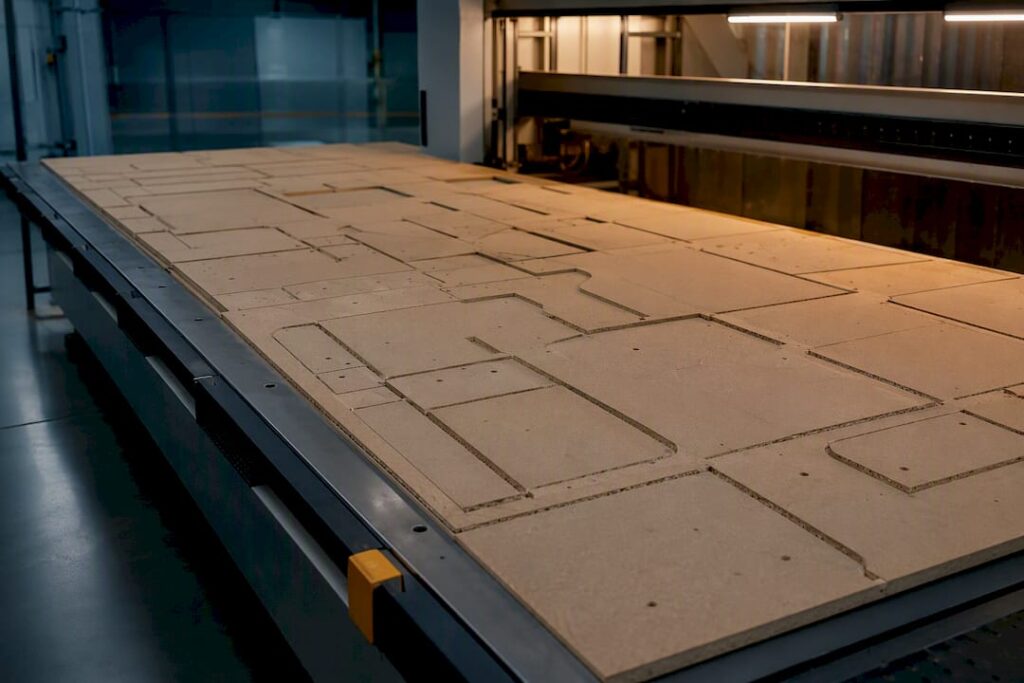
CNC panel processing is the automated routing, cutting and drilling of sheet materials into installation-ready parts, delivered with a repeatability that manual cutting can’t match. The main payoff is threefold: dimensional accuracy on every part, consistent output across shifts, and material yield that improves once nesting software replaces guesswork. As Panel Systems notes, machining holes, cutouts and edge profiles ahead of time also strips labour out of the installation stage.
TL;DR:
- Nested full-sheet machining maximizes material yield and is ideal for high-volume, repeatable production, while work-cell flow offers greater flexibility for complex parts.
- Machine size, spindle power, and automation features directly influence processing capacity, cost, and suitability for different substrate types.
- Proper safety protocols, including guarding and dust extraction, are essential to prevent hazards related to tooling, dust, and manual sheet handling.
- Regular preventive maintenance and having spare parts readily available reduce downtime and keep production lines running smoothly.
- Quality control begins with CAD checks, in-cycle inspections, and post-machining verification, with automated labeling improving traceability for batch issues.
Table of Contents
- Where panel processing fits in a production line
- Nested full-sheet machining vs work-cell point-to-point
- Machine features that determine output and cost
- Materials and applications: matching process to substrate
- Nesting software and yield optimisation on the shop floor
- Specifying equipment: a procurement checklist
- What Anderson brings to panel processing projects
- Safety protocols that keep panel processing lines running
- Maintenance schedules and common troubleshooting
- Quality control and inspection on the shop floor
- Author viewpoint: what surprises most buyers
- Get a quote or demo for your panel processing line
- Sources
Where panel processing fits in a production line
Panel processing sits between raw sheet stock and finished, ready-to-install components. It’s the stage where a flat pack cabinet, a joinery run, or an architectural cladding panel actually takes shape.
The technology shows up across a wide spread of production environments:
- Furniture and cabinetry manufacturing, where volume and part repetition justify automation
- Commercial joinery, producing shop fittings, reception counters and custom cabinetry
- Architectural panels for facades, wall linings and acoustic treatments
- Mass timber and structural fit-out components requiring precise connection points
Machined output typically arrives with drilled shelf holes, hinge bores, cutouts and edge profiles already in place, which is exactly what reduces on-site cutting and installation time on installation-ready panels. Whether a business outsources this work or buys its own machine usually comes down to volume and part complexity. Low-volume, highly bespoke runs often make more sense with a contract processor. Once part counts climb into the hundreds or thousands per month, or designs get complex enough that outsourcing lead times start hurting delivery schedules, owning the equipment tends to pay for itself faster than most people expect.
Nested full-sheet machining vs work-cell point-to-point
Panel production generally splits into two approaches, and most established plants eventually run some blend of both, as CADCode Systems explains.
- Nested full-sheet machining treats the whole sheet as a single canvas, cutting parts in an optimised layout on a vacuum table. This maximises yield on flat, single-face parts and suits high-volume, repeatable product lines.
- Work-cell / point-to-point flow uses beam saws for initial breakdown, then routes individual parts through machining centres or vacuum pods for drilling, edge profiling and multi-face work.
Nesting wins on material efficiency and unattended run time. Work-cell setups win on flexibility, particularly for parts needing five-sided machining or solid-wood components that don’t sit flat on a single table.
The trade-off is mostly about unloading rhythm and tooling investment. Nested machining requires more thought at the layout stage but less handling per part. Work-cell flow demands more physical handling between stations but adapts faster to a changing product mix.
Pro Tip: If your product mix shifts often, don’t force everything through a single nested workflow. A hybrid line, beam saw for volume breakdown, vacuum-pod machining for the five-sided parts, usually outperforms a pure nesting setup on flexibility without sacrificing much yield.
Machine features that determine output and cost
Specification decisions here directly shape both throughput and total cost of ownership. Bed size and vacuum table configuration set the ceiling on what a machine can process in one cycle, with full-sheet processors commonly sized from around 4 by 8 feet up to 5 by 12 feet, using vacuum plenum tables to hold flat sheet stock securely, according to Woodshop News.
Beyond the bed, a handful of specs do most of the heavy lifting:
- Frame stiffness affects cut quality at higher feed rates, particularly on dense composite panels
- Spindle power and tool changer capacity determine how many operations run in a single unattended cycle
- Drill banks and aggregate heads speed up shelf-hole drilling and angled boring without swapping tools
- Automation such as conveyors, part-removal systems, labelling and automatic pallet changers (APCs) cuts the dead time between cycles
Conveyor and removal systems in particular reduce unloading and cleaning downtime, which matters more as part counts per sheet climb. Five-axis or multi-head configurations only earn their premium when parts genuinely need compound angles or simultaneous multi-face machining. Buying that capability for straightforward flat-panel work is money spent on a capacity you’ll rarely use.
Materials and applications: matching process to substrate
Different sheet materials behave differently under a router bit, and tooling choices should follow the material, not the other way around.
- Plywood and MDF machine cleanly with standard carbide tooling and suit both nested and work-cell workflows
- Compact laminate needs sharper, wear-resistant cutters and slower feed rates to avoid chipping the decorative face
- Aluminium composite panels require dedicated router bits and dust extraction tuned for metal fines, not just timber dust
- Solid stock often needs point-to-point centres or rotary indexers, since it rarely sits flat the way sheet goods do, a distinction Woodshop News draws clearly between panel processors and multi-face machining centres
Edge banding decisions get made downstream of the cutting stage, but sheet choice still dictates which banding process runs cleanly and which finish holds up over time.
Nesting software and yield optimisation on the shop floor
Guillotine-style panel-saw planning cuts in straight, full-length passes. Nested CNC optimisation packs irregular shapes into leftover space the way a jigsaw puzzle comes together, which is why nesting consistently beats guillotine cutting on yield for anything other than simple rectangular parts.
The numbers back this up. Manual layout planning typically wastes somewhere between 25% and 35% of material, while professional nesting optimisers bring that down to roughly 5% to 10%, cutting layout planning time is reduced substantially in the process.
A few practical levers push yield further:
- Respecting grain direction and kerf width in the nesting algorithm, rather than treating every cut as zero-width
- Reusing offcuts systematically instead of scrapping them after each run
- Running pendular (twin-table) cycles so one table loads while the other machines, cutting non-cut downtime
- Automated labelling that prints and applies part tags during the machining cycle, removing a separate tagging step and cutting mis-labelling errors on the line
Specifying equipment: a procurement checklist
Before requesting quotes, nail down the production profile the machine actually needs to serve.
- Define part mix and batch sizes. Are you running long batches of similar parts, or short runs of highly varied components? This alone often decides nested vs work-cell.
- Model growth, not just current volume. A machine sized for today’s throughput with no automation headroom becomes a bottleneck within a couple of years for a growing shop.
- Check facility fit. Confirm floor space, power supply, dust extraction capacity and clearance for maintenance access before the machine arrives, not after.
- Map software integration. Confirm your CAD/CAM package talks cleanly to the machine’s nesting and control software, and whether it needs to feed data into an existing MES.
- Run the ROI numbers. Model saved labour hours per shift, expected yield improvement from nesting, and realistic throughput gains against the machine’s purchase and running cost.
Pro Tip: Ask any shortlisted supplier for typical spare-parts lead times before you sign, not after your first breakdown. A machine that’s cheap to buy but slow to service can cost you more downtime in year one than a pricier alternative with local parts stock.
What Anderson brings to panel processing projects
The company has extensive experience building CNC machinery, including nesting-capable panel processors and production centres with automatic pallet changers. That history sits behind a few practical strengths for panel processing buyers:
- Nesting-focused machines built for high-yield full-sheet production
- APC-equipped production centres for shops running mixed batch sizes without constant reloading
- CAD/CAM and nesting software support to help new buyers get workflows running faster
- Post-sale parts, service and maintenance support, plus industry-specific guidance across furniture, aerospace and automotive applications
Detailed specifications for individual machine ranges sit on Anderson’s machinery guides for readers comparing bed sizes, spindle options and automation packages.
Safety protocols that keep panel processing lines running
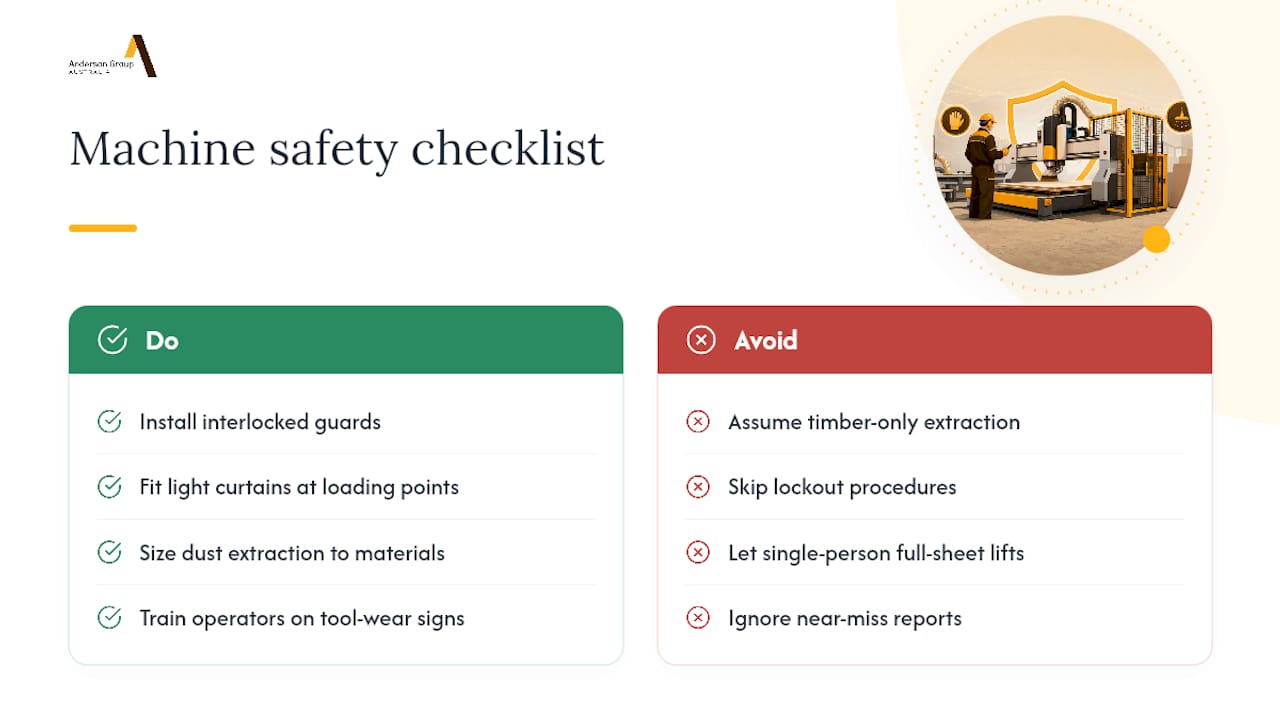
CNC panel processing carries real hazards, mainly around moving beds, exposed tooling, dust extraction and manual handling of large sheet stock. A workable safety program starts with machine guarding: interlocked doors on the cutting zone, light curtains where operators load and unload, and emergency stops within reach at every access point.
Dust and fines management deserves its own attention, particularly with aluminium composite or laminate materials where fine particulate poses both an inhalation and, in the case of metal dust, a combustion risk. Extraction systems need sizing to the actual material mix running through the shop, not just the timber-dust assumption most systems are designed around by default.
Operator training should cover more than button-pushing. Technicians need to understand tool wear indicators, correct vacuum seal checks before a cycle starts, and what an abnormal cutting sound or vibration actually means before it becomes a broken bit or a damaged spindle. Lockout-tagout procedures for maintenance work are non-negotiable, especially on machines with pneumatic clamping or hydraulic pallet changers where stored energy can move a component unexpectedly.
Manual handling of full sheets, particularly at the 5 by 12 foot end of the bed-size range, is where a surprising number of workplace injuries happen. Two-person lifts, vacuum lifters, or infeed conveyors reduce that risk more reliably than a laminated safety poster ever will. Regular safety audits, paired with a genuine reporting culture for near-misses, tend to catch problems long before they show up as an incident report.
Maintenance schedules and common troubleshooting
Preventive maintenance on a panel processor generally runs on three timescales: daily, weekly and quarterly. Daily checks cover vacuum seal integrity, dust extraction airflow, and a visual inspection of tooling for chips or excessive wear. Weekly tasks extend to lubrication points, belt tension and a check of the tool changer’s carousel alignment. Quarterly work usually involves spindle bearing checks, electrical cabinet inspection and a full recalibration of axis positioning.
Vacuum leaks are among the most common issues on full-sheet processors, and they show up first as parts shifting slightly during a cut or edges that don’t finish cleanly. The fix is usually a worn gasket or a cracked plenum seal rather than anything mechanical. Spindle overheating, another frequent complaint, often traces back to a coolant or air-cooling system that’s fallen behind on its service interval rather than the spindle itself failing.
Tool breakage during a cycle is almost always a feed-rate or material mismatch rather than a defective tool. Running laminate at feed rates set for MDF, for example, puts far more stress on the cutting edge than the tool is rated for. Keeping a log of tool life against material type helps predict replacement needs before a bit fails mid-cycle and scraps a part.
Spare-parts availability matters more than most buyers expect at purchase time. A control board failure or a proprietary spindle part with a six-week lead time can idle an entire production line, which is exactly why lead times deserve a real question during procurement, not an afterthought once the machine is running.
Quality control and inspection on the shop floor
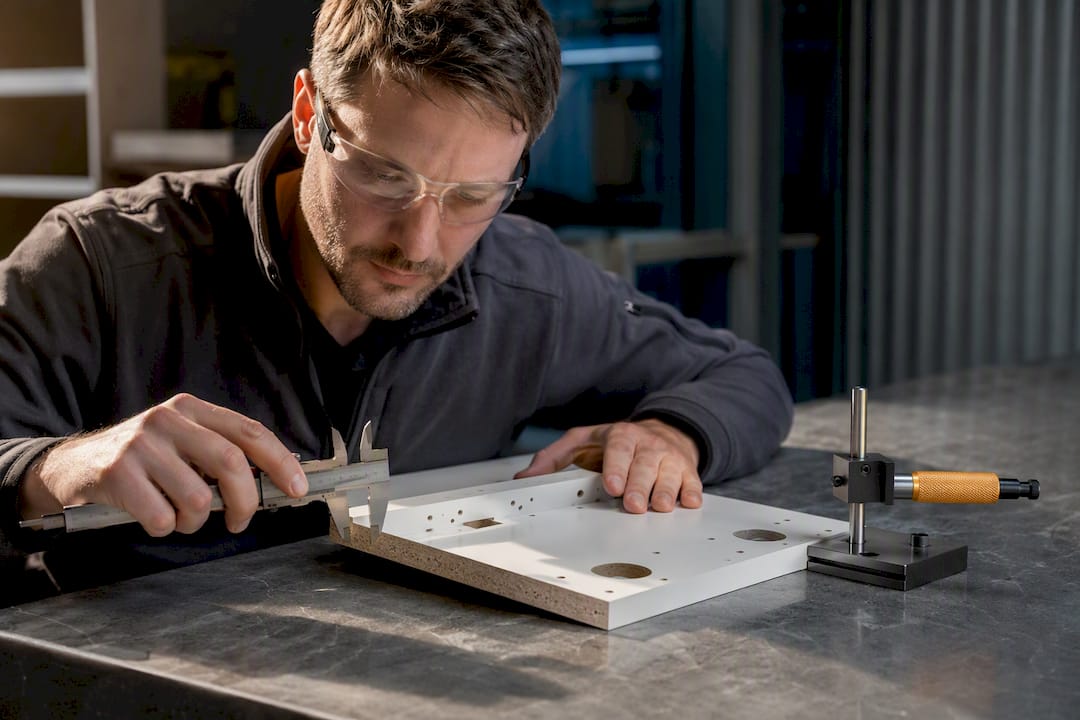
Quality control in panel processing starts before the first cut, with a program check against the CAD/CAM file to confirm toolpaths match the design intent. Most shops run a first-off inspection on every new job, checking dimensional accuracy, hole positions and edge profile against the drawing before letting a full batch run unattended.
In-cycle checks matter just as much. Vacuum hold-down monitoring catches a part that’s shifted mid-cut before it becomes a scrapped panel rather than after. Some shops fit probing systems that verify part position and thickness automatically between operations, catching material inconsistencies that a purely visual check would miss.
Post-machining inspection typically covers three things: dimensional accuracy against tolerance (often within a fraction of a millimetre on critical joinery), edge and surface finish quality, and hole or cutout placement for hardware fit-up. Random sampling works for long, stable production runs. Short or highly bespoke runs generally warrant full inspection of every part, since there’s no statistical run length to justify sampling.
Traceability closes the loop. Automated part labelling during the machining cycle, tying each part back to its job number and cut file, makes it far easier to isolate a quality issue to a specific batch, machine setting or material lot rather than guessing after the fact.
Author viewpoint: what surprises most buyers
Most procurement teams overweight spindle power and underweight automation. A machine with modest spindle specs but a well-designed automatic pallet changer often outproduces a more powerful standalone unit once unloading time is factored in. The two pitfalls I see most: budgeting tooling as an afterthought, and skipping the spare-parts lead-time question until the first breakdown forces it.
— Scott
Get a quote or demo for your panel processing line
The company offers panel processing systems designed for manufacturers seeking consistent output and reliability, backed by extensive experience in CNC machinery. If yield and automation are the deciding factors for your next machine, the Genesis PLUS nesting CNC is built specifically for full-sheet production with the vacuum table and tool-changer configuration this guide has walked through.
Anderson’s team can walk through part mix, batch sizes and facility requirements with you directly, and match a configuration to your production profile rather than a generic spec sheet. Browse the full woodworking CNC machinery range or get in touch to request a demo and a written specification for your shop.
Sources
- Beyond basic panel processing | Woodshop News Magazine
- Highlighting panel processing methods | CADCode Systems
- Panel Cutting Optimizer – Minimize Sheet Material Waste
- The role of CNC machining in panel fabrication | Panel Systems