
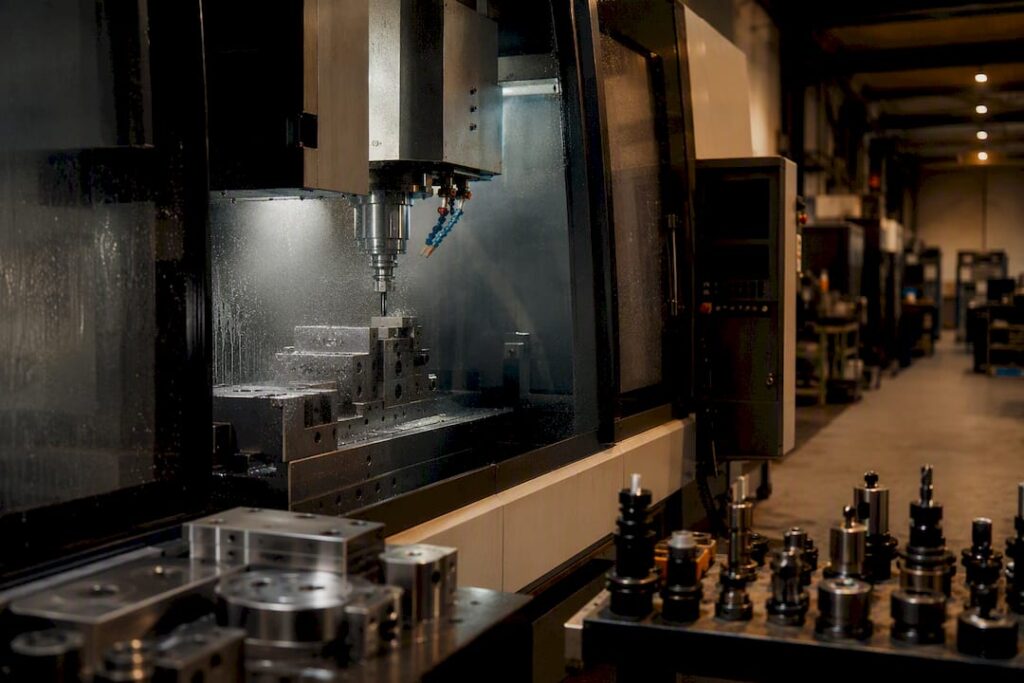
Lights-out machining means running CNC production overnight, on weekends, or across extended shifts with no operator on the floor. It only works when a process is stable, repeatable, and backed by layered validation systems: in-process probing, tool life monitoring, and deterministic restart logic. Skip any one of those and an unattended shift usually ends in scrap or a crashed spindle, not extra output.
TL;DR:
A reliable lights-out shift depends on layered validation systems, including probing, tool management, and crash-proof restart logic, to prevent scrap or machine damage.
Hardware must feature robotic load handling, auto pallet changers, and sufficient coolant and chip evacuation capacity to ensure continuous operation overnight without supervision.
The best parts for unattended machining are those with stable, well-characterized processes, predictable tooling, and a history of minimal fault alarms.
Programming discipline, such as restart logic and probing as a gate, is more critical for success than machine complexity or brand, with proper shut-down routines ensuring safety and traceability.
Implementing lights-out manufacturing should start with one part family and controlled testing, gradually expanding only when consistent results and process stability are verified.
Table of Contents
-
The five mandatory systems for reliable unattended machining
-
Monitoring, data and ongoing controls: keeping unattended runs healthy
What lights-out machining covers and when it pays off
Lights-out manufacturing) typically covers overnight blocks of several hours, weekend runs of a few days, or extended third shifts where no operator is rostered. It suits parts with stable geometry, predictable cycle times, and tooling that wears consistently: brackets, housings, repeat aerospace or automotive components, and cabinetry parts run in volume.
The payoff shows up as extra spindle hours rather than extra staff. A machine that runs an unattended overnight block on top of a normal day shift can add significantly more cutting time without a second crew. Shops report shorter lead times and better machine utilisation as tool monitoring, probing, and pallet systems have matured, making unattended runs practical well beyond the aerospace primes that pioneered them.
It is a poor fit for one-off jobs, unproven programs, or materials with erratic chip formation. Save those for daylight hours with an operator watching.
The five mandatory systems for reliable unattended machining
Every reliable lights-out cell runs on the same five layers, and skipping any one of them is where most overnight failures start.
-
Deterministic safe-start and restart routines that reset every modal state before the first cut, so the machine never assumes a condition left over from the last job.
-
In-process probing with validation, confirming part presence, fixture seating, and offset accuracy before committing to a cycle, not just after it.
-
Tool life management with sister-tool strategies, so a worn or broken tool triggers an automatic swap instead of a scrapped batch.
-
Spindle and axis load monitoring with adaptive response, cutting feed or stopping the cycle when load spikes past a set threshold.
-
Safe end, park, and logging routines, leaving the machine in a known state and a full record of what happened for the morning review.
Pro Tip: Treat probing as a gate, not a formality. If the probe cycle returns a value outside tolerance, the program should stop and alarm rather than proceed on a “close enough” offset. That single rule prevents the majority of unattended scrap runs.
Equipment and cell design: what a lights-out cell needs
Hardware choices decide whether a cell survives eight unsupervised hours or grinds to a halt at 2am. Palletised automation, robotic tending, and automated tool changers are the baseline, not the upgrade.
-
Pallet pools and auto pallet changers with zero-point fixturing give repeatable workholding across dozens of cycles without operator resets.
-
Robots or bar feeders handle loading, and part catchers or conveyors keep finished parts from colliding with the next cycle.
-
Chip evacuation and coolant flow need to be sized for the longest unattended run, not the average one, or packing will stall spindles by midnight.
-
Tool break sensors, reliable probing hardware, and a UPS to ride out power dips all protect the run from small faults becoming total losses.
-
Networked alarms and remote status feeds let a supervisor check in from home rather than finding a dead machine at sunrise.
A large-format platform like the MASS-5 5-axis machining centre is built around exactly this kind of rigidity and repeatability, which matters more overnight than during a supervised day shift.
How do you pick parts and processes for lights-out?
Not every job belongs in an unattended cell, and ranking candidates properly saves months of trial and error. Academic work on intelligent process planning backs this up directly: automation works best where process features and sequencing are already well understood, not where engineers are still learning the part.
-
Check process capability first. A part with tight, well-characterised variation (a strong Cpk) is a far safer bet than one still drifting between runs.
-
Confirm tooling predictability. Know expected tool life in cycles, and stage spare or sister tools before the first unattended shift, not after a failure.
-
Build in-process validation points. Decide where the program probes, measures, or checks before it commits to the next operation.
-
Review alarm history. A machine with a clean fault log is a better lights-out candidate than one that alarms weekly for unrelated reasons.
-
Run the economics. Weigh the cost of occasional scrap against the value of extra unattended runtime. If one bad batch wipes out a week of gains, the part is not ready yet.
Programming discipline and crash-proof logic
Most overnight crashes trace back to the program, not the machine. Programming errors are unforgiving during unattended runs because nobody is there to catch the mistake before it becomes a crash.
A proper safe-start block resets every modal condition (work offsets, feed rate overrides, coolant state) at the top of the program, so nothing carries over from a prior job. Restart-safe sections matter just as much: if a cycle stops mid-program, the machine needs to know exactly where it was and restore that state cleanly rather than guessing.
-
Re-apply tooling offsets explicitly rather than assuming they persisted.
-
Force a safe Z retraction before any rapid move in X or Y.
-
Build sister-tool substitution logic directly into the tool-change block.
-
Integrate probing checkpoints at every stage where geometry or fixturing could have shifted.
Pro Tip: Before the first unattended run, walk the program backwards from any point a tool could break, and ask what the next block actually does. If the answer is “cuts air” or “crashes into the fixture,” fix that logic before scheduling the shift.
Monitoring, data and ongoing controls: keeping unattended runs healthy
Spindle load, axis load, alarm frequency, and tool-life counters are the four numbers worth watching in real time. Together they tell you whether a cell is drifting toward a failure hours before it happens.
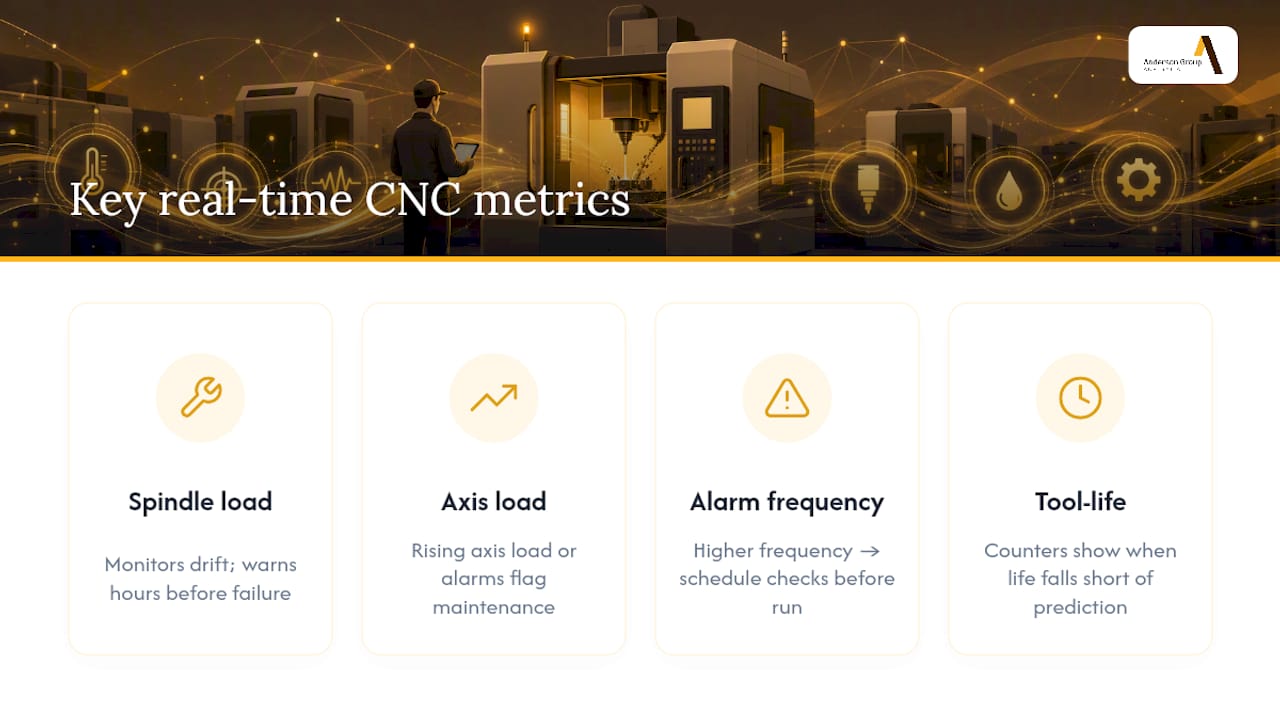
Remote alerts should sort into three tiers: immediate stop for anything safety or crash related, degraded operation (reduced feed, alarm logged) for borderline load spikes, and a logged event for anything worth reviewing in the morning but not worth waking someone up over.
Trend analysis turns this data into a maintenance schedule rather than a guessing game. Rising alarm frequency on one axis, or tool life consistently falling short of prediction, both flag maintenance windows worth scheduling before the next unattended block, not after it fails.
Step-by-step ramp-up plan: pilot, validate and scale
Start narrow. Practitioners consistently recommend beginning with one machine and one part family rather than rolling unattended shifts across a whole shop floor at once.
-
Pick a single part family with strong process capability and define clear acceptance criteria: acceptable scrap rate, cycle count, alarm tolerance.
-
Run controlled overnight tests with strict stop criteria and full logging, treating the first few runs as diagnostic, not production.
-
Review every alarm, scrap part, and tool-life trend the next morning, then refine the program or tooling before the next attempt.
-
Expand in stages, adding pallets or extending the unattended window only once results stabilise, not before.
-
Set up governance, a simple post-mortem process for any failure, so lessons get built back into the program rather than repeated.
Planning and validating a lights-out machining trial
Most guides on this topic focus on the hardware. That is backwards. The single biggest predictor of whether an unattended shift succeeds is programming discipline, not how many axes the machine has or how good the robot tender looks on a spec sheet.
Shops that fail at lights-out almost always skipped the boring part: they never built restart logic that assumes something will go wrong, and they never validated a program’s behaviour at every point a tool could break. Shops that succeed treat probing as a gate rather than a courtesy, and they start with one part family, not five.
Where hardware does matter is fixturing repeatability. A cell built around a machine like the MASS-5, with workholding, handling and any probing or automation options confirmed for the exact configuration, can reduce avoidable setup variation that would otherwise sit on the programmer’s shoulders. The same logic applies to high-throughput setups like Anderson’s STRYKER-6S point-to-point through-feed machining line, where consistent part presentation matters as much as the cutting cycle itself.
If your shop is weighing up a pilot cell, get in touch with Anderson to talk through what a first unattended part family should look like on your floor.
Anderson: built for shops running unattended shifts
Anderson designs CNC machining centres around the exact systems this guide covers: stable fixturing, pallet handling, and high-precision probing that make unattended runs viable rather than risky. The MASS-5 5-axis machining centre suits complex, high-value parts that need repeatable accuracy across long unattended windows, while machines with auto pallet changing and zero-point fixturing keep workholding consistent across dozens of cycles without a hand on the fixture.

For shops moving furniture, metalwork, or advanced materials production into unattended shifts, Anderson’s industries page covers where these platforms fit today. If you’re scoping a pilot cell, get in touch to discuss which Anderson platform matches your part family and shift plan.
Sources
For deeper technical detail on restart logic and crash-proof programming, cnccode.com’s guide to unattended machining is worth reading in full. MachineMetrics’ practitioner blog on lights-out manufacturing covers readiness criteria in more depth, and Metaltech’s overview of lights-out CNC hardware is a solid reference for cell design choices.