
Some CNC equipment may qualify for an immediate deduction, but eligibility depends on the business, the asset, its cost, its taxable use and the applicable income-year rules. A machinery purchase does not qualify simply because it is invoiced before year end. Use the current official guidance and ask a registered tax agent to assess the proposed transaction.
Before you get excited about tax season, run this checklist:
-
Confirm eligibility to use the small-business simplified depreciation rules, including the applicable aggregated-turnover tests.
-
Identify each depreciating asset and its complete tax cost. A separate invoice does not necessarily make an upgrade a separate asset.
-
Make sure it will be installed and ready for use, not just delivered, by the relevant deadline.
Have the adviser classify a controller retrofit, tooling package or other upgrade before assuming that it is a separate qualifying asset. An invoice below the threshold alone does not establish an immediate deduction.
Key Takeaways
Check business eligibility, the complete asset cost and the date of first taxable use or installation ready for taxable use. A commissioning document can be evidence, but it does not replace the statutory tests.
| Point | Details |
|---|---|
| Check the complete asset cost | Confirm the applicable threshold and asset classification with your tax agent. |
| Establish actual taxable use or readiness | Delivery or commissioning paperwork alone does not decide the claim. |
| Check the depreciation treatment | Business eligibility, taxable use and pool rules depend on the facts. |
| Compare finance agreements | Review GST, interest, ownership, repayments and total cost; no structure guarantees a better outcome. |
| Confirm the supplier scope | Agree installation, training and support in the machinery proposal. |
Table of Contents
-
Instant asset write off Australia: eligibility and the $20,000 limit explained
-
What does “installed ready for use” actually mean for CNC gear?
-
Chattel mortgages, leasing and other ways to fund a CNC purchase
-
Considerations for businesses transitioning between turnover thresholds
-
Does the instant write off apply to second-hand CNC machines?
-
How the write off interacts with other depreciation approaches
-
What “first used or installed ready for use” means for a CNC machine specifically
Instant asset write off Australia: eligibility and the $20,000 limit explained
For the proposed purchase, check the ATO instant asset write-off guidance for the relevant income year, the asset-cost threshold, exclusions and business-use calculation. The threshold applies to the complete cost of each asset, rather than only the business-use percentage or cash balance after a trade-in.
Legislative update checked on 29 September 2026: the Treasury Laws Amendment (Tax Reform No. 2) Act 2026 received Royal Assent on 26 August 2026. Its Schedule 2 retains the $20,000 threshold without an annual expiry in those amended provisions. The Schedule commences on 1 October 2026 and applies the asset amendment to first taxable use or installation ready for taxable use on or after 1 July 2026. Confirm how the commencement and application provisions affect your claim with your tax agent.
Separate assets can be assessed individually where the tax rules treat them as separate depreciating assets. Ask the adviser to distinguish asset cost, subsequent improvement costs and genuinely separate items before allocating a machinery package.
-
Do not subtract a trade-in allowance merely to bring the replacement asset below the threshold. Work out the replacement asset’s complete cost and the disposal treatment separately.
-
Assets used partly for private purposes only let you claim the business-use percentage.
-
Some capital works and car limit exclusions still apply regardless of the asset’s cost.
What does “installed ready for use” actually mean for CNC gear?
This is where CNC purchases trip people up. The ATO’s test isn’t about when you paid the invoice or when the machine arrived on a truck. It’s about when the asset is physically used, or installed and ready for its intended purpose. Industry commentary has flagged this repeatedly as the point where last-minute EOFY purchases fall over, because complex machinery rarely goes from delivery to production in a single afternoon.
The installation record may include the following items where relevant to the actual machine. These are practical evidence and safety matters, not an exhaustive ATO eligibility checklist:
-
Site preparation, including power supply, earthing and dust extraction connections.
-
Foundation work or anchoring, especially for larger machining centres.
-
Controller and software configuration matched to your production files.
-
Test cuts and commissioning sign off from the supplier or technician.
-
Operator training completed to a point where the machine can run a job.
Agree installation responsibilities and an achievable schedule before ordering. Record the actual first taxable use or installation-ready date; do not assume that delivery, training or a signed checklist establishes it on its own.
How the instant write off applies to real CNC purchases
Assess a whole machine, a separate accessory and an improvement to an existing machine according to their actual tax classification. The label used on the invoice does not decide the treatment.
A retrofit, controller or attachment is not automatically deductible because its quoted price is below $20,000. Its treatment may depend on whether it is a separate depreciating asset or an addition to an existing asset, the cost rules and the relevant income year. Ask the tax agent to classify it before purchase.
Full CNC machining centres are a different story. A full five-axis machine costing significantly more than the threshold doesn’t qualify for the instant write off at all.
Compare the timing of allowable deductions using the actual eligible cost, business use and depreciation rules. A deduction reduces taxable income; it is not a refund of the asset’s price. Avoid comparing nominal deductions without considering the business’s tax position and cash flow.
Combined purchases need careful cost allocation. If you buy a machine, tooling and installation as one package, you generally need to separate genuinely distinct assets from the core machine cost, and second-hand machines follow the same rules as new ones provided they meet the same use tests.
Chattel mortgages, leasing and other ways to fund a CNC purchase
Compare cash purchase, borrowing, hire purchase and leasing using the actual agreements, overall cost, repayment obligations and expected operating cash flow. Tax outcomes are one part of that comparison.
-
For a financed purchase, confirm GST-credit eligibility, attribution timing, interest treatment and asset ownership with the tax agent. A finance product name does not guarantee an upfront credit.
-
Hire purchase and leasing can have different ownership and GST consequences. Review the actual agreement with an adviser; the ATO’s explanation of hire purchase and leasing shows why the contract terms matter. Do not infer tax ownership from an accounting lease label.
-
Have the adviser calculate GST, interest, depreciation and lease deductions separately under the chosen arrangement. Do not treat finance deductions and depreciation as mutually exclusive alternatives.
Use written finance offers and business-specific calculations when comparing funding options. No finance method is universally better, and financing a machine does not make it eligible for an instant asset write-off.
None of this should be decided on tax grounds alone. Run the numbers with your accountant against your actual cashflow and production timeline before committing to a finance structure.
Claiming the write off: records you need to keep
An IAWO claim is only as strong as your paperwork. If the ATO ever asks questions, you’ll need to show more than a receipt.
-
Tax invoice showing the purchase price, GST component and supplier details.
-
A commissioning report or signed checklist confirming the date the machine became ready for use.
-
Photos or a test-cut log demonstrating the machine was operational.
-
Proof of payment and the installation date, which may differ from the invoice date.
-
BAS entries reflecting any GST credits claimed on the purchase.
Document the taxable-use proportion and ask the adviser to calculate the deduction and any pool movements. Pooling, disposals and write-off rules require the complete facts; a headline percentage does not determine every claim.
Pro Tip: Confirm the exact treatment with a registered tax agent before you lodge. A $200,000 mistake in a pool calculation is expensive to unwind later.
Why supplier commissioning support matters for your claim
Installation planning supports operational readiness and helps establish reliable records. The machinery supplier can confirm the agreed installation scope; a tax agent determines the tax treatment.
Anderson Group Australia supplies CNC machinery, servicing and spare parts. Confirm the exact machine configuration, installation arrangements and available support with the team.
-
Confirm whether a site-readiness assessment is included in the machinery proposal.
-
Agree installation and commissioning responsibilities, inclusions and any separate charges in writing.
-
Confirm available operator training and its schedule with the machinery supplier.
Compare production capability, operating costs and support alongside tax treatment over your intended ownership period. Do not assume one machinery life or tax outcome applies to every investment.
Considerations for businesses transitioning between turnover thresholds
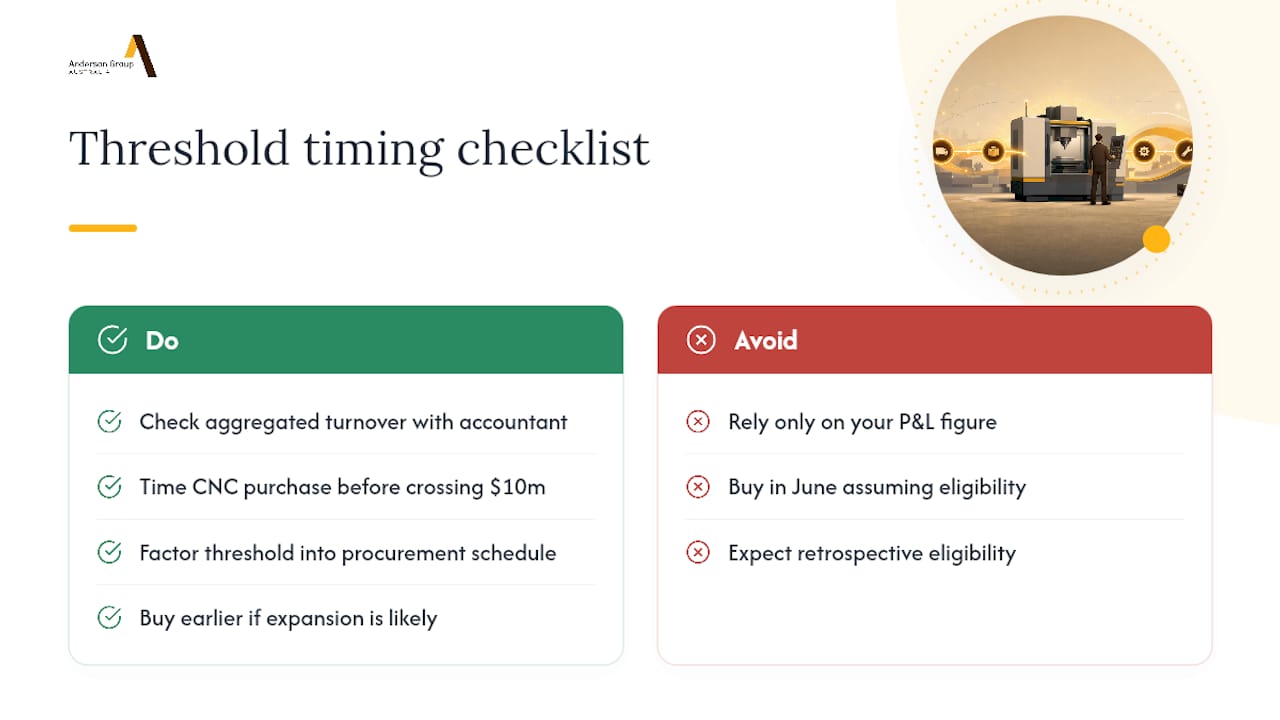
Turnover fluctuates, and that has real consequences for which depreciation rules apply to you. Aggregated turnover is calculated by combining your business’s turnover with that of any connected or affiliated entities, not just the figure on your own profit and loss statement.
Crossing $10 million during an income year does not automatically establish the loss of small-business status for that year. The ATO describes alternative turnover tests, including previous-year, estimated current-year and actual current-year turnover, with conditions. Ask the tax agent which test applies.
Eligibility is assessed under the relevant income-year tests. It is not simply switched on from the day turnover falls below a threshold.
Review connected entities, affiliates, excluded internal dealings and the applicable test with the tax agent before making an eligibility assumption.
Plan procurement around the business case, genuine installation needs and verified tax eligibility. Moving a purchase forward does not by itself establish access to simplified depreciation.
The timeline from CNC purchase to a valid claim
Understanding the sequence of events matters as much as understanding the rules themselves. Here’s roughly how it plays out for a typical CNC purchase.
Order placement usually happens weeks or months before delivery, especially for machines built or configured to order. This is the point to lock in a commissioning date with your supplier, not an afterthought once the machine is on the truck.
Record delivery and the installation steps required for this machine. Delivery is relevant evidence, but it is not by itself proof of first taxable use or installation ready for taxable use.
Document actual installation, commissioning and testing where required. The relevant date is determined from the facts of first taxable use or installation ready for taxable use, rather than automatically from the sign-off date.
Plan operator training as an operational and safety requirement. Do not use its completion date alone as the tax eligibility test.
Claim any allowable deduction through the relevant tax return with the necessary records. The tax agent should confirm the income year and treatment from the actual facts; crossing 30 June can affect timing without making every form of deduction unavailable.
Does the instant write off apply to second-hand CNC machines?
Buying used doesn’t automatically disqualify you. Second-hand CNC machines are eligible for the instant asset write off under the same rules as new equipment, provided the machine costs less than $20,000, you meet the turnover test, and it’s installed ready for use within the relevant date window.
In practice, this is where second-hand purchases often work in a buyer’s favour. A used three-axis mill or a retrofit-ready older machine can genuinely land under the $20,000 threshold, where an equivalent new model would sail past it. That opens the instant deduction to smaller workshops that might otherwise be stuck pooling a larger purchase.
Used equipment may need repairs, installation or other work before it is ready for the intended taxable use. Establish the actual state and timing rather than assuming that every additional service postpones eligibility.
There’s also a valuation question. The cost that counts is what you actually paid, including any refurbishment or freight costs directly tied to getting the machine operational. If you buy a used machine for $12,000 but spend another $9,000 getting it commissioned and calibrated, the total cost of the asset may tip over the $20,000 limit, moving it into the small business pool instead.
Document the condition and any pre-purchase inspection reports. If the ATO ever queries a second-hand claim, evidence that the machine required genuine commissioning work, rather than being usable off the truck, supports your installed-ready-for-use date.
How the write off interacts with other depreciation approaches
The instant asset write off doesn’t operate in isolation. It sits alongside the small business pool and, historically, alongside temporary full expensing, which applied more broadly during the pandemic period but has since been replaced by the current, narrower $20,000 measure.
For an asset costing $20,000 or more, there’s no partial application of the instant write off. You can’t split a $30,000 machine into “$20,000 instant, $10,000 pooled.” It’s an all-or-nothing test based on the asset’s total cost.
If you’ve previously claimed an instant deduction for an asset under simplified depreciation, and you later spend money improving it, that improvement cost can potentially also be immediately deducted, provided the improvement itself costs less than the $20,000 limit in the year it’s incurred. This matters for CNC owners who add a fourth axis, upgrade a controller, or retrofit tooling onto a machine they’ve already claimed.
Because the instant write off’s threshold and eligibility have shifted multiple times over recent years, don’t assume the rule that applied to a machine you bought two years ago still applies to one you’re buying now. Check the current settings for the income year in which you’re making the purchase, not the settings you remember from a previous EOFY.
What “first used or installed ready for use” means for a CNC machine specifically
This phrase carries more weight for CNC equipment than for almost any other asset class a small business buys, because CNC machines rarely go from crate to production run in one step.
The ATO’s own guidance treats “installed ready for use” as a factual test, not a documentation formality. An asset is installed ready for use when it’s capable of being used for its intended purpose, even if you haven’t actually run a paying job on it yet. For a laptop or an office chair, that’s a same-day event. For a CNC machining centre, it’s the end of a process.
Keep appropriate evidence of delivery, installation and operational readiness. Do not describe every commissioning report, test cut or training record as a universal ATO prerequisite. Confirm the evidence needed for the particular claim.
If equipment is not first used or installed ready for taxable use until July, the relevant deduction timing may fall in the next income year. Ask the tax agent to assess the facts and applicable rules instead of relying on the invoice or scheduled commissioning date.
Where the usual advice gets it wrong
A purchase before 30 June is only one fact. Business eligibility, asset classification and cost, taxable use, and the actual readiness date all affect the claim.
Allow realistic time for the required site work, installation and testing. Confirm supplier availability instead of assuming that any month or standard lead time guarantees completion.
For a machine above the applicable instant asset threshold, assess other depreciation treatment and financing with the tax agent. Compare the complete investment rather than assuming finance always matters more than depreciation.
Agree realistic installation arrangements and obtain transaction-specific tax advice before committing to a purchase.
Getting your CNC purchase installed and claim-ready
Confirm machine delivery, installation and commissioning arrangements before making a purchase. Assess tax eligibility and timing with the current official guidance and your adviser; supplier scheduling does not guarantee tax treatment.
Contact Anderson Australia to discuss the proposed machine configuration, documentation and installation arrangements. Confirm available site assessment, training and support in the quotation. Obtain independent advice on finance and tax; do not assume that finance introductions or a particular tax outcome are included.
Where to check the official rules
-
ATO instant asset write off guidance covers eligibility, thresholds and pooling rules in detail.
-
Read the enacted legislation and its commencement/application provisions alongside current ATO guidance.
-
Business offers a plain-English walkthrough for small business owners.
This article is general information, not a substitute for advice from a qualified financial advisor. Consult a qualified financial professional about your own circumstances before acting on anything here.
Sources
-
Instant asset write-off for eligible businesses | Australian Taxation Office
-
$20,000 Instant Asset Write-off | Australian Taxation Office
-
Equipment finance for manufacturers | Asset Finance Australia