
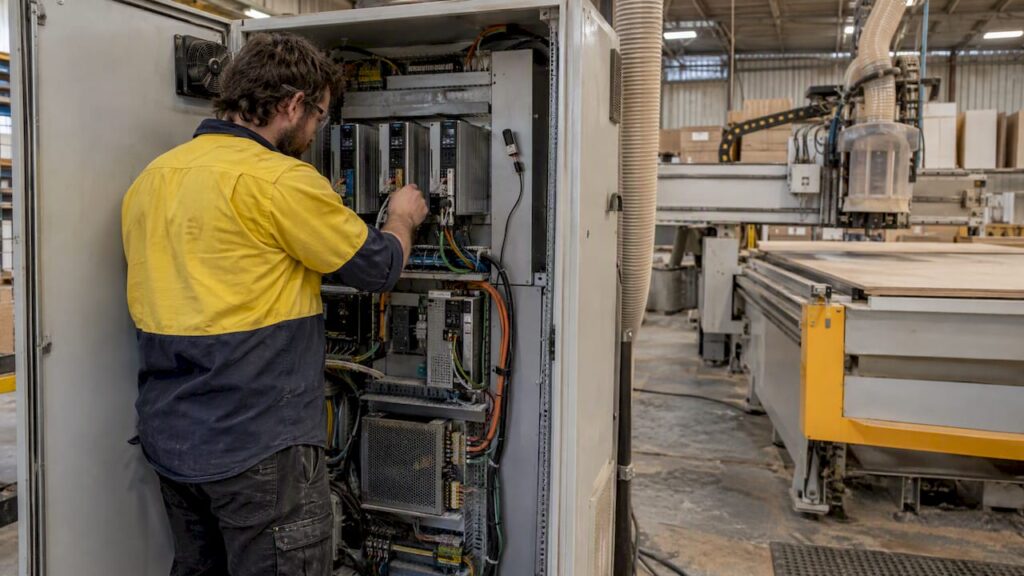
For low heat loads with clean ambient air, a filter fan handles ventilation. Moderate loads, or dusty sites where outside air is a problem, call for an air-to-air heat exchanger. Anything needing below-ambient temperatures, or high heat density, needs a sealed cabinet air conditioner or a closed-loop cooler. Whichever family fits, confirm it with a heat-load calculation before you buy, and check the condensation risk and IP rating before you commit to drawing in outside air.
TL;DR:
- Filter fans are suitable for low heat loads and clean air environments, but they risk pulling in dust or moisture if outside air quality is poor.
- Air-to-air heat exchangers are ideal for dusty or oily sites with acceptable ambient temperatures, as they keep the interior sealed while rejecting heat externally.
- Sealed cabinet air conditioners or closed-loop coolers are necessary when ambient temperatures exceed internal set points or when outside air quality can’t be maintained.
- Accurate heat load calculations use equipment dissipation values, enclosure surface area, material transfer coefficients, and temperature differences, with thermal modeling recommended for complex setups.
- Proper installation, placement, and maintenance practices—including clearance, airflow routing, and routine filter or fan checks—are crucial to ensure cooling reliability and prevent failures.
Table of Contents
- Types of cabinet cooling and when each makes sense
- How to size cooling: inputs, formula and a worked example
- Decision guide: choose fan, heat exchanger, air conditioner or closed-loop
- Installation and placement best practices to get the cooling to work
- Humidity, condensation and IP rating decisions
- Operation and maintenance checklist for reliable cooling
- Energy efficiency, derating and redundancy considerations
- Practical considerations for cabinetised machines and panel-processing control cabinets
- FAQ
- Sources
- Standards, manufacturer tools and regulatory pages to consult
Types of cabinet cooling and when each makes sense
Cabinet cooling splits into passive and active methods, and picking the wrong family wastes money either way: oversized active cooling burns power for no benefit, undersized passive ventilation lets components cook. The starting point for any design is understanding what each technology actually does, a point the Rittal buying guide for enclosure thermal management lays out clearly.
- Filter fans and roof/side filtered ventilation pull ambient air through the enclosure and exhaust it, but they only work when ambient is already below the target internal temperature, and they let in whatever is in the air.
- Air-to-air heat exchangers move heat across a sealed barrier using an external airflow, so the cabinet interior never mixes with outside air, which suits dusty or oily sites that still have reasonable ambient temperatures.
- Cabinet air conditioners use a sealed, closed refrigerant circuit to cool internal air below ambient, the only reliable way to hold a set point when outside temperatures already exceed what the electronics can tolerate.
- Closed-loop coolers, including vortex or compressed-air units and thermoelectric coolers, suit smaller, sealed enclosures or spot cooling where a full air-conditioning circuit is overkill.
- Passive measures, meaning generous enclosure sizing, sensible internal layout, vent hoods and vented doors, reduce the load every other method has to handle and should be the first design step regardless of what active cooling follows.
Panel-processing control cabinets in a joinery or cabinet shop often sit in the moderate range: enough heat from drives and power supplies to need forced air, but rarely enough to justify a sealed air conditioner unless the shop floor itself runs hot or dusty.
How to size cooling: inputs, formula and a worked example
Sizing starts with the heat the equipment actually produces, not a guess at enclosure size. The standard approach, detailed in Rittal’s white paper on selecting energy-efficient climate products, uses a small set of inputs:
- Enclosure dimensions and effective surface area, calculated with the standard VDE-based surface-area formula for the cabinet’s height, width and depth.
- Material heat transfer coefficient (K), which varies with the enclosure material and determines how much heat the cabinet skin sheds on its own.
- Equipment heat dissipation (Qv), taken from component datasheets for drives, power supplies, contactors and anything else generating heat inside the box.
- Ambient and target internal temperatures, which set the delta T the cooling system has to overcome.
The formula is Qe = Qv minus (A multiplied by K multiplied by delta T), where Qe is the additional cooling capacity required once the enclosure’s own conduction losses are subtracted from total heat dissipation.
As an illustrative example, say a cabinet dissipates several hundred watts internally (Qv), has an effective surface area of a few square metres, a steel K value typical for enclosures, and needs to hold a target temperature roughly 10°C below a 35 to 45°C ambient. Enclosure conduction removes some heat naturally, leaving a few hundred watts of additional cooling required. These figures are for illustration only; always pull real heat-dissipation values from component datasheets.
Industry sources describe standard enclosure setpoints typically falling between 35°C and 50°C depending on the components inside, which gives a useful sanity check against the target temperature used in the calculation above.
When a cabinet has several configurations, high-density drives, or sits near other heat sources, hand calculations get unreliable fast. Thermal modelling tools such as Schneider Electric’s EffiClima or Rittal’s Therm/RiTherm calculators handle the variables more precisely and are worth the time for anything beyond a simple single-enclosure job.
Decision guide: choose fan, heat exchanger, air conditioner or closed-loop
The decision comes down to three questions: is ambient cooler than your target internal temperature, is the air clean enough to bring inside, and what utilities or maintenance support do you actually have on site.
- If ambient is reliably below the target internal temperature and the air is clean, a filter fan is the simplest and cheapest option.
- If ambient is acceptable but the air carries dust, oil mist or moisture, an air-to-air heat exchanger keeps the cabinet sealed while still rejecting heat.
- If ambient regularly meets or exceeds the target internal temperature, only a sealed air conditioner or closed-loop system will hold the set point, a limit Schneider Electric’s thermal management guidance makes explicit.
- If chilled water or compressed air is already available on site, that infrastructure can simplify the choice between a closed-loop cooler and a standalone air conditioner.
Before locking in a choice, run a short checklist: required cooling capacity in watts, available footprint on the cabinet, power supply for the unit, and whether maintenance staff can actually reach it for filter changes or servicing.
Pro Tip: Size for your site’s hottest realistic day, not the annual average, or the unit will fall short exactly when you need it most.
Installation and placement best practices to get the cooling to work
Where you mount the cooling unit matters almost as much as which unit you choose. A well-sized air conditioner performing badly is usually an installation problem, not a product fault.
- Leave clearance around the unit, typically 203 to 406 millimetres depending on the model, so intake and exhaust air can move freely and technicians can service it without dismantling the cabinet.
- Mount filter fans low on the door or side panel for intake and high for exhaust, creating a cross-ventilation path rather than letting air recirculate near the inlet.
- Mount roof-mounted air conditioners and heat exchangers where internal airflow reaches hot components directly, not just where there happens to be panel space.
- Route intake and exhaust to avoid short-circuiting, where exhaust air gets pulled straight back into the intake, which quietly defeats the whole system.
- Coordinate with mechanical and electrical trades early on condensate drain routing, cable duct positions and nearby heat sources like VSDs, so the cooling unit isn’t fighting a duct run or a motor added after the fact.
Humidity, condensation and IP rating decisions
Condensation forms when warm, moist air meets a cooler surface inside the cabinet, a real risk whenever outside air is introduced or a cabinet sits through daily temperature swings. Beyond nuisance moisture, condensation inside a live enclosure is a safety and inspection issue.
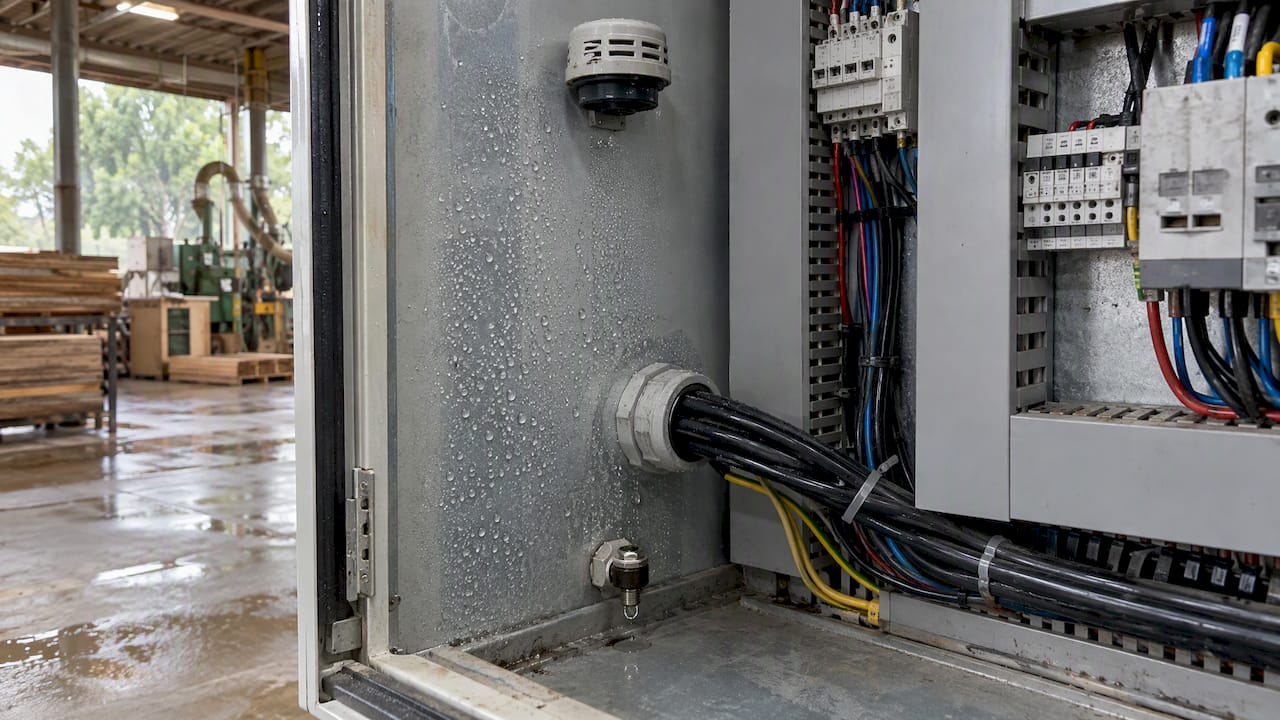
WorkSafe Queensland’s guidance points to clause 1.7.1 of AS/NZS 3000, which requires equipment to be constructed and installed to withstand external influences, and recommends breather or pressure-equalisation valves plus condensate drains for outdoor or humid installations. Internal heaters, such as the ClimaSys CR resistance heaters Schneider Electric documents, hold internal temperature above the dew point in seasonal or outdoor cabinets. The IP rating itself should match the approach: a sealed air conditioner or heat exchanger supports a higher IP rating than a filter fan that draws in unfiltered outside air by design.
Operation and maintenance checklist for reliable cooling
Cooling systems fail quietly. A blocked filter or a stuck thermostat doesn’t trip an alarm on day one, it just lets internal temperature creep until something else fails first.
- Check and replace filters on a fixed interval rather than waiting for a visible problem, since airflow drops well before a filter looks obviously dirty.
- Inspect fans for bearing noise and reduced airflow, and verify thermostats and condensate drains are still doing their job.
- Place temperature probes near actual hot spots, not just at one central thermostat, since a single reading can mask a localised problem.
- Keep basic spares on hand, filter mats, fan motors and thermostats, so a fault doesn’t become unplanned downtime.
Pro Tip: A thermostat reading normal doesn’t mean the whole cabinet is fine, a second probe near the busiest drive catches problems a single sensor misses.
When a fault points to the refrigerant circuit itself rather than airflow or filters, that’s the point to call in specialist service rather than keep troubleshooting on site.
Energy efficiency, derating and redundancy considerations
Refrigerant-based cooling loses capacity as ambient temperature climbs, which is why designs should target the site’s high-percentile ambient rather than an average figure. Free-cooling options, such as airside or waterside economisers, can cut energy use during cooler periods but only pay off where ambient swings enough to make them worthwhile. For critical control systems, redundancy such as N+1, running one more cooling unit than the calculated minimum, protects against a single unit failure without shutting down production; higher levels like 2N add cost for applications that genuinely can’t tolerate any downtime. The cooling approach chosen also feeds into component life and total cost of ownership, since components run cooler and more consistently last longer than ones cycling through temperature swings.
Practical considerations for cabinetised machines and panel-processing control cabinets
In CNC control cabinets, the main heat sources are variable-speed drives, servo amplifiers and power supplies, usually clustered together rather than spread evenly through the enclosure. That clustering is exactly where temperature probes should go, not at a single central point that can read comfortably normal while a drive nearby runs hot.
Layout matters as much as cooling capacity. Grouping components by heat output, keeping drives away from sensitive control electronics, and giving the airflow path a clear route from intake to exhaust all reduce hotspots before any active cooling even switches on, a principle that applies whether the cabinet sits on a nesting machine or a panel saw. Shops running CNC panel processing and nesting-first production workflows deal with this regularly, since control cabinets on that equipment often sit close to dust extraction and chip collection, adding both heat and airborne contamination to the mix.
Cooling maintenance should run alongside machine servicing rather than as a separate task, since filter changes and fan checks are easiest to schedule during planned machine service visits. For machinery selection and servicing enquiries on wood-processing equipment, Anderson Group Australia’s wood machinery range and broader machine lineup cover the equipment these control cabinets are built for.
FAQ
What is the best cooling method for a small electrical cabinet?
For a small cabinet with low heat load and clean ambient air, a filter fan is usually sufficient and the cheapest option to install and maintain. If the air is dusty or oily, an air-to-air heat exchanger keeps the enclosure sealed while still rejecting heat.
How do I calculate the cooling capacity needed for a control cabinet?
Use the formula Qe = Qv minus (A multiplied by K multiplied by delta T), where Qv is equipment heat dissipation from datasheets, A is enclosure surface area, K is the material’s heat transfer coefficient, and delta T is the gap between target and ambient temperature. Tools such as EffiClima or Rittal’s Therm calculator handle multi-component or high-density cabinets more precisely than a hand calculation.
When do I need a sealed air conditioner instead of a fan?
A sealed cabinet air conditioner or closed-loop cooler is needed whenever ambient temperature approaches or exceeds the desired internal cabinet temperature, since a filter fan can’t cool below ambient. It’s also the right choice where incoming air would introduce dust, oil or moisture the equipment can’t tolerate.
How do I stop condensation forming inside an electrical enclosure?
Install a breather or pressure-equalisation valve and a condensate drain, as recommended in WorkSafe guidance on large electrical equipment installation, and add an internal heater to keep the cabinet above the dew point in cold or outdoor conditions. These measures matter most where outside air is introduced or where the cabinet experiences daily temperature swings.
How often should cabinet cooling filters and fans be serviced?
Filters should be checked and replaced on a fixed schedule rather than only when visibly dirty, since airflow drops before the filter looks obviously clogged. Fans should be inspected regularly for bearing noise and reduced output, alongside routine checks of thermostats and condensate drains.
Sources
- Industrial enclosure solutions — a buying guide (Rittal)
- Thermal management systems (Schneider Electric Australia)
- Are you installing large electrical equipment? (WorkSafe Queensland)
Standards, manufacturer tools and regulatory pages to consult
Any cabinet cooling design should be checked against AS/NZS 3000 for installation requirements, including the clause 1.7.1 provisions on protecting equipment against external influences that WorkSafe Queensland discusses. For assembled switchgear and control gear, IEC 61439 covers temperature-rise verification and service conditions, and should be consulted directly when proving assembly thermal performance. Manufacturer thermal calculators such as EffiClima and Rittal’s Therm/RiTherm tools help size equipment beyond simple hand calculations, and for high-density or redundant cooling layouts, engineering guidance on containment and redundancy in server-room cooling offers useful principles that carry over to industrial cabinets.