
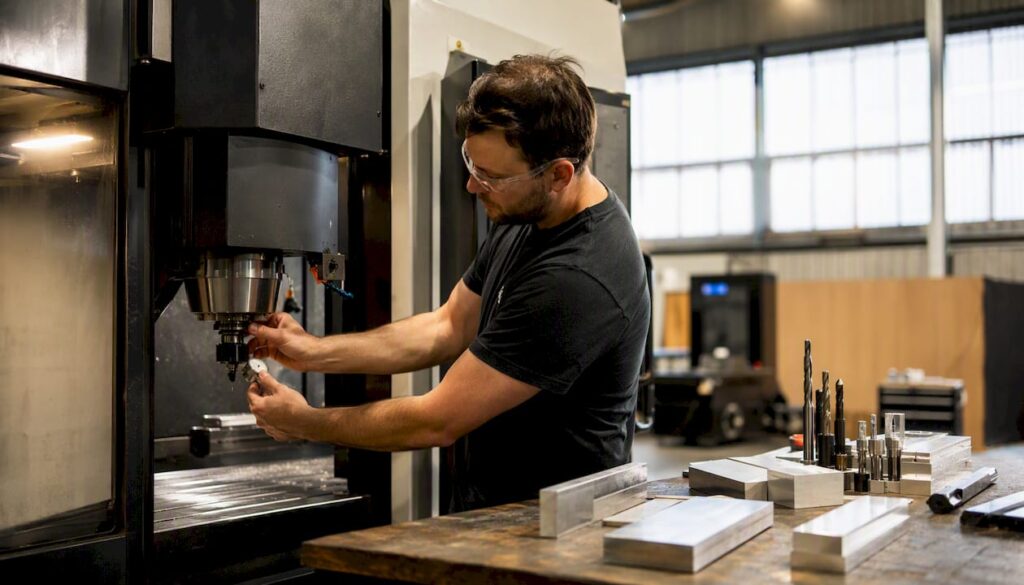
Small-batch CNC equipment decisions depend on the part mix, repeat orders, setup effort, staff capability and investment case. Anderson Group Australia supplies machinery, servicing and parts; it does not offer subcontract machining. Use this guide to assess production capability and discuss suitable equipment.
Compare the complete cost of the proposed in-house process with your current production arrangements, including programming, fixturing, inspection, staffing, site work and maintenance.
The main decision drivers, in order of weight:
-
Quantity and repeat frequency: use the actual part mix and forecast demand in the investment model; no universal batch-volume threshold determines whether to buy.
-
Tolerance and inspection needs: tight tolerances demand skilled operators and metrology equipment, not just a machine.
-
Required axes: 3-axis covers most prismatic parts; 5-axis, for complex multi-face geometry, adds significant machine cost.
-
Floor space and services: CNC machining centres need compressed air, coolant management, and a stable slab.
-
Staff skills and maintenance: a machine without a competent operator and a service contract is a liability.
-
Cashflow and finance: lease or chattel mortgage options change the monthly cost equation considerably.
-
Lead-time sensitivity: compare the actual delivery and setup arrangements for the proposed production route.
Document forecast volumes and repeat requirements when comparing machinery or production proposals. Include setup and inspection assumptions in the cost model.
Key takeaways
Assess small-batch CNC capability using part requirements, forecast demand, staffing and a complete cost model. A universal volume band does not establish the most suitable production route.
| Point | Details |
|---|---|
| Compare production routes | Use the actual part mix, demand, capability and full cost model when comparing in-house production and subcontract supply. |
| Model volume and utilisation | Batch size, setup, cycle time and repeat demand affect economics; fixed quantity bands do not decide the investment. |
| Prepare clear requirements | Provide drawings, material, tolerances, finishes and inspection requirements when requesting machinery or production proposals. |
| Agree suitable inspection | Define the first-article and ongoing inspection plan from the drawing, risk and quality requirements. Confirm suitable equipment and reporting. |
| Discuss machinery with Anderson | Anderson supplies CNC machinery, servicing and spare parts. Confirm the proposed configuration, installation, training and support scope. |
Table of Contents
-
What does the supplier workflow look like for a small batch?
-
What the shift to small-batch CNC means for Australian manufacturers
What does “small batch” actually mean for CNC work?
The term gets used loosely, so it helps to pin it down. In practical CNC terms, small-batch production spans roughly 10–1,000 parts depending on complexity, material, and the number of setups required. Three bands cover most situations:
-
One-offs and prototypes (1–9 parts): the focus is on proving geometry and fit, not cost per part. Setup time dominates. Lead times are typically 3–10 business days for straightforward geometry.
-
Pilot runs (10–100 parts): validating a design for function and manufacturability before committing to tooling or inventory. This is where low-volume CNC projects sit most naturally, and where DFM feedback from a supplier is most valuable.
-
Small production batches (100–1,000 parts): recurring orders for custom components, spare parts, bridge production while tooling is made, or limited-edition products. Per-part cost drops meaningfully here as setup is amortised across more pieces.
Small-batch CNC occupies the space where injection moulding is too expensive to tool up for, additive manufacturing is too slow or structurally limited, and sheet fabrication alone can’t deliver the geometry. It’s the pragmatic middle ground for functional metal and plastic parts in low-to-mid volumes.
Where small-batch CNC sits relative to alternatives is worth understanding. Injection moulding tooling in Australia typically starts at $8,000–$30,000 AUD for a simple tool, which only makes sense above several thousand parts. Additive manufacturing (3D printing) handles complex geometry but struggles with surface finish, material properties, and throughput for anything above a handful of parts. Sheet metal fabrication is fast and cheap for flat or bent profiles but can’t produce prismatic or turned features without additional operations. CNC machining fills the gap: no tooling investment, full material choice, and tolerances down to ±0.01 mm or tighter.
Use-cases that consistently land in this space include custom aerospace brackets, automotive prototype housings, medical device components, marine hardware, furniture hardware in specialty materials, and spare parts for legacy equipment where the original tooling no longer exists.
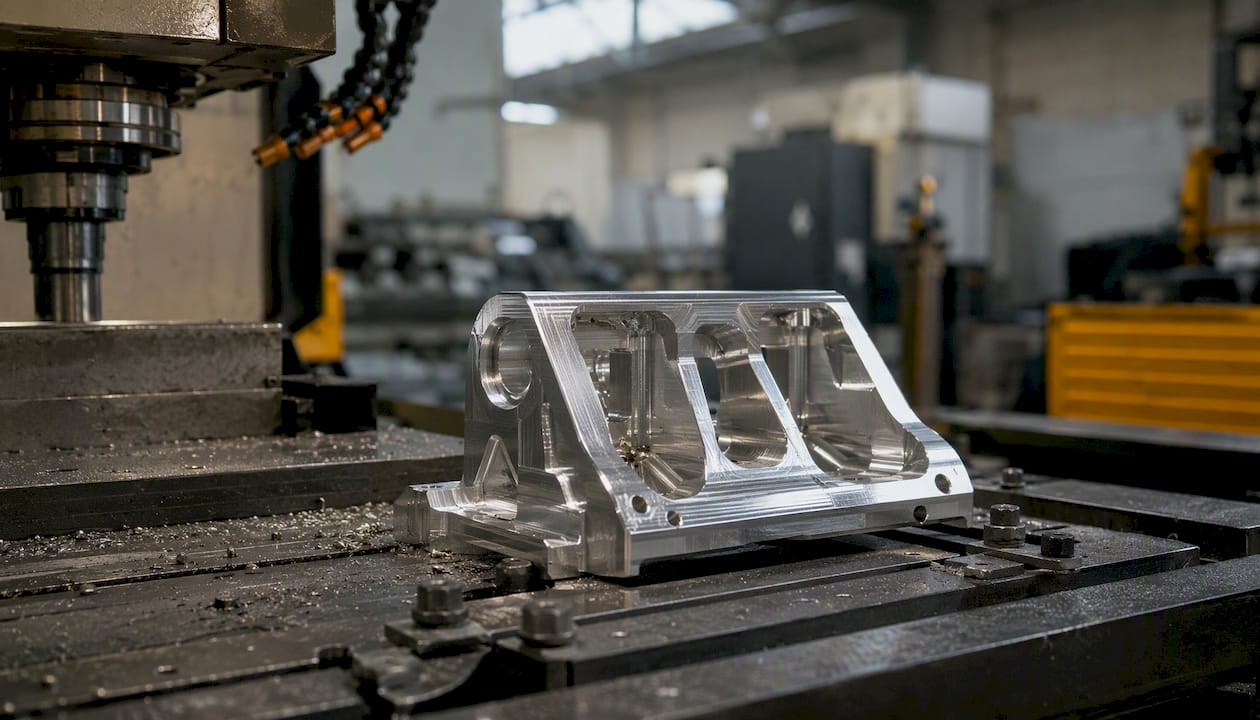
When should you outsource vs buy a CNC machine?
Compare in-house production and subcontract supply using the actual part mix, forecast workload, staffing, process capability, premises and full costs. Choose the route that meets the production requirements and business case rather than following a universal outsource-first rule.
The buy-vs-outsource checklist
Work through these in order:
-
Immediate quantity: use the actual workload and future demand in the cost model; no fixed monthly part count determines the appropriate production route.
-
Repeat frequency: if the same part family runs every month, the setup cost argument for buying strengthens quickly.
-
Tolerance and inspection: if your parts need CMM verification and you don’t have one, buying a machine without buying metrology equipment is half a solution.
-
Required axes: a 3-axis vertical machining centre costs a fraction of a 5-axis centre. Know which your parts actually need.
-
Floor space: a mid-size vertical machining centre needs roughly 6–10 m² of floor space plus access clearance, a compressed air supply, and coolant drainage.
-
Staff skills: do you have a qualified CNC machinist or programmer on staff, or would you need to hire one?
-
Cashflow and finance: chattel mortgage or lease arrangements can convert a large capital outlay into a monthly payment that competes directly with your outsourcing invoice.
-
Lead-time sensitivity: if turnaround is your primary constraint, in-house production gives you control that no external supplier can fully match.
Calculating a simple payback horizon
For a simple payback estimate, divide the incremental upfront investment by the expected annual net cash benefit. When comparing with outsourcing, calculate that benefit from the costs actually avoided less the additional in-house operating costs, including labour, programming, tooling, utilities, maintenance, inspection and expected downtime. Use consistent assumptions and test changes in demand and utilisation. If the net benefit is zero or negative, this simple payback calculation does not produce a recovery period. A two-, three- or five-year rule is not a universal investment decision.
Pro Tip: *The costs most buyers underestimate are fixturing (custom fixtures for small batches can cost $500–$3,000 AUD each), CAM programming time (budget 2–8 hours per new part), tooling amortisation across short runs, and unplanned downtime.
Smaller-format CNC mills and routers have made CNC machining more accessible for small manufacturers in recent years, lowering the floor space and capital barriers. That’s a genuine shift, but accessible doesn’t mean free of the operator and programming requirements above.
Which CNC processes suit small runs best?
The short answer: 3-axis milling for prismatic parts, 5-axis for complex multi-face geometry, turning for cylindrical parts, and EDM for hard-to-reach cavities or hardened materials. Laser and waterjet cutting work well for blanking sheet material before a CNC finish operation.
Here’s how the main processes map to small-batch needs:
-
3-axis CNC milling: the workhorse. Covers the majority of prismatic aluminium, steel, and plastic parts. Setup is straightforward, tooling is standard, and most job shops run these machines. Tolerances to ±0.025 mm are routine.
-
4-axis milling: adds a rotary axis, useful for parts needing features on multiple faces without re-fixturing. Reduces setup count and improves repeatability across a batch.
-
5-axis milling can provide access to suitable multi-face geometry, depending on the machine, tooling and workholding. Confirm the exact material capability and required process; five axes alone do not establish suitability for aerospace, medical or metalworking applications.
-
CNC turning and turn-milling: for cylindrical and rotational parts. Faster cycle times than milling for shafts, bushings, and fittings. Turn-mill centres combine both operations.
-
CNC routing and nesting: for sheet-based materials including timber panels, aluminium sheet, plastics, and composites. Nesting software maximises material yield across a batch. Particularly relevant for furniture, cabinetry, and marine interior work.
-
Wire and sinker EDM: for hardened tool steels, intricate cavities, and features that cutting tools can’t reach. Slower, but the only practical option for certain geometries.
-
Laser and waterjet cutting: efficient for blanking flat profiles from sheet before CNC machining. Laser cutting offers precision and speed advantages for small batches of sheet metal components, particularly where tight edge tolerances matter.
| Part type | Recommended process | Typical tolerance | Setup complexity |
|---|---|---|---|
| Flat prismatic block | 3-axis milling | ±0.025 mm | Low |
| Multi-face housing | 4/5-axis milling | ±0.01–0.025 mm | Medium |
| Shaft or bushing | CNC turning | ±0.01 mm | Low |
| Panel or sheet profile | CNC routing/nesting | ±0.01 mm or tighter | Low |
| Hardened cavity/die | Wire or sinker EDM | ±0.01 mm or tighter | High |
| Sheet blank | Laser or waterjet | ±0.025 mm | Low |
When evaluating a machine purchase for small-batch work, prioritise: spindle power matched to your primary material, a tool magazine large enough to run a full job unattended, pallet change options for lights-out or overnight runs, and a footprint that fits your floor plan with room for material staging.
What materials and finishes work well for small-batch CNC?
Aluminium alloys (6061 and 7075 in particular) are the easiest and most cost-effective metals for small-batch CNC. They machine fast, hold tight tolerances, and accept anodising cleanly. Stainless steel (304 and 316) is the next most common, used where corrosion resistance matters. Alloy steels and tool steels add cost and cycle time. Titanium is viable for high-value aerospace and medical parts but demands slower feeds, specific tooling, and adds significantly to per-part cost.
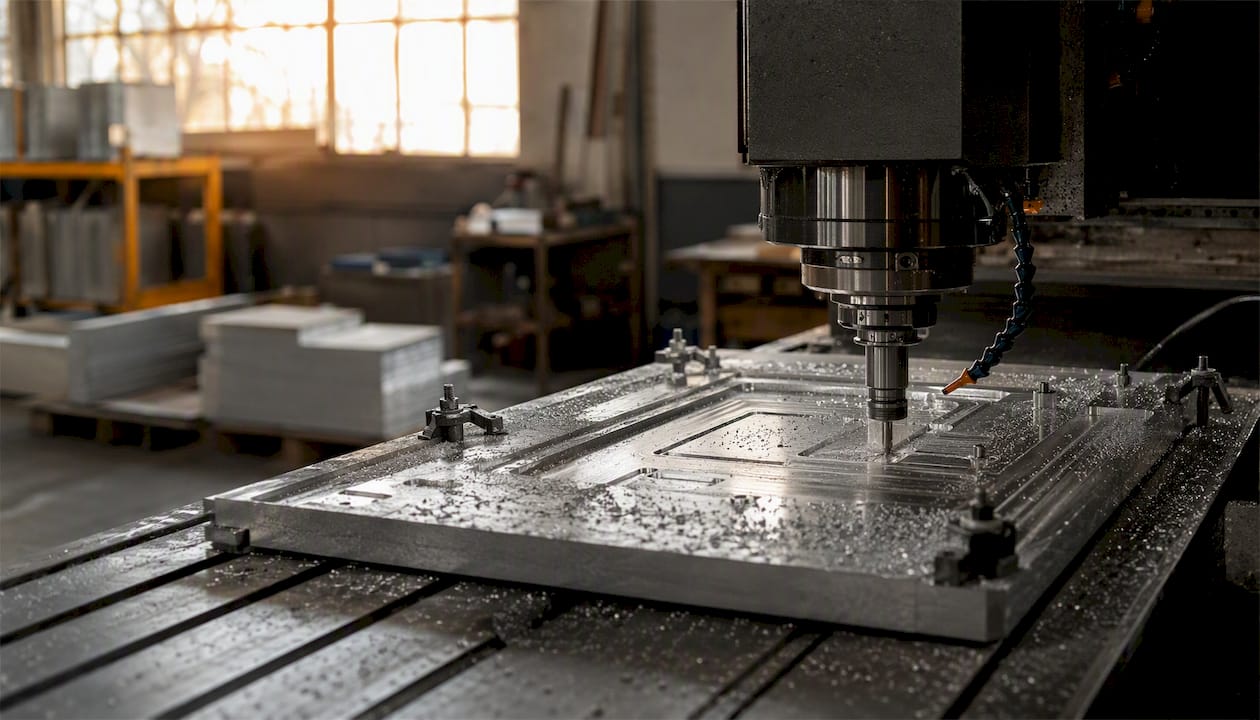
For engineering plastics, POM (Delrin) and nylon are the everyday choices: stable, machinable, and inexpensive. PEEK is the go-to for high-temperature or chemically aggressive environments, but it costs roughly 10–20 times more than POM per kilogram. Acrylics and polycarbonates machine well for optical or display applications. Composites (carbon fibre, G10/FR4) require diamond-coated tooling and dust extraction, which adds to setup cost.
Common secondary operations and finishes paired with small-batch CNC work include:
-
Anodising (Type II and Type III): standard for aluminium. Type III (hard anodise) adds wear resistance. Typical lead time from an Australian anodiser is 3–7 business days.
-
Powder coating: for steel and aluminium where colour and corrosion resistance matter more than dimensional precision on coated surfaces.
-
Passivation: for stainless steel parts in food, medical, or marine environments.
-
Heat treatment: stress relieving, case hardening, or through-hardening for steel parts. Adds 3–5 business days and affects final dimensions, so sequence it before final machining where possible.
-
Electroplating (nickel, chrome, zinc): for wear or corrosion protection. Adds dimensional build-up, so design with plating allowance.
-
Tumbling and vibratory finishing: for deburring and surface smoothing across a batch. Fast and inexpensive for small parts.
-
Sanding and polishing: for cosmetic surfaces or optical components.
Ask your supplier which alloy they stock in the blank size you need before locking in your material spec.*
Material selection should balance four things: machinability (cycle time and tooling cost), raw material cost, part function (strength, corrosion, temperature), and finish compatibility. Getting one of those wrong at the design stage is the most common source of avoidable cost in small-batch work.
What drives cost and lead time for small-batch CNC?
Setup cost is the dominant variable at low volumes, and it doesn’t scale with quantity the way cycle time does. A job that takes four hours to set up and 20 minutes per part costs roughly the same to set up whether you’re making 5 parts or 50. That’s why per-part cost drops sharply as quantity rises through the 10–100 range, then more gradually from 100 to 1,000.
The main cost drivers, in order of typical impact:
-
Setup and fixturing: programming, proving, and fixturing a new part. Often $200–$800 AUD per setup for a straightforward job.
-
Cycle time: spindle-on time per part, multiplied by the machine hourly rate. Rates for CNC milling in Australia typically run $80–$180 AUD per hour depending on machine class and region.
-
Material cost: especially significant for titanium, PEEK, and tool steels.
-
Tooling: standard tooling is usually included in the hourly rate, but specialty cutters for exotic materials or tight features may be quoted separately.
-
Inspection and reporting: CMM first-article reports add $150–$500 AUD per part number. Dimensional reports for every part in a batch add more.
-
Finishing and secondary ops: anodising, plating, and heat treatment each add cost and lead time.
-
Packing and freight: for small batches of precision parts, proper packaging matters. Budget $30–$150 AUD depending on part size and destination.
For lead times, low-volume CNC projects vary with geometry, material, and inspection scope. A simple 3-axis aluminium part in a batch of 20 might be ready in 5–10 business days. A complex 5-axis stainless part with CMM reporting and anodising could take 3–5 weeks end to end.
Automated online quoting platforms can return a manufacturing analysis and price within hours, which is useful for benchmarking and DFM feedback before you commit to a supplier.
When comparing quotes, request:
-
Estimated setup time and cycle time per part (or at least a confirmation that these were considered separately).
-
Whether tooling is included or quoted separately.
-
The inspection scope: what’s checked, how, and what documentation is provided.
-
Freight terms and packaging method.
-
Payment terms and whether staged deliveries (first article, then full batch) are available.
Structuring delivery in stages reduces financial risk. Ask for a first-article sample before the full batch runs. Most reputable Australian job shops will accommodate this, and a complete RFQ that includes material, quantity, tolerance notes, and finish requirements gives suppliers everything they need to price accurately and quickly.
How to prepare files and design for small-batch CNC
The single biggest source of quoting delays and rework in small-batch CNC is incomplete or ambiguous documentation. Suppliers can’t price what they can’t fully understand.
The DFM rules that save the most cost and time:
-
Avoid over-tolerancing. Apply tight tolerances only to features that genuinely need them. Every ±0.01 mm callout on a non-critical surface adds inspection time and slows the job. Design guidelines for small-batch CNC consistently flag over-tolerancing as a primary cost driver.
-
Design radiused internal corners. Sharp internal corners require EDM or very small-diameter end mills with slow feeds. A 1 mm radius on an internal pocket corner is far cheaper to machine than a 0.2 mm radius or a square corner.
-
Keep cavity depth proportionate. Deep, narrow pockets are slow to machine and prone to chatter. A depth-to-width ratio above 4:1 starts adding cost; above 6:1, consider redesigning the feature.
-
Design for standard stock sizes. Blanks cut from standard bar or plate sizes cost less and arrive faster than custom-sawn stock.
-
Consolidate setups. Every time a part needs to be re-fixtured, you add cost. Design features to be accessible from as few setups as possible.
-
Specify surface finish by Ra value, not by description. “Smooth” means nothing to a machinist. Ra 1.6 µm (a standard milled finish) or Ra 0.8 µm (a fine finish requiring additional passes) are unambiguous.
The file set to provide with every RFQ:
-
Native 3D CAD file (STEP or IGES as a minimum, native format preferred)
-
2D drawing with all critical dimensions, tolerances, datums, and surface finish callouts
-
Material specification (alloy grade, temper, and any relevant standard)
-
Finish requirements (type, colour, thickness where applicable)
-
Lot traceability requirements (batch numbers, material certs)
-
Expected annual demand and delivery schedule
Pro Tip: *If you have multiple part variants that share a common blank size, present them together and ask the supplier to nest them on a common fixture or plate.
A clear machining plan that includes blank size, tooling strategy, and fixture planning helps reduce setup time and improves quoting accuracy for both parties.
What does the supplier workflow look like for a small batch?
A well-run small-batch CNC job follows a predictable sequence. Knowing the milestones helps you manage lead time and avoid the most common cost surprises.
-
RFQ submission (Day 1): you supply the file set above. The supplier reviews geometry, material, and inspection requirements. Automated platforms can return a quote within hours; manual quoting typically takes 1–3 business days.
-
DFM review and quote acceptance (Days 1–3): the supplier flags any DFM issues (undercut features, unreachable tolerances, missing callouts). You resolve them and accept the quote. Payment terms are agreed here.
-
CAM programming and fixturing (Days 3–7): the supplier programs toolpaths, designs or sources fixtures, and orders material if not in stock. This is often the longest single step for a new part.
-
First-article machining and inspection (Days 7–12): one or a small number of parts are machined and fully inspected against the drawing. The first-article inspection report (FAIR) is sent to you for approval.
-
Client approval of first article (Days 12–14): you review the FAIR and either approve or request changes. This gate is critical. Don’t skip it to save a day.
-
Full batch production (Days 14–20+): the remaining parts are machined. In-process checks are run on critical features at defined intervals.
-
Final inspection, packing, and despatch (Days 20–25): final dimensional check, any secondary operations (finishing, plating), packing, and freight. Delivery to an Australian address typically adds 1–5 business days depending on origin.
This protects you from paying in full for a batch that has a design issue, and it gives the supplier confidence to commit material and programming time upfront.*
For repeat orders of the same part, steps 3 and 4 compress significantly. A supplier who has already programmed and fixtured your part can often move from order to despatch in 5–8 business days.
What quality checks should you ask for on small batches?
For small batches, insist on a first-article inspection report before the full run proceeds. This is non-negotiable for any part that goes into a safety-critical or customer-facing application.
The inspection options available from most capable Australian job shops and CNC service providers include:
-
CMM first-article report: a coordinate measuring machine report covering all critical dimensions on the drawing. The gold standard for complex parts. Expect to pay $150–$500 AUD per part number for this service.
-
Dimensional report (manual): callipers, micrometers, and gauges for simpler geometry. Faster and cheaper than CMM, appropriate for less complex parts.
-
Surface finish measurement: profilometer readings for Ra values where surface finish is a functional requirement.
-
Hardness testing: Rockwell or Vickers testing for heat-treated parts.
-
Material certificates (mill certs): traceability documentation from the material supplier confirming alloy grade, heat number, and mechanical properties. Standard practice for aerospace, defence, and medical applications.
-
In-process checks: documented checks at defined intervals during the batch run, not just at the end. Providers who run first-article verification and in-process checks deliver more consistent results across a batch than those who only inspect finished parts.
For industry-specific requirements: ISO 9001 certification is the baseline quality management system to look for in any supplier. Aerospace work may require AS9100 certification. Medical device components may require ISO 13485. Ask for the relevant certificate, not just a claim.
Pro Tip: Mark your critical dimensions on the drawing with a balloon or flag and explicitly request that the supplier’s CMM report covers those features by number. Suppliers who receive a drawing with clearly identified critical features produce more targeted, useful inspection reports than those working from a generic “inspect all” instruction.
How Anderson supports small-batch CNC in Australia
Anderson Group Australia supplies CNC machinery, servicing and spare parts. Confirm the exact machine configuration, installation arrangements and available support with the team.
Key product lines mapped to small-batch needs:
-
Genesis PLUS nesting CNC: discuss sheet and panel production requirements, materials, workholding, tooling and software with Anderson Australia. Confirm the exact configuration and validate material yield against the proposed jobs.
-
AXXIOM 5-axis series: assess the documented configuration for the intended plastics, aluminium or composite application. Confirm the material, spindle, tooling, workholding and accuracy requirements; do not generalise this into suitability for every metal part.
-
MASS-5 large-scale 5-axis machining centre: consider the documented non-ferrous-metal and composite applications, work envelope and machine configuration. Confirm the actual part, tooling and workholding requirements with Anderson Australia.
-
Focaseiki production machining centres: compare the exact machine configuration against the required material, part geometry and workload. Confirm pallet-changing and automation options separately; the linked DM page does not itself establish an APC configuration.
Discuss installation, training, parts and service with Anderson Australia and confirm the scope and response arrangements in the proposal.
Next steps with Anderson:
-
Discuss the available equipment evaluation options with Anderson Australia.
-
Bring your part drawings or a representative sample part to the demo.
-
Provide drawings, materials, tolerances and batch sizes for a machinery suitability discussion.
-
Assess finance and tax assumptions with your own adviser and confirm any supplier arrangements separately.
Browse Anderson’s machinery guides and factory setup resources to understand which machine class fits your production context before committing to a demo.
What the shift to small-batch CNC means for Australian manufacturers
Small-batch CNC demand is rising, and the reasons aren’t complicated. Supply chain disruptions over the past several years pushed manufacturers to shorten their order quantities and increase reorder frequency. That change in buying behaviour has made low-volume CNC capability more strategically valuable than it was a decade ago.
The accessibility of 5-axis machining is the development worth watching most closely. Five-axis machines that once required a large aerospace shop to justify are now available at price points and footprints that mid-size Australian manufacturers can absorb. The operational barrier, finding and retaining a skilled 5-axis programmer, remains real, but it’s shrinking as CAM software becomes more automated and supplier training programmes improve.
Model a representative part family using realistic demand, utilisation and operating costs, and test the case against lower volumes, downtime and cost changes. Additional jobs require their own capacity and margin assessment; they are not automatically profit.
Contact Anderson Australia to discuss machinery for your part mix and planned production. For subcontract cutting or machining, engage an appropriate independent service provider.
Anderson: the practical choice for in-house small-batch CNC
Anderson Group Australia supplies CNC machinery, servicing and spare parts. Confirm the exact machine configuration, installation arrangements and available support with the team.