

Start with the business.gov.au Grants and programs finder and the relevant government program pages. Select location, industry, assistance type and grant status. Check the current guidelines for each opportunity; a listing or historical award does not establish that applications are open or that your project qualifies.
-
Modern Manufacturing Initiative — a historical program; check the official page for the particular stream’s status.
-
Industry Growth Program — the official main program page says it is paused to new applications, as checked on 29 September 2026.
-
Advanced manufacturing commercialisation support — verify the current provider, opportunity, guidelines and application status before shortlisting.
-
Manufacturing Modernisation Fund (MMF) — co-funded capital grants for SMEs (historical rounds; check for new intakes)
-
Defence Industry Development Grants (DIDG) — four streams covering sovereign priorities, exports, skilling, and security
Use the official Queensland and Victorian program pages to check current opportunities. Older round announcements are background information, not evidence of an open intake.
Match the actual project and expenditure to the selected program’s objectives and eligibility rules before preparing an application. A machinery purchase can be outside scope even when it improves productivity.
Key takeaways
A useful application starts with a project that fits a currently available program, a documented budget and the evidence required by that program. Funding is subject to eligibility, assessment and the funding agreement.
| Point | Details |
|---|---|
| Filter and verify current status | The finder includes closed opportunities; check the current official program page. |
| Match the actual project | Eligibility depends on current guidelines, permitted activities and expenditure. |
| Plan the required contribution | Confirm funding sources, contribution rate and reimbursement timing. |
| Clarify uncertainty early | Program advice assists interpretation but does not guarantee acceptance. |
| Check advisory availability | As checked on 29 September 2026, IGP is paused to new applications. |
Table of Contents
-
What are the main federal manufacturing grants in Australia?
-
How do you write a competitive application and avoid common mistakes?
What are the main federal manufacturing grants in Australia?
The following examples cover different types of manufacturing support and include historical or paused programs. Recheck current application status and the exact opportunity guidelines before relying on any example.
Modern Manufacturing Initiative (MMI)
The Modern Manufacturing Initiative Manufacturing Integration Stream is closed to applications as checked on 29 September 2026. Its former funding limits and criteria are historical reference material. Do not assume another MMI stream is open or that past rules will apply to a future round.
Industry Growth Program (IGP)
The Industry Growth Program main page states that new applications are paused as checked on 29 September 2026. The program is designed for innovative commercialisation and growth projects in specified National Reconstruction Fund priority areas, not ordinary business-as-usual upgrades. Its published pathway includes an advisory report before eligible participants can seek grant funding; receiving advice does not guarantee a grant. Existing participants should confirm their position with the program.
Advanced Manufacturing Commercialisation Fund (AMGC)
Treat references to past advanced manufacturing commercialisation funds as research leads. Confirm the responsible provider, current opportunity name, application status and guidelines before assuming that a fund is available or suitable for a project.
Manufacturing Modernisation Fund (MMF)
Past Manufacturing Modernisation Fund rounds illustrate capital co-funding, but an old guideline or recipient announcement does not establish a current opportunity. Check the official grants finder and program page for an open round and its current conditions.
Defence Industry Development Grants (DIDG)
The Defence Industry Development Grants program page is being updated and lists different status and timing information for its streams. As checked on 29 September 2026, it specifically flags the Sovereign Industrial Priorities stream as temporarily closed and expects updated materials in November. Check the exact stream’s live instructions and confirm any ambiguity with the program contact before applying or committing expenditure.
Supply Chain Resilience Initiative (SCRI)
The SCRI funded projects to establish or scale manufacturing capability for critical products identified in the Sovereign Manufacturing Capability Plan. Grants were offered across a broad range to support projects that establish or scale manufacturing capabilities for critical products, with mandatory cash contributions and minimum eligible project expenditure thresholds. Past rounds are closed, but the program structure illustrates how sovereign-capability grants are assessed.
Federal program summary:
| Program example | Current research status | Funding information | Next check |
|---|---|---|---|
| MMI Integration Stream | Closed | Historical round amounts | Current official opportunity page |
| Industry Growth Program | Paused to new applications | Published streams have separate criteria | Program notice and participant eligibility |
| Advanced manufacturing commercialisation support | Verify current provider and opportunity | Do not assume a former fund is available | Current guidelines and application status |
| MMF | Historical rounds | Past amounts are reference only | Evidence of any new opportunity |
| DIDG | Stream-specific transition underway | Stream limits and conditions differ | Live stream notice and program contact |
| SCRI | Historical rounds | Past amounts are reference only | Current official opportunities |
What state manufacturing grant programs should you check?
Review state opportunities against the location of the project, eligible activities, application status and co-contribution rules. Do not assume state grants are faster or easier than federal opportunities.
-
Queensland: the Transforming Queensland Manufacturing Grants Program listing is closed to applications as checked on 29 September 2026. Check the official program page for any new round. Benchmarking services have their own conditions and should not be assumed to be included in a grant.
-
Victoria: the July 2024 Manufacturing Growth Program Round 2 announcement reports past awards. It does not establish an open intake in September 2026. Check Business Victoria for the current opportunity, contribution requirements and closing date.
-
For South Australia, Western Australia, Tasmania and other jurisdictions, use the current official business and grants portals. Department names, programs and funding rounds change; verify the responsible agency and current guidelines.
State grants almost always require that the funded activity occurs within the state. If your manufacturing footprint spans multiple states, you may be eligible for more than one program, but you will need to apportion project activities and expenditure accordingly. Plan your cash co-contribution mechanics early: many state programs specify what counts as a cash contribution and whether concessional loans qualify.
Contact the program officer to clarify the rules or an uncertainty before preparing the application. Informal advice does not replace the formal eligibility and assessment process.
How do you find currently open manufacturing grants?
The grants landscape changes constantly. Programs open and close, new rounds are announced, and eligibility criteria shift between intakes. A systematic search process beats relying on word-of-mouth or industry newsletters.
-
Use the Grants and programs finder and set the grant-status filter deliberately. It includes Open, Coming soon and Closed options. Then verify the actual program page and current guidelines.
-
Check each program page for open-to-applications status and minimum eligible spend. Many programs list a minimum project expenditure threshold. If your project spend falls below it, move on rather than trying to inflate your budget to qualify.
-
Consider official program alerts and departmental announcements, and recheck status before applying. Alerts do not guarantee that every relevant opening will reach you.
-
Contact the program officer directly. Program officers are there to help applicants understand eligibility. A brief call or email before you invest time in an application can confirm whether your project fits and clarify what counts as eligible expenditure.
Closed-round guidelines can help identify questions to research. Do not assume their eligibility, cost categories, contribution rules or assessment criteria will carry into a new round.
What are the typical eligibility rules and funding ranges?
Eligibility differs by opportunity. Check each of the following against the actual current guidelines rather than treating the list as a universal requirement:
-
Active Australian Business Number (ABN)
-
Registered for GST
-
Not a tax-exempt entity
-
Permitted entity types, including any rules for companies, trustees, partnerships, sole traders or joint applications.
-
Activities to be delivered in Australia
-
Required co-contribution, permitted funding sources and whether cash or in-kind contributions are accepted.
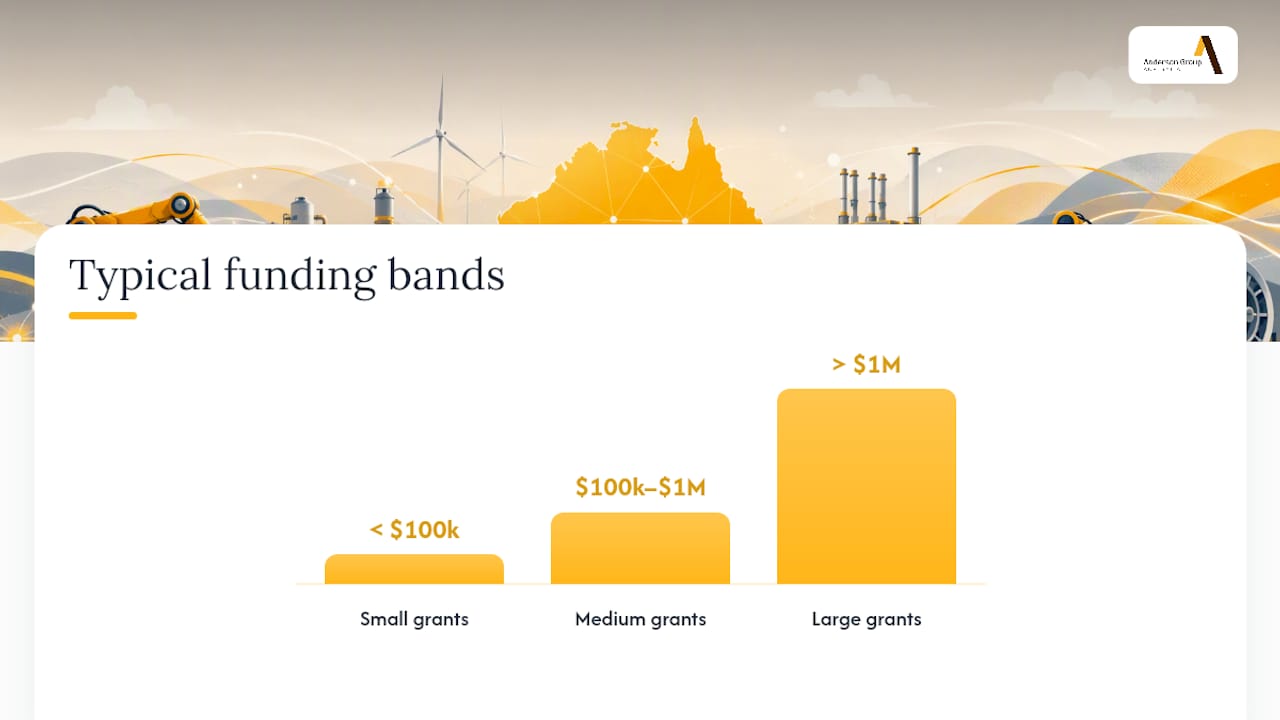
Use the published minimum and maximum grant amount for the chosen opportunity. The examples below are project categories to research, not currently available funding bands:
-
Advisory, skills and early commercialisation: verify the current program, eligible applicant and cost categories.
-
Equipment and productivity projects: confirm that the proposed machinery and project activities are eligible before budgeting for a contribution.
-
Larger commercialisation and scaling projects: assess the full program conditions, project stage, funding limits and available co-funding.
Calculate the business contribution from the actual program’s eligible-cost and grant-rate rules. A requirement to contribute $2 per $1 of grant means the grant covers one-third of that combined amount; it is not the reverse of a grant covering one-quarter. Confirm permitted contribution sources and timing.
One important distinction: many programs limit how other government grants can be used to meet your co-contribution. If you are stacking federal and state funding, check the rules on each program before assuming one can count toward the other’s matching requirement.
What does a typical grant application require?
Most manufacturing grant applications follow a similar structure. Understanding the components before you start saves time and reduces the risk of submitting an incomplete application.
Common application components:
-
Project plan covering objectives, activities, milestones, and expected outcomes
-
Detailed budget with line-item breakdown and co-contribution evidence
-
Cash-flow projections showing you can fund your share of the project
-
Board or executive sign-off confirming organisational support
-
Risk mitigation plan addressing key project risks
-
Evidence of capacity to deliver (staff, facilities, prior experience)
Use the specific assessment criteria and weightings in the current opportunity guidelines. Common topics to investigate include:
-
Alignment to program priorities and National Manufacturing Priorities where applicable
-
Capacity to deliver the project on time and within budget
-
Impact and value for money, including job creation, export potential, and commercialisation pathway
Check the actual published application and assessment process. A possible sequence is:
-
Program opens and guidelines published
-
Application window or batch closing date specified by the program.
-
Assessment period determined by the program; do not rely on a generic 8–16 week estimate.
-
Conditional approval letter issued
-
Grant agreement negotiated and executed
-
Project commences; milestone reporting begins
-
Payments made against verified milestones
Check the proposed funding agreement for payment timing, reporting, acquittal and audit requirements. Allow for these costs and for expenditure that may need to be funded before reimbursement.
How do you write a competitive application and avoid common mistakes?
The gap between a funded application and a rejected one usually comes down to specificity. Assessors read hundreds of applications; the ones that stand out connect every project activity to a measurable outcome that the program was designed to achieve.
Do this:
-
Map each project activity directly to the program’s stated objectives. If the program funds productivity improvements, quantify the productivity gain your project will deliver.
-
Show capacity to deliver with named staff, existing facilities, and relevant prior projects.
-
Provide realistic budgets with supplier quotes, not estimates. Assessors notice when numbers look rounded.
-
Demonstrate a clear commercialisation pathway, including target markets, customers, and revenue projections where relevant.
-
Align to National Manufacturing Priorities if the program requires it. Name the priority sector explicitly.
Avoid these:
-
Over-claiming eligible expenditure. If you are unsure whether a cost is eligible, ask the program officer before including it.
-
Relying on in-kind contributions where the program requires cash. This is one of the most common reasons applications fail at the eligibility stage.
-
Submitting incomplete documentation. A missing board resolution or an unsigned financial statement can disqualify an otherwise strong application.
-
Vague impact claims. “Improved productivity” without a baseline and a target figure tells assessors nothing.
Evidence of impact matters most in the assessment. Job creation numbers, export revenue projections, and a clear pathway from funded activity to commercial outcome all strengthen your case. If your project involves new capability that opens higher-value orders or new markets, say so explicitly and back it with data.
Review the application against the current assessment criteria. Confirm whether a program advisory service is available and within scope; new IGP applications are currently paused. Obtain a written scope and fee quote if engaging an independent grants adviser.
How do capital equipment purchases fit grant criteria?
A CNC purchase is eligible only where the selected program permits the equipment and associated activities. Check rules for order dates, deposits, project commencement, related parties and expenditure incurred before approval before making commitments.
Depending on the opportunity, equipment evidence may include:
-
Formal supplier quotes (not estimates) with itemised pricing and lead times
-
Depreciation schedules or asset life justification
-
Integration plans showing how the equipment connects to your production process
-
Evidence of productivity or quality improvements the equipment will deliver
-
Training and upskilling costs associated with the new equipment
The framing matters as much as the numbers. A CNC machine purchase is not just a capital expense; it is a capability investment. Present it that way. Show the assessor what the machine enables: higher-precision output, new product categories, reduced waste, faster throughput, or the ability to take on orders you currently cannot fulfil. If the equipment supports export readiness or allows you to move into higher-value manufacturing, make that case explicitly.
For example, a proposed CNC investment can be supported by drawings, a machine specification, an itemised quotation and evidence of the capability required for the project. Verify the precise machine configuration and achievable outcomes; an aerospace or automotive use case does not establish grant eligibility.

Anderson Australia supplies machinery for wood, metal and advanced materials. Request the exact model specification, quotation and available delivery/installation information for the proposed project; confirm any additional supplier documentation separately.
Ask the program which supplier documents are required, then request those documents and confirm the quoted scope. A supplier quotation does not itself establish eligible expenditure or a funding award.
Your one-week action plan to get an application started
Use the following sequence to organise the initial research. The time needed depends on program access, project readiness and document availability.
-
Day 1 — Search and shortlist. Use the Grants and programs finder with your state, Manufacturing as the industry, and your assistance type. Identify one or two programs that match your project type and confirm they are open.
-
Contact the program officer to clarify the rules and any uncertainty about expenditure or co-contribution. Formal eligibility remains subject to the program’s process.
-
Days 3–5 — Collect documents and quotes. Gather your ABN and GST registration details, financial statements, and any existing project plans. Request formal quotes from suppliers. If your project involves capital equipment, get itemised quotes with lead times and specifications.
-
Day 6 — Draft your budget and milestones. Build a line-item budget that separates eligible from ineligible expenditure. Map your project activities to milestones with realistic completion dates.
-
Day 7 — Draft your application outline. Write a one-page project summary covering what you are doing, why it aligns to the program’s objectives, what outcomes you will deliver, and how you will measure them. This becomes the backbone of your full application.
A few reminders before you submit: confirm the program is still open on the day you apply (status can change), budget for your matching contribution in cash, and do not submit until every required document is attached.
The practical approach that actually works
Most manufacturers approach grants backwards. They find a program, get excited about the dollar figure, and then try to fit their project into the eligibility criteria. That approach produces weak applications and a lot of wasted effort.
The smarter sequence is the reverse: start with your project, classify the expenditure into grant-recognised categories (capital equipment, commercialisation, advisory, training), and then search for programs where your project is a natural fit. The grants finder makes this straightforward when you use the assistance-type filters properly.
Establish how the business will meet any required contribution and fund the project through the payment schedule. Use the program’s rules for acceptable contribution sources rather than assuming every program requires the same cash arrangement.
Obtain the specification, quotation and other supplier evidence required for the actual opportunity. Ask Anderson Australia to confirm the documentation and installation information available for the selected machine; do not assume a grant-specific certification service is included.
For complex projects, consider suitable independent advice after confirming scope, fees and conflicts. Check program advisory availability first: the IGP main page currently states that new applications are paused.