
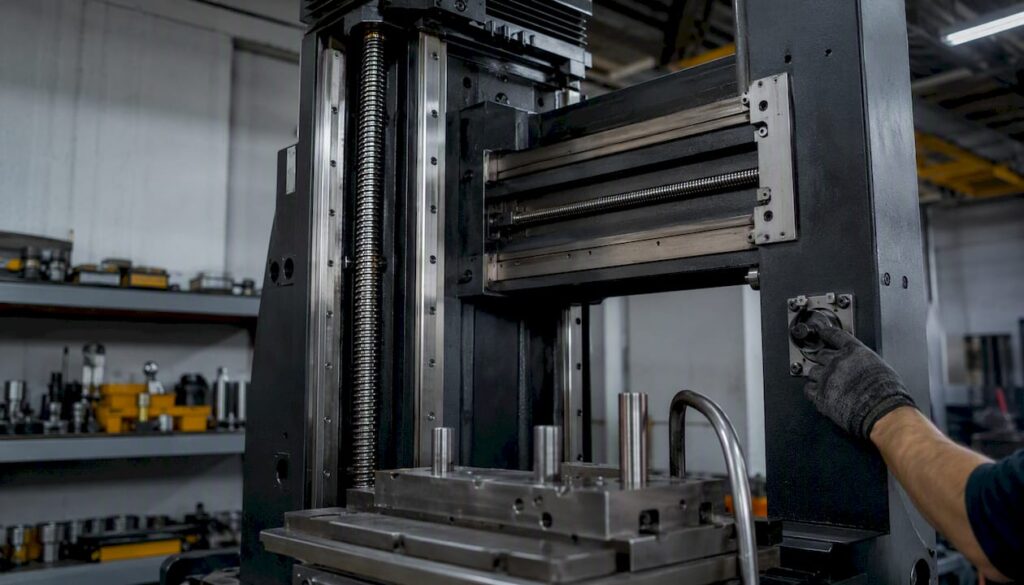
A double column machining centre (also called a bridge-type or gantry machining centre) is a large-format CNC machine where two vertical columns support a horizontal cross-beam, creating a rigid bridge structure that resists deflection under heavy cutting loads. For Australian manufacturers specifying this class of machine, Anderson Group Australia’s double column machining centre is the recommended locally available option.
Three reasons that verdict holds up:
-
Structural rigidity: the dual-column bridge design delivers measurably higher stiffness than single-column C-frame machines, which matters when you are taking deep cuts in steel, cast iron, or large aluminium billets.
-
Work envelope fit: Anderson’s double column models accommodate large-part work envelopes suited to rail, mining, heavy transport, and industrial machinery components.
-
Local support: confirm installation, parts and service arrangements for the proposed machine, including any agreed response commitments.
Key takeaways
Assess double-column machinery against the required work envelope, loads and accuracy. Confirm the exact configuration and installation requirements with Anderson Australia.
| Point | Details |
|---|---|
| Terminology is interchangeable | Gantry, bridge-type, and double column all describe the same dual-column bridge structure; treat them as one family when comparing quotes. |
| FAT data beats catalogue specs | Always request measured positioning repeatability from a witnessed factory acceptance test, not just ISO catalogue figures. |
| True installed cost is higher than machine price | Budget for transport, foundations, utilities, commissioning, and tooling, which can add significantly to the purchase price. |
| Local service reduces total cost of ownership | A vendor with Australian-based technicians and local spare parts holdings materially cuts downtime risk on a heavy-format machine. |
| Anderson for Australian buyers | Anderson’s Focaseiki double column range is available in Australia with local installation, commissioning, and aftersales support. |
Table of Contents
-
What are double column machining centres and how do they work?
-
Which Australian industries use double column machining centres?
-
Anderson Group Australia’s double column machining centre range
-
What procurement teams consistently get wrong about these machines
-
Anderson Group Australia’s double column machining centre support
What are double column machining centres and how do they work?
The defining feature is the bridge. Two columns rise from either side of the machine bed, connected at the top by a cross-beam. The spindle head travels along that beam on the X-axis, the beam itself moves on the Y-axis (or the table moves), and the ram or spindle descends on the Z-axis. That closed-loop structure is far stiffer than a cantilevered C-frame, which is why the form factor dominates heavy-part machining.
Gantry, bridge and double column machining centres are terms used interchangeably across vendor spec sheets. All three describe the same dual-column bridge philosophy. The practical difference is mostly marketing: a “gantry” machine often has a moving bridge over a fixed table, while a “double column” machine more commonly has a fixed bridge with a moving table, but the structural logic is identical. Treating them as the same family avoids mis-comparisons when you are reading competing quotations side by side.
Head and attachment options vary significantly between models:
-
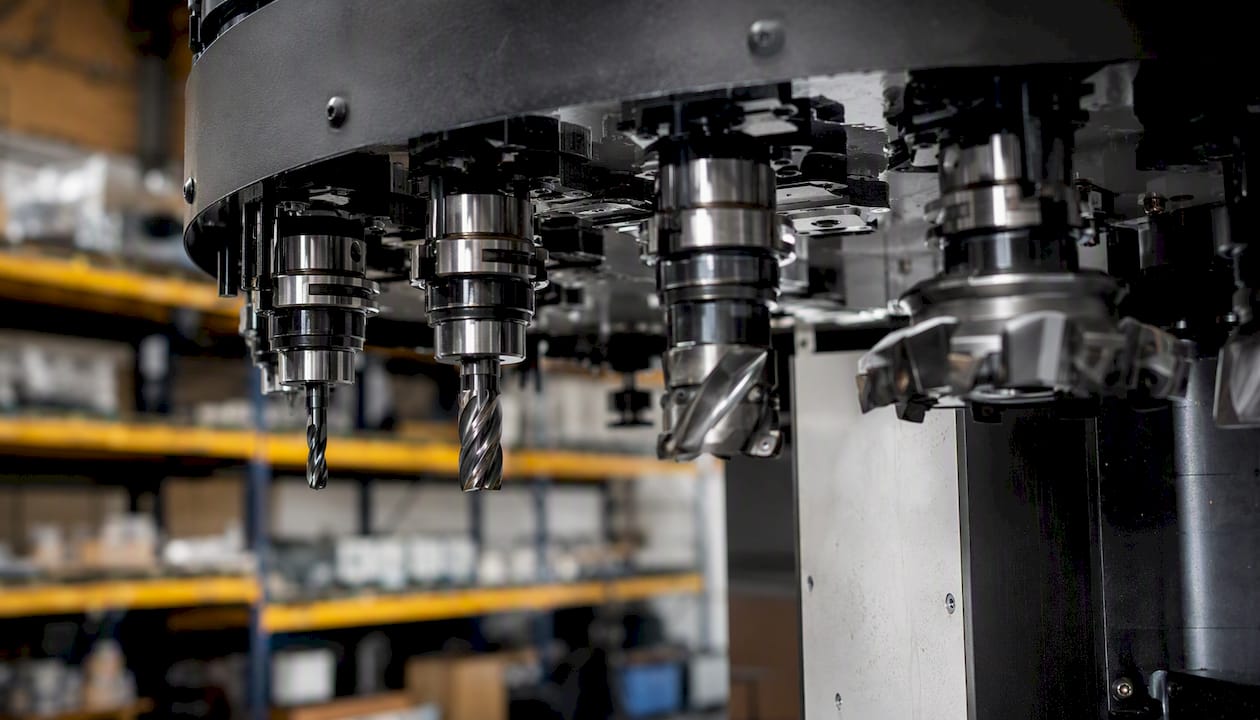
Ram spindle: a square or round ram that extends vertically, giving additional Z-reach for deep cavities or tall workpieces.
-
Universal head: a swivelling head that allows angular cuts without repositioning the part, useful for compound-angle features on large castings.
-
B/C-axis heads: full 5-axis capability, where the B-axis tilts and the C-axis rotates, enabling complex contouring in a single setup.
Pro Tip: When comparing spec sheets, check whether the quoted Z-travel includes or excludes ram extension. Some vendors quote spindle-nose-to-table distance at maximum ram extension, which inflates the apparent working height.
Key specifications engineers use to compare these machines
The comparison dimensions that matter in a procurement context are more specific than most vendor brochures suggest. Map every quote against this checklist before shortlisting.
| Specification | What to look for |
|---|---|
| Work envelope (X/Y/Z travel) | Match to your largest planned workpiece with fixturing clearance added |
| Table size and load capacity | Confirm static and dynamic load ratings, not just table dimensions |
| Spindle power and torque | AC spindle motor power (kW) at continuous and peak rating; torque at low RPM for heavy roughing |
| Spindle speed range | Low-end RPM for large-diameter tooling; high-end for finishing aluminium or composites |
| Guideway type | Boxways for heavy roughing rigidity; linear rails for higher speed and lighter cuts |
| Positional accuracy | Vendor-stated positioning accuracy and repeatability (µm); ask for measured FAT data, not catalogue figures |
| Thermal control | Spindle chiller, column temperature compensation, coolant-through-spindle |
| ATC capacity and speed | Number of tool pockets; chip-to-chip time; tool weight and diameter limits |
| Pallet changer (APC) | Single or dual pallet; pallet change time; compatibility with your fixturing system |
| Control system | Fanuc, Siemens, Mitsubishi or equivalent; G-code compatibility with your CAM software |
A procurement-focused comparison between double column and C-frame vertical machining centres highlights that FAT-measured repeatability data is the single most reliable differentiator between machines with similar catalogue specifications. Ask every vendor for their measured positioning repeatability under load, not just the ISO 230-2 catalogue figure.
Automation options that materially affect throughput include automatic tool changers (ATC) with multiple tool pockets, automatic pallet changers (APC) for unattended or lights-out operation, on-machine probing for in-process measurement, and chip conveyor and coolant management systems sized for the expected material removal rate. Anderson’s production machining centre range covers APC and ATC configurations worth reviewing alongside double column options when throughput is the primary driver.
Which Australian industries use double column machining centres?
The form factor earns its place when parts are too large, too heavy, or too complex for a standard vertical machining centre (VMC). The industries that reach that threshold most often in Australia include:
-
Rail and heavy transport: bogie frames, axle housings, and locomotive structural components regularly exceed VMC table capacity and require the rigidity to hold tolerance across long surfaces.
-
Mining equipment: pump bodies, crusher frames, and hydraulic manifolds in hard materials where deflection under cutting load directly affects bore alignment.
-
Hydraulics and fluid power: large valve bodies and hydraulic cylinder bores where positional accuracy across multiple features in a single setup is non-negotiable.
-
Industrial machinery and power generation: large gearbox housings, turbine casings, and generator frames where flatness and parallelism tolerances are tight.
-
Aerospace and defence: structural airframe components, large jig fixtures, and tooling plates where material removal rates are high and dimensional traceability is required.
-
Marine: propeller shaft housings, large engine block surfacing, and structural hull components.
Anderson serves these sectors directly, including automotive, aerospace, marine, and heavy engineering, which gives their application engineers practical context when specifying a machine for a particular duty cycle.
The crossover point where a double column machine becomes the preferred choice over a VMC or C-frame is roughly when your workpiece exceeds 1,200 mm in any horizontal dimension, weighs more than 2,000 kg, or requires sustained heavy roughing cuts that would deflect a cantilevered spindle. Below that threshold, a well-specified VMC is often faster and cheaper to run.
How to choose the right double column machining centre
A repeatable procurement process prevents the most common mistake: buying on work envelope alone and discovering the spindle power, accuracy, or service network does not match the actual duty.
-
Define the work envelope first. Measure your largest planned workpiece, add fixturing height and clearance, and set that as the minimum X/Y/Z travel requirement. Do not compress this step.
-
Specify material removal rate and spindle requirements. Heavy steel roughing needs high torque at low RPM; aluminium finishing needs high RPM with lower torque. A machine optimised for one is often a compromise on the other.
-
Choose head and attachment options. If your parts require angular features or 5-axis contouring, specify B/C-axis heads at the RFQ stage, not as an afterthought.
-
Decide on automation level. ATC is standard; APC is worth specifying if you run multiple setups or want unattended operation. Probe systems pay back quickly in reduced inspection time.
-
Set accuracy and thermal control requirements. For tolerances tighter than ±0.01 mm, ask specifically about spindle thermal compensation, column temperature management, and whether the machine has been tested to ISO 230-3.
-
Assess footprint and foundation needs. Double column machines typically require reinforced concrete foundations with specific load-per-square-metre ratings. Get the vendor’s foundation drawing before committing to a site.
-
Verify service and support. Ask for the vendor’s Australian service SLA, local spare parts holdings, and a list of installed machines in Australia you can reference.
Vendor questions worth asking directly: What is the current lead time from order to FAT? Can you provide measured repeatability data from a recent FAT on the same model? What is your local spare parts holding for this machine? Who is the field service engineer covering my state, and what is their response time commitment?
Red flags: vague accuracy claims without ISO standard references, no FAT offered or FAT conducted only at the factory with no customer witness option, motor and drive specifications listed as “equivalent” without naming the actual brand, and no named local service contact.
Installation, foundations, and total cost
The purchase price is typically a significant portion of the total installed cost for a machine in this class, with additional expenses for transport, foundations, utilities, commissioning, and tooling. Budget realistically across these cost buckets:
-
Machine price: varies by work envelope, spindle power, head options, and automation level.
-
Transport and rigging: heavy-format machines require specialised freight, port handling, and crane or forklift rigging at the site. Interstate or port-to-site logistics in Australia, add meaningful cost.
-
Foundation and civil works: reinforced concrete pads, anchor bolt installation, and floor levelling are typically required. The vendor’s foundation drawing specifies load ratings and isolation requirements.
-
Utilities upgrades: three-phase power supply sizing, compressed air, coolant drainage, and chip handling infrastructure.
-
Installation and commissioning: factory-trained technicians, geometric alignment, and control system configuration.
-
Fixturing and tooling: first-off tooling, workholding, and probing systems are often underbudgeted.
-
FAT and acceptance testing: travel costs for witness testing at the factory, plus on-site acceptance testing after installation.
A realistic procurement timeline from order placement to production-ready runs roughly: order confirmation → manufacture (typically 16–26 weeks depending on model and options) → factory acceptance test → international freight (4–8 weeks to Australia) → site installation and commissioning (2–4 weeks) → production sign-off. Plan for 6–9 months from order to first production cut as a conservative baseline.
What to expect from service and support in Australia
A double column machine running two shifts in a production environment generates significant downtime cost when it stops unexpectedly. The service network matters as much as the machine specification.
Verify these points with every vendor before signing:
-
Does the vendor hold critical spare parts (spindle cartridges, servo drives, ATC components) in Australia, or are they shipped from overseas on demand?
-
Are there trained field service engineers based in Australia, and which states do they cover?
-
What is the contractual response time for a breakdown call?
-
Does the machine support remote diagnostics, and can the vendor access the control system remotely for fault diagnosis?
-
What does the standard warranty cover, and for how long? Is on-site labour included?
Pro Tip: Ask the vendor for a spare parts criticality list at the time of purchase. Stocking the top 10–15 critical consumables and wear items locally can cut mean time to repair by days on a machine where freight from Asia takes 2–3 weeks.
Factory acceptance tests are the procurement team’s primary verification tool. A properly conducted FAT runs the machine through its full axis travel, measures positioning accuracy and repeatability to ISO 230-2, tests the ATC and APC cycles, and confirms the control software configuration. Witnessing the FAT in person, or receiving a full documented report with measured data, is the minimum standard. Accepting a machine on the vendor’s word alone is a risk that experienced procurement teams do not take.
Anderson Group Australia’s double column machining centre range
Anderson Group Australia supplies CNC machinery, servicing and spare parts. Confirm the exact machine configuration, installation arrangements and available support with the team.
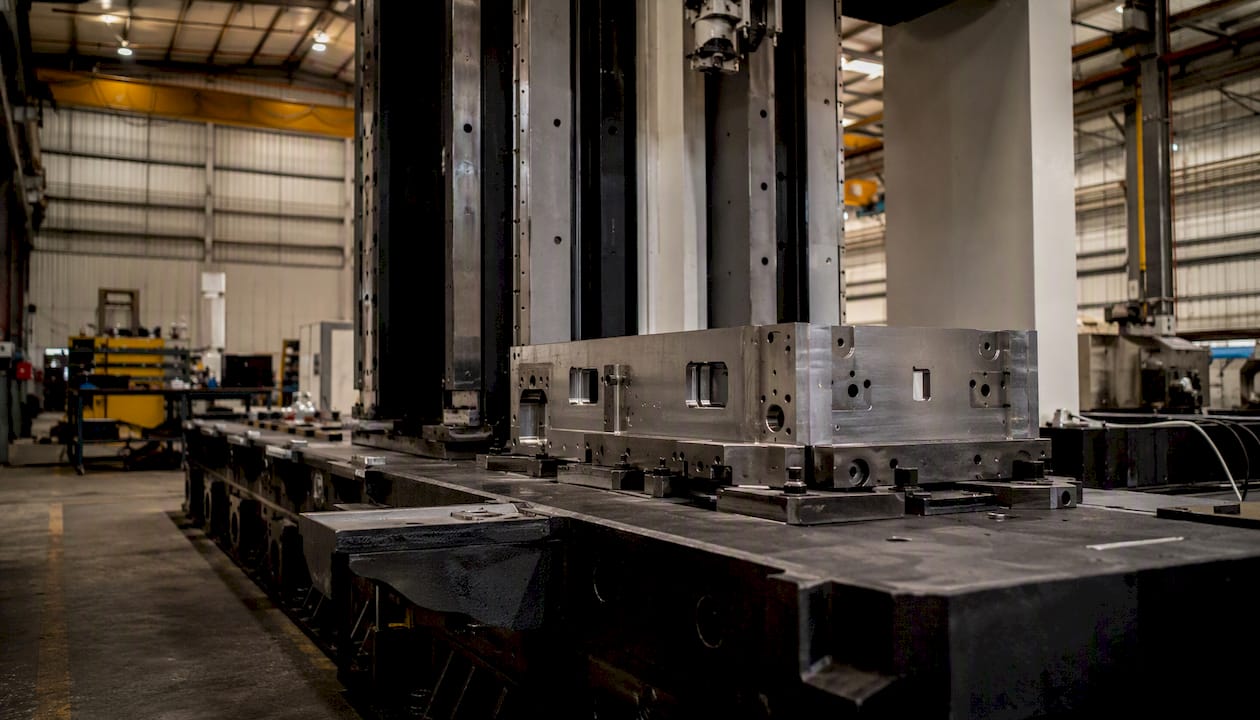
The Focaseiki double column machines are suited to manufacturers who need a large work envelope, sustained heavy-duty cutting capability, and a machine that can be configured with ram spindle, universal head, or B/C-axis attachments depending on the part complexity. Key fit-for-purpose indicators:
| Buyer profile | Recommended configuration |
|---|---|
| Large structural components, flat surfacing, heavy roughing | Ram spindle, boxway guideways, high-torque spindle motor |
| Mixed prismatic parts with angular features | Universal head or B/C-axis head, mid-range spindle power |
| Production runs with multiple setups | APC dual-pallet configuration, on-machine probing, large ATC |
| Tight tolerances on bores and surfaces | Thermal compensation, ISO 230-2 FAT documentation, linear scale feedback |
Anderson’s broader CNC machinery range includes the MASS-5 large-scale 5-axis machining centre and the MASS-B enclosed 5-axis machine, which are worth reviewing when the part geometry demands full 5-axis contouring rather than a 3+2 approach. The MASS-5 is particularly relevant for aerospace and automotive tooling applications where simultaneous 5-axis motion is required alongside a large work envelope.
Confirm which installation, warranty, parts and maintenance services are included or available, along with their conditions and response arrangements.
When should you buy a double column machining centre?
Compare a double-column machine with other suitable options using actual part size, processing requirements, handling and costs. Discuss the proposed configuration and available support with Anderson Australia.
Three concrete next steps for procurement teams:
-
Request a detailed specification matrix from Anderson covering work envelope, spindle options, guideway type, accuracy data, and automation configurations for the Focaseiki double column range.
-
Schedule a factory acceptance test as a contractual requirement before shipment, and arrange for a technical representative to witness it.
-
Arrange a site survey with Anderson’s installation team to confirm foundation requirements, utilities, and access constraints before committing to a delivery date.
Contact Anderson directly to discuss your part sizes, duty cycle, and accuracy requirements. The earlier the application engineering conversation happens, the better the machine specification will match your actual production needs.
What procurement teams consistently get wrong about these machines
The specification process for double column machines attracts a particular kind of overconfidence. Engineers who have successfully specified VMCs assume the same process scales up. It does not, and the gap shows up in three places.
First, accuracy claims. A catalogue figure of ±0.005 mm positioning accuracy means nothing without the test conditions: temperature, load, axis position, and measurement method. The only figure worth trusting is one measured during a witnessed FAT on the specific machine being purchased, under conditions that approximate your actual cutting environment. Vendors who resist this request are telling you something.
Second, service assumptions. When a spindle cartridge needs replacing and the nearest trained technician is in another country, the cost of lost production quickly exceeds the purchase price saving.
Third, automation scope. Procurement teams often specify the machine correctly but underspecify the automation. An ATC with a moderate number of pockets sounds adequate until the first complex part requires more tools. Specifying automation at the upper end of your anticipated need, rather than your current need, is almost always the right call on a machine with a 15–20 year service life.
Anderson Group Australia’s double column machining centre support
Anderson’s double column machining centres are available to Australian manufacturers with full local support across the entire lifecycle: initial specification, site survey, installation, commissioning, and ongoing maintenance.
Provide part dimensions, materials, loads and accuracy requirements when enquiring about a double-column machine. Confirm the proposed configuration, foundation and utilities information, installation responsibilities and any factory acceptance test in the quotation.
Contact Anderson Group Australia to request a specification review or arrange a site appraisal.
Sources
-
Gantry, bridge and double column machining centres explained
-
Understanding the difference: double column vs. C frame vertical machining centre
A note on using FAT documentation: during procurement, request the vendor’s standard FAT checklist before the machine is built. Reviewing it early lets you add application-specific tests, such as thermal drift measurements over a full shift or loaded axis reversal tests, that are difficult to add after manufacture is complete.