

An ATC CNC router pays for itself when your shop runs multi-tool jobs, processes batches of panels, or loses significant operator time to manual tool changes. If you’re changing tools multiple times per job and running those jobs daily, the automatic tool changer earns its keep fast. If you’re cutting single-profile parts at low volume, it probably doesn’t.
Three questions settle it quickly:
-
Average job complexity: Do your parts require drilling, routing, and profiling in one setup? Multi-operation nests are where automatic tool changers shine.
-
Daily tool-change frequency: Shops changing tools frequently throughout the day are burning operator hours that an ATC eliminates.
-
Labour and downtime cost: A single operator running lights-out or managing multiple machines can’t stop to swap collets manually. An ATC makes that model viable.
The practical rule: if your average job needs four or more tool changes and you’re running more than ten jobs a week, an ATC CNC router will almost certainly reduce your cost per part and free up your most expensive resource — your operator’s time.
The next step is a site survey and spec sheet review with a local supplier. Anderson Group Australia can assess your floor layout, power supply, and production profile before you commit to a machine.
Key takeaways
An ATC CNC router delivers measurable ROI for Australian manufacturers running multi-tool jobs at medium to high volume, provided the machine is properly commissioned and supported locally.
| Point | Details |
|---|---|
| Who should buy an ATC | Shops running four or more tool changes per job at ten or more jobs per week will see clear cycle-time and labour savings. |
| Main cost buckets | Budget for machine price, freight, GST, electrical upgrades, commissioning, tooling, and an ongoing service contract. |
| Lead time to production | Plan 16–26 weeks from order to first production cut, including factory lead time, shipping, and on-site commissioning. |
| Maintenance is the hidden variable | A documented PM schedule and local spare-parts stock are what separate reliable ATC operation from costly downtime. |
| Anderson as local supplier | Anderson provides on-site commissioning, Australian warranty, operator training, and spare parts support across woodworking, metalwork, and advanced materials. |
Further reading and sources
-
Anderson’s industry applications — sectors served including furniture, automotive, and aerospace
-
ATC Repair and Maintenance Services by Trescal — single-source repair, calibration, and cloud-based inventory for ATC equipment
-
Control Tower Maintenance Guide (2026) — ATC & Airfield Operations — Oxmaint — structured CMMS-driven maintenance and PM scheduling
-
Benchmarking of maintenance and service processes in air traffic control systems — ISO/IEC process-maturity frameworks applied to maintenance programme design
Table of Contents
-
What is an ATC CNC router and how does it differ from fixed-spindle machines?
-
When is an ATC CNC router worth the investment for your shop?
-
What does an ATC CNC router cost in Australia, and how long does it take?
-
What should you confirm with an Australian supplier before signing?
-
How do you plan maintenance and manage lifecycle costs for an ATC system?
-
What questions should you ask vendors, and what are the red flags?
-
How Anderson supports ATC CNC deployments for Australian manufacturers
-
What the data actually tells us about ATC investment decisions
-
Anderson Group Australia: your next step for ATC CNC procurement
What is an ATC CNC router and how does it differ from fixed-spindle machines?
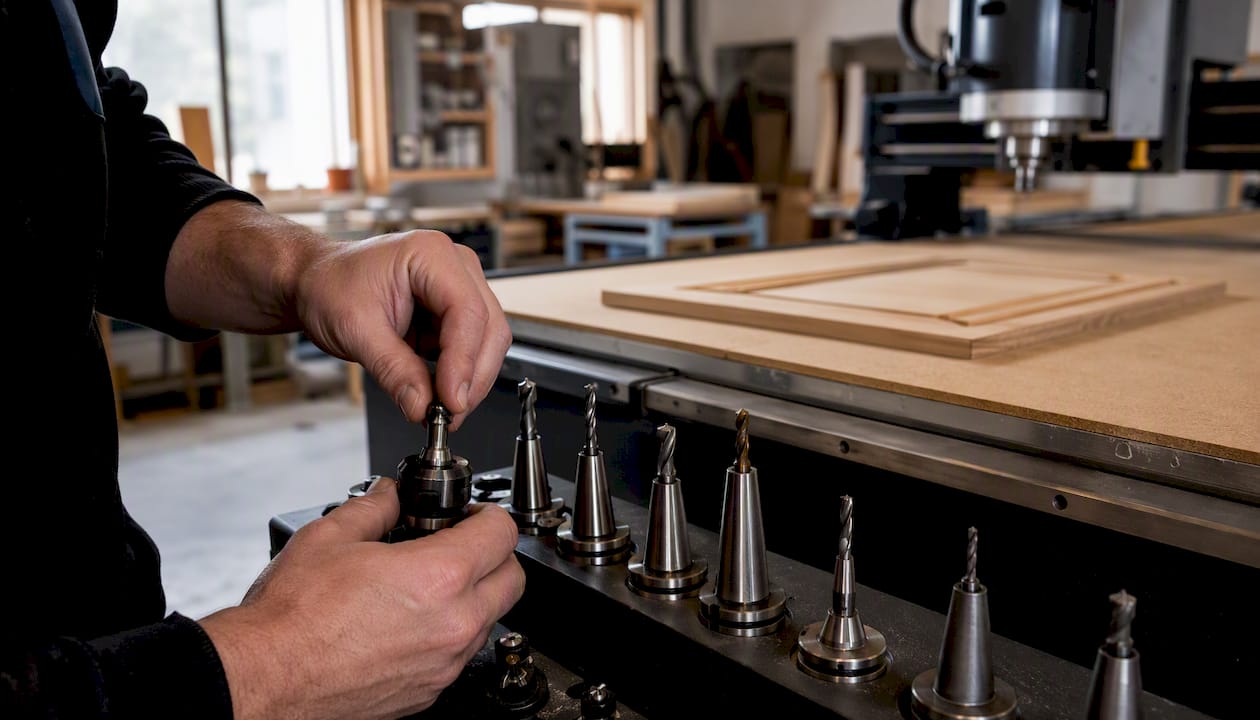
A standard CNC router holds one tool at a time. Changing to a different cutter means stopping the machine, manually releasing the collet, fitting the new tool, re-zeroing, and restarting. An ATC CNC router — where ATC stands for Automatic Tool Changer — eliminates that sequence entirely. The machine stores multiple tools in a magazine and swaps between them mid-program, without operator involvement.
The industry term you’ll see on spec sheets is “automatic tool change CNC” or simply ATC spindle. The three common magazine configurations are:
Carousel (disc) type: Tools are stored in a rotating disc mounted above or beside the spindle. The carousel indexes to the required tool position and the spindle picks up or drops off tools in a single motion. Typical capacity runs from 6 to 12 tools.
Linear (rack) type: Tools sit in a fixed row along one axis of the machine. The spindle travels to the rack, deposits the current tool, picks up the next, and returns to work. Linear changers commonly hold 8 to 24 tools and suit longer tool sets used in panel processing. A vendor example in this category pairs a high-power spindle with a multi-position linear tool changer, a vacuum table, automatic oiling, and integrated dust extraction — a bundle that’s become fairly standard for woodworking ATC machines.
Arm (fork) type: A mechanical arm grips the incoming tool while the spindle still holds the outgoing one, then performs a simultaneous swap. Change times are faster than carousel or linear types, which matters on high-cycle production lines.
Buyer note: the magazine type affects change time, footprint, and maintenance complexity. A linear rack is simpler to service; an arm changer is faster but has more moving parts to keep aligned.
Ancillary features vendors commonly bundle with ATC routers include vacuum tables (zone-controlled or full-bed), dust extraction ports, tool presetters, tool length probing, and nesting or CAD/CAM software licences. These add real value but also add to the quoted price — confirm what’s included before comparing machine prices.
When is an ATC CNC router worth the investment for your shop?
The honest answer is: not always. The ATC mechanism adds capital cost, mechanical complexity, and maintenance requirements. For the right production profile, those costs are often justified by the gains. For the wrong one, you’re paying for capability you’ll never use.
Scenarios where an automatic tool changer CNC delivers clear value:
-
Cabinet and joinery shops running nested panel production, where a single sheet requires drilling, routing, profiling, and edge detailing in one program
-
Sign-making and routing shops producing batches of mixed-profile parts that each need three or more cutters
-
Furniture manufacturers running repeat orders where cycle-time consistency directly affects throughput and delivery
-
Single-operator or lights-out shifts where stopping to change tools manually is simply not an option
-
Any shop where operator labour cost is significant and tool changes consume a notable portion of the shift
When an ATC is not the right call:
Low-volume hobby or desktop operations often don’t justify the cost. If you’re cutting one-off decorative pieces with a single V-bit, a manual-change router is faster to set up and far cheaper to buy and maintain. Similarly, production lines that run a single tool type continuously — foam cutting, for instance — gain little from a tool magazine.
The ROI case rests on three levers. First, cycle time: eliminating manual tool changes on a multi-tool job can save a significant amount of time per cycle, compounding across a full shift. Second, labour: one operator can supervise multiple ATC machines simultaneously in a way that’s impossible with manual-change equipment. Third, quality consistency: the ATC returns to a known tool-length offset every time, removing the human error that creeps into manual re-zeroing.
Cabinet making is the clearest use case in Australia. A nested panel job on a Genesis PLUS nesting CNC machine typically calls for a drilling head, a compression spiral, a profile cutter, and sometimes a V-groove tool — four changes per sheet, dozens of sheets per shift. Without an ATC, that’s a full-time job just managing the spindle.
What does an ATC CNC router cost in Australia, and how long does it take?
The machine price is only one line item. Australian buyers consistently find that the out-the-door cost runs meaningfully higher than the ex-works figure once all the site-readiness and commissioning costs are added.
| Cost component | Typical range / notes |
|---|---|
| Machine (ex-works or landed) | Varies by size, spindle power, and ATC type; confirm with supplier |
| International freight and customs | Significant for machines shipped from Europe or Asia; get a landed price |
| GST (10%) | Applied to the landed value; confirm with your accountant |
| On-site delivery and rigging | Crane or forklift access, floor loading confirmation required |
| Electrical upgrade (3-phase) | Many workshops need a switchboard upgrade; budget accordingly. |
| On-site commissioning and FAT | Should be included in the supplier’s scope; confirm in writing |
| Operator training | On-site training days; confirm number of days included |
| Vacuum table and dust extraction | Often quoted separately; confirm what’s bundled |
| Tooling (initial set) | Collets, tool holders, and cutting tools for your first jobs |
| Ongoing: spare parts and service contract | Annual cost; ask for a schedule at quote stage |
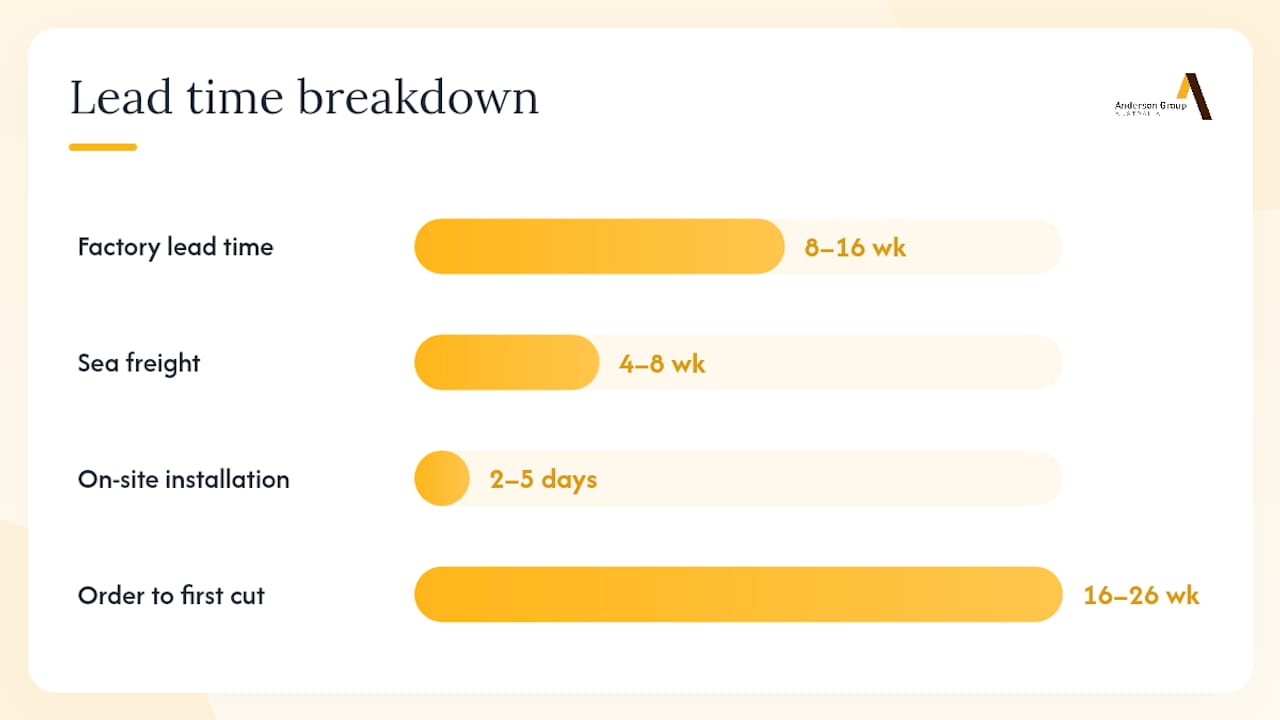
Lead times from order to production-ready vary. Factory lead time for a configured machine typically runs 8–16 weeks depending on the manufacturer and specification. Shipping to Australia adds 4–8 weeks for sea freight from Europe or Asia. On-site installation and commissioning generally takes 2–5 days for a standard gantry router. From order to first production cut, plan for 16–26 weeks as a realistic window.
Pro Tip: Ask your supplier for a landed, commissioned price in Australian dollars inclusive of GST. A low ex-works price can look very different once freight, electrical work, and commissioning are added.
What specs should you compare on ATC router spec sheets?
Vendor spec sheets vary in what they foreground, but the fields below are the ones that actually determine whether a machine suits your work. Use this as your apples-to-apples checklist.
Working area and table:
-
X × Y × Z travel (confirm usable vs. nominal)
-
Table type: vacuum (zone-controlled or full-bed), slat, or sacrificial board
-
Maximum workpiece weight and clamping method
Spindle:
-
Power rating (kW) and duty cycle (S1 continuous vs. S6 intermittent)
-
Spindle taper: ER32, ER40, ISO30, HSK-F63 — this determines which tool holders you can use
-
Maximum RPM and speed range
ATC mechanism:
-
Magazine type (carousel, linear, arm) and tool capacity
-
Tool change time (spindle-to-spindle seconds)
-
Tool retention method and clamping force
-
Tool presetter availability and automatic tool length measurement
Motion system:
-
Drive type: servo motors (preferred for production) vs. stepper
-
Linear rail and ball-screw grade
-
Axis repeatability (typically ±0.01–0.03 mm on quality machines) and positional accuracy
-
Maximum rapid traverse and cutting feedrates
Control and software:
-
Controller brand (Siemens, Fanuc, Syntec, HSD, or proprietary)
-
CAD/CAM or nesting software compatibility and any bundled licence
-
Remote diagnostics capability
-
PLC and automation I/O for downstream integration
Pro Tip: Repeatability matters more than positional accuracy for production work. A machine that returns to the same position within ±0.02 mm every time is more useful than one claiming ±0.01 mm accuracy that drifts over a shift.
What should you confirm with an Australian supplier before signing?
Specs on a data sheet tell you what the machine can do in ideal conditions. The supplier’s service model tells you what happens when it doesn’t.
Commissioning and FAT: On-site commissioning should be written into the contract scope, not treated as an optional extra. Factory acceptance testing (FAT) — where the machine runs your actual parts or representative test cuts before or at delivery — is the only reliable way to verify that the accuracy and repeatability specs are real. Ask for documented test results, not just a verbal assurance.
Warranty and local support: Confirm the warranty period, what it covers (parts, labour, travel), and what it excludes. For Australian buyers, the critical question is response time. A machine under warranty is still costing you money if the nearest technician is overseas and the lead time for a replacement sensor is six weeks.
Ask this directly: “If my ATC magazine jams on a Monday morning, what is your guaranteed on-site response time, and do you carry the relevant spare parts in Australia?”
Training: Operator training should cover machine operation, tool-change sequences, basic maintenance checks, and controller programming. Maintenance training — covering ATC mechanism inspection, lubrication schedules, and sensor checks — is equally important and often overlooked at purchase.
Service contracts: A planned maintenance contract locks in scheduled visits, priority response, and often discounted parts. For production shops where downtime costs thousands of dollars per day, a service contract is rarely the expensive option.
Local spare parts availability is a decisive factor for Australian buyers. Long lead times on critical ATC components — a magazine drive motor, a tool retention piston, a proximity sensor — can turn a minor fault into a week-long shutdown.
How do you plan maintenance and manage lifecycle costs for an ATC system?
The ATC mechanism is the most maintenance-intensive part of a CNC router. It has more moving parts, tighter tolerances, and more sensors than the rest of the machine combined. Treating it as “set and forget” is how shops end up with unplanned downtime.
Routine maintenance tasks:
-
Daily: Clean the tool magazine pockets and tool tapers; check for chips or coolant contamination in the spindle taper; verify tool retention by feel or indicator
-
Weekly: Inspect magazine indexing accuracy; check proximity sensor function; lubricate magazine drive mechanism per manufacturer schedule; review tool length offsets for drift
-
Monthly: Full ATC calibration check; inspect collets and tool holders for wear or runout; check pneumatic pressure and air quality at the ATC valve block; review spindle bearing temperature trends
-
Annually: Full ATC mechanism disassembly inspection; replace worn collets; spindle runout measurement; controller backup and software update; review and update the maintenance log
A structured, CMMS-driven maintenance schedule converts routine checks into scheduled work orders with audit-ready records, reducing unplanned downtime far more effectively than reactive repairs. Academic benchmarking applying ISO/IEC process-maturity frameworks to maintenance programmes confirms that defined KPIs and logistics support are what separate reliable maintenance from ad-hoc fixes.
Common ATC failure modes and corrective actions:
| Failure mode | Likely cause | Corrective action |
|---|---|---|
| Tool drops during cutting | Worn collet or low clamping pressure | Replace collet; check pneumatic pressure |
| Magazine fails to index | Sensor fault or drive motor issue | Clean sensor; check drive coupling |
| Tool change cycle aborts | Air pressure drop or PLC fault | Check compressor; review PLC error log |
| Spindle taper contamination | Chip ingress from inadequate dust extraction | Improve extraction; add taper cleaning cycle |
| Tool length offset error | Presetter drift or probe fault | Recalibrate presetter; replace probe tip |
For repairs beyond scheduled maintenance, Trescal’s ATC repair and calibration services offer single-source restoration including cloud-based inventory management, legacy equipment repair, and component replacement — useful when OEM parts are scarce or lead times are long.
Lifecycle cost drivers to budget for: spare collets and tool holders (replace every 6–12 months in production use), periodic ATC calibration (annually or after any collision), labour for planned maintenance checks, and a service contract if in-house capability is limited.
What questions should you ask vendors, and what are the red flags?
A vendor who can’t answer these questions clearly is telling you something important.
-
Site requirements: What are the exact 3-phase power requirements (kVA, voltage, phase)? What compressed air pressure and flow rate does the ATC require? What is the floor loading specification?
-
ATC reliability: What is the mean time between failures for the magazine mechanism on this model? What is the most common failure mode, and what does it cost to fix?
-
Spare parts: Which ATC components do you stock in Australia? What is the lead time for parts you don’t stock locally? Can I see a recommended spare-parts list?
-
Service response: What is your on-site response time for a production-stopping fault? Is that response time written into the service contract?
-
Commissioning scope: Is on-site commissioning included in the quoted price? Does it include running my actual parts, or only a standard test program?
-
References: Can you provide contact details for two or three Australian customers running this machine in a similar application?
Red flags to watch for:
-
Vague or missing accuracy and repeatability specs (a reputable vendor publishes these)
-
No local service capability — only remote support or overseas technicians
-
Commissioning quoted as a separate, optional extra
-
No FAT or demo option before delivery
-
Warranty that excludes ATC mechanism wear or “consumable” components without defining what qualifies
-
Quotes that don’t itemise delivery, installation, and commissioning separately
Validate claims by requesting demo parts cut on the actual machine you’re buying, witnessing a factory test, and asking for a written spare-parts list with current Australian pricing.
How Anderson supports ATC CNC deployments for Australian manufacturers
Anderson Group Australia supplies CNC machinery, servicing and spare parts. Confirm the exact machine configuration, installation arrangements and available support with the team.
For woodworking and panel production, the Genesis PLUS nesting CNC machine is built around the nested panel workflow — vacuum table, ATC spindle, and nesting software integration. The EXXACT PRO 4-axis CNC router suits routing and profiling applications where 4-axis capability extends what a standard 3-axis ATC machine can produce. For manufacturers moving beyond panel work into precision metalwork or complex 3D parts, Anderson’s STRATOS CNC Machining Centre and vertical machining centres have different material, workholding and machine configurations. Check the exact STRATOS model for its documented wood, plastics, composites or non-ferrous application, and review Focaseiki machining centres separately for the required metal work.
Confirm the warranty, commissioning, training and spare-parts arrangements offered for the exact machine. Include the agreed scope in the proposal.
Plan commissioning, operator training and tool-change maintenance against the machine instructions. These are important operating arrangements, but they do not guarantee a period without downtime.
To arrange a site survey, request a spec sheet, or discuss which machine family suits your production profile, contact Anderson directly through Andersonaustralia.
What the data actually tells us about ATC investment decisions
The conventional wisdom in the CNC market is that ATC routers are for large shops with big budgets. That framing is outdated. The real threshold is operational: how many tool changes per shift, and what does each one cost in operator time and cycle interruption?
A cabinet shop running ten nested panel jobs a day, each requiring four tool changes, is executing forty manual interventions per shift without an ATC. At even five minutes per change — conservative for a proper collet swap and re-zero — that’s over three hours of productive time lost daily. The ATC doesn’t just save time; it removes the cognitive load of tracking which tool is loaded, which offset is active, and whether the last operator remembered to re-zero after the change.
What gets underestimated is the quality argument. Manual tool changes introduce variability. Every time an operator fits a tool by hand, there’s a small but real chance of a seating error, a contaminated taper, or an incorrect offset. Over a production run, those errors accumulate into rejects and rework. An ATC returns to a known, measured tool position every single time.
The maintenance concern is legitimate — ATC mechanisms do require more attention than a fixed spindle. But a documented maintenance schedule, a small stock of critical spare parts, and a supplier with local service capability reduce that risk to manageable. The shops that avoid ATC because of maintenance concerns often end up spending more on rework and operator overtime than they would have spent on a service contract.
Anderson Group Australia: your next step for ATC CNC procurement
Provide your materials, drawings, workload and site requirements when discussing an ATC CNC router with Anderson Australia. Confirm the configuration and evaluation options available for the proposed equipment.
Request a proposal that identifies the machine configuration, price basis, installation scope and indicative schedule. Confirm any finance or leasing arrangements separately rather than assuming they are offered by the machinery supplier.
Visit Anderson’s woodwork CNC machinery page to review machine families, or contact Anderson directly to request a site survey, arrange a factory demo, or get a tailored quote for your application.