
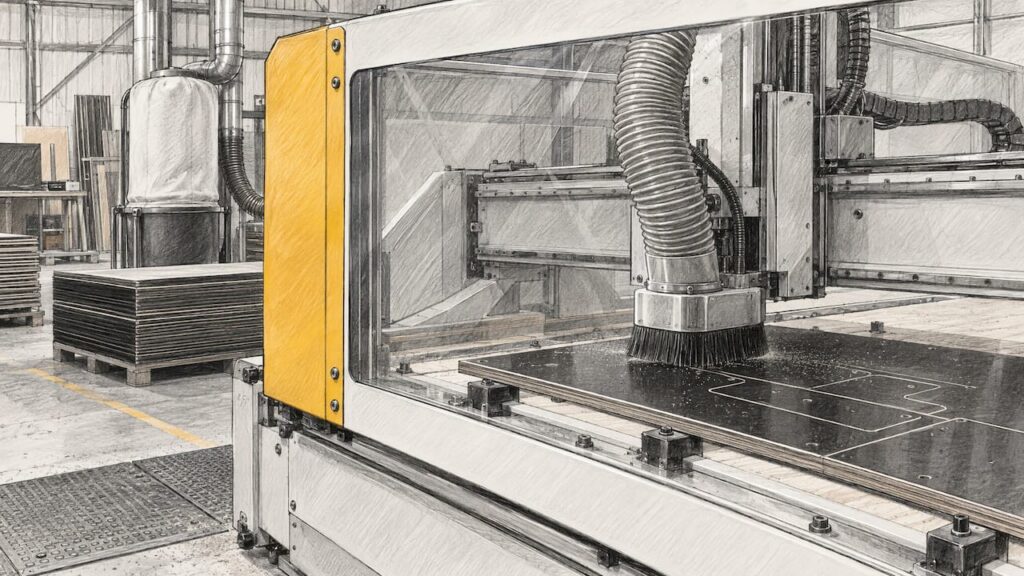
Phenolic sheet machines well on a rigid CNC router when you use sharp carbide tooling, support the sheet with a sacrificial backing board, keep heat low and capture dust at the source. The material is abrasive on tools and hard on spindles and guides, so the machine matters as much as the bit. This guide covers the tooling, the cutting strategy, the dust and fume controls that apply in Australia, and the machine features to settle before you buy.
It is written for cabinet makers, joinery shops, furniture makers and manufacturers who already run a CNC router or nesting machine and are adding phenolic work: benchtops, jig plates, panels, spacers and insulating parts.
TL;DR
- Phenolic is a thermoset laminate of paper or cotton layers and resin. It machines dry, but dust and heat need managing.
- Use sharp solid carbide tooling for production. Compression or upcut spiral bits suit routing, and diamond tooling suits glass-based grades.
- Clamp a sacrificial backing board under every through-cut and slow the feed as the tool exits, to stop bottom-ply delamination.
- Treat the dust as a workplace health hazard: extract at source and wear respirators rated to AS/NZS 1716.
- Confirm extraction, hold-down and spindle options on the exact machine model before you order.
Table of Contents
- What phenolic is and why it behaves differently from timber
- Which operations suit a CNC router
- Cutting tools for phenolic
- Cutting strategy that prevents chipping and delamination
- Dust, fumes and workplace health in Australia
- Choosing a machine for phenolic work
- Phenolic applications to plan for
- Talk to us about your phenolic application
- FAQ
- Sources
What phenolic is and why it behaves differently from timber
Phenolic laminate is made by coating layers of paper or fabric with phenolic resin, then heating and pressing them. It is a thermoset plastic, so once it is formed it does not soften and reflow the way thermoplastics do. You will also hear it called Bakelite, Micarta or Texolite, and all grades weigh roughly half as much as aluminium.
Two grades matter most on a woodworking shop floor:
- Paper phenolic (XX and similar): the common sheet for insulating parts, jigs and panels.
- Cotton phenolic (CE and similar): tougher and more fibrous, used for gears, bushings and mechanical parts.
Glass-based grades such as G10/FR4 are harder on tooling again. If you are unsure of the grade, get it from your sheet supplier before you choose a cutter.
For a cabinet or joinery shop, the practical differences from MDF or plywood are these:
- The material is much denser, so cutting forces on the tool and spindle are higher.
- Fibres fray and leave a fuzzy burr on the cut edge.
- Routing throws long, stringy chips that need somewhere to go.
- Heat builds quickly in the cut, and heat is what damages both the part and the tool.
If you have already worked through other engineered materials, our guides on machining plywood on a CNC and on PVC heat control on CNC routers cover related ground. Phenolic sits between them: denser than ply and more abrasive than PVC.
Which operations suit a CNC router
Phenolic sheet can be cut, milled, drilled and chamfered. Routing, drilling and milling are the effective methods for sheet work, provided the parameters and tooling suit the material. Typical router jobs include jig plates, panel cutouts and custom profiles. Machining is normally done dry.
Match the operation to the machine type, because they are different jobs:
| Job | Typical approach | Machine type |
|---|---|---|
| Profiling full sheets into parts | Nested routing with compression or upcut spiral bit | Nesting router |
| Cutouts, pockets and shallow detail | Routing with finishing pass | Nesting or flatbed router |
| Through-holes in thick sheet | Drilling with backing board, reduced exit feed | Router with drilling spindle |
| Tight-tolerance bores and metal-like parts | Milling or grinding | Machining centre |
Parts that need very fine bore tolerances or very smooth surfaces move beyond routing. One technical guide says that for surface finishes below 16 Ra or bores tighter than ±0.001 inch, grinding is the appropriate finishing method. Most cabinet, joinery and panel work never gets near that level.
Cutting tools for phenolic
Carbide for production, HSS only for short runs
High speed steel can be used for small runs and non-glass products, but tungsten carbide is preferable for extensive machining. For glass-based composites, diamond-tipped tools give longer life and a better finish. Another guide notes that carbide-tipped tools are more economical when production quantity, speed or finish matter, and that tools must be extremely sharp.
For dense phenolic benchtop materials, polycrystalline diamond (PCD) router bits are an option. A trade report says PCD can outlast carbide by 50 to 150 times on phenolic materials, depending on density and strategy. It also says spindle speed should be reduced to about 12,000 or 14,000 RPM, depending on tool diameter, to avoid heat generation. That is a reminder that the right speed depends on the tool and the material, not on a single number.
Bit geometry
For routing sheet, a published starting point is a two- or three-flute solid carbide upcut spiral end mill. For a 12.7 mm (1/2 inch) tool it suggests 18,000 to 24,000 RPM and a feed of 150 to 250 inches per minute (about 3.8 to 6.4 m/min). Because phenolic produces long, stringy chips, the flutes need adequate chip clearance.
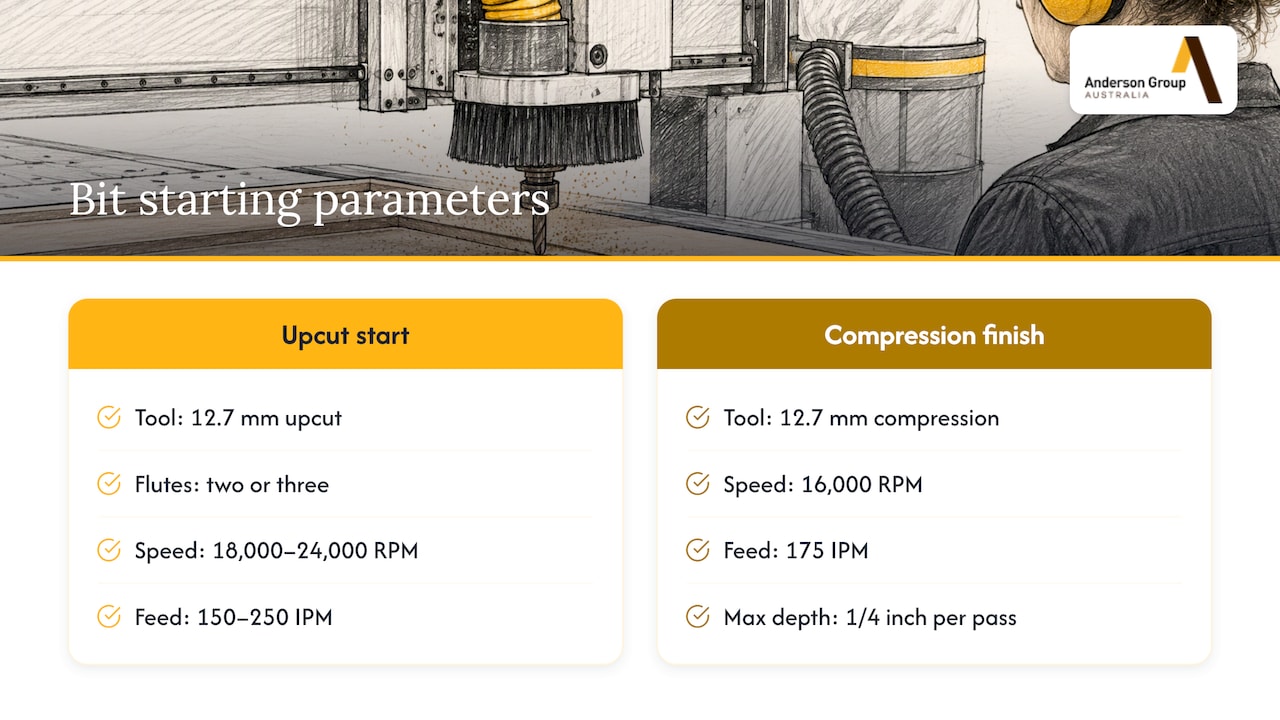
For a cleaner top surface, a compression bit helps. If the top face shows fuzz, the first thing to check is a worn bit, and a compression router with climb milling is the suggested fix. One manufacturer’s finishing recipe for thick solid-surface-style phenolic sheet uses a 12.7 mm compression bit at 175 IPM and 16,000 RPM, with a maximum depth of 1/4 inch (about 6 mm) per pass.
Treat published speeds as starting points
The numbers above come from the people who publish them, for their own sheet grades and machines. Your spindle power, bit diameter, sheet density and vacuum or clamping setup change the right answer. Run a test cut on offcut sheet of the same grade, check the edge and the bit temperature, then adjust. That is general guidance, not a machine specification.
Cutting strategy that prevents chipping and delamination
Most phenolic defects come from the same few causes: dull tools, too much heat, and unsupported exit faces.
Backing board for every through-cut
When a drill or router bit exits the bottom of a sheet, it pulls on the last ply. Without support, the bottom ply delaminates before the tip clears, leaving a frayed exit. The fix is a sacrificial backing board and a 50% feed reduction over the last 20% of hole depth. The same source recommends thermoset scrap about 3.2 mm (0.125 inch) thick or medium-density fibreboard, not metal.
In a woodworking shop this is familiar territory: it is the same logic as a spoilboard on a nesting table. It does mean your spoilboard surface, and the way your table holds thin or small parts, becomes part of the process.
Edges: climb milling, shallow passes, onion skin
For delamination along a routed edge, the guidance is to climb mill, reduce depth of cut and use multiple passes. For thick sheet, rough cut first, leaving a thin skin (an “onion skin”) of material, vacuum the dust from each pass, then take a finishing pass. Leave the rough cut slightly oversize so the finishing bit does the work that determines edge quality.
Heat and coolant
Phenolic is machined dry. Air cooling is preferable, because liquid coolants are difficult to remove from finished parts. The same source advises keeping work temperature under 150°C, as higher temperatures may distort the material. Dry grinding is a special case: it concentrates heat at the surface and can cause micro-cracks that only show in service.
Dust extraction on a wood-panel router is a separate matter from liquid coolant, and the two should not be confused when you specify a machine. If a job calls for high-pressure or through-spindle coolant, that is a metal-machining requirement and needs exact-model confirmation.
Burr removal
Fabric-based phenolic frays and leaves a fuzzy burr that can be tricky to remove. Hand sanding handles small runs. Sharp tools and correct climb or compression strategies reduce the burr at the source, which saves more time than cleaning it afterwards.
Dust, fumes and workplace health in Australia
This is the part of phenolic machining that deserves the most care. Machining generates fine dust, and heat can release fumes. Phenolic resin is made with phenol and formaldehyde, and formaldehyde is a regulated airborne contaminant.
Exposure standards. Cancer Council Australia lists the current Australian formaldehyde exposure standard as 1 ppm (1.2 mg/m³) over 8 hours and 2 ppm (2.5 mg/m³) over 15 minutes. It also notes that WHS Regulation 50 requires air monitoring where there is a possible risk to health or a potential to exceed the limit. Under the model WHS Regulations, a business must ensure workers are not exposed above the workplace exposure standards.
What changes on 1 December 2026. The terminology moves from “workplace exposure standards” to “workplace exposure limits”. Safe Work Australia has said that the formaldehyde level stays the same as the current standard and that there will be no change to the limits for the nine chemicals under review from that date. Adoption into each state and territory’s WHS laws is still what makes the list enforceable, so check your own regulator.
Respiratory protection. Cancer Council Australia advises P1 or P2 replaceable filters or disposable half-face respirators for machining wood products, notes that FFP3 is advisable at high dust levels, and says an organic vapour filter protects against formaldehyde vapours. Respirators should comply with AS/NZS 1715 and 1716. An Australian laminate SDS gives the same class P1 or P2 guidance for machining and notes that fine airborne laminate dust can ignite, so dust build-up should be avoided, work areas ventilated and ignition sources in electrical equipment, including extraction, kept away.
Extraction at source. A UK machining guide states that all dust-generating operations are potentially hazardous without precautions, and calls for extraction at source and/or personal protection. Your safety data sheet for the specific sheet, and your state WHS regulator, set the obligations for your site. If you are unsure whether your shop’s air quality complies, speak to a qualified occupational hygienist.
Choosing a machine for phenolic work
The material tells you what the machine needs. Use this as a checklist, then confirm each item against the exact model.
- Rigid frame and a spindle with a suitable speed range. Dense material loads the spindle more than timber does, and speed often needs to come down for heat control. A published guide for commercial phenolic sheet suggests 3 to 5 kW and 18,000 to 24,000 RPM for sheet from 2 to 50 mm. Treat that as a reference range, not a requirement for any particular machine.
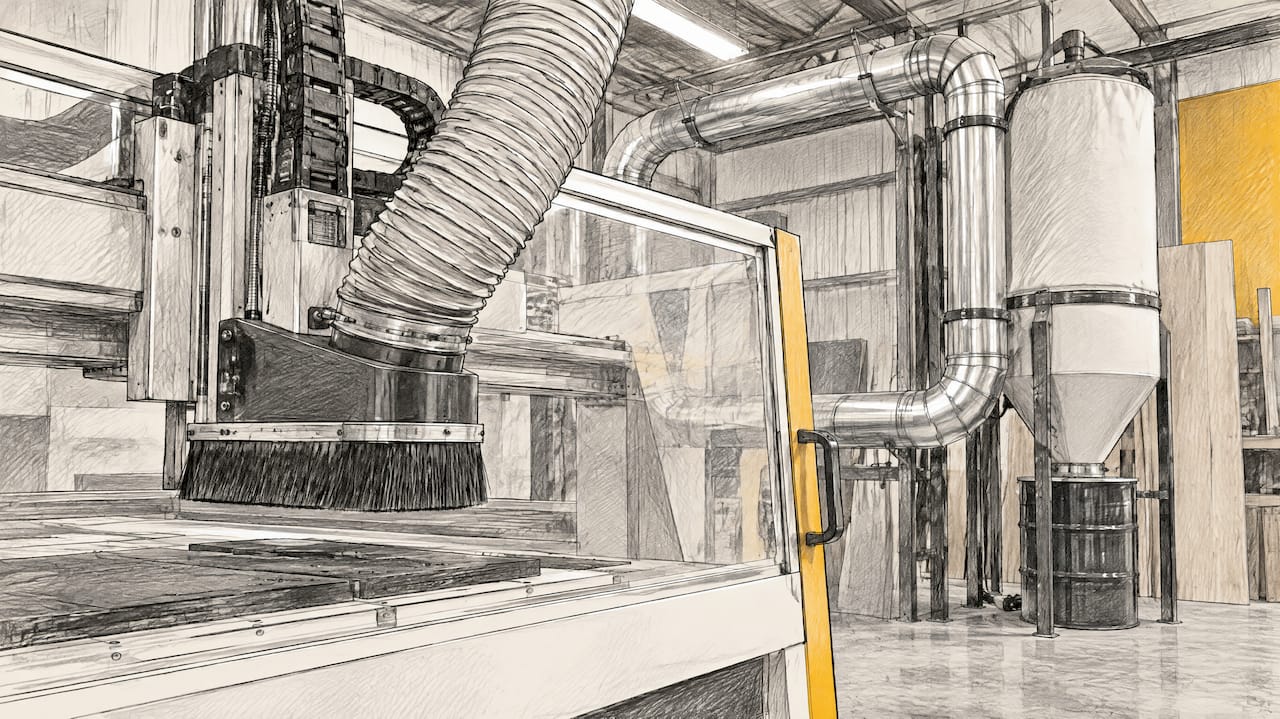
- Dust extraction designed in. The same guide notes that fine phenolic dust builds up in spindle bearings and linear guides, which speeds wear. Ask how the machine captures dust at the tool and from the table, and what extraction capacity you will need to connect.
- Reliable hold-down. Sheet must be held flat and supported, with a spoilboard or backing material for through-cuts. Confirm that your table and vacuum zones suit small phenolic parts.
- Tool change and drilling capability. If the job mixes routing and many holes, check how drilling is handled on that model.
- Controller and feed control. Slowing the feed at hole exit and at corners is much easier with a controller that handles it automatically.
We do not infer features from a family name or axis count. Pallet changing, probing, rotary accessories, extraction capacity and coolant options vary by exact model and configuration, so each one should be confirmed in writing for the machine you are considering.
Where phenolic fits in a woodworking shop
For kitchen, cabinet, joinery and furniture manufacturers, phenolic is usually a secondary material on a nesting or panel-processing machine, alongside melamine, MDF and ply. If your main work is nested panel cutting, the productivity points in our guides on CNC panel processing and nesting productivity apply to phenolic sheet too, with the tooling and extraction changes above. Other plastics and composites have their own quirks: see polycarbonate, UHMW and carbon fibre.
Parts that need milling-level precision in glass-based phenolic or in mixed metal and composite work belong on a machining centre instead of a router. Those are a different product range from woodworking nesting machines.
Phenolic applications to plan for
Phenolic sheet and rod are used for terminal boards, insulators, washers, spacers, cams, bushings, gears and many other machined parts, with sheet commonly from 1/32 to 2 inches (about 0.8 to 50 mm) thick and 36 to 48 inches wide. A shop can use the material in three ways:
- Jigs and fixtures: routing and drilling templates, nesting jig plates and clamp blocks for your own production.
- Panels and benchtop components: profiles and cutouts in dense decorative or structural sheet.
- Mechanical and insulating parts: gears, spacers and insulators, usually in cotton or paper grades.
High-volume production should be planned around carbide. One guide says HSS is acceptable for paper and cotton phenolic in low quantities because those fibres are not very abrasive, and that uncoated carbide is the standard recommendation for production, with an insert lasting about 200 to 400 parts at moderate parameters for non-glass grades. Its router starting points are 20,000 to 26,000 RPM and 100 to 180 IPM for paper phenolic, and 18,000 to 24,000 RPM and 80 to 150 IPM for cotton phenolic, both dry with local exhaust ventilation. These are one publisher’s figures for its materials, so validate them on your own machine.
Talk to us about your phenolic application
Anderson Group Australia supplies CNC machinery, servicing and parts to Australian manufacturers, with most of our customers in kitchen, cabinet, joinery and furniture manufacturing. We also supply machinery for plastics and composites. We help you choose a machine for your own production; we do not offer subcontract cutting or machining.
If phenolic is a regular material in your workflow, start with our advanced materials machinery range. For nesting and panel work with wood-based sheet, see our wood machinery. Tell us the sheet grade, thickness, part sizes and monthly volume, and we will help match your application to a machine and confirm the specifications on the product page.

To discuss your application or request a quote, start from the Anderson Group Australia site.
FAQ
Can you CNC machine phenolic sheet?
Yes. Phenolic can be routed, milled, drilled and chamfered on a CNC, and it is normally cut dry. Use sharp carbide or diamond tooling, a backing board for through-cuts and effective dust extraction.
What cutting tools work best on phenolic?
Solid carbide two- or three-flute spiral bits suit production routing, and compression bits improve the top surface. For glass-based grades, diamond-tipped tools last longer. HSS suits only short runs of paper or cotton grades.
How do you stop phenolic delaminating when drilling?
Clamp a sacrificial backing board under the sheet and cut the feed by half over the last fifth of the hole depth. A worn drill makes it worse, so replace tools before they dull.
Is phenolic dust dangerous?
Treat it as hazardous. Phenolic resin involves formaldehyde, which has an Australian workplace exposure standard, and machining dust should be captured at source. Wear a respirator meeting AS/NZS 1715 and 1716, and check your SDS and state WHS regulator for your obligations.
Sources
- Phenolic Thermoset Composite Laminates
- Phenolics (High Pressure Laminate)
- Phenolic Machining: A Comprehensive Guide
- Machining Cotton Phenolic: Speeds, Feeds and Tooling
- Machining Thermoset Sheet
- Machining Phenolic Laminates
- Cutting and Machining Guide
- Phenolic countertops
- Cutting and machining paper and fabric phenolic
- Phenolic Machining Services
- CNC Machining (Richlite)
- Wood products, Cancer Council Australia
- Safe Work Australia Quarterly Newsletter, May 2024
- Decision Regulation Impact Statement: workplace exposure limits for 9 chemicals
- Thermolaminated Products SDS
- Phenolic Sheet and Rod
- CNC router selection for phenolic laminate sheet cutting