
Choose EVA if your edgebander runs intermittently, your work is standard dry-area cabinetry and you want the simplest machine to look after. Choose PUR if the machine runs most days, your work goes into kitchens, bathrooms, laundries or commercial fit-outs, and you want a thinner, tougher glue line. The glue is only half the decision: a PUR edge bander is built differently from an EVA one, and the way you run your shop decides which suits you.
This guide compares the two glue systems on the points a kitchen, cabinet or joinery manufacturer cares about, then explains what each means for the machine you buy. Where something belongs to a specific Anderson model, we say so. Where we haven’t documented it, we ask you to confirm the configuration with us.
TL;DR
- EVA: a thermoplastic hot melt that re-melts when heated. It can sit in the glue pot between jobs, costs less to run and suits standard interior work.
- PUR: a reactive adhesive that cures with moisture into a permanent bond. It gives better heat and moisture resistance and a finer glue line, but needs a PUR-capable machine and a steady production rhythm.
- Machine fit: PUR needs a sealed, moisture-protected glue system. Don’t assume a model takes PUR from its name; confirm the exact configuration before you order.
- Handling: PUR needs ventilation, correct storage and disciplined cleaning. Read the adhesive’s safety data sheet (SDS) before it goes near the machine.
Table of Contents
- How EVA and PUR actually differ
- Side-by-side comparison
- Where PUR earns its place
- Where EVA is still the sensible pick
- What changes on the machine
- Running PUR: storage, cleaning and idle time
- Safety when heating PUR
- A simple way to decide
- What to check at a demonstration
- Talk to us about your edgebander
- FAQ
- Sources
How EVA and PUR actually differ
EVA (ethylene vinyl acetate) is a thermoplastic. It melts, goes onto the edge, cools and holds. Because the process is physical, heating it again softens it again. Australian commercial joinery maker Krost describes EVA as applied at roughly 170°C to 200°C, with service limits around 80°C where the bond can re-soften.
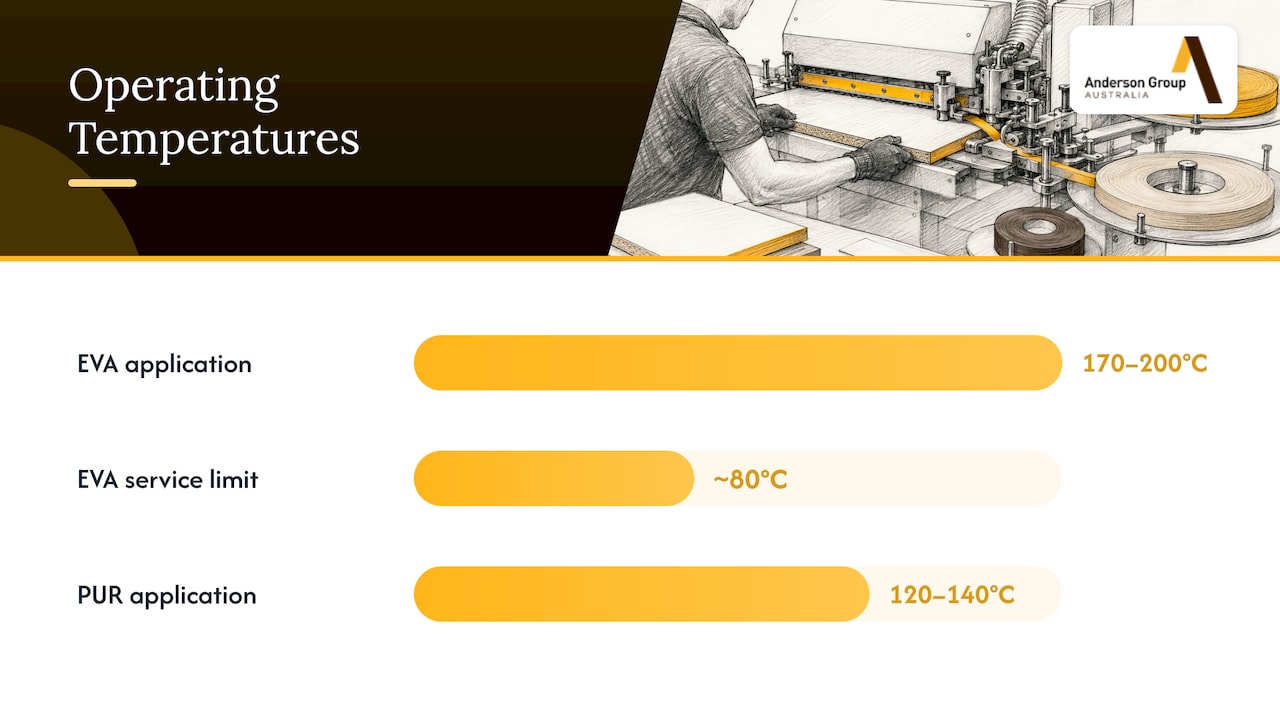
PUR (polyurethane reactive) is applied at a lower temperature, around 120°C to 140°C according to the same source, then reacts with ambient moisture over two to five days. It cross-links into a thermoset that does not go back to liquid. That is why a cured PUR joint tolerates heat and steam that would let an EVA joint creep.
The practical consequence is less about chemistry and more about behaviour in the machine:
- EVA can be reheated repeatedly. Joiners magazine notes it can stay in the glue unit for weeks between jobs.
- PUR starts curing when exposed to air, so the pot, the applicator and the schedule all have to respect that.
Side-by-side comparison
Figures below come from the cited sources. Adhesive formulations vary, so treat them as typical ranges and read the data sheet for the adhesive you actually buy.
| Factor | EVA | PUR |
|---|---|---|
| Bond type | Thermoplastic, re-melts under heat | Reactive, cross-links permanently |
| Heat resistance | Rated medium-low in the CATAS Edge Bonding Handbook | Rated high in the same handbook |
| Water resistance | Rated low (CATAS) | Rated high (CATAS) |
| Cold resistance | High (CATAS) | High (CATAS) |
| Application temperature | About 170°C to 200°C (Krost) | About 120°C to 140°C (Krost) |
| Glue use | Higher | Roughly one-third the volume of EVA (Krost) |
| Glue line | Visible, can collect dust and darken | Very fine, close to seamless |
| Between jobs | Can sit in the pot | Needs a plan for weekends and idle periods |
| Machine | Standard edge bander | PUR-capable, sealed glue system |
| Adhesive cost | Lower | Higher |
Joiners magazine reports that a PUR bond can be up to six times stronger than EVA, with a thinner glue line and waterproof qualities. Strength claims like that depend on the product, so use them to understand direction, not to promise a result to a client.
Where PUR earns its place
PUR makes the most sense where the joint is under stress or on show.
Wet and hot areas. Sink cabinets, vanities, laundries and commercial kitchens put edges near steam, splashes and cleaning chemicals. Woodshop News notes the industry has been moving from EVA towards PUR for sink cabinets, bathroom furniture and lab or clinic work, and that cured PUR will not re-melt.
Visible joints. A fine glue line is the main reason cabinetmakers raise PUR with us. EVA’s thicker line can collect dust and darken over time. If glue lines are your concern, our guide on preventing visible glue lines on cabinet edges covers the machine and setup factors that sit alongside the choice of adhesive.
Long service life. Once micro-gaps open on an edge, moisture can reach the core and cause swelling. Krost makes this point about commercial environments, where a joint is cleaned hard and used daily.
High-volume running. Joiners magazine observes that PUR suits larger workshops where the edgebander runs most days for long periods, because the glue is used up before it can harden in the unit.
Where EVA is still the sensible pick
EVA remains the practical choice for many shops, and there is nothing second-rate about it when it matches the work.
- Intermittent use. If the edgebander is used a few days a week or in bursts, EVA tolerates the stop-start rhythm. It can be reheated again and again.
- Dry-area, standard cabinetry. Bedroom storage, office joinery and flat-pack components rarely see the heat or moisture that tests an EVA bond.
- Lower running cost. Adhesive costs less per kilogram and the machine is simpler.
- Mixed small jobs. Frequent changes of edge material and colour are easier when the glue is not racing a cure.
Because EVA’s service limit sits well below PUR’s, it is worth asking where the finished piece will live. A wall cabinet in a bedroom and a cabinet beside an oven are different briefs.
What changes on the machine
This is the part that is often skipped in glue comparisons. A PUR edge banding machine is not an EVA machine with different glue in the pot. It needs a sealed, moisture-protected glue system, and you should confirm that with the supplier model by model.
Our edgebander range is the AFS series. To keep models distinct: AFS models are edgebanders, ATS is a nesting, routing and drilling machine, ADM is six-sided drilling and routing, and ARS is a panel-return system. Within the edgebanders:
- AFS 243 compact edgebander is the compact option for smaller footprints.
- AFS 559-40 narrow panel edgebander is the model to look at for narrow panel work.
- AFS 568 PRO servo edgebander is the larger servo model, covered in our features and comparison guide.
Which of these is offered with an EVA or a PUR glue system is a configuration question. We don’t infer it from the family name, and neither should you. Check the model’s product page and ask us to confirm the glue system, pre-milling, corner rounding, tape magazine and other options on the exact machine quoted.
Pre-milling, corner rounding and the rest
Glue choice interacts with the other stations. Pre-milling gives the adhesive a fresh, square panel edge to bond to. KLEIBERIT, an adhesive manufacturer, notes that reactive PUR hot melts have slightly lower initial tack than EVA and recommends edges that fit perfectly and maximum roller pressure. In practice, a clean, accurately prepared edge matters more with PUR. Whether a particular machine has pre-milling or corner rounding is something to confirm on its specification, not assume.
For a wider view of machine types, sizes and features, see our guide to choosing an edgebander for Australian cabinet shops.
Running PUR: storage, cleaning and idle time
PUR rewards discipline. These points come from adhesive makers and trade sources; follow your adhesive’s own data sheet and machine manual where they differ.
- Keep it sealed until use. Woodshop News says PUR has a shelf life of about a year and begins to cure on exposure to air, so it should stay in its sealed packaging until needed.
- Plan for idle time. Joiners magazine warns PUR cannot be left in the unit over a weekend without risking hardening and possible replacement of the gluing station. KLEIBERIT’s cartridge-system documentation says its PUR 707.9 ME can stay in the melting tank overnight without cleaning, so the answer depends on the product and system. Check both.
- Clean with the right solvent and purge media. Woodshop News notes squeeze-out needs solvent rather than a damp cloth, and that PUR can set hard if equipment is not purged properly.
- Mind the board. Krost points out that PUR draws part of its cure moisture from the substrate, so a very dry board slows the reaction. Board moisture content is a real production variable.
- Regular glue pot cleaning. One Master-Profil work instruction calls for removing the glue pot and roller applicator at end of shift and cleaning pots at least monthly with its specified cleaner. That is one manufacturer’s procedure, not a universal rule.
For routine care on any edgebander, our edgebander maintenance checklist runs from shift checks to quarterly tasks. We don’t publish a fixed service interval or inclusions for specific models here; ask us to confirm the agreed scope for your machine.
Safety when heating PUR
Polyurethane hot melts contain isocyanates, and heating adhesive releases vapours. The Australian Spray Painting and Powder Coating Code of Practice states that isocyanates are commonly found in adhesives and polyurethane plastics, that heated isocyanate-containing materials may release isocyanates, that exposure should be treated as high risk, and that labels and SDS should be checked. That code is written for spray painting, but the hazard information applies to the chemical wherever it is used.
KLEIBERIT’s data sheet adds that hot melts release vapours even at the stated working temperature, and that running above the recommended temperature for a long period can create harmful decomposition products. It recommends a suitable ventilation system.
In practice:
- Get the SDS for the exact PUR adhesive and follow its handling, ventilation and personal protective equipment advice.
- Never run the glue pot hotter than the adhesive’s stated range.
- Raise health concerns about your own site with your WHS adviser or your state or territory work health and safety regulator. We can’t assess your workplace exposure for you.
Our edgebander safety and selection guide covers the machine side of safe operation.
A simple way to decide
Work through these in order.
- Where do the products end up? Kitchens, bathrooms, laundries, clinics and commercial fit-outs point to PUR. Dry-area interior work points to EVA.
- How often will the machine run? Most days for long stretches suits PUR. A few days a week with long gaps suits EVA.
- How visible is the edge? High-gloss and dark boards show a glue line. A finer line is a real benefit there.
- Can you manage handling and cleaning? PUR needs a routine, ventilation and correct storage. If that is not realistic yet, EVA is the lower-friction start.
- What does the adhesive cost against the rework risk? PUR adhesive costs more per kilogram, though it uses less volume. Compare your own reject, callback and warranty experience, not an industry average.
Is a PUR machine worth the investment?
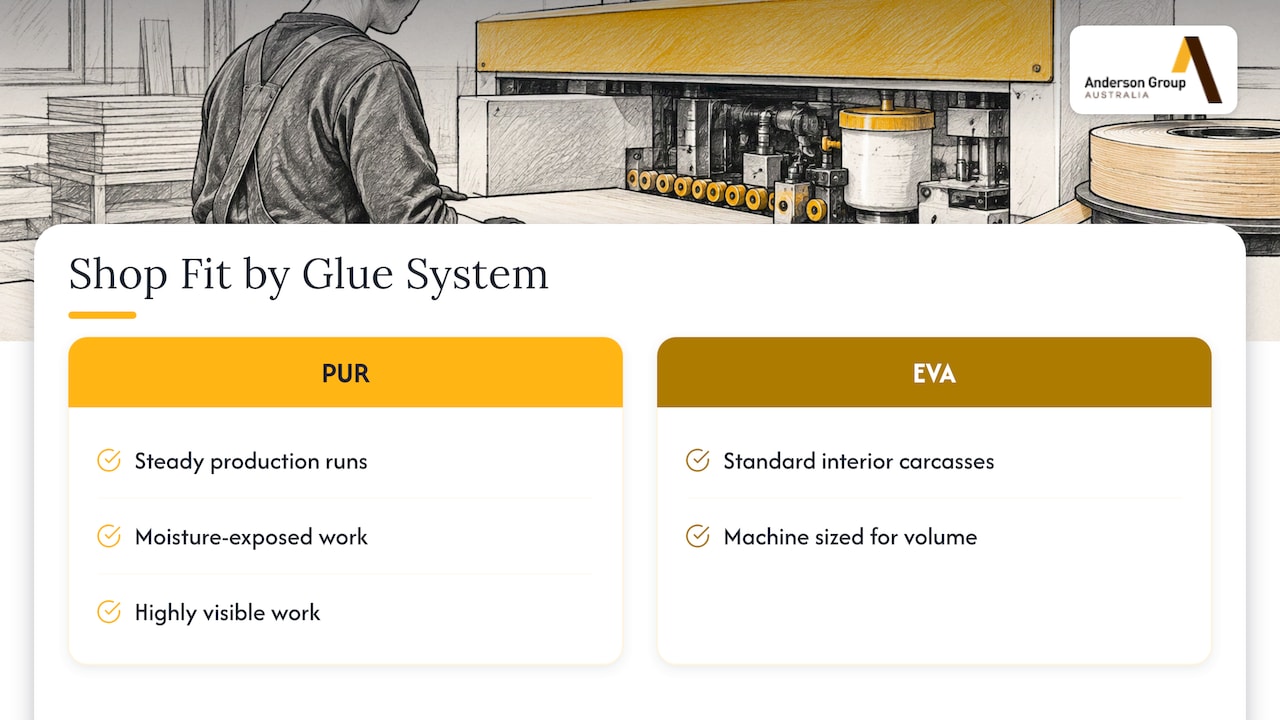
That depends on your product mix and run rate, and we won’t quote a payback figure we can’t document. What we can say is that shops with steady production and moisture-exposed or highly visible work have the strongest reasons to consider PUR. If your mix is mostly standard interior carcasses, an EVA machine sized well for your volume may be the better fit. Many buyers also want a machine that matches their growth, which is why the guide to choosing an edgebander looks at size and feed before glue.
What to check at a demonstration
Bring your own panels and edge materials where possible and look at:
- Glue line along the full edge and at the corners.
- Edge finish and chipping on your actual substrates, including melamine and any thin or thick laminates you use.
- How quickly the glue unit heats and how it is purged or cleaned.
- Operator access for one-person running, and whether a return system suits your layout.
- Which options are fitted on the quoted machine and which are extras.
Ask for the specification of the exact configuration in writing so what you see matches what you buy.
Talk to us about your edgebander
We supply edgebanders, CNC nesting machines and drilling equipment to Australian kitchen, cabinet, joinery and furniture manufacturers, with servicing and parts. We help you choose machinery for your own production. We don’t offer subcontract cutting or finished-part manufacturing.
Tell us what you build, how many panels you edge a day and where the work is installed, and we will match it to a model and confirm the glue system and options. Start with our wood machinery range or request a quote.
If you also run a nesting router upstream, the way parts leave the CNC affects edging flow. See fully automated CNC nesting production lines for cabinet shops for how the stages connect.
FAQ
Should I choose PUR or EVA glue for my edge bander?
Choose PUR if the machine runs most days and your work sees heat, steam or moisture. Choose EVA for intermittent running and standard dry-area cabinetry. The glue system is fixed by the machine’s configuration, so confirm what the exact model supports before ordering.
Can I run PUR on an EVA edgebander?
Not as a rule. Research from adhesive and trade sources shows PUR cures on exposure to air and sets hard if not purged properly, which is why PUR needs a machine with a sealed glue system. Ask the supplier whether a specific machine is PUR-capable.
Does PUR need special ventilation?
Yes, treat it that way. KLEIBERIT’s data sheet says hot melts release vapours even within working temperature and recommends suitable ventilation. Follow the SDS for your adhesive and speak to your WHS adviser about your site.
Why is my edge adhesion poor?
Common causes include a dirty or poorly milled panel edge, glue temperature outside the adhesive’s range, low roller pressure and, with PUR, very dry boards that slow the cure. Check the adhesive data sheet first, then the machine settings. Contact us with the model and materials and we will help you work through it.
Sources
- PUR and Laser Edgebanding in Commercial Joinery (Krost)
- Edge Bonding Handbook (CATAS)
- Laser, EVA or PUR glue? (Joiners magazine, June 2022)
- Edgebanding basics (Woodshop News)
- KLEIBERIT 707.9.85 ME technical data sheet
- Work Instructions for Edge Banding (Master-Profil)
- Spray Painting and Powder Coating Code of Practice (legislation.gov.au)