
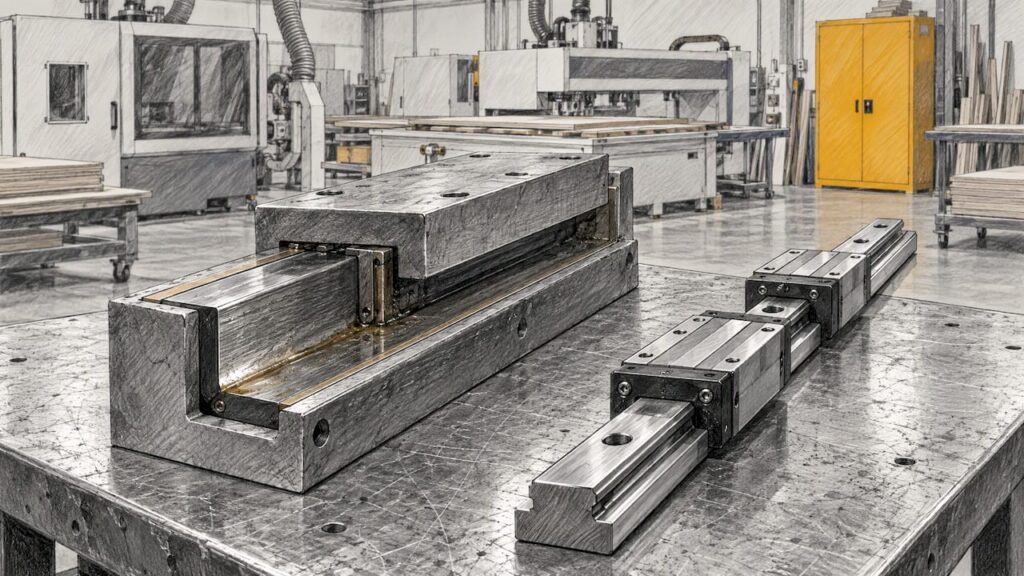
Box ways suit heavy, interrupted cutting where vibration damping and load capacity matter most. Linear guideways suit work where fast rapids, quick acceleration and low friction matter most. Neither is right or wrong. The better choice depends on what you cut, how hard you cut it and how much of your cycle is spent moving rather than cutting. This guide explains the engineering difference, compares the two on the criteria buyers care about, and lists what to confirm with a supplier before you commit.
TL;DR
- Box ways guide an axis on broad sliding surfaces. They offer high stiffness, heavy load capacity and strong vibration damping.
- Linear guideways use rolling elements. They offer far lower friction, faster positioning and quicker acceleration and deceleration.
- Box-way machines typically cost more to build. Linear guides tolerate crashes less well, while box ways tolerate them better but are harder to repair once damaged.
- Choose by application: heavy or interrupted metal cutting leans to box ways, high-speed and light-cut work leans to linear guides.
- Our Focaseiki Boxway Vertical Machining Centre range is the box-way option for metal and aluminium. For a specific model’s guide type, confirm it on the product page or with us.
Table of Contents
- What box ways and linear guideways actually are
- Rigidity and vibration damping
- Speed, acceleration and friction
- Crash tolerance, repair and wear
- Purchase cost and lifecycle cost
- Which one suits which job
- The Boxway Vertical Machining Centre range
- What to check before you buy
- Common misconceptions
- Talk to us about your application
- FAQ
- Sources
What box ways and linear guideways actually are
A box way is a broad, flat sliding surface. The moving casting rides on the stationary one, with lubrication between the mating faces. Box ways emphasise contact area, damping and load support, and the sliding surfaces often carry a nonmetallic liner to reduce friction and stick-slip.
A linear guideway works differently. Recirculating balls or rollers run inside bearing blocks that travel along a rail. The same source describes linear guides as emphasising rolling motion and fast positioning.
The whole trade-off comes from contact geometry:
- Broad sliding contact spreads load and absorbs vibration, but adds friction.
- Rolling contact keeps friction very low and responds quickly, but offers less inherent damping and less tolerance for severe side loads, according to machine-tool engineers cited by Fabricating & Metalworking.
This is a different question from drive type. Guides carry the axis; the drive moves it. If you are weighing linear motors as well, our article on how a linear motor CNC cuts cycle time for panel shops covers that separately.
Rigidity and vibration damping
Box ways are the traditional choice for stiffness. One American Machinist review credits boxway systems with a combination of high stiffness, heavy load-carrying capacity and above-average vibration damping. Their large contact areas make them stable and help them absorb vibration.
That matters when the cut itself generates vibration: deep roughing in steel or cast iron, large-diameter face milling, or interrupted cuts where the tool repeatedly enters and leaves the material. Damping reduces chatter, which protects surface finish and tool life.
Linear guideways are not weak. A well-specified linear system, particularly one using roller rather than ball elements, can be very stiff. The difference is that a linear guide gets its performance from a rolling interface with less inherent damping, so the machine designer relies more on the surrounding structure to control vibration.
Speed, acceleration and friction
This is where linear guideways pull ahead. Engineering commentary from the 1990s put the friction of high-performance linear guideways at roughly one-twentieth that of box ways, which means less wear and lower power demand. Lower friction is also why linear systems are associated with substantially higher feedrates and with quick acceleration and deceleration.
Box ways can show stick-slip, a jerky start-and-stop motion at very low speeds. Liners such as Turcite-type materials are used specifically to reduce it. Rolling-element guides do not show this behaviour.
The speed advantage only pays off when the part program uses it. Consider where your machine spends its time:
- Many short moves, lots of tool changes, light cuts: rapids and acceleration dominate cycle time, so linear guides help.
- Long, heavy cuts: cutting time dominates, and faster rapids save little.
Speed claims in brochures describe the machine’s capability, not your cycle time. Ask for rapid traverse and acceleration figures for the exact model and compare them with the moves in your own programs.
Crash tolerance, repair and wear
A crash is an event every shop eventually risks, so it belongs in the decision.
American Machinist reports that linear guideways are generally more susceptible to crash damage, which can cause subsurface cracking in the rolling elements. Box ways cope with impacts better because the load is spread over a larger area, though the same source notes they are more difficult to repair once damaged.
In practice, that means two different risk profiles:
- A linear guide is more likely to need block or rail replacement after a hard crash, but the parts are modular.
- A box way is less likely to be damaged, but damage can mean re-scraping or regrinding a casting.
Good tool and process monitoring reduces crash risk on either design. See our guides on broken tool detection options and tool life monitoring from controller data.
Purchase cost and lifecycle cost
Box ways usually involve more manufacturing work, including careful machining, heat treating and grinding. That typically raises the initial purchase cost compared with a linear guideway machine of similar size.
Purchase price is only part of the picture. A fair comparison also includes:
- installation and setup costs
- lubrication and consumables
- expected maintenance and any guide replacement
- tooling and spindle wear under your actual cutting conditions
- downtime if something fails
Our article on CNC lifecycle cost modelling shows how to build that comparison for your own business rather than relying on a headline price.
Which one suits which job
The table summarises the general engineering picture from the sources above. It is general guidance, not a specification of any Anderson or Focaseiki model.
| Criterion | Box ways | Linear guideways |
|---|---|---|
| Contact | Broad sliding surfaces | Rolling balls or rollers |
| Vibration damping | Strong | Lower inherent damping |
| Load capacity | Heavy | Good, depends on rail size and element type |
| Friction | Higher, liners reduce stick-slip | Very low |
| Rapids and acceleration | Typically lower | Typically higher |
| Crash tolerance | Better, but harder to repair | More susceptible to damage |
| Purchase cost | Typically higher | Typically lower |
When American Machinist put the question to a machine builder, the answer was that damping and heavy cutting may favour box ways, while speed may favour linear ways. The same article quotes an engineer arguing that no system is inherently right or wrong and that the choice should follow the application’s needs for damping, traverse rate and expected loads.
One engineer quoted in an older trade article points out that box ways damp well at low spindle speeds and feed rates, but running that slowly is inefficient with modern tooling, spindles and controls. That is a fair warning: do not buy damping you will never use at the cost of productivity you would.
Heavy metal cutting and tough materials
If your work is roughing in steel, cast iron or large aluminium blocks, with deep cuts and long tool engagement, box ways are worth a close look. Stiffness and damping keep the cut stable.
Light, fast, high-feed work
Aluminium and other non-ferrous parts machined with light cuts at high feedrates, or parts needing many short moves, usually benefit from linear guideways.
Wood, plastics and composites
Wood panel processing is a different problem from metal milling. Nesting and panel work involves large sheets, long traverses, high feed speeds and light cutting forces, with dust rather than liquid coolant to manage. Cutting forces are far lower than in steel, so the main reasons to pick box ways (heavy cuts and severe vibration) rarely apply. For that work, the more useful questions are about axis speed, bed size, vacuum hold-down, dust extraction and the software and tooling behind the machine. Guide type is one line on the specification, not the deciding factor.
We do not state a guide type for our wood machines in this article. If it matters to your decision, ask us to confirm it for the exact model. Our wood machinery range covers nesting, routing, drilling and panel-processing machines for kitchen, cabinet, joinery and furniture manufacturers.
The Boxway Vertical Machining Centre range
For metal and aluminium work where rigidity is the priority, we supply the Focaseiki Boxway Vertical Machining Centre series (VMC1171, 1371, 1471, 1590, 1790 and 2090). According to the product page, the series has these documented features:
- Four box ways on the machine base, described by the manufacturer as the best technical solution for rigidity and motion control.
- Hardened slide ways: high-frequency induction treatment to a hardened depth of 2 mm and a hardness of HRC 55.
- Turcite-B coating on the sliding surfaces, which are fine-scraped for loading and precision.
- Gear head spindle, designed for high torque, suited to power milling and small-radius interpolation.
Those points are the manufacturer’s documented description. They do not tell you which options a given configuration includes. Do not assume pallet changing, probing, rotary accessories, through-spindle coolant or any other option from the range name. Confirm the exact model and configuration with us before you rely on it.
The Focaseiki range is our metal and aluminium line and is separate from our woodworking machines. Nothing on that page should be read as applying to a nesting or panel machine.
What to check before you buy
Use this list with any supplier, ours included.
- Define your heaviest cut. Material, depth, width and tool diameter. If the heaviest cut is occasional, do not size the machine only around it without asking whether another process suits it.
- Define your most common cut. The machine will spend most of its life here.
- Request exact figures for the exact model. Rapid traverse, acceleration, spindle torque curve, table load capacity and axis travels.
- Ask what the guide type is on every axis. Some machines mix designs, so do not assume.
- Ask about lubrication. What system is used, what it consumes and what the service routine is.
- Ask about crash recovery. What would repair involve, and what parts and service are available in Australia?
- Confirm service scope. Ask us to confirm in writing what is included, because we do not publish response times or maintenance intervals as general promises.
- Check workholding. Stiff guides do not help if the part moves. See CNC workholding methods with datum logic.
- Plan acceptance testing. Our guide to a 90 day reliability plan with a ballbar test shows how to verify performance after installation.
Common misconceptions
“Linear guides are always more accurate.” Linear guides avoid stick-slip, so they are often considered more accurate in motion. But accuracy also depends on the structure, thermal behaviour, scales or encoders, calibration and the installation. Hand-scraped box ways are the basis of many precision machines. Ask for the accuracy and repeatability figures the manufacturer documents for the specific model.
“Box ways are outdated.” Not for heavy cutting. They remain a sensible choice where damping and load capacity dominate.
“Faster rapids mean faster parts.” Only if your programs spend a meaningful share of time moving rather than cutting.
“The guide type decides everything.” It is one factor alongside spindle, structure, control, workholding, tooling and service support.
Talk to us about your application
We help Australian manufacturers choose machinery for their own production. Our focus is kitchen, cabinet, joinery and furniture manufacturing, where we match nesting and panel-processing machines to the work. For metal and aluminium milling, we match applications to the Focaseiki range. We sell machinery, service and parts. We do not offer subcontract cutting or machining.
If you are comparing box-way and linear-guide machines for metal work, send us the material, the heaviest cut and the part size and we will point you to the right model and confirm specifications from the product page. You can see the full machining centre range or our metal machinery range, then request a quote or discuss your application with us.
FAQ
Are box ways better than linear guideways?
Neither is better in every case. Box ways generally give more damping and load capacity, which helps in heavy or interrupted cuts. Linear guideways give lower friction and faster motion, which helps in high-speed, light-cut work. Choose against your own application.
Do box ways make a machining centre slower?
Generally, yes in rapid traverse and acceleration, because sliding friction is higher than rolling friction. Whether that slows your parts depends on how much of your cycle is rapid movement. Ask for the model’s documented figures.
Is a box-way machine more expensive?
Typically it costs more to build because the ways need careful machining, heat treating and grinding. Compare lifecycle cost as well, including maintenance, downtime and tooling, rather than purchase price alone.
Which guide type suits CNC nesting of wood panels?
For nesting, speed, bed size, vacuum hold-down and dust extraction usually matter more than guide type, because cutting forces in sheet material are low. Ask us to confirm the details of the specific nesting model you are considering.
Sources
- Which way is right? | American Machinist
- Applications show the way | American Machinist
- Anatomy of a High-Performance Machine | CTE
- Controlling Machine Vibration | Fabricating & Metalworking