
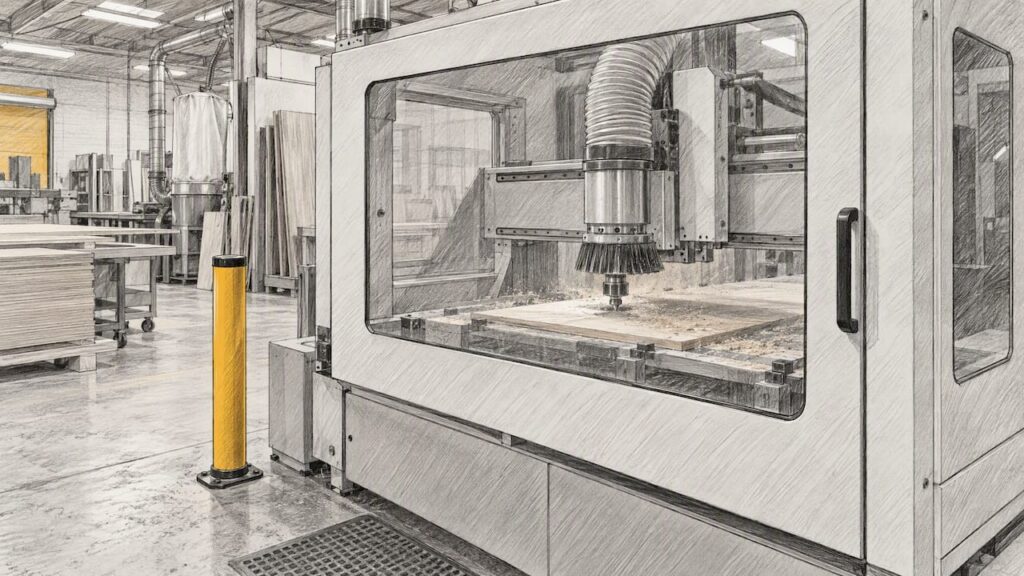
A direct drive spindle couples the motor straight to the spindle shaft with no belt, pulley or gear between them. An integral motor spindle goes a step further and builds the motor into the spindle itself. The result is a compact, smooth, quiet spindle that suits high speeds. The trade-off is that you cannot simply swap the motor if it fails, and heat has to be managed carefully. Whether it is the right choice for your shop depends on your material, your tooling and the torque you need at the speeds you actually run.
This guide explains the terms, compares the drive types, and gives Australian buyers a checklist to take to a supplier. Where we state a documented fact, we link the source. Where we offer general guidance, we say so.
TL;DR
- A direct drive spindle has no belt or gear between motor and shaft. An integral motor spindle has the motor built into the spindle assembly itself.
- Benefits include smoother, quieter running and good surface finish. Limits include heat build-up and a repair-not-replace path when the motor fails.
- Compare spindles on the torque-versus-rpm curve, not on the drive label or peak speed alone.
- For nesting and panel work, judge the spindle against your tooling, cooling and dust extraction. Ask us to confirm the exact model and configuration before you assume anything.
- Metal and aluminium milling is a different application, handled by the Focaseiki metal range, and needs its own spindle and coolant checks.
Table of Contents
- What a direct drive spindle actually is
- How power and speed behave compared with belt drive
- What you gain
- What you give up
- Side-by-side summary
- Are direct drive spindles suitable for nesting and panel processing?
- A buyer’s checklist for any spindle
- How long should a spindle last?
- Wood, metal and plastics: different spindle questions
- Choosing the machine, not just the spindle
- Talk to us about your application
- FAQ
- Sources
What a direct drive spindle actually is
The spindle is the part of the machine that rotates the tool (or, on a lathe, the workpiece) and delivers energy to the cutting zone. Academic work on machine tool spindle units notes that spindles were classically driven by belts or gears, while motorised spindles do not need mechanical transmission elements such as gears and couplings.
There are four designs you will see quoted in the field: belt-driven, gear-driven, direct-coupled and motorised (integral motor) spindles. In practice:
- Belt drive: the motor sits beside or behind the spindle and turns it through a belt and pulleys.
- Gear drive: a gearbox sits between motor and spindle, common where very high torque at low speed is needed.
- Direct drive (inline): the motor is coupled to the spindle shaft. Trade press describes an inline spindle, also called a direct-drive spindle, as coupled directly to the motor.
- Integral motor (motorised): the motor is part of the spindle. A spindle manufacturer’s technical book describes it as including the motor as an integral part of the spindle shaft and housing assembly, rather than relying on an external motor to provide torque and power. One machining publication describes the motor winding surrounding the rotary shaft, which is what removes belts, pulleys and gears.
People use “direct drive” and “integral motor” loosely, and some suppliers use them interchangeably. When you read a specification, ask which of the two it is. A coupled motor can be removed and replaced separately. A built-in motor cannot.
How power and speed behave compared with belt drive
The old rule of thumb says belts give torque and direct drive gives speed. The real answer is in the torque curve.
MoldMaking Technology reports that an inline spindle gives excellent surface finish and smoother, quieter operation. The same article reports that one builder’s direct-drive machines matched belted torque above 1,500 rpm and delivered more above 7,200 rpm. That is one manufacturer’s claim about its own machines, not a universal law. It does show why a generic belt-versus-direct rule is a poor basis for a purchase: the comparison only means something when both spindles are laid out as torque against rpm.
A spindle maker’s perspective points the other way on cutting style. IBAG North America notes that conventional belt-driven machines rely on high torque for chip load, while integral motor spindles emphasise high speeds and faster feed rates, which calls for smaller diameter tools and lighter depths of cut.
Put those together and the general guidance is:
- If your work is light, fast cutting with small tools, an integral motor spindle fits the pattern.
- If your work needs heavy chip loads at low rpm with large tools, look hard at the torque curve below the speeds you plan to run.
- If a supplier quotes only a maximum rpm, ask for the full curve. Peak speed on its own tells you very little.
What you gain
From the documented material, the benefits of removing the belt are these:
- No belt side-load and no gear noise. A direct-coupled spindle removes belt side-load and gear noise, though the coupling condition and fit still need inspecting.
- Compactness and dynamics. The same source says integral motor spindles trade the ease of fitting a more powerful motor for compactness, higher speeds and higher dynamics.
- Smoother running and finish. As above, trade press links inline spindles with smoother, quieter operation and excellent surface finish.
These are potential benefits, not guarantees. They depend on how well the specific spindle is designed, balanced, cooled and matched to the job.
What you give up
Heat
A built-in motor puts its heat right next to the bearings. A 2022 academic review of high-speed motorised spindles states that heat from the built-in motor and bearings can cause thermal deformation and affect machining accuracy if it is not removed in time. For ultra-precision machines, the same review says thermal error from the spindle can be as high as 90%. That figure applies to ultra-precision machining, not to general panel or cabinet work, but the principle carries over: cooling matters, and you should ask how the spindle is cooled.
Balance and wear
The same review notes that at high speeds, unbalance is inevitable and can cause vibration, wear and reduced spindle life and accuracy. Tool holders, collets and tools all contribute. Good tooling practice matters more as speed rises.
Design compromises
Spindle manufacturer Dynomax says integral motor spindle components must be selected for the required speed, power, stiffness and load capacity, with compromises among them. It also notes that motor size and capacity depend strongly on available space, and bearing size affects load capacity and stiffness. A spindle that is excellent at one thing is rarely best at everything.
Repair, not replacement
An integral motor spindle is a single assembly. A spindle repair company explains that a burned stator on an integral motor spindle requires a spindle repair rather than a motor replacement. Motorised spindles also need attention to windings, cooling, cleanliness and balance, and a full mechanical rebuild when the time comes. That is a cost and downtime consideration you should weigh before buying, not after.
Side-by-side summary
| Factor | Belt drive | Direct drive (coupled) | Integral motor |
|---|---|---|---|
| Power path | Motor, belt, pulleys, spindle | Motor coupled to shaft | Motor built into the spindle |
| Typical emphasis | Torque at low to mid speed | Smooth running, speed | Compactness, high speed, dynamics |
| Side-load on shaft | Yes, from belt tension | Removed | Removed |
| Heat concern | Motor is remote | Motor is remote from bearings | Motor heat sits next to bearings |
| Motor failure | Replace motor | Replace motor, check coupling | Spindle repair |
| What to ask for | Belt condition, pulley ratio | Coupling condition and fit | Cooling, balance, rebuild path |
This table is general guidance drawn from the sources above. Individual spindles vary, so treat it as a starting framework for your questions.
Are direct drive spindles suitable for nesting and panel processing?
Here we have to be careful. We found no authoritative technical source that tests direct drive against belt drive specifically for nesting of sheet material, so what follows is general guidance. It is not a documented finding.
Wood panel processing has different demands from metal milling:
- Tools are often small to mid diameter and run at high rpm. That pattern lines up with the speed-and-feed emphasis the spindle makers describe for integral motor designs.
- Cuts are shallow per pass but long and repeated. Duty cycle matters. Spindle life depends on operational frequency, load conditions and maintenance, so a two-shift cabinet shop and a one-shift joinery shop should not size the spindle the same way.
- Dust is constant. Panel work generates fine dust, and the Dynomax and MZI material both point to cleanliness as a spindle concern. Extraction design is a separate question from spindle drive, and we treat it separately.
- Tool changes may be frequent. If your job mix includes cutting, drilling and grooving in one program, ask how the machine handles tooling and whether the configuration you are considering includes the changer you need.
The question for a kitchen or cabinet manufacturer is rarely “direct drive or belt?” in isolation. It is “what spindle, tool holder, cooling and extraction does this exact machine have, and does it suit my sheet sizes, tooling and shifts?”
Keep the machine families distinct
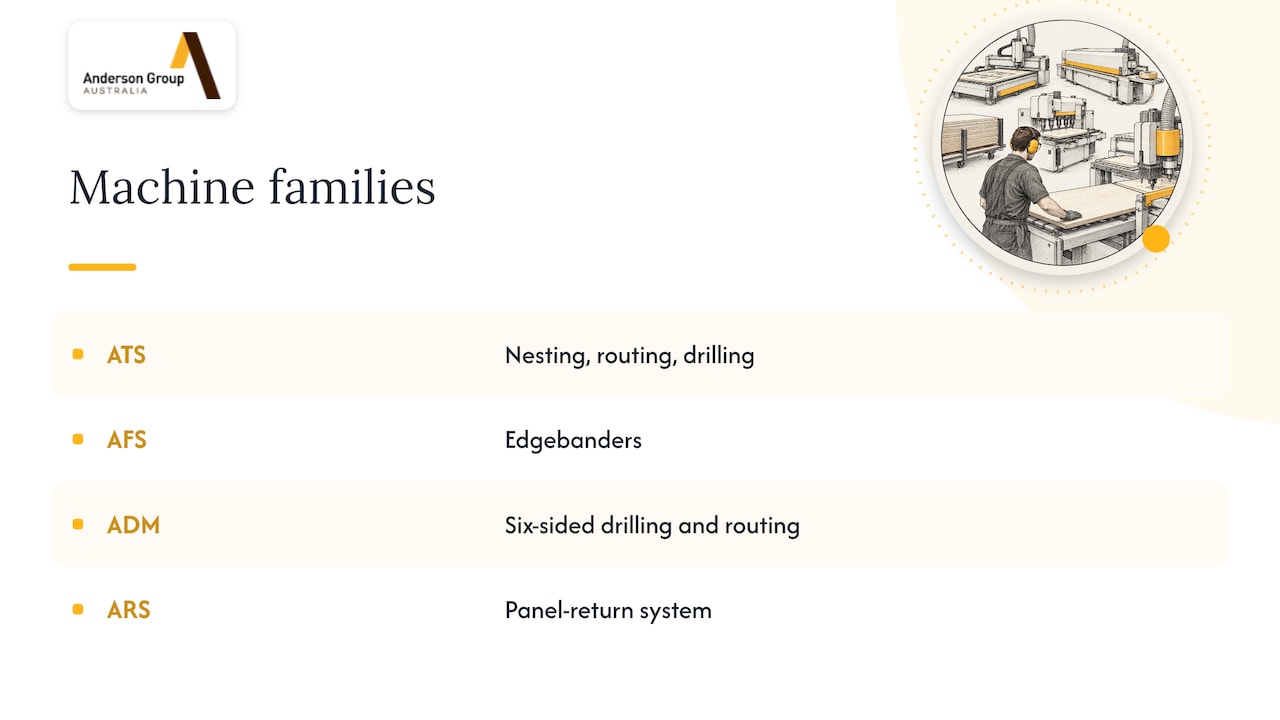
Our woodworking range covers different jobs, and we keep them separate on purpose. ATS models are nesting, routing and drilling machines. AFS models are edgebanders. ADM is six-sided drilling and routing. ARS is a panel-return system. A spindle question belongs to the machine that has a spindle doing the cutting, so for edgebanding or panel return the conversation is different. We do not assume a spindle specification, pallet change, probing, extraction capacity or coolant option from a family name or axis count. We confirm each against the exact model and configuration, and we ask you to do the same with any supplier.
A buyer’s checklist for any spindle
Dynomax lists the factors a manufacturer should assess: spindle power, axial and radial load, maximum speed, tooling style, size and capacity, drive design, available machine space, complexity, cost and cooling requirements. Turn that into questions you can put to us or any supplier:
- What is the torque or power curve across the rpm range I will use? Ask for the curve, not just a peak.
- What is the tooling interface, and what tool diameters does the spindle suit? Match this to the tools in your cut library.
- How is the spindle cooled? Air, liquid or another method, and what does it need from your site.
- What is the balance grade and how is tooling balance handled? Unbalance causes vibration and wear at speed.
- What happens when the spindle needs work? Ask about the repair path, who performs it in Australia, and what scope is agreed. We only describe service inclusions, response times and local stock where they are documented, so ask for the agreed scope in writing.
- What are the maintenance requirements? Operator manuals should communicate them, as the spindle life guidance notes.
- Is the option I want fitted to the exact model I am quoted? Never assume.
For a deeper look at how spindle options hold up across production, our guide on CNC spindle options in production goes further, and our preventive maintenance checklist covers the routine care that protects any spindle.
How long should a spindle last?
No honest number applies to every spindle. The research is clear that life depends on how often it runs, the load it sees and how it is maintained. Unbalance and heat both shorten it. Anyone who quotes you a single lifespan without asking about your duty cycle is guessing.
What you can do is watch the spindle while it works. Reading load on the controller can show trends before a failure. Our guide on spindle load monitoring explains how to read it, and tool life monitoring from controller data shows how that data can reduce scrap. For faster cutting strategies more broadly, see high speed machining.
Wood, metal and plastics: different spindle questions
The right spindle depends on what you cut.
- Wood and panels: speed, tooling, extraction and duty cycle lead the conversation. Our wood machinery range is where kitchen, cabinet, joinery and furniture manufacturers should start.
- Plastics and composites: these are a secondary part of what we supply. Heat and dust behaviour differ from timber, so confirm the model for your specific material.
- Metal and aluminium: this is Focaseiki territory, and the questions change. Torque at lower speeds, rigidity and coolant matter more. Browse the metal machinery range, and if coolant delivery through the spindle is part of your thinking, our article on through spindle coolant and pump pressure explains what to ask. Coolant fitment is never assumed from a family name, so confirm it on the exact model.
Wood-panel dust extraction and liquid coolant are different systems solving different problems. Do not mix the two when you write a specification.
Choosing the machine, not just the spindle
A spindle is one part of a machine. Table size, frame rigidity, controller, tool changer, vacuum hold-down and extraction all affect what comes off the machine. If you are weighing a direct drive spindle because you want faster cycle times, the drive type alone will not deliver that. Our article on linear motor CNC for panel shops looks at the other side of that question: axis motion and cycle time.
If you are comparing machines across a shortlist, we suggest you:
- List the five most common parts you cut and the tools they use.
- Note sheet sizes, material thickness and shifts per day.
- Ask each supplier to state spindle, tool interface, cooling and extraction for the exact model.
- Ask what is documented and what is general, and keep the two apart.
Talk to us about your application
Anderson Group Australia supplies CNC machinery, servicing and parts to Australian manufacturers, with a primary focus on kitchen, cabinet, joinery and furniture production. We help you choose machinery for your own production. We do not offer subcontract cutting or machining.
If you are weighing spindle options for nesting, routing or panel processing, describe your parts, materials and shifts and we will match them to a machine and confirm the specification against the product page.
Start with the wood machinery page, see the full machine listing, or contact us through our site to discuss your application or request a quote.
FAQ
What is the difference between a direct drive spindle and an integral motor spindle?
A direct drive spindle couples the motor to the spindle shaft without a belt. An integral motor spindle builds the motor into the spindle itself, so the rotor sits on the shaft and the stator in the housing. Suppliers sometimes use the terms interchangeably, so ask which design a specific spindle is.
Is a direct drive spindle better than a belt-driven spindle?
Not automatically. Direct drive removes belt side-load and can run smoother and quieter, while belt drive can suit heavier cutting at lower speeds. Compare torque against rpm for the speeds and tools you actually use, rather than relying on the drive label.
What are the different types of CNC spindles?
The common designs are belt-driven, gear-driven, direct-coupled and motorised (integral motor) spindles. Each trades torque, speed, compactness, noise and serviceability differently. The right one depends on your material, tooling and production demands.
How long should a CNC spindle last?
There is no single figure. Spindle life depends on how often it runs, the loads it sees and how well it is maintained, and unbalance at high speed can shorten it. Ask the supplier for maintenance requirements and the agreed service scope for your machine.
Can a failed integral motor spindle be fixed by replacing the motor?
Usually not. Because the motor is part of the spindle assembly, a burned stator generally means repairing the spindle rather than swapping a motor. Ask before you buy who handles spindle repair in Australia and what is covered.
Sources
- Machine tool spindle units (ScienceDirect)
- Book of Spindles, Part 1 (Dynomax)
- Machining Center Spindles: What You Need to Know (MoldMaking Technology)
- Justifying Use of a High-Speed Spindle (Today’s Machining World)
- Belt, Direct-Drive and Motorized Spindles (MZI Precision)
- Belt, Direct Drive and Integral Motor Spindles (HST Spindles)
- 6 Elements of Ultra-High-Speed Spindles (IBAG North America)
- A Review of Key Technologies for High-Speed Motorized Spindles (MDPI)
- How to Choose the Right Spindle for Your Application (Setco)