
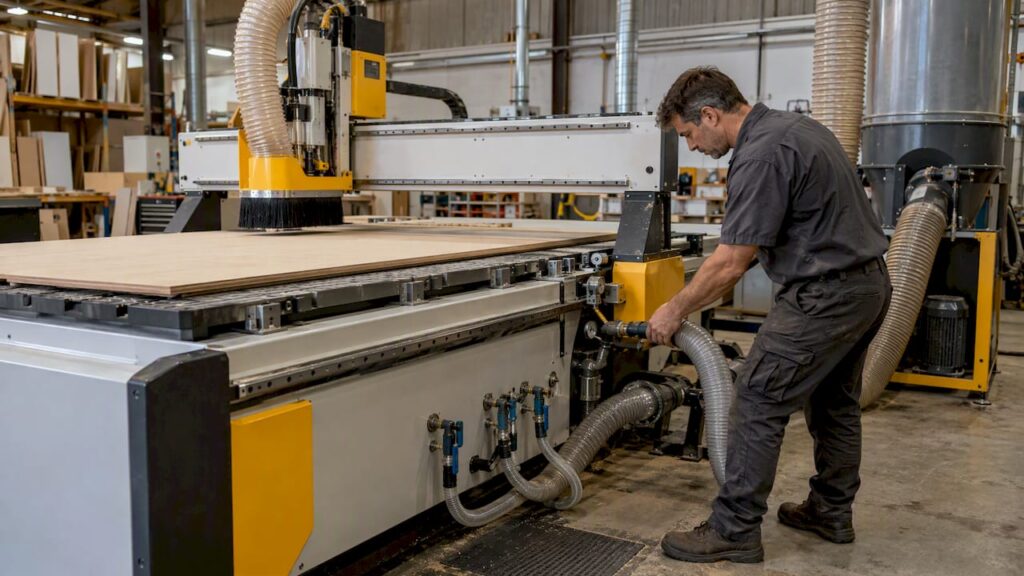
Commissioning is the point where a CNC machine stops being a delivery and becomes a piece of plant you are responsible for running. A sound checklist covers six things: site and services ready before delivery, documents and safety systems, dry runs, test cuts on your own material, operator training, and a written sign-off that names what is still open. This guide sets them out in the order you will meet them, with the Australian WHS duties attached to the steps where they apply.
It is written for kitchen, cabinet, joinery and furniture manufacturers buying nesting and panel-processing machines, though most of it applies to any CNC. Where something is a documented duty, we link the source. Where it is general guidance, we say so.
TL;DR
- Commissioning is more than plugging in and cutting one part. Under the model WHS regulations, plant must not be commissioned until the person with management or control has established it is safe, so far as is reasonably practicable.
- Agree acceptance criteria in writing before the machine ships: what is tested, on what material, measured how, and who signs.
- Test the whole system, not only the machine: dust extraction, vacuum holding, tool changing, guarding and emergency stops.
- Settle training, service and parts scope before the technician arrives, and ask your supplier to confirm in writing what is included.
- Keep a factory acceptance test (FAT) and a site acceptance test (SAT) separate. They answer different questions.
Table of Contents
- What commissioning means under Australian WHS rules
- FAT versus SAT: two tests, two purposes
- Before the machine arrives: site readiness
- The commissioning checklist, step by step
- Acceptance criteria: how to write ones you can measure
- Questions to put to your supplier before commissioning starts
- Where Anderson fits
- FAQ
- Sources
What commissioning means under Australian WHS rules
In the Model Code of Practice for managing the risks of plant, Safe Work Australia sets out that a person with management or control of plant at a workplace must ensure plant is not commissioned unless they have established that it is, so far as is reasonably practicable, without risks to health and safety. That is Regulation 204 of the model WHS Regulations. The same section requires that risks be monitored during installation and commissioning, and that the people doing the work are competent.
Two practical consequences follow.
- The duty sits with you, not only the installer. The supplier’s technician may do the work, but the person with management or control of your workplace still has to establish the machine is safe before it enters production.
- New risks found during commissioning must be passed on. The code expects an installer who identifies a new risk to notify the relevant parties, including the designer, manufacturer or supplier and the person with management or control of the plant.
The model laws are adopted by each state and territory, and Victoria runs its own OHS framework. If you are in Victoria, read WorkSafe Victoria’s plant safety basics alongside the model code. Check your own jurisdiction’s current regulation with your regulator or a WHS adviser before you sign off.
For the standards side, our guide on meeting AS/NZS 4024 for CNCs covers the safety actions Australian PCBUs should take on machinery guarding.
FAT versus SAT: two tests, two purposes
Readers often search for a factory acceptance test checklist and a commissioning checklist as if they were the same document. They are not.
| Factory acceptance test (FAT) | Site acceptance test (SAT) | |
|---|---|---|
| Where | At the manufacturer or supplier | In your factory, on your power and floor |
| Question answered | Does the machine, as built, meet the agreed specification? | Does it still do so installed, connected and run by your people? |
| Typical content | Witnessed run, configuration check, documentation review | Services, extraction, vacuum, dry run, test cuts, safety functions |
| Who signs | Buyer’s representative and supplier | Buyer and supplier, with open items listed |
A FAT is not always practical. Many machines sold in Australia are imported and are not available to witness locally. If a FAT is not offered, ask what pre-shipment testing is documented and what you can see before dispatch. Do not assume a witnessed test exists: ask, and get the answer in the purchase documents.
The SAT is the one that matters for your WHS duty, because it happens at your workplace with your services and your operators.
Before the machine arrives: site readiness
Most commissioning delays trace back to the building, not the machine. Settle these items while the machine is still on the water.
Floor, space and access
- Confirm the delivery route: door height and width, floor loading along the path, and where the truck and forklift or crane will stand.
- Check the slab where the machine will sit against the manufacturer’s installation drawing. Only use the figures in the documentation for your exact model.
- Allow working space for loading and unloading sheets, offcuts, maintenance access and clear emergency exits. Our guide to budgeting CNC floor space explains why the vendor footprint is rarely the real footprint.
Electrical and compressed air
- Have a licensed electrician confirm supply, protection and isolation against the machine’s data plate and installation manual. Electrical work must meet the wiring rules that apply to your site.
- Confirm compressed air pressure, flow and quality against the manual. Moisture in air lines is a common cause of problems with pneumatic components, so check the dryer and filtration are in place.
- Fit a clearly labelled isolation point within reach of where the technician and your maintenance staff will work.
Dust extraction and vacuum
For a wood-panel nesting machine, dust extraction and vacuum holding are services you must plan, not accessories you add later. Confirm with the supplier, for your exact model and configuration, the extraction connections required and the vacuum arrangement, and who is supplying and connecting each. Do not assume capacity from the machine family name.
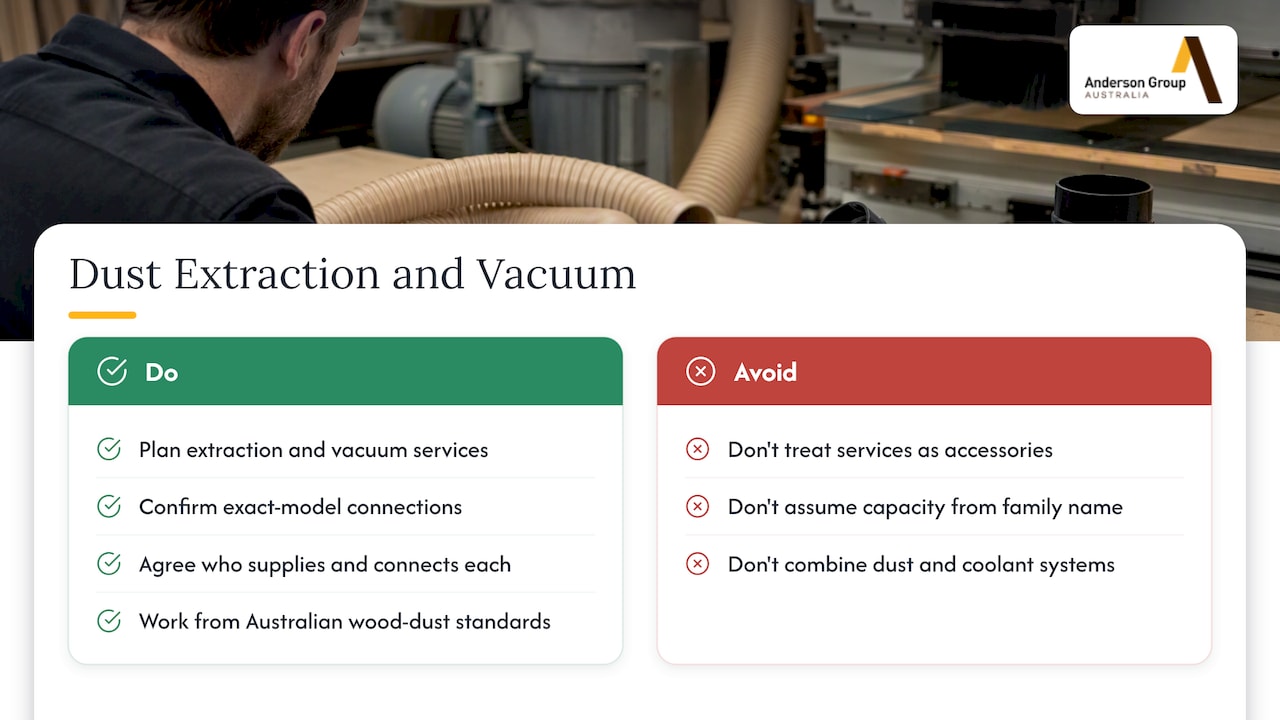
On the compliance side, wood dust has workplace exposure standards in Australia. Our summary of Australian wood dust standards gives a checklist to work from. Wood dust extraction is a separate system from liquid coolant used in metal machining. Keep the two conversations apart.
Software and data
- Decide which CAD/CAM or nesting software will post to the machine, and who installs it.
- Prepare a representative job file in advance, using your real sheet sizes and a real cabinet or furniture layout. A generic demo file tells you little.
- Confirm network, backup and remote-support arrangements with your supplier if you want them.
The commissioning checklist, step by step
Use this as a working template. Add the manufacturer’s own procedure for your model; where the two differ, ask the supplier to explain in writing.
1. Paperwork and pre-start review
- Obtain the manual, electrical diagrams, installation drawing and any safety documentation for the exact machine and configuration supplied.
- Check the data plate against the order: model, options fitted, voltage and phase.
- Compare the delivered machine to the purchase specification, line by line. Record any option that is missing or different.
- Inspect the crate and machine for transport damage and photograph it before unpacking. Notify the carrier and supplier promptly in line with your contract terms.
- Confirm who on site is the competent person for installation and commissioning, and record their role.
2. Mechanical installation
- Position and level the machine as the installation manual directs for that model.
- Remove transport locks and restraints, and tick each off on a list so none is left in place.
- Check fasteners, covers and guards are fitted and secure.
- Fill lubrication points to the manufacturer’s specification, not a generic one.
3. Services connection and power-up
- Connect electrical supply, compressed air, dust extraction and vacuum as specified.
- Check rotation direction on motors, pumps and fans before running anything under load.
- Power up the controller without running axes, and look for alarms and error messages. Record each one.
- Confirm the air pressure and vacuum readings against the manual.
4. Safety function verification
This is where the WHS duty becomes concrete. WorkSafe Victoria notes that plant risk management is hierarchical and specific to your workplace, so test each protection on your machine as installed rather than relying on a generic list.
- Emergency stops: press each one and confirm the machine stops and cannot restart until reset deliberately.
- Guards, light curtains, bumpers and interlocks, where fitted to your model: test that opening or breaking each stops motion.
- Safe shutdown and restart procedure: write it down and display it at the machine.
- Isolation and lockout: confirm the point works and everyone knows where it is.
- Markings and signage: floor markings, warning labels and exclusion zones in place.
If you find a risk you cannot control with what is installed, stop. The NSW version of the code of practice describes control of risks arising from installation or commissioning as a specific duty, and the right step is to notify the supplier and your WHS adviser before production begins.
5. Dry runs
A dry run moves the machine through its program with no material and, where possible, no tool engaged. It is the safest time for hidden problems to show.
- Home all axes and confirm the travel directions match the display.
- Run each axis slowly end to end, listening for noise and watching for binding or unusual vibration.
- Run a program that exercises the tool changer, if fitted to your configuration, through every tool position.
- Run the vacuum zones or clamping, and confirm holding and release.
- Run a full nesting job in air at the intended feed rates, with the extraction running.
- Test pause, feed hold and abort in the middle of a program, and confirm the machine resumes or recovers as the manual describes.
Any feature on this list depends on what your model actually has. Do not assume automatic tool change, pallet changing, probing, rotary accessories or through-spindle coolant from a family name or number of axes. Confirm each against the product page and your quote.
6. Test cuts on your own material
Test cuts turn a machine that moves into a machine that produces parts. For a kitchen or cabinet shop:
- Use the board you actually buy: melamine, MDF, plywood or whatever dominates your work. Include a sheet from a bad batch if you have one, since real warp and thickness variation are what the machine will face.
- Cut a representative part set: a standard carcass, some small parts, an internal profile and any joinery features you rely on.
- Measure the finished parts with your own instruments and compare them to the tolerance on your drawing, not to a figure quoted in a brochure.
- Check the edge quality, tab or hold-down behaviour and whether small parts stay put.
- Record the tool, feed, speed and depth for each test so the results can be repeated.
Write the acceptance criteria before the test, not after. For example: which dimensions will be measured, how many parts, on which material, with what instrument. The tolerance is yours to set from your product requirements, and the machine documentation tells you what the manufacturer specifies. For checking geometry and repeatability over time, our guide on verifying reliability with a ballbar test shows one approach buyers use.
7. Operator and maintenance training
The Safe Work Australia code states that workers must be trained and have the appropriate skills to carry out a task safely, and that training should come from a competent person. Treat training as part of commissioning, not a bonus.
- Operators: loading, program selection, starting and stopping, emergency procedures, daily checks.
- Programmers: nesting settings, tool libraries, post-processor use.
- Maintenance: lubrication, filter checks, air and vacuum checks, who to call for what.
- Record who was trained, when and on what. Keep it with the plant records.
If you are planning this for a nesting machine, our guide to installation and operator training for CNC nesting machines covers the planning questions in more depth.
8. Handover and sign-off
Sign-off should be a document, not a handshake.
- List every test performed, the result and who witnessed it.
- List open items with an owner and a date. A machine can be accepted with a short punch list, as long as none of the items is a safety function.
- Attach the manuals, drawings, parameter backups and the software licences.
- Record the date commissioning was completed and the date the warranty period starts, as set out in your contract.
- Agree what happens next: first service, parts ordering and the support contact.
Acceptance criteria: how to write ones you can measure
Searchers looking for machine acceptance criteria usually want a template. The structure below works for any CNC.
| Area | Criterion (write yours) | Evidence |
|---|---|---|
| Specification match | Delivered options equal ordered options | Checked data plate and quote |
| Safety functions | Each stop, guard and interlock halts motion | Witnessed test, signed |
| Motion | Axes run full travel without alarms or abnormal noise | Dry-run log |
| Holding | Vacuum or clamping holds test parts through the cut | Test cut record |
| Part accuracy | Measured dimensions within your stated tolerance on N parts | Measurement sheet |
| Extraction | Dust is captured at the machine during cutting | Visual check and extraction readings where you have them |
| Documentation | Manuals, diagrams, backups handed over | Checklist |
| Training | Named people trained and recorded | Training register |
General guidance, not a documented requirement: keep the tolerance column specific to your parts. A tolerance that suits a sheet-metal fabricator may be pointless for a melamine carcass, and the reverse is also true.
Questions to put to your supplier before commissioning starts
Buyers often forget to agree the boundaries of support before the technician is on site. Ask for answers in writing.
- What does commissioning include for my exact model and configuration, and what is excluded?
- Does it include connection and testing of my dust extraction, vacuum or other systems, or is that for my installer?
- How many people will be trained, for how long, and on what?
- What is the plan for first service, spare parts and ongoing support, and what is the process to request them?
- What documentation and software will I receive?
- What happens if the machine fails an agreed test?
We do not publish standard commissioning inclusions, response times or stock levels here. Ask us to confirm the agreed scope for your machine in the quote.
Where Anderson fits
Anderson Group Australia supplies CNC machinery, servicing and parts to manufacturers, with a primary focus on kitchen, cabinet, joinery and furniture makers. If you are choosing a nesting or panel-processing machine, start with our wood machinery range, then check the specifications on the product page for the model you are considering. For metal and aluminium milling, the metal machinery range is the place to start.
We help you choose machinery for your own production. We do not offer subcontract cutting or machining. To discuss your application and what commissioning should cover, request a quote or talk to the team.
FAQ
What is the difference between commissioning and a factory acceptance test?
A factory acceptance test checks the machine against the specification at the supplier’s premises. Commissioning happens at your site, after installation, and confirms the machine works with your services, your operators and your materials. Under WHS rules, it is the commissioning stage that ties to your duty to establish the plant is safe.
Who is responsible for commissioning a CNC machine in Australia?
The person with management or control of the plant at the workplace must establish the plant is safe before it is commissioned, and must ensure the people who commission it are competent. The supplier’s technician may carry out the work, but the duty does not transfer to them. Confirm how your state or territory applies the model laws.
How long does CNC commissioning take?
It depends on the machine, the services you have ready and the scope of training, so no single figure is reliable. Ask your supplier for a schedule for your exact model and configuration, and allow time for any open items from the dry runs and test cuts.
What should I test cut during acceptance?
Use your own production material and a representative set of parts, including small parts and any joinery features you depend on. Define the dimensions, number of parts and measuring method before the test. Measure against your own drawing tolerance and record the tooling and cutting settings used.
Sources
- Model Code of Practice: Managing risks of plant in the workplace, Safe Work Australia
- Managing the risks of plant in the workplace, Safe Work Australia, November 2024
- Code of practice: Managing the risks of plant in the workplace, SafeWork NSW
- Plant: Safety basics, WorkSafe Victoria