
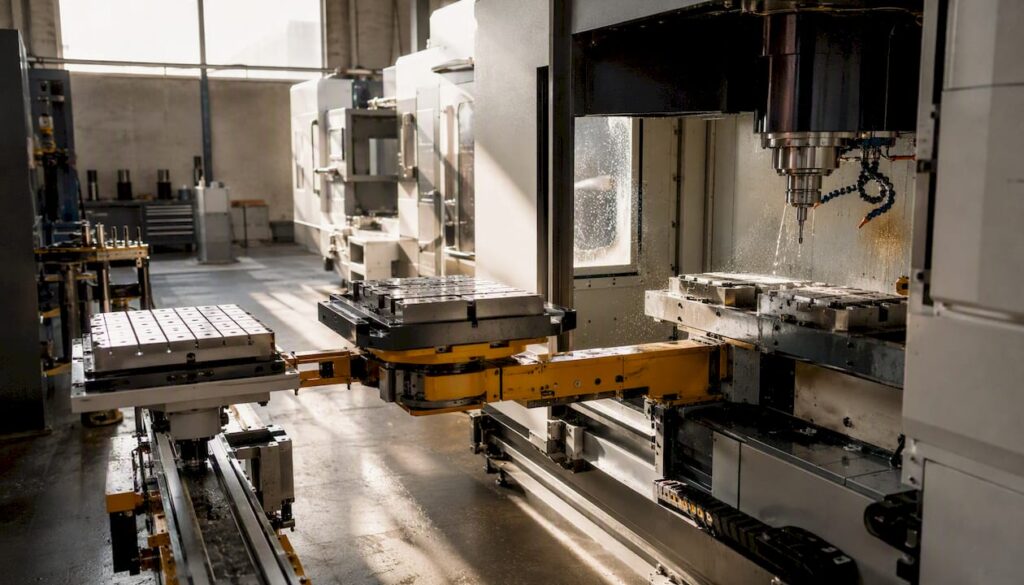
Fitting an automatic pallet changer (APC) to a CNC machining centre is one of the fastest ways to lift spindle utilisation, cut non-cut time, and open the door to lights-out production. In practical terms, that means your machine keeps cutting while your operator loads the next job offline. Practitioners report spindle utilisation climbing from industry averages near 35% to 80–90% after APC installation, and some manufacturers report customer productivity uplifts of 50–90%.
The core auto pallet changer benefits at a glance:
-
Spindle utilisation rises from typical shop averages (~35%) toward 80–90%
-
Non-cut time drops by eliminating mid-cycle setup and fixture changes
-
Lights-out and unattended runs become viable without a robot cell
-
Repeatability improves, with zero-point systems holding tolerances around ±0.0025 mm
-
Operator hours per part fall as loading shifts offline
-
Payback is typically modelled in months, not years, for two-shift shops
Key takeaways
| Point | Details |
|---|---|
| Spindle utilisation uplift | APCs can lift utilisation from ~35% to 80–90%, effectively doubling productive hours per shift. |
| Payback in months | Model payback using total installed cost divided by monthly net benefit; two-shift shops often see payback in months. |
| APC before robot | APCs deliver faster ROI than robot cells for most shops; add a robot later for full part handling if needed. |
| Zero-point is non-negotiable | Specify a zero-point clamping system for ±0.0025 mm repeatability and fast, accurate pallet changeover. |
| Anderson local support | Anderson supplies APC-equipped VMCs and production machining centres with in-country installation and service across Australia. |
Table of Contents
-
What are the measurable auto pallet changer benefits for your shop?
-
How do you model the ROI and payback for an APC in Australia?
-
Which APC features and specs matter most when you are specifying?
-
What maintenance does an APC need, and what support is available in Australia?
-
APC versus robot tending: which automation path is right for your shop?
-
A field note on what APC installation day actually looks like
What are the measurable auto pallet changer benefits for your shop?
Every benefit an APC delivers traces back to one mechanism: the machine never waits for a human to finish setting up. The KPI that captures this most directly is Overall Equipment Effectiveness (OEE), specifically its availability and performance components.
Spindle utilisation is the headline metric. Fitting an APC can push that figure toward 80–90%, effectively doubling or tripling the productive hours extracted from the same machine. That is not a marginal gain; it is a structural shift in how much output a single VMC can deliver per shift.
Cycle throughput and parts per shift follow directly. When pallet exchange takes seconds rather than the five to fifteen minutes a manual setup typically consumes, you recover that time as additional cutting cycles. For a part with a 12-minute cycle time, recovering even eight minutes of setup per cycle adds up to a meaningful extra part per hour across a full shift.
Reduced non-cut time, faster setup, lights-out enablement and improved repeatability are the four benefits that manufacturer guidance consistently highlights. The lights-out angle deserves particular attention for Australian shops running two or three shifts: an APC lets a single operator load multiple pallets before leaving, then the machine runs unattended through the night. No robot cell required, no complex programming, no re-fixturing mid-run.
Labour savings are real but often underestimated in initial business cases. The operator is not eliminated; they are freed to run a second machine, handle inspection, or manage the next job’s prep. That redeployment is where the labour cost saving actually appears in the P&L.
| Metric | Baseline (manual loading) | Post-APC expectation | How to measure |
|---|---|---|---|
| Spindle utilisation | ~35% | 80–90% | Machine controller data / OEE software |
| Setup time per pallet | 5–10 min | 10–30 sec (exchange) | Stopwatch / cycle log |
| Parts per 8-hour shift | Baseline count | 30–50% more typical | Production log comparison |
| Operator touches per part | Multiple | One (offline load) | Time-and-motion study |
| OEE score | Low–mid range | Substantially higher | OEE = Availability × Performance × Quality |
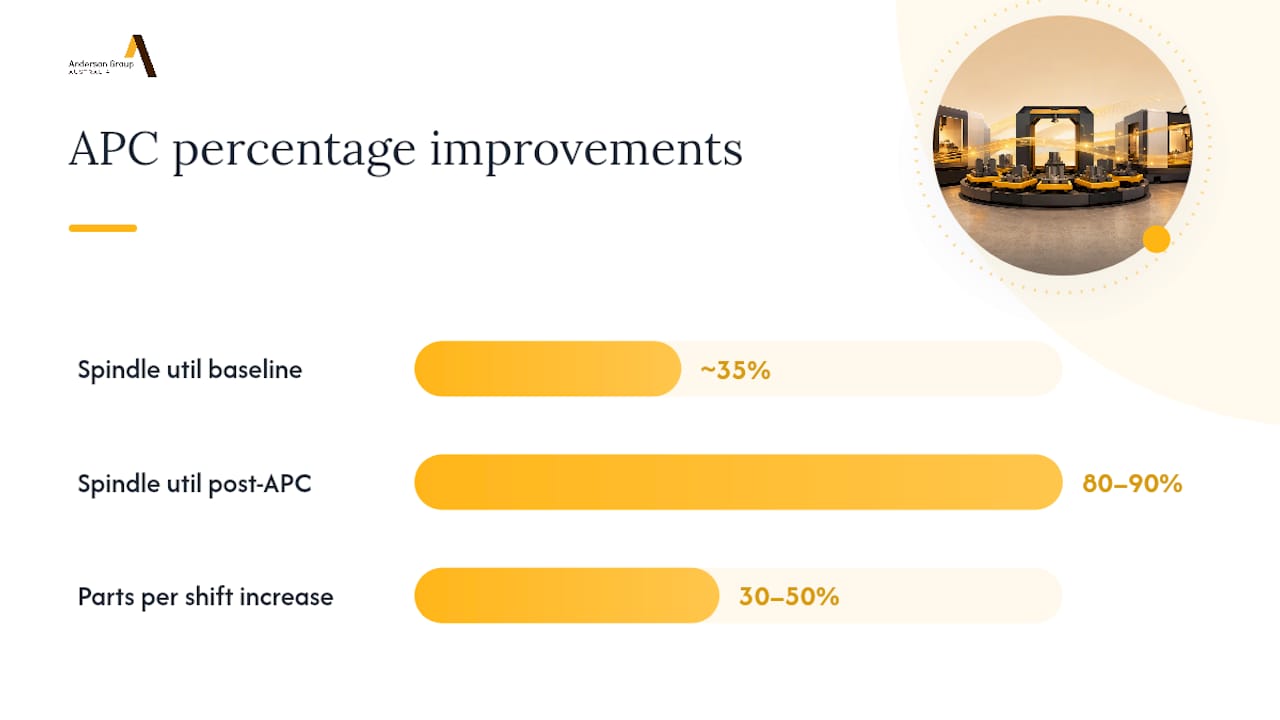
Figures represent typical practitioner-reported ranges; actual results depend on part mix, cycle time and shop configuration.
How does an automatic pallet changer actually work?
An APC replaces or supplements the machine table with two (or more) pallets on a transfer mechanism. While the machine cuts on pallet A, the operator loads and clamps the next job on pallet B offline, outside the machine envelope. When the cut finishes, the control triggers a swap: the pallets exchange in seconds, and cutting resumes on the freshly loaded pallet.
The three common transfer types each suit different production profiles:
-
Shuttle (linear) transfer: one pallet slides out while the other slides in along a linear track. Simple, reliable, and the most common configuration on VMCs. Exchange times are typically under 30 seconds.
-
Twin-pallet rotary: the two pallets rotate on a central axis. Compact footprint, fast exchange, well-suited to smaller machining centres where floor space is tight.
-
Dual shuttle / multi-pallet systems: two or more pallets queue on a rail or carousel. Suited to longer unattended runs where the operator loads several pallets in advance.
Zero-point clamping is what makes the repeatability claim meaningful. A zero-point system uses precision receiver plates on the pallet and the machine table so every pallet locates to the same datum every time. Vendor specifications cite repeatability around ±0.0025 mm, which means you can pull a pallet, send it to inspection, return it, and resume cutting without re-indicating. For high-mix shops running tight-tolerance parts, that is a genuine setup-time eliminator.
Control integration is straightforward on modern machining centres. The APC communicates via M-codes in the part program: an M-code at the end of the cutting cycle triggers the PLC handshake, the pallets swap, and the next program starts. Most retrofits use the machine’s existing I/O without requiring a new controller. The operator interface is typically a simple pendant or push-button station at the load position.
Can you retrofit an APC to your existing VMC?
Most APCs are designed to mount to existing vertical machining centres without structural modification to the machine itself. The pallet receiver bolts to the machine table, and the transfer mechanism attaches to the machine base or a standalone frame alongside it. Anderson supplies VMC models including the VMC-600APC, 860APC and 1100APC with integrated APC interfaces, covering a range of table sizes and pallet capacities for Australian shops.
Before committing to a retrofit, work through this site-prep checklist:
-
Floor loading capacity: APC frames and heavy pallets add significant static load. Confirm your slab rating with a structural engineer if you are near the limit.
-
Crane or forklift access: large pallets (400 kg and above) need mechanical handling for initial installation and ongoing pallet changes where manual lifting is impractical.
-
Machine receiver alignment: the pallet interface must be aligned to the machine’s X/Y datum within the system’s tolerance. Plan for a half-day of precision alignment work.
-
Guarding and light curtains: Australian WHS regulations require appropriate guarding around the pallet exchange zone. Safety planning for automated equipment should be part of your pre-purchase scope, not an afterthought.
-
Power and PLC I/O: confirm available I/O channels on the machine controller for the APC handshake signals. Most modern Fanuc, Mitsubishi and Siemens controls have spare I/O; older machines may need an I/O expansion card.
-
Coolant and chip management: the load station sits adjacent to the machine; plan chip guards and coolant drainage so the offline loading area stays clean.
Typical installation timeline:
-
Pre-purchase site survey (half day) — measure machine, confirm floor, identify I/O
-
Equipment delivery and positioning (half day to one day)
-
Mechanical alignment and pallet receiver installation (half to one day)
-
PLC wiring and M-code integration (two to four hours)
-
Test cycles and prove-out (two to four hours)
-
Operator training (two to four hours)
Qualified technicians typically complete mechanical alignment and control integration in one to two days on site, with operator training measured in hours rather than days.
Pro Tip: Schedule the installation at the start of a planned maintenance shutdown or a low-volume week. The machine is already down for other work, so the APC installation adds no net production loss.
How do you model the ROI and payback for an APC in Australia?
The payback calculation is simpler than most capital equipment decisions because the benefit is direct and measurable: more parts from the same machine, with the same or fewer operators.
Simple payback formula:
Payback (months) = Total installed cost ÷ Monthly net benefit
Monthly net benefit = (additional parts per month × margin per part) + (labour hours saved per month × labour rate AUD)
Cost drivers to include in your total installed cost:
-
APC unit price (varies by pallet size, capacity and pallet count)
-
Zero-point system and pallet tooling
-
Guarding and light curtains (required for WHS compliance)
-
Installation and commissioning labour
-
PLC integration (may be included or quoted separately)
-
Spare parts kit and first-year consumables
-
Extended warranty or service contract
Worked example (illustrative figures only — not a quote):
A two-shift general engineering shop in Melbourne runs a VMC with a 10-minute average cycle time. Manual loading consumes a significant portion of each cycle. After fitting an APC, exchange time drops substantially. The shop recovers notable time per cycle, adding extra parts per hour across a full day.
At an illustrative AUD $45,000 installed cost and a conservative net benefit of AUD $8,000 per month (additional margin plus partial labour redeployment), payback lands around six months. Shops with higher margins, longer shifts, or higher labour costs will see faster payback; lower-volume or short-run shops should model sensitivity around uptime and scrap rate.
For equipment procurement planning, model at least three scenarios: base case, 20% lower throughput, and a downtime event of two weeks. If payback stays under 18 months in the pessimistic case, the investment is low-risk.
Which APC features and specs matter most when you are specifying?
Not every option on a spec sheet earns its price. For most Australian production shops, prioritise in this order:
| Feature | Priority | Why it matters |
|---|---|---|
| Zero-point clamping system | Must-have | Repeatability ±0.0025 mm eliminates re-indicating between runs |
| Pallet capacity (kg) | Must-have | Must match your heaviest fixture plus workpiece |
| Safety interlocks and light curtains | Must-have | WHS compliance; non-negotiable for CE/AS-marked installations |
| Pallet count (2 vs multi) | High-impact | More pallets = longer unattended runs; adds footprint |
| Pallet size (mm) | High-impact | Must accommodate your largest fixture family |
| Coolant-through pallet interface | Situational | Needed for through-spindle coolant with pallet-mounted tooling |
| Integrated chip conveyor | Situational | Worth specifying for high-volume aluminium or steel work |
| Robot-ready interface | Situational | Only if a robot cell is in the 3–5 year plan |
Pallet size and weight capacity are the two specs that most often get under-specified. A pallet that is 50 mm too small forces a fixture redesign later.
What maintenance does an APC need, and what support is available in Australia?
APCs are mechanically straightforward: a transfer mechanism, a clamping system, and a set of precision pallet faces. Maintenance is predictable and low-cost relative to the machine itself.
Typical maintenance schedule:
-
Daily: check pallet face cleanliness; wipe receiver seats; confirm clamping pressure indicator
-
Weekly: inspect transfer mechanism for chips and coolant ingress; check guarding interlocks
-
Monthly: lubricate transfer rails and clamping actuators per manufacturer schedule; check alignment of pallet receiver to machine datum
-
Quarterly: full inspection of zero-point clamping elements; measure and log repeatability; inspect light curtains and safety relay function
-
Annually: replace wear items (seals, clamping springs, pallet face inserts if worn); full alignment check
Spare parts to keep on hand locally:
-
Clamping seals and O-rings (consumable, low cost)
-
Spare pallet face inserts (one set minimum)
-
Transfer mechanism drive belt or chain (one spare)
-
Safety relay module (one spare; long lead time if ordered reactively)
For Australian shops, local supplier presence shortens downtime from weeks to days. A supplier who stocks spare parts in-country and can dispatch a technician within 48 hours is worth paying a modest premium for over an offshore-only option. Service contracts that include an annual inspection and a defined response time are worth considering for high-utilisation shops where an APC failure stops production entirely.
Warranty expectations vary by supplier. Ask specifically: what is covered, for how long, and what is the response time commitment for a machine-down event in your state?
APC versus robot tending: which automation path is right for your shop?
The honest answer: for most shops chasing spindle utilisation gains, an APC is the higher-ROI first step. Robots add flexibility later, but they also add complexity, cost, and a longer time to ROI.
APCs allow shops to keep existing processes and fixturing, which is the single biggest reason they deliver faster payback than robotic cells. There is no gripper design, no collision-avoidance programming, no part-presentation fixture to engineer. The operator loads the pallet the same way they always have — just offline, while the machine runs.
The decision matrix is straightforward. Choose an APC first when:
-
Your primary goal is spindle utilisation and throughput on an existing VMC
-
You run high-mix or short-run work where robot programming would be re-done constantly
-
Your parts or fixtures are heavy enough that robotic handling would require a large, expensive robot
-
You want lights-out capability without the full cost and complexity of a robot cell
Add a robot later when:
-
You need full part handling (loading raw stock, unloading finished parts, deburring)
-
Your volume and part consistency justify the programming investment
-
You want to de-skill the loading operation entirely
The staged approach — APC first, robot integration later — is the path manufacturer guidance and practitioner experience consistently recommend for shops that are not yet running high-volume, single-part production.
Why Anderson Group Australia for your APC installation?
Anderson Group Australia supplies CNC machinery, servicing and spare parts. Confirm the exact machine configuration, installation arrangements and available support with the team.
Anderson’s APC-equipped machine range covers the most common production scenarios:
-
Production Machining Centre with APC — purpose-built for high-utilisation production with integrated APC and zero-point interface
-
VMC-600APC, 860APC and 1100APC — vertical machining centres with factory-integrated APC options across three table sizes
-
Zero-point system compatibility across the range, supporting fast pallet changeover and high repeatability for tight-tolerance work
Anderson’s full CNC machinery range spans metalwork, woodwork, and advanced materials, so an APC-equipped machining centre can sit alongside existing Anderson equipment with consistent control interfaces and shared service support.
For Australian manufacturers in aerospace, automotive, general engineering, and marine sectors, Anderson’s local service network means a machine-down event gets a technician on site faster than an offshore-only supplier can arrange freight for a spare part.
[Contact Anderson for a site survey and APC specification review — the team can assess your existing VMC for APC compatibility and provide a detailed installation scope.]
A field note on what APC installation day actually looks like
A typical APC installation at an Australian production shop starts early. The machine is powered down, the table is cleared, and the technician begins with a precision measurement of the machine’s T-slot datum before anything is bolted on. That alignment step is where most of the day goes — not because it is difficult, but because it is the one step that determines whether the repeatability spec is achievable in practice.
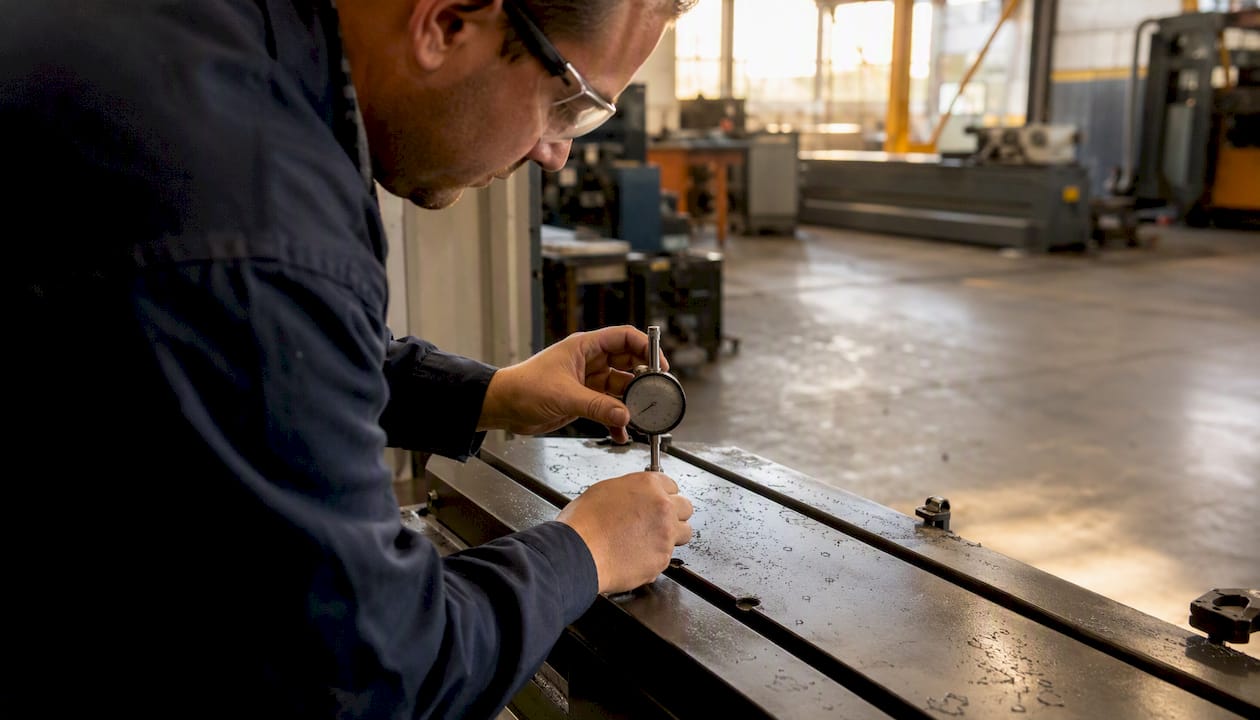
By mid-afternoon, the transfer mechanism is mounted, the PLC wiring is complete, and the first test cycles are running. The moment the pallets swap for the first time and the machine resumes cutting without anyone touching it, the operators in the room invariably stop what they are doing to watch. That reaction is consistent across installations: people who have spent years manually loading parts find the first automatic exchange genuinely surprising.
The common pitfall is under-preparing the load station area. Chips and coolant from the machine find their way to the load position faster than most shops expect. A simple chip guard and a drip tray, specified before installation day, save a messy retrofit later.
Contact Anderson to arrange a site survey before you commit to a specification. The survey takes half a day and answers the questions that matter: floor loading, I/O availability, pallet size, and whether your current fixture family needs any adaptation.
Anderson’s APC solutions: request a demo or site survey
Contact Anderson Australia to confirm the availability and configuration of machining centres with pallet options. Agree installation, parts and service arrangements in the proposal; do not assume an unconfirmed response time.
The Production Machining Centre with APC is the starting point for most enquiries. Anderson also supplies VMC models with integrated APC options across three table sizes, and the team can advise on zero-point system compatibility with your existing fixture family. Anderson serves manufacturers across metalwork, woodwork, and advanced materials sectors throughout Australia.
To move forward: contact Anderson at Andersonaustralia to book a site survey, request a specification sheet, or arrange a live demonstration at Anderson’s facility.