
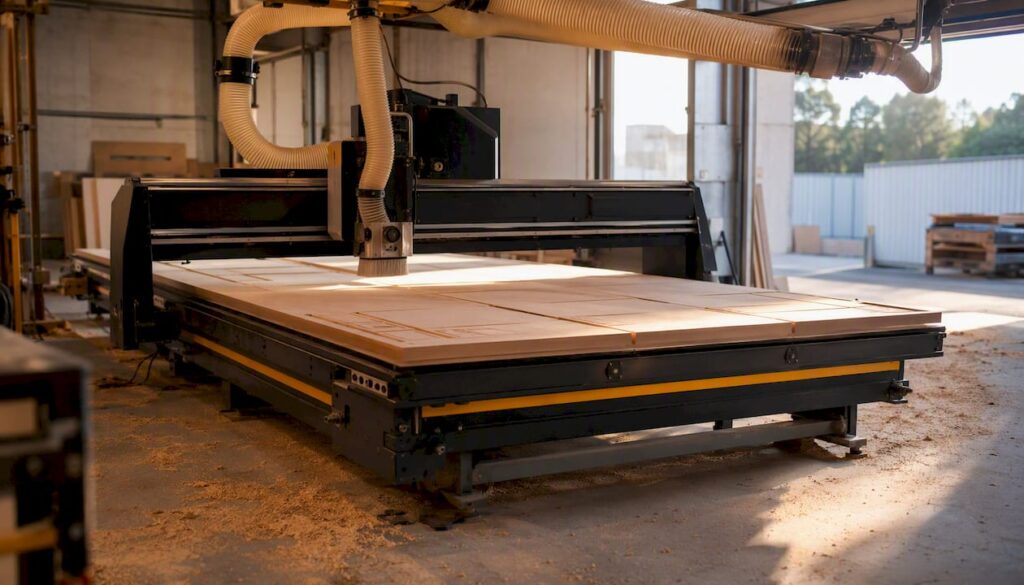
If you need to machine full 4’×8’ or larger sheets reliably in Australia, the short answer is this: buy an industrial enclosed machine with a proper extraction strategy. DIY builds are viable for low-volume hobby work, but they carry real limits on speed, accuracy and dust management that production businesses cannot afford.
Before you contact a single supplier, run through this checklist:
-
Measure your largest workpiece (length, width, thickness)
-
Confirm your door and corridor access for a machine footprint of at least 2.5 m × 3.5 m
-
Check whether you have three-phase power or need a phase converter
-
Identify your extraction plan (centralised cyclone or dedicated canister collector)
-
Set a realistic budget band: hobby DIY costs are generally lower than industrial purchase costs, which start from a moderate budget level upward.
Then, once those five items are documented, contact a local industrial supplier for a site assessment. The sections below give you the detail to make that conversation productive.
Key takeaways
A large-format CNC router for production use in Australia requires an industrial enclosed machine with a correctly sized extraction system, three-phase power, and professional installation — DIY builds suit only low-volume, low-tolerance hobby work.
| Point | Details |
|---|---|
| Extraction comes first | Size your dust collection for the hardest material you will cut before selecting a machine. |
| Table size drives sheet yield | A 4’×8’ (1,220 mm × 2,440 mm) table is the minimum for full-sheet processing without re-clamping. |
| Build vs buy on throughput | Industrial purchase is the responsible choice above 10 sheets per week or tolerances tighter than 0.3 mm. |
| Installation needs professional rigging | Machines above 1,500 kg require forklift unloading, floor-load checks, and three-phase power confirmed before delivery. |
| Anderson for Australian production | Anderson’s EXXACT PRO, MASS-B and Genesis PLUS cover panel nesting, enclosed 5-axis and mid-volume routing with local commissioning support. |
Table of Contents
-
Site, transport and installation: what to confirm before delivery day
-
What to measure before you contact a vendor or start a build
What does “large format” mean for a CNC router?
The term “large format” is an informal descriptor, not a certified standard. In the CNC industry, the recognised category is “large-bed” or “production-format” routing, and it generally starts where a machine can process a full sheet of material in a single setup without re-orientation.
The most common working envelopes you will encounter are:
| Nominal size | Metric equivalent (approx.) | Typical applications |
|---|---|---|
| 4’×8’ | 1,220 mm × 2,440 mm | Cabinetry, furniture panels, signage, MDF nesting |
| 5’×10’ | 1,525 mm × 3,050 mm | Full-sheet composite panels, aluminium sheet, foam tooling |
| 5’×12’ | 1,525 mm × 3,660 mm | Long-run furniture, marine panels, architectural joinery |
| Gantry/bridge | 2,000 mm+ × 4,000 mm+ | Aerospace skins, large-format moulding, structural composites |
The 4’×8’ envelope is the minimum for processing standard Australian sheet goods (1,200 mm × 2,400 mm) without a re-clamp. Moving to 5’×10’ adds clearance for oversized panels and reduces edge-loss on composite sheets. Gantry-style machines, sometimes called bridge mills, suit very large structural parts and are typically found in aerospace and automotive fabrication rather than furniture shops.
Full-sheet processing matters for throughput and waste. When a machine table is smaller than the sheet, operators must re-clamp mid-job, which introduces registration error and adds cycle time. For a furniture shop running 30+ sheets per day, that adds up fast.
What machine components actually determine performance?
Frame and gantry
Welded steel frames outperform aluminium extrusion on large beds. Extrusion is fine for desktop and mid-size machines, but at 5’×10’ and beyond, the lower stiffness of extrusion allows gantry flex under cutting loads, which shows up as chatter and dimensional error. Welded steel, properly stress-relieved, holds geometry across temperature cycles.
Drive systems
Three drive architectures dominate large-format machines:
-
Rack and pinion: Fast, cost-effective on long axes, and easy to service. Backlash is the trade-off; quality helical rack sets reduce it significantly. Standard on most production routers.
-
Ball screw: Higher positional accuracy, lower backlash, but practical length limits apply. Typically used on the Y and Z axes where travel is shorter.
-
Belt drive: Acceptable for hobby and light prosumer builds only. Stretch and compliance make it unsuitable for production-grade work on large beds.
Linear motion
Profile rail (square-section linear guides) is the correct choice for any machine you expect to hold tolerances under 0.1 mm. Round rail is cheaper and tolerates contamination better, but deflects under side load. On a large-format machine cutting hardwood or aluminium, profile rail is not optional.
Long-rail accuracy is commonly compromised by thermal expansion, rail straightness errors and inadequate rail preload. Choose guidance and drive architectures that minimise cumulative error over large beds, and specify machines where the rail mounting surfaces are ground, not just milled.
Motors
Stepper motors are adequate for hobby builds and light prosumer machines where speeds are modest. Servo motors with closed-loop feedback are the right choice for production machines: they maintain torque at higher feed rates, recover from missed steps, and give you real-time position confirmation. At large-format scale, a stalled stepper during an unattended run means a ruined sheet and a potential spindle crash.
Spindle selection
High-frequency (HF) spindles are standard on production routers. For wood and MDF, a mid-range kW spindle with an ER collet system covers most tooling needs. Aluminium and composites benefit from higher power spindles with active cooling. Tooling geometry matters as much as power:
-
Up-cut spiral: Good chip evacuation, rougher top surface
-
Down-cut spiral: Clean top surface, chips pack into the cut
-
Compression: Clean top and bottom simultaneously, ideal for veneered panels and plywood
The i2R CNC Router User’s Manual recommends solid carbide tooling and explains these geometries for plywood, MDF and composites in practical terms.
Vacuum and nesting tables
Vacuum tables with auto tool changers materially increase throughput for panel processing and justify industrial purchase when weekly volumes are high. Zoned vacuum tables let you hold partial sheets without losing hold-down across the whole bed. For furniture nesting, a typical vacuum pump specification.
Pro Tip: When comparing vacuum systems, ask for the hold-down pressure at the spoilboard surface under a running spindle, not just the pump rating. Leakage through worn spoilboard and open zones drops effective hold-down significantly.
| Drive type | Accuracy | Speed | Maintenance | Best use |
|---|---|---|---|---|
| Rack and pinion | Moderate | High | Low | Long axes, production routing |
| Ball screw | High | Moderate | Low | Short axes, precision work |
| Belt | Low | Moderate | Medium | Hobby/light prosumer only |
Dust extraction and enclosures: plan this before you buy
Extraction sizing and containment is the first filter for any large-format project. Many Australian workshops choose a machine first and extraction second, then discover the extraction system is undersized for the actual cut conditions. Fine particulates from MDF, composites and foam require higher airflow than standard woodworking dust, and any shortfall means particulates settling in linear rails and spindle bearings.
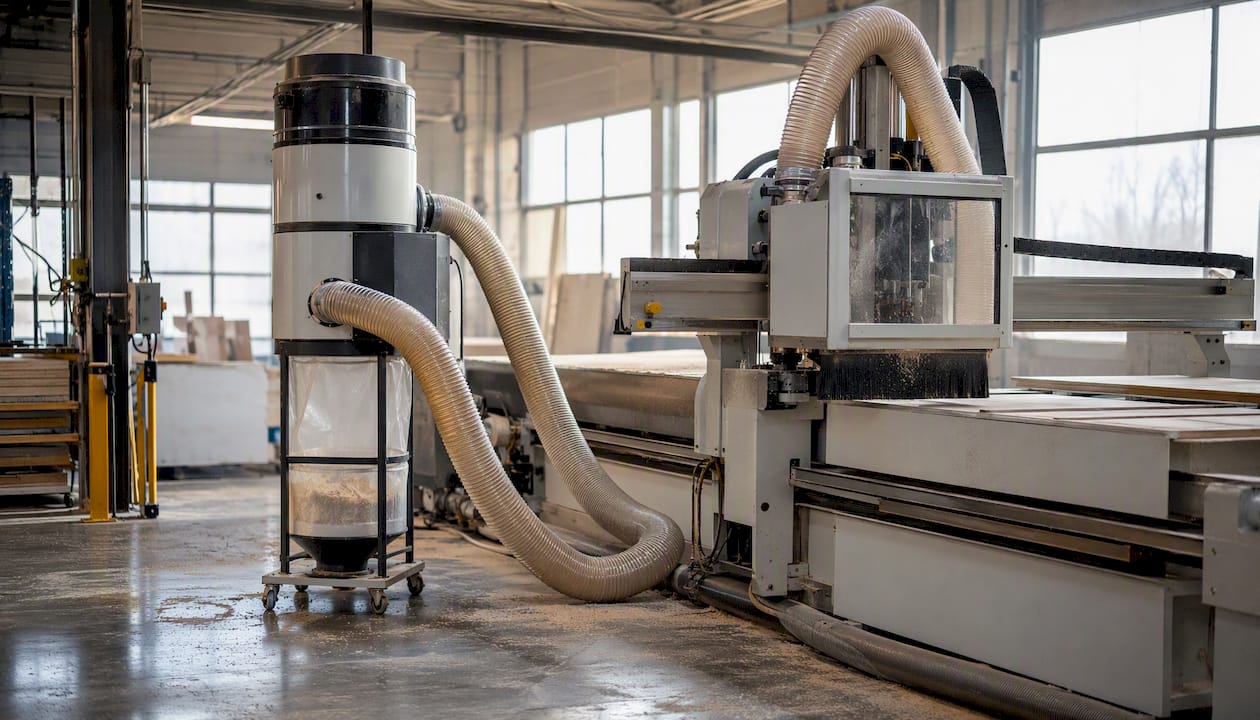
The i2R CNC Router User’s Manual is explicit: dust masks and adequate extraction are required, and extraction systems must eliminate hazardous swarf, dust and particulates and prevent dust ingress into running gear and spindle bearings. Practical setup steps include floor-bearing checks and keeping slack in the dust hose so the spindle can reach the full table without pulling the hose taut.
For collector type, canister and bag-style dust collectors are well-suited to CNC router integration. Canister units offer quick-release bins and high-velocity airflow for wood dust, and they mount cleanly alongside a large-format cell without occupying excessive floor space. For higher-volume shops, a centralised cyclone collector with a dedicated drop box handles the volume better and reduces filter-change frequency.
Enclosure operational requirements add another layer. The i2R CNC safety enclosure manual specifies pre-operation conditions: all doors closed, E-stops reset, controller powered on, and the correct machine profile installed. Missing any one of these prevents operation or creates an unsafe state. Treat these as commissioning milestones, not afterthoughts, and convert them into a daily startup checklist once the machine is running.
Pro Tip: Seal all cable entry points into the machine enclosure with foam or brush strips. Unsealed penetrations are the most common path for fine dust to reach electronics and drive components.
Build vs buy: what the numbers actually look like
The honest answer is that a reliable large-format DIY build costs more time and money than most guides suggest, and the gap between a finished DIY machine and a production-grade industrial router is significant.
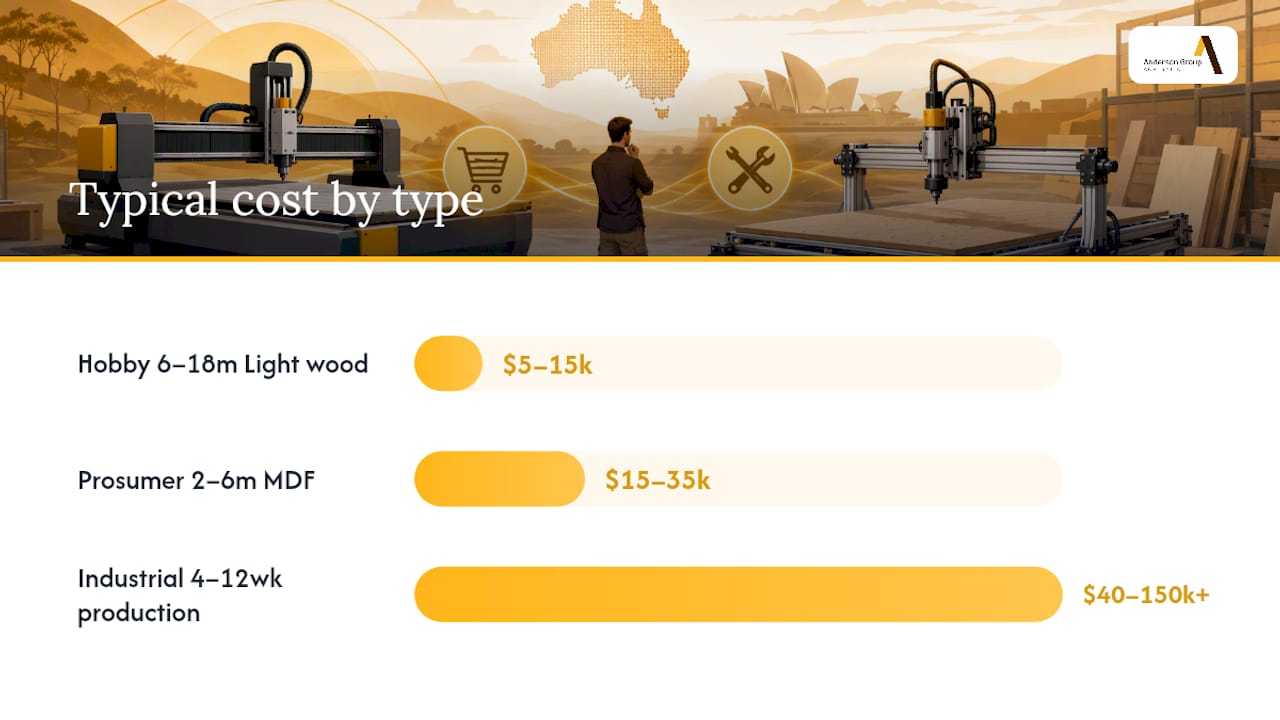
| Route | Typical cost (AUD) | Time to commission | Practical ceiling |
|---|---|---|---|
| Hobby/garage DIY (materials + components) | $5,000–$15,000 | 6–18 months | Light wood, foam, low throughput |
| Prosumer kit (pre-engineered, self-assembled) | $15,000–$35,000 | 2–6 months | MDF, plywood, limited aluminium |
| Industrial purchase (installed, commissioned) | $40,000–$150,000+ | 4–12 weeks | Full production, all materials |
Cost concentrates in five areas for a DIY build: the structural frame and gantry (steel, welding, machining), linear motion components (rails, carriages, ball screws), the spindle and VFD, control electronics (controller, drivers, breakout board), and extraction plus vacuum. Open-source build plans are available under licences such as Creative Commons BY-NC-SA 4.0, which sets reuse conditions for community-contributed designs.
A credible DIY large-format build requires:
-
Structural design and CAD modelling (40–80 hours)
-
Steel fabrication or sourcing of welded frame components (specialist skill or outsourcing cost)
-
Electrical wiring and drive configuration (20–40 hours, requires competent person)
-
Software tuning: controller setup, axis calibration, homing and limit switches (10–30 hours)
-
Extraction commissioning: ducting, collector sizing, sealing (10–20 hours)
Hidden costs catch most DIY builders: accuracy tuning after the first cuts, rework when frame geometry is off, consumables (spoilboard, tooling, collets), and the downtime cost of a machine that is not running while you debug it. For a business with weekly throughput targets, that downtime has a real dollar value.
Decision flow:
-
Weekly throughput under 10 sheets and tolerances above 0.5 mm? A prosumer kit may be adequate.
-
Throughput 10–50 sheets per week or tolerances under 0.3 mm? Industrial purchase is the responsible choice.
-
Throughput above 50 sheets or multi-material (composites, aluminium)? Industrial enclosed machine with servo drives and auto tool change.
Site, transport and installation: what to confirm before delivery day
A large-format industrial router is not a machine you wheel through a standard door. Production machines with vacuum tables and steel frames can weigh 1,500–3,000 kg or more. The ToughCut 1300 mm × 3,100 mm specification illustrates this: the machine requires forklift or tail-lift unloading, and the vacuum pump alone adds significant weight and footprint.
Access and dimensions: Confirm door widths (typically need 2.0 m+ clear), ceiling height for any overhead crane or gantry lift, and whether the truck can access your loading dock with a tail lift or forklift.
Floor loading: Industrial routers concentrate load on a small number of feet. Check your floor’s bearing capacity with a structural engineer if you are on a suspended slab or older concrete. A machinery plinth or levelling feet on a reinforced pad is standard practice for machines above 1,500 kg.
Power and utilities: Most production routers require three-phase 415V supply. Confirm amperage draw with the supplier before ordering. Air-operated valves and vacuum pumps may also need a compressed air line at 6–8 bar. Enclosures generate heat; factor HVAC into the cell design if the machine runs continuously.
Installation team: The i2R CNC safety enclosure manual notes that at least 3–4 able-bodied persons are needed for manual lifting of the machine onto its stand. For full industrial machines, professional rigging is not optional. Onsite commissioning typically adds 1–3 days to the installation schedule; budget for it.
Pro Tip: Ask your supplier for the machine’s centre-of-gravity coordinates and lifting point specifications before the riggers arrive. This prevents improvised rigging that can damage the frame or injure personnel.
Lead times to Australia vary: prosumer machines from Asian manufacturers typically run 8–16 weeks from order to delivery; European and purpose-built machines can run 16–26 weeks. Add 2–4 weeks for customs clearance and local freight.
What to measure before you contact a vendor or start a build
Vendors give you better quotes and more accurate lead times when you arrive with documented specs rather than a general description. Here is what to have ready:
-
Maximum panel size: Length × width × thickness of your largest workpiece
-
Typical materials: List every material you expect to cut (MDF, plywood, aluminium, composites, foam)
-
Required tolerance: Positional accuracy needed for your tightest part (e.g., ±0.1 mm for cabinet carcasses, ±0.05 mm for jigs and fixtures)
-
Weekly throughput: Number of sheets or parts per week at peak production
-
Spindle power: Minimum kW needed for your hardest material
-
Vacuum zones: Number of independent hold-down zones required
-
Tool changer: Whether automatic tool change is needed and how many tools
-
Controller preference: Whether you have existing CAM software (e.g., Autodesk Fusion or similar) that constrains controller choice
-
Delivery and installation: Confirm site access dimensions, power supply, and whether you need commissioning included
-
Warranty and service: Ask specifically about local service capability, spare-parts availability in Australia, and response time
Email template snippet:
Pro Tip: Send this same template to every supplier you approach. Identical inputs make responses directly comparable and expose gaps in service coverage quickly.
How Anderson Group Australia meets large-format needs
Anderson Group Australia supplies CNC machinery, servicing and spare parts. Confirm the exact machine configuration, installation arrangements and available support with the team.
Three machines align directly with large-format requirements:
-
EXXACT PRO 4-Axis CNC Router: A production-grade routing solution suited to panel nesting, furniture and cabinetry work. Confirm the exact configuration and tooling for angled drilling or grooving instead of assuming that an axis count guarantees these operations without another setup.
-
MASS-B Enclosed 5-Axis CNC Machine: The enclosed format addresses the enclosure SOP requirements discussed earlier. Factory-fitted interlocks, integrated extraction provisions and a 5-axis head make this the right choice for composite, aerospace or automotive work where containment and precision are both non-negotiable.
-
Genesis PLUS Nesting CNC Machine: Designed specifically for panel nesting workflows with vacuum table configuration and high-throughput cycle times. For furniture manufacturers running 30+ sheets per day, this is the machine to evaluate first.
Agree installation responsibilities and required checks before handover. Confirm the machinery supplier’s support scope and any extraction, guarding or specialist commissioning work with the responsible providers.
When requesting a quote from Anderson, ask specifically about site assessment visits. Anderson’s team can evaluate your floor, power supply and access before the machine ships, which eliminates the delivery-day surprises described in the installation section above. Contact Anderson at Andersonaustralia to arrange a site assessment or machine demonstration.
The build-vs-buy trade-off: a supplier’s perspective
The DIY large-format CNC community produces genuinely impressive machines. Some of the open-source gantry designs circulating in Australian maker spaces are well-engineered, and for a hobbyist cutting foam and light plywood a few times a month, a well-executed kit build is a reasonable investment of time and money.
Where the calculus changes is throughput and tolerance. When a business needs to run 20 or more sheets per day, hold sub-0.2 mm tolerances across a 2.4 m panel, and keep the machine running five days a week, a DIY build becomes a liability rather than an asset. The hidden costs, the debugging time, the extraction shortfalls, and the accuracy drift on long rails under thermal load are not hypothetical risks. They are the consistent experience of Australian manufacturers who have made the transition from DIY to production machines.
The advice worth taking from this guide: if your throughput target or tolerance requirement puts you in the industrial category, treat the purchase as infrastructure, not a discretionary spend. A machine that runs reliably for ten years at production speed pays back its cost many times over compared to a DIY build that requires constant attention.
For readers who are genuinely at the decision point, a site assessment with a local supplier is the most productive next step. It costs nothing and gives you a realistic picture of what your premises can accommodate and what machine specification your workflow actually needs.
Anderson’s production-grade solution for large-format work
Production manufacturers in Australia need more than a machine spec sheet. They need a supplier who can assess the site, commission the extraction, verify the enclosure interlocks, and be reachable when something needs attention six months after installation.
Anderson Group Australia supplies CNC machinery, servicing and spare parts. Confirm the exact machine configuration, installation arrangements and available support with the team.