
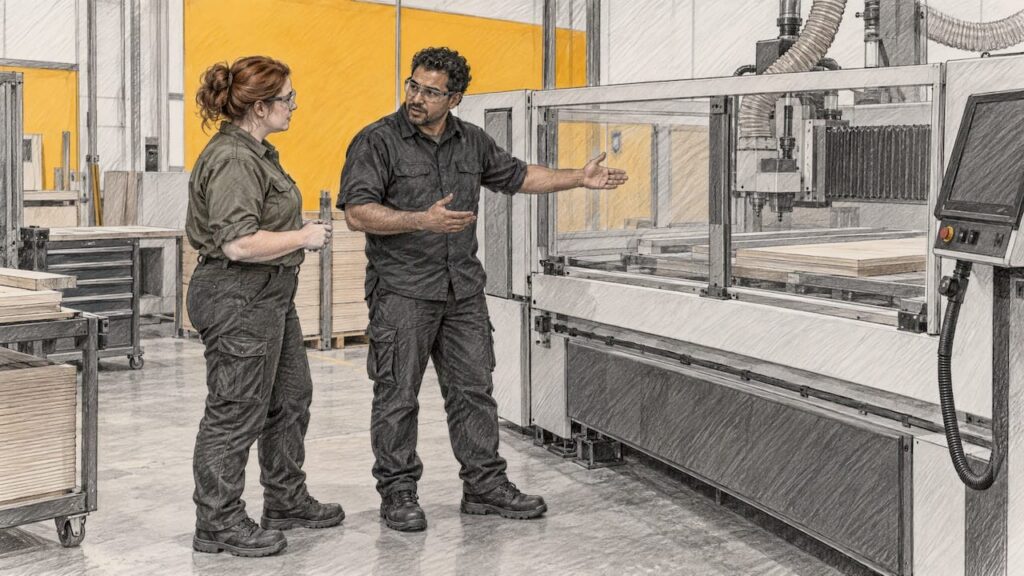
CNC technical support is help keeping your own machine producing: diagnosing faults, servicing, supplying parts and guiding operators. It is not subcontract cutting or machining, where someone else makes your parts. If you run nesting, edgebanding or drilling equipment in a kitchen, cabinet, joinery or furniture shop, the useful question is not “who is nearest?” but “who supplies the machine, the servicing and the parts as one relationship, and what exactly is the scope?” Anderson Group Australia supplies CNC machinery, machine servicing and parts to Australian manufacturers, so this guide is written from that side of the bench.
TL;DR
- Technical support means supporting a machine you own: fault diagnosis, servicing, parts and operator guidance. It does not mean outsourced cutting.
- Support is easiest when the machine supplier, the servicing and the parts come from one Australian source, because the people answering already know the model.
- Always name the exact model and configuration when you ask for help. Anderson models are distinct: AFS are edgebanders, ATS is nesting, routing and drilling, ADM is six-sided drilling and routing, and ARS is a panel-return system.
- Service scope, response times and maintenance intervals should be agreed in writing for your machine. Do not assume them from a brochure or a family name.
- Wood panel dust extraction and metal-machining coolant are separate topics with separate checks.
Table of Contents
- What “CNC technical support” actually covers
- Common faults technical support is called in for
- Keep applications and models distinct
- What to confirm before you rely on any support arrangement
- Panel dust extraction is not coolant
- A practical way to log a support request
- Why buying machine, service and parts from one source simplifies support
- Where Anderson fits
- What to do this week
- FAQ
- Sources
What “CNC technical support” actually covers
Search results for this phrase are a mixed bag. Some pages sell machined parts, some list electronic repair benches for controllers, and some are directories of repairers. They answer different needs. For a manufacturer who owns production machinery, support usually breaks into five jobs:
- Fault diagnosis. Alarms, axis errors, vacuum or feed problems, inconsistent cut quality.
- Scheduled servicing. Inspecting, lubricating, cleaning and checking the parts that wear.
- Parts. Identifying the right consumable or replacement for your exact model and getting it to site.
- Operator guidance. Setup, tooling choices and routine checks so faults are caught early.
- Application advice. Whether a job, material or batch size suits the machine you have, or the next one you might buy.
Anderson Group Australia describes its business as machinery sales, servicing and parts for Australian manufacturers. It does not offer subcontract cutting, machining or finished-part manufacturing. If your enquiry is “make these parts for me”, that is a different service from the one covered here.
How support differs from subcontract machining
A subcontract machinist is paid per part and owns the machine. A support relationship exists because you own the machine and need it to run. The practical difference shows in what you ask. A subcontractor needs your drawing and tolerance. A support provider needs your model, configuration, serial details, the fault symptoms and what changed before it began. Bring the second set of information and you will get to a diagnosis faster.
What a CNC mechanic does
A “CNC mechanic” in everyday use is a technician who diagnoses and repairs the mechanical, pneumatic, electrical and control side of CNC equipment. On a panel-processing machine that can mean spindles, vacuum systems, linear guides, drives and the controller. The title is not a single regulated trade, so what matters is whether the person knows your machine family. Ask what they have worked on and which models they can support.
Common faults technical support is called in for
Most shop-floor problems are not mysterious. They tend to fall into a few groups, and recognising the group helps you describe the problem accurately.
- Cut quality drift. Ragged edges, chipping on laminated board, or parts that no longer match. Often tooling wear or incorrect tool settings before it is a machine fault.
- Dimensional inaccuracy. Parts out of size after a stretch of good production. Debris on reference surfaces, vacuum loss or a loose hold-down can be the cause, and so can mechanical wear.
- Programming and data errors. Wrong offsets, wrong tool data or a post-processor mismatch. The machine does what the file says.
- Dust and debris build-up. Panel work produces fine dust that settles into rails, sensors and filters.
- Overheating or heavy loading of tools. Usually a feed, speed or tool-condition issue.
A good support call separates these early. If you can tell the technician “the fault appears only on the second sheet after the vacuum pump has run for an hour”, you have saved a site visit’s worth of guessing. Our CNC preventive maintenance checklist and schedule sets out routine checks that catch many of these before they stop production, and machine monitoring for Australian workshops covers how to see trends rather than only breakdowns.
Keep applications and models distinct
The quickest way to waste a support call is to describe a machine by its category instead of its model. Anderson’s wood range includes several distinct machine types, and each has its own service questions:
| Machine family | What it is | Typical support questions |
|---|---|---|
| AFS | Edgebanders (edge banding machines) | Glue application, trimming and finishing units, panel feed |
| ATS | Nesting, routing and drilling | Vacuum table, spindle, tool changer, dust shoe, software and nesting files |
| ADM | Six-sided drilling and routing | Drilling heads, panel positioning, routing units |
| ARS | Panel-return system | Panel handling and return, interface with the machine it serves |
| Genesis PLUS | Anderson wood machinery for nesting and panel processing | Confirm the exact configuration with us before you ask for parts or options |
The table identifies what each family is. It is not a list of what is fitted to every machine. Features such as pallet changing, probing, rotary accessories, extraction capacity, linear feedback or through-spindle coolant depend on the exact model and configuration. Do not assume any of them from a family name or axis count. If you are not sure what your machine has, say so and ask for it to be confirmed against the product documentation.
You can see the wood range on the Anderson wood machinery page.
What to confirm before you rely on any support arrangement
This is the section to take to a supplier meeting. The answers should be given for your machine, not in general.
1. Who supports the exact model
Ask which models and configurations are supported, and by whom. A machine bought through an Australian supplier should have an Australian contact for faults and parts. Overseas manufacturer pages are useful technical references, but they are not a local support channel.
2. What the service scope includes
Service inclusions, response times, maintenance intervals and local stock levels should be agreed for your machine and put in writing. We do not state them as universal because they depend on the model, the site and the arrangement. If someone quotes a response time, ask what it applies to: phone contact, remote diagnosis or a technician on site.
3. How parts are identified and supplied
Parts are fastest when you can quote the model, serial information and the part’s position on the machine. Photos of the part and the label help. Ask which parts are held locally and which are ordered in, and keep a short list of consumables you use regularly.
4. What happens during installation and training
Support starts on day one. A machine that was installed correctly and an operator who was trained properly cause fewer calls. Our guide to nesting machine installation and operator training covers what to expect from that stage.
5. How safety fits in
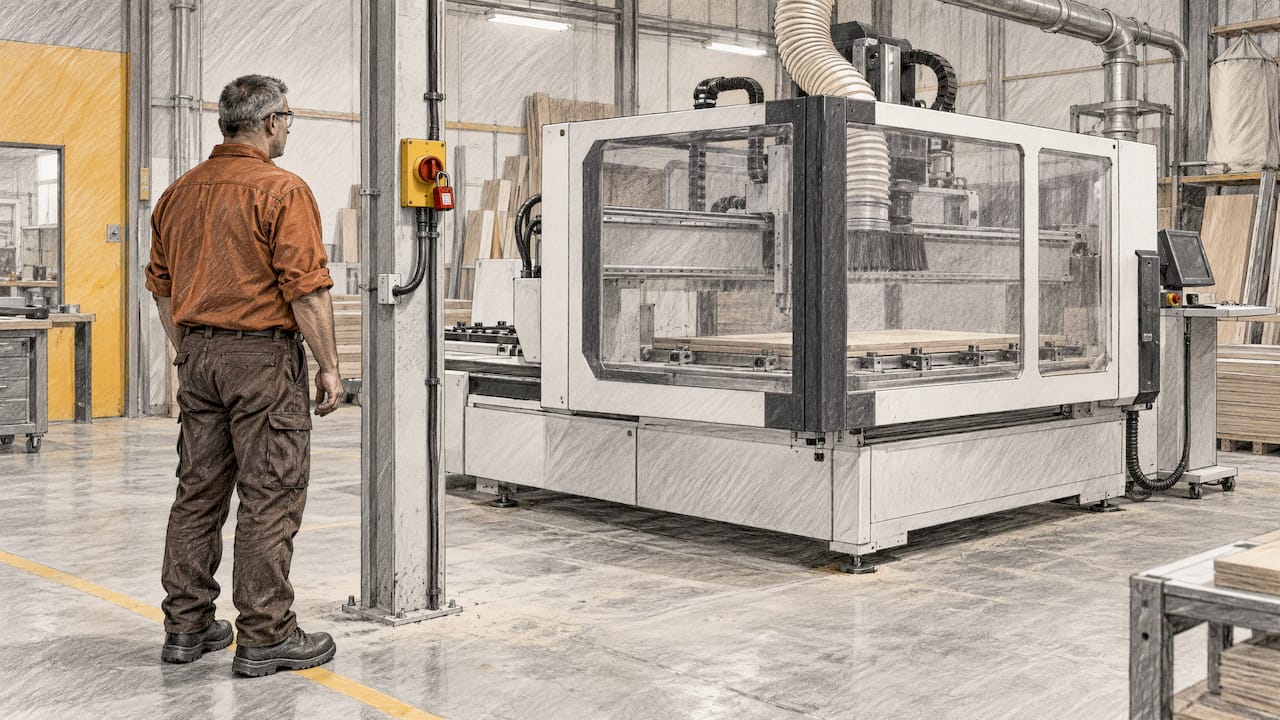
Maintenance work happens near moving parts, so lockout and guarding matter as much as the repair itself. In Australia, machinery safety guidance refers to the AS/NZS 4024 series, which covers safety of machinery. SafeWork NSW’s guide to machine safety refers to parts of that series, including safety distances to prevent danger zones being reached by limbs. Under work health and safety law the person conducting a business or undertaking, the PCBU, carries the duties, so keep your own safe-work procedures current. Our article on AS/NZS 4024 actions for Australian PCBUs sets out practical first steps. For a specific legal question about your site, talk to your state work health and safety regulator or a WHS adviser.
Panel dust extraction is not coolant
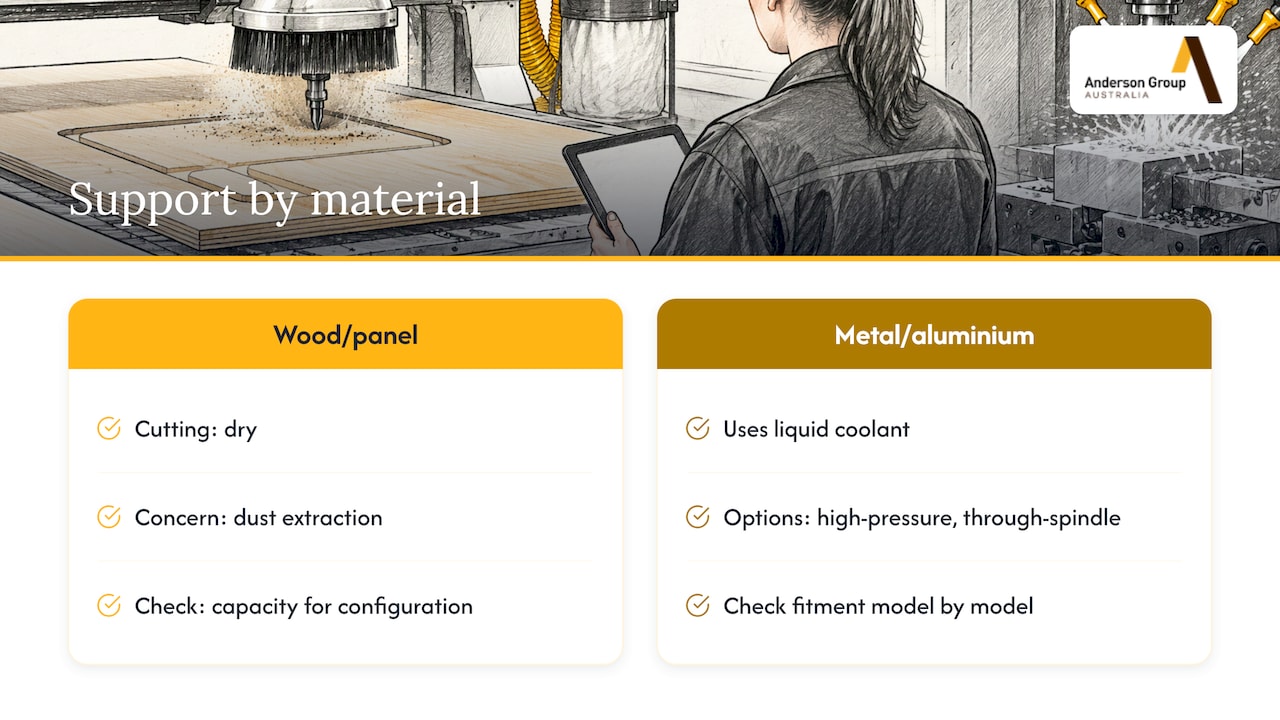
Wood-panel nesting machines and metal machining centres have different support issues, and they should not be blended.
Wood and panel work is dry cutting. The support concern is dust: extraction at the tool, ducting, filters and the dust build-up around rails and sensors. Wood dust is a recognised respiratory hazard in Australian workplace guidance, which is why capture at the source matters and why filters and ducts belong on your regular check list. Extraction capacity is a property of the exact machine and the extraction system connected to it, so confirm it for your configuration.
Metal and aluminium machining uses liquid coolant, and in some cases high-pressure or through-spindle coolant. Those options are checked model by model. Do not infer coolant fitment or retrofit availability from a machine-family name. Metal machining enquiries belong with the Anderson metal machinery range, which covers the Focaseiki machining centres. Our aluminium machining guide is a good starting point for that reader. Plastics and composites are a secondary range, and the same rule applies: state the material and the machine.
A practical way to log a support request
When something goes wrong, a few minutes of notes make the first conversation productive.
- Model and configuration. For example, which ATS, AFS or Genesis PLUS machine, and which options are fitted.
- What happened. The alarm text, the symptom and the exact moment it appeared.
- What changed. New tool, new material batch, new program, power event, filter change.
- What you have already checked. Vacuum level, air supply, tool condition, dust build-up, emergency stops.
- Photos or video. Of the part, the label and the fault.
- Production impact. Which jobs are waiting, so the right priority can be agreed.
Do not clear a fault repeatedly and carry on if the cause is unknown. Recurring alarms and drifting accuracy are signals to stop and diagnose. Do not remove guards or bypass safety devices to keep a job moving.
Why buying machine, service and parts from one source simplifies support
When the party that supplied your machine also services it and supplies its parts, the model knowledge sits in one place. You are not relaying a fault between a seller, a repairer and a parts counter, each seeing only part of the picture. That is the idea behind Anderson Group Australia’s approach: Australian CNC machinery sales, servicing and parts, with the wood industry representing more than 90% of its customer base, and a primary focus on kitchen, cabinet, joinery and furniture manufacturers.
It also means the machine recommendation and the support conversation can be joined up. If you are choosing between a nesting machine and an edgebander, or planning to add drilling capacity, the questions about uptime, parts and training can be raised at the quote stage rather than after the first breakdown. Our guide to cabinet CNC machining walks through those selection questions for kitchen and cabinet makers, and the high precision CNC machining buyer’s guide covers specifications more broadly.
Where Anderson fits
If you run, or plan to run, woodworking and panel-processing machinery, Anderson Group Australia supplies the machines, servicing and parts for Australian manufacturers. Start with the wood machinery range, or the full machines listing if you are comparing across materials. Tell us your application and your current machine, and we can discuss the right configuration, check specifications against the product page and talk through the service scope for your production. For a quote or a service enquiry, use the contact options on the Anderson Group Australia site.
Specifications on this page are general guidance. Verified specifications for each machine are on its product page, and anything about your own machine should be confirmed against the exact model and configuration.
What to do this week
You do not need a new contract to improve support. Four small jobs help:
- Write down the model, configuration and serial details for every CNC machine, edgebander and drilling machine on the floor, and keep them where the maintenance lead can find them.
- Build a short consumables and spares list for each machine.
- Review your dust extraction filters and ducting against your routine maintenance schedule.
- Ask your supplier to confirm, in writing, the agreed service scope for each machine.
None of this replaces a service arrangement, but it makes every future call shorter.
FAQ
What does CNC technical support include?
It typically covers fault diagnosis, servicing, parts and operator guidance for a machine you own. The exact inclusions, response times and maintenance intervals depend on the machine and the arrangement, so ask for the scope to be confirmed for your model.
Is CNC technical support the same as subcontract CNC machining?
No. Technical support keeps your own machine running. Subcontract machining means someone else cuts or manufactures parts for you. Anderson Group Australia supplies machinery, servicing and parts and does not offer subcontract cutting or machining.
What should I tell a technician when a CNC machine faults?
Give the model and configuration, the alarm or symptom, what changed beforehand, what you have already checked and the production impact. Photos or video of the fault and the machine label speed up diagnosis.
Can I assume my machine has pallet changing, probing or through-spindle coolant?
No. These depend on the exact model and configuration and cannot be inferred from a family name or axis count. Confirm them against the product page or with us before you plan work or order parts around them.